.png)


Advanced DTC retention strategies that boost loyalty and LTV

TL;DR:
- Most 8-figure DTC brands reach retention ceilings due to limited marketing infrastructure.
- Building automated flows, precise segmentation, and strong governance is essential for sustainable retention.
- Tracking cohort-level metrics and enforcing strict suppression rules prevents fatigue and improves long-term LTV.
Most 8-figure DTC brands hit a retention ceiling not because their products are weak, but because their marketing infrastructure can’t support scale. The instinct is to send more campaigns, more often, to more people. That approach leads to fatigue and shrinking ROI fast. Sustainable retention at scale requires a fundamentally different operating model: one built on automated flows, precise segmentation, and the kind of governance architecture that protects your most valuable customers while systematically converting everyone else.
Table of Contents
- Prerequisites: Foundation for scalable retention
- Step-by-step: Building automated retention flows
- Avoiding common mistakes: Governance and fatigue management
- Tracking retention success: Metrics and verification
- Why true retention at scale demands governance-first thinking
- How The Email Marketers empowers advanced retention
- Frequently asked questions
Key Takeaways
| Point | Details |
|---|---|
| Governance first | Strong suppression and pacing rules prevent fatigue and build sustainable retention flows. |
| Flows outperform campaigns | Automated, segmented flows drive loyalty and higher lifetime value compared to campaign blasts. |
| Track the right metrics | Measuring cohort-specific reorder rates and returning revenue gives true retention insight. |
| Avoid common pitfalls | Mistakes like over-messaging and neglecting VIP suppression can erode ROI quickly. |
| Toolkit drives results | The Email Marketers platform enables high-impact retention execution for DTC brands. |
Prerequisites: Foundation for scalable retention
Before you touch a single flow or fire off another campaign, you need to audit your infrastructure. Scalable retention isn’t a creative problem. It’s an operational one. The brands that grow their LTV (lifetime value) year over year aren’t just writing better subject lines. They’re building systems that respond to customer behavior in real time, at volume, without human intervention.
Here’s what your tech stack needs to look like before advanced retention execution is even possible:
| Tool | Role in retention | Minimum capability needed |
|---|---|---|
| ESP (email service provider) | Campaign delivery and flow automation | Behavioral triggers, dynamic content |
| CDP (customer data platform) | Unified customer profiles | Cross-channel data sync, segment builder |
| SMS platform | Text-based lifecycle touchpoints | Two-way messaging, keyword automation |
| Analytics/BI tool | Cohort tracking and revenue attribution | Custom reporting, flow-level attribution |
Beyond the tech stack, you need clear governance rules in place. Governance in retention marketing refers to the policies that control who gets what message, when, and how often. Without it, your flows and campaigns compete with each other for inbox space, and your highest-value customers feel the pressure most.
The most critical governance mechanisms are:
- VIP suppression lists: Your top-tier buyers should be excluded from generic campaign blasts. They deserve curated, personalized flows that match their purchase history and loyalty status.
- Campaign pacing rules: Define how many messages per week any given customer can receive across email and SMS combined. Most 8-figure brands cap this at four to five touchpoints per week.
- Unengaged suppression: Customers who haven’t opened or clicked in 90 to 180 days should be moved to a re-engagement sequence and eventually removed from primary sends to protect deliverability.
- Channel preference flags: Tag customers by their preferred communication channel based on actual behavior, not assumptions. Some buyers only convert from SMS. Others ignore texts but open every email.
Staying ahead of the retention marketing trends shaping e-commerce right now means treating these governance rules as living documents, not one-time setups. Revisit them quarterly as your list grows and your product catalog evolves.
Pro Tip: Run a rapid governance audit before launching any new flow. Pull a report showing how many customers received more than seven messages in the last 30 days. If that number is above 15% of your active list, your pacing rules need immediate tightening.
Step-by-step: Building automated retention flows
With segmentation and governance in place, it’s time to move into the step-by-step execution of automated retention flows. This is where the strategy becomes tangible. Each flow should map to a specific lifecycle stage and respond to a defined behavioral trigger.
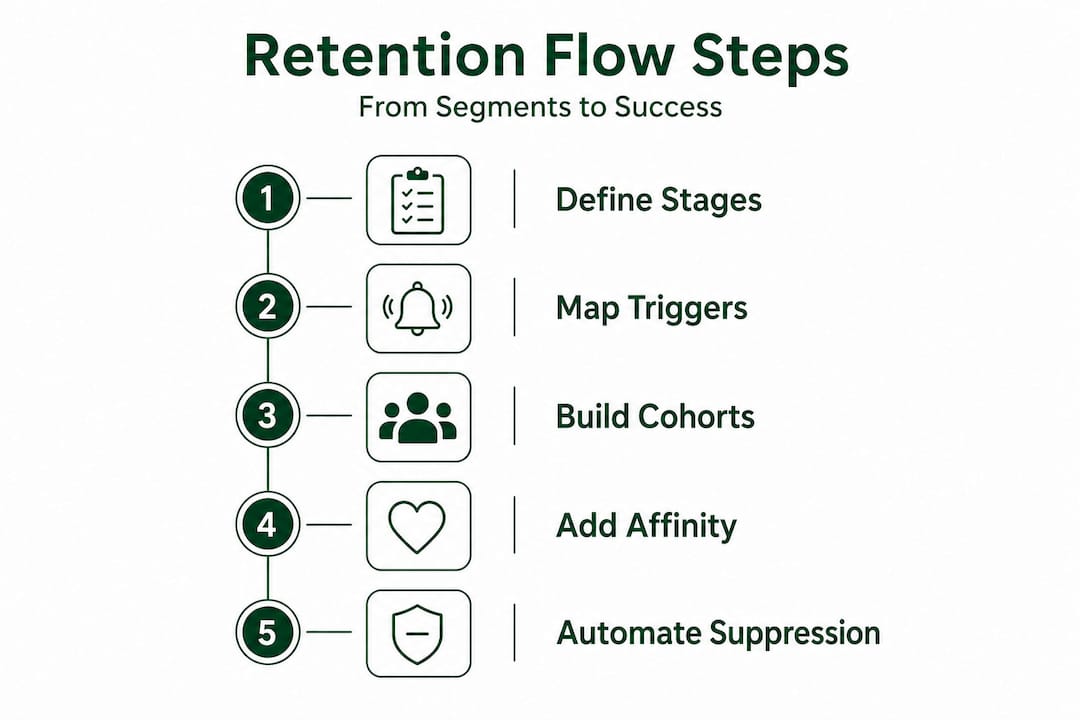
Step 1: Define your lifecycle stages. Every customer sits somewhere on a journey from first purchase to loyal advocate. The most productive stages to build flows around are: new buyers (day 0 to 30), active repeat buyers (two or more purchases), at-risk customers (no purchase in 60 to 90 days), and VIPs (top 10% by revenue).
Step 2: Map behavioral triggers for each stage. A trigger is the specific customer action (or inaction) that fires the flow. Examples include a second purchase triggering a loyalty onboarding sequence, 75 days without a purchase triggering a win-back flow, or a cart abandonment triggering a multi-touch recovery sequence across email and SMS.
Step 3: Build purchase cohort segments. This is where most brands underinvest. Rather than treating all repeat buyers as one group, segment them by what they bought and when. A customer who bought your hero product in Q4 has a completely different reorder window than someone who bought an accessory item in Q2. Cohort-based segmentation lets you improve retention emails by matching message timing to actual repurchase probability.
Step 4: Layer in product affinity signals. Connect your CDP data to your ESP so flows can dynamically populate with products that match each customer’s browsing and purchase history. A customer who bought skincare gets different cross-sell recommendations than someone who bought supplements. This isn’t just personalization for its own sake. It’s precision that increases conversion.
Step 5: Automate suppression within each flow. Build suppression logic directly into your flows so that if a customer purchases during a win-back sequence, they’re immediately moved to the repeat buyer flow. No manual intervention needed. This is the compounding advantage of flows over campaigns.
Here’s how flow-driven retention stacks up against a campaign-only approach:
| Dimension | Campaign-only | Flow-driven retention |
|---|---|---|
| Timing | Batch send on marketer’s schedule | Triggered by customer behavior |
| Personalization | Segment-level at best | Individual-level with dynamic content |
| List fatigue risk | High | Low with suppression governance |
| Scalability | Diminishing returns at scale | Compounds as data improves |
| Revenue attribution | Hard to isolate | Flow-level tracking possible |
Smart brands also track retention performance at the cohort level, not just in aggregate. As one DTC retention expert put it, measuring only aggregate repeat rate blends acquisition and retention signals together, making it nearly impossible to know if your flows are actually working. The solution is tracking cohort reorder percentage by acquisition month and product category.
Pro Tip: Use email personalization tokens tied to CDP data to make every flow message feel handcrafted. At minimum, pull in first name, last product purchased, and days since last order. These three data points alone lift open rates meaningfully on re-engagement flows.
Avoiding common mistakes: Governance and fatigue management
Once your flows are live, maintaining strong governance and avoiding campaign fatigue becomes critical. Most brands launch their flows successfully and then slowly undermine them by layering campaign sends on top without accounting for message frequency.

The symptoms of list fatigue are clear and measurable: rising unsubscribe rates, falling open rates over successive sends, and shrinking revenue-per-send even as list size holds steady. If you’re seeing any combination of these, the problem is almost always governance failure.
The most frequent governance mistakes at scale include:
- Overriding suppression for “important” campaigns: Every marketing team has experienced the pressure to hit a revenue target by blasting the full list. This is the fastest path to burning your best customers.
- Failing to update VIP thresholds: Your VIP definition from 18 months ago may no longer reflect your actual top tier. Static thresholds cause high-value customers to fall through the cracks.
- Treating email and SMS as separate programs: Customers experience both channels simultaneously. If your email team and SMS team aren’t coordinating sends, customers will receive overlapping messages on the same day from both.
- Ignoring flow-level fatigue: Even within a single flow, customers can hit fatigue points. An eight-email win-back sequence with two-day gaps feels aggressive to someone who simply bought elsewhere for a season.
- No sunset policy: Without a clear policy for retiring long-unengaged contacts, your deliverability degrades silently over months.
As real-world retention case breakdowns confirm, scaling without a flow foundation and proper governance consistently leads to fatigue. It’s not a hypothesis. It’s a pattern.
“VIP customers require a completely different communication architecture than your general list. Suppression isn’t just list hygiene. It’s brand respect.”
Protecting your VIP segment is particularly important because these customers have the highest LTV and the highest churn cost if you lose them. Dedicate specific flows to them with longer gaps between touches, exclusively curated content, and early-access offers that acknowledge their status rather than just selling to them.
Pro Tip: Set a hard limit of two promotional campaign sends per week, and optimize retention campaigns by reserving the remaining weekly touchpoints for behavior-triggered flows only. This ratio keeps revenue flowing without burning your list.
Tracking retention success: Metrics and verification
To ensure all your advanced strategies are working, verification with nuanced metrics is a must. The most dangerous number in retention marketing is your aggregate repeat purchase rate. It feels meaningful but it’s actually a blended metric that mixes the behavior of newly acquired customers with that of long-term loyalists. When acquisition spikes, your repeat rate can fall even if your retention is improving.
The right framework separates these signals:
Cohort reorder percentage: For every group of customers acquired in a specific month, track what percentage placed a second order within 30, 60, and 90 days. This tells you how well your new buyer onboarding flows are working on a per-cohort basis, not in aggregate.
Monthly returning revenue: Track the total revenue generated each month by customers who purchased previously, separate from first-time buyer revenue. This number should grow month-over-month as your flows mature and your loyalty base deepens.
Flow-level revenue per recipient (RPR): For each automated flow, measure the revenue earned divided by the number of customers who entered the flow. This is the clearest measure of individual flow performance and lets you prioritize optimization efforts.
Segment engagement decay rate: Monitor how quickly engagement metrics (opens, clicks, conversions) fall across sequential messages in a flow. Sharp drops after message three, for example, indicate that’s where your messaging or timing needs work.
Here’s how a sample retention metrics dashboard should look at scale:
| Metric | What it measures | Target benchmark |
|---|---|---|
| Cohort reorder % (90-day) | New buyer retention quality | 30% or higher |
| Monthly returning revenue | Loyalty base health | 10% month-over-month growth |
| Flow RPR | Individual flow efficiency | 2x or more vs. campaign RPR |
| VIP churn rate | Top-tier retention | Below 5% quarterly |
| List health score | Deliverability and engagement quality | Above 75 out of 100 |
Tracking these email retention metrics requires your ESP and CDP to be properly integrated. If you’re pulling these numbers manually from disconnected dashboards, you’ll always be two weeks behind the signals you need to act on.
As cohort-level analysis consistently shows, the brands that track retention wrong, by relying on aggregate repeat rate alone, make worse decisions about where to invest and which segments to prioritize. The brands winning in retention are the ones who’ve built reporting that shows exactly which acquisition cohorts are sticking and which are slipping.
Key metrics to prioritize over aggregate repeat rate:
- Cohort reorder percentage segmented by acquisition channel
- Revenue from returning customers as a percentage of total monthly revenue
- Win-back flow conversion rate by recency band (60 days, 90 days, 120 days)
- SMS vs. email attribution split within the same flow
Why true retention at scale demands governance-first thinking
Here’s a perspective that most agencies won’t share with you: campaign volume is not a proxy for loyalty. We’ve seen brands with three campaigns per week burning their lists down to hollow engagement numbers while simultaneously believing their retention is strong because their email revenue looks solid. The problem is they’re measuring gross channel revenue, not net retention quality.
The conventional wisdom says “more touchpoints, more revenue.” It’s seductive because it’s true in the short term. You can juice revenue by increasing send frequency. But you’re borrowing against future engagement every time you do it without a behavioral reason to send.
What actually builds sustainable retention is boring to talk about but transformative to execute: governance, suppression, cohort measurement, and flows triggered by behavior rather than marketing calendars. The brands we work with that see the largest LTV gains aren’t always the ones with the most creative emails. They’re the ones who’ve built the most disciplined suppression logic and the most behavior-responsive flow architecture.
The uncomfortable truth is that real retention strategy wisdom sits in the operational layer, not the creative one. You can have brilliant copy and beautiful design. But if your VIPs are being blasted with the same promotional campaign as someone who bought once six months ago, you’re eroding trust faster than your creative can rebuild it.
Governance-first thinking means you define the rules before you build the flows. It means suppression is a first-class citizen in your retention architecture, not an afterthought. And it means your measurement framework rewards cohort retention quality, not just raw volume of repeat purchases.
How The Email Marketers empowers advanced retention
If this guide has made one thing clear, it’s that scalable retention requires more than good content. It requires an infrastructure built on segmentation discipline, governance rigor, and cohort-level measurement that most brands haven’t fully built yet. That’s exactly where The Email Marketers comes in. Our team builds the full retention architecture: from suppression governance to behavior-triggered flows to retention case studies that show real LTV impact for 8-figure DTC brands. Explore our Retention Lab to see how we diagnose and fix retention systems, or start with our Retention Toolkit to get immediate access to the frameworks we use with our highest-growth clients.
Frequently asked questions
What is the difference between campaign and flow-driven retention?
Campaigns are one-off messages sent on a marketer’s schedule, while flows are automated sequences triggered by customer behavior, delivering ongoing engagement tailored to each segment. As campaign-heavy scaling without flow foundations consistently shows, campaigns alone lead to fatigue and diminishing returns.
Which retention metric matters most for DTC brands?
Cohort reorder percentage and monthly returning revenue give far deeper insight than aggregate repeat rate, which blends acquisition and retention signals together. Tracking retention correctly at the cohort level is what separates brands that optimize effectively from those flying blind.
How do you prevent email fatigue in high-frequency retention marketing?
Use behavior-triggered automated flows combined with suppression governance to control message pacing and protect your VIP segments from overload. Scaling without this foundation is one of the most common and costly mistakes in DTC retention.
What technology stack is required for scalable retention?
You need an ESP, CDP, SMS platform, and a BI or analytics tool with cohort reporting capability to execute advanced segmentation and trigger-based messaging at scale.
Recommended
- Advanced Strategies to Combine Paid Advertising and Email Marketing for Customer Loyalty
- The Email Marketers Retention Toolkit
- Advanced SMS marketing tips to boost retention for DTC brands
- Optimize retention campaigns: 5% boost drives 95% profit
- Integrating WhatConverts to Unlock Better Data and Triple ROAS for TekBrands


