.png)


Triggered Email Marketing: Boost Retention with Smart Automation
TL;DR:
- Triggered email marketing responds to customer behavior, increasing relevance and engagement.
- Key campaigns like abandoned cart and post-purchase emails yield high ROI for DTC brands.
- Success requires continuous optimization, segmentation, personalization, and strategic execution.
Batch-and-blast email campaigns feel productive. You send to your full list, watch the open rate tick up slightly, and assume the work is done. But bulk emails rarely build the kind of loyalty that keeps customers coming back. The real retention lever is triggered email marketing, a strategy that sends the right message at the exact moment a customer takes a specific action. When done well, it feels less like marketing and more like a conversation. This guide breaks down how triggered email marketing works, which campaigns matter most for DTC brands, and how to build a system that consistently drives repeat purchases and lifetime value.
Table of Contents
- Understanding triggered email marketing
- Types of triggered email campaigns for DTC brands
- How to set up triggered email automation
- Personalization strategies to maximize retention
- Measuring success and optimizing campaigns
- Why most e-commerce triggered email strategies fall short
- Level up your retention with expert-triggered email campaigns
- Frequently asked questions
Key Takeaways
| Point | Details |
|---|---|
| Triggered email basics | Triggered emails automate targeted messages based on customer actions for better engagement. |
| Best campaign types | Abandoned cart and post-purchase emails are high-ROI triggered campaigns for DTC brands. |
| Combine automation and personalization | Using customer data for personalized messaging maximizes retention and revenue. |
| Track and optimize | Monitor key performance metrics to improve results over time. |
| Go beyond set-and-forget | The best brands continually refine triggered campaigns for lasting customer loyalty. |
Understanding triggered email marketing
Triggered email marketing is fundamentally different from sending a weekly newsletter or a promotional blast to your full list. Instead of you deciding when to send, the customer’s behavior decides. A shopper adds items to their cart and leaves. A buyer completes their first purchase. A subscriber goes quiet for 90 days. Each of these moments is a trigger, and your automation platform responds to each one with a pre-built, targeted email.
This behavior-based approach is what separates triggered emails from regular campaigns. Standard batch emails go out on a schedule regardless of what any individual customer has done. Triggered emails are personal by design because they respond to something real.
Common customer triggers include:
- Cart abandonment: Customer adds items but doesn’t check out
- Browse abandonment: Customer views a product page without adding to cart
- Post-purchase: Customer completes a transaction
- Welcome sequence: New subscriber or first-time buyer joins your list
- Winback: Customer hasn’t purchased in 60, 90, or 120 days
- Birthday or anniversary: Date-based milestone for loyalty reward
- Replenishment: Product is likely running low based on purchase cycle
The results speak for themselves. Triggered email open rates outpace mass email campaigns significantly, because recipients receive messages tied directly to their own actions rather than a generic promotion.
Here’s a quick comparison of how triggered and batch emails stack up:
| Feature | Triggered emails | Batch emails |
|---|---|---|
| Send timing | Based on customer action | Scheduled by marketer |
| Personalization | High, behavior-driven | Low to moderate |
| Relevance | Very high | Variable |
| Engagement rates | Significantly higher | Average |
| Setup effort | Higher upfront | Lower upfront |
| Long-term ROI | Excellent | Diminishing |
Automation technology is what makes this scalable. Platforms like Klaviyo connect directly to your e-commerce store, listen for event data, and fire emails without manual intervention. Exploring automated email campaigns in depth gives you a clearer picture of the full ecosystem, and an email marketing automation deep dive can help you understand the technical layers underneath.
Types of triggered email campaigns for DTC brands
Knowing what triggered emails are is only the starting point. Knowing which ones to prioritize for your DTC brand is where the real strategy begins.
Here’s a breakdown of the most impactful triggered campaigns:
| Campaign type | Purpose | Optimal timing | Example message |
|---|---|---|---|
| Abandoned cart | Recover lost revenue | 1 hour, 24 hours, 72 hours | “You left something behind. It’s still waiting.” |
| Welcome series | Build brand relationship | Immediately, day 3, day 7 | “Welcome to the family. Here’s what we stand for.” |
| Browse abandonment | Re-engage window shoppers | 2 to 4 hours after browsing | “Still thinking about it? Here’s why others love it.” |
| Post-purchase | Reduce buyer’s remorse, upsell | Day 1, day 7, day 30 | “Your order is on its way. Here’s what pairs perfectly.” |
| Winback | Reactivate lapsed customers | 60, 90, 120 days post-purchase | “We miss you. Here’s 15% to come back.” |
| Birthday/anniversary | Reward loyalty | Day of milestone | “Happy birthday! A gift is waiting inside.” |
| Replenishment | Drive repeat purchase | Based on product cycle | “Running low? Reorder in one click.” |
Abandoned cart emails recover up to 10% of lost sales, making them the single highest-ROI trigger for most DTC brands. But the full suite of triggers compounds over time, building a retention engine that runs in the background while your team focuses on growth.
Timing and relevance are everything. Sending a winback email too early feels pushy. Sending a post-purchase upsell before the first order even arrives feels tone-deaf. Study your own customer data to find the timing windows that match real purchase behavior.
For a deeper look at email campaign best practices, you’ll find guidance on sequencing, frequency, and message tone that applies directly to DTC retention.
Pro Tip: Don’t run triggers in isolation. Layer segmentation on top of each trigger. A winback email for a VIP customer who spent $500 should look and feel completely different from one sent to a one-time buyer who spent $30.
How to set up triggered email automation
With a clear picture of which campaigns to build, here’s how to actually set them up.
- Map your customer journey. Before touching your email platform, sketch out the key moments in your customer lifecycle. Where do people drop off? Where do they convert? Where do they go silent? These moments are your trigger candidates.
- Choose your triggers. Start with the highest-impact ones: abandoned cart, welcome, and post-purchase. Add complexity over time as you validate performance.
- Select and integrate your platform. Your automation tool needs to talk directly to your e-commerce store. Without clean event data flowing in, your triggers can’t fire accurately. Automation platforms make triggered campaigns scalable because they handle the logic, timing, and personalization without manual effort.
- Craft your messages. Write each email with a single goal. Abandoned cart emails should remove friction and create urgency. Welcome emails should build trust and set expectations. Keep copy tight and focused.
- Build your workflows. Set up the trigger conditions, delays, and branching logic inside your platform. A three-email abandoned cart sequence, for example, might branch differently for first-time visitors versus returning customers.
- Test before you launch. Send test emails to yourself and colleagues. Check rendering on mobile and desktop. Verify that dynamic content fields populate correctly.
- Monitor and optimize. Once live, watch performance weekly. Adjust subject lines, timing, and offers based on what the data shows.
Pro Tip: Map your customer journey before you build a single flow. The brands that win at triggered email aren’t the ones who set up the most triggers first. They’re the ones who identify the right moments and build around those with precision. Learning how to personalize email content at each stage of the journey makes every trigger more effective.
“Email automation isn’t just a time-saver. It’s a revenue multiplier when built around real customer behavior and continuously refined.”
Personalization strategies to maximize retention
Automation handles the when. Personalization determines the whether. Whether a customer opens, clicks, and buys again comes down to how relevant your message feels to them specifically.
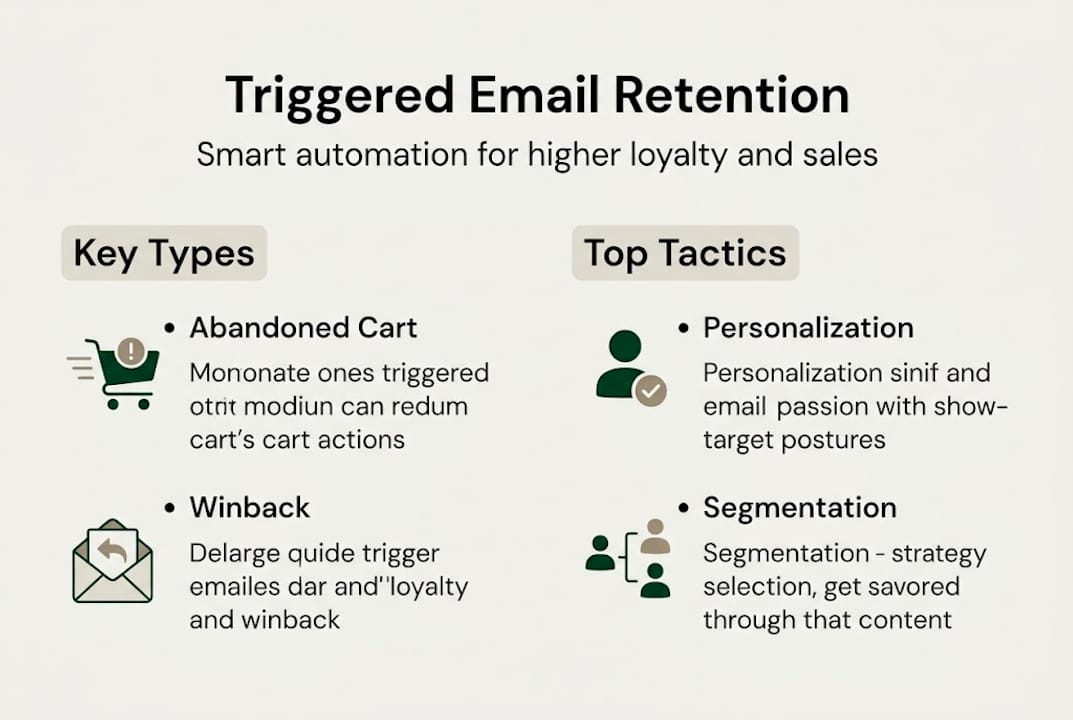
The most effective personalization tactics for triggered emails include:
- Dynamic product recommendations: Pull in items based on browse history, past purchases, or category affinity. A customer who only buys skincare shouldn’t see apparel recommendations.
- Segment-based offers: A loyal customer who has purchased five times doesn’t need a 20% discount to come back. A lapsed customer might. Tailor incentives to behavior, not just to the trigger.
- Tone and messaging style: A customer who bought a premium product expects a different voice than someone who bought a clearance item. Match the messaging to the segment.
- Purchase cycle timing: Use order history to predict when a customer is likely to need a refill or a replacement, then reach out just before that window.
- Location and context: Seasonal messaging, regional promotions, and local events can add a layer of relevance that generic campaigns miss entirely.
Personalized emails increase retention and customer lifetime value in ways that generic triggers simply can’t match. The data is clear: customers who receive relevant, behavior-driven communication buy more often and stay longer.
Building a personalized email strategy requires first-party data as your foundation. Every purchase, click, and page view tells you something. Use that signal to shape what each customer receives.
Pro Tip: First-party data is your competitive advantage. Third-party data is available to every brand. Your own customer behavioral data is unique to you. Build your personalization engine around what your customers actually do, not demographic assumptions.
For practical tactics on email personalization engagement, focus on dynamic content blocks that swap based on segment rules. Even small personalization touches, like using a customer’s first name alongside their most recently viewed category, can meaningfully lift click rates.
Measuring success and optimizing campaigns
Personalization and automation create the conditions for success. Measurement is what locks it in over time.
The essential KPIs for triggered email performance are:
- Open rate: Measures subject line effectiveness and sender reputation
- Click-through rate: Indicates content relevance and CTA strength
- Conversion rate: Tracks how many email recipients complete the desired action
- Revenue per email sent: The clearest indicator of direct business impact
- Unsubscribe rate: A rising rate signals frequency or relevance problems
- List growth rate: Ensures your addressable audience is expanding, not shrinking
Key metrics for triggered campaign success include open, click, conversion rates, and revenue impact, and reviewing all four together gives you a complete picture of campaign health.
Here’s a practical testing framework to keep campaigns improving:
| Test element | What to test | Optimization goal |
|---|---|---|
| Subject line | Personalization, urgency, length | Improve open rate |
| Send time | Morning vs. evening, weekday vs. weekend | Maximize opens and clicks |
| Offer type | Discount vs. free shipping vs. no incentive | Increase conversion rate |
| Email length | Short and punchy vs. detailed and rich | Improve click-through rate |
| CTA copy | Single vs. multiple, action-oriented language | Drive more conversions |
| Trigger delay | 1 hour vs. 3 hours vs. 24 hours | Find the optimal response window |
A/B testing is not optional for serious retention programs. It’s how you compound gains over time. Run one test per variable, give it enough volume to reach statistical significance, and apply learnings across your full flow library.
Reviewing email metrics best practices and optimizing campaigns for retention regularly ensures your benchmarks stay current and your strategy evolves with your audience.
Why most e-commerce triggered email strategies fall short
Here’s the uncomfortable truth: most brands set up a few basic flows, pat themselves on the back, and move on. An abandoned cart sequence and a welcome series go live, and suddenly the program is considered “done.” That mindset is exactly why so many triggered email programs underperform.
Automation is not a strategy. It’s infrastructure. The brands that actually win in retention use triggers as a starting point, then layer in sophisticated segmentation, behavioral personalization, and relentless iteration. They treat their email program like a product, not a set-it-and-forget-it tool.
The other mistake is optimizing for efficiency instead of relevance. Sending more emails faster is not the goal. Sending the right email at the right moment to the right person is the goal. That requires ongoing investment in data quality, creative testing, and audience understanding.
For brands that want to move beyond the basics, exploring email automation tips built specifically for e-commerce brands is a strong next step. The gap between a basic triggered program and a world-class one is not technology. It’s strategic intent and execution discipline.
Level up your retention with expert-triggered email campaigns
Building a triggered email program that genuinely drives retention takes more than a platform subscription and a few templates. It takes strategy, segmentation, creative precision, and continuous optimization. That’s exactly what we do at The Email Marketers. Our Retention Lab is designed to help DTC brands build and scale triggered email systems that compound over time, while our Retention Toolkit gives your team the frameworks to execute with confidence. Want to see what results actually look like? Our case study on email retention shows the real impact of a well-built triggered email strategy on revenue and customer lifetime value.
Frequently asked questions
What is triggered email marketing?
Triggered email marketing is the automated sending of targeted emails based on specific customer actions or inactions, such as making a purchase or abandoning a cart. Triggered emails are automated based on user behavior, making them far more relevant than scheduled batch campaigns.
Which triggered email should my e-commerce brand start with?
Abandoned cart emails are usually the most impactful starting point for DTC brands because they directly recover revenue already in motion. Abandoned cart emails recover up to 10% of lost sales, making them the highest-ROI trigger to launch first.
How can I personalize triggered emails for higher conversions?
Leverage first-party data and dynamic content to tailor messages, product recommendations, and offers to each customer’s actual behavior. Personalization boosts retention and customer value far beyond what generic triggered emails can achieve.
How do I measure the success of my triggered email campaigns?
Track open rates, click-through rates, conversions, and revenue per email sent as your core performance indicators. Open, click, conversion, and revenue are the essential KPIs that together reveal true campaign health.
Can triggered emails help boost customer retention?
Yes, triggered emails significantly improve retention by delivering timely, relevant communication that encourages repeat purchases. Triggered emails drive higher retention than generic campaigns because they respond to what customers actually do, not what marketers assume they want.


