.png)


The Importance of Email Marketing for Retention

TL;DR:
- Email marketing provides an unmatched ROI of $36 to $42 per dollar spent, emphasizing its importance in customer retention and revenue growth. Automating targeted flows, enhanced by AI personalization, significantly boosts revenue, while proper deliverability infrastructure is essential for reaching inboxes effectively. Focusing on relevant metrics like click-through and conversion rates ensures accurate performance measurement in 2026 and beyond.
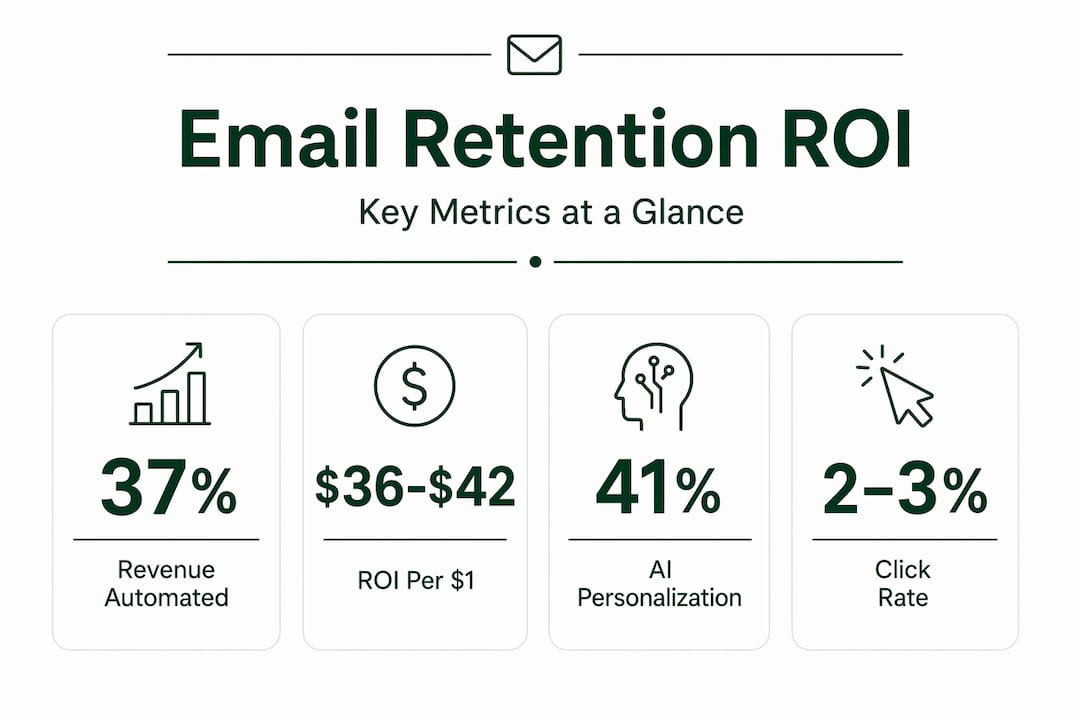
Email rarely gets the respect it deserves. While brands pour budgets into paid ads and social content, email marketing consistently delivers an average ROI of $36 to $42 for every dollar spent, with top performers exceeding $70. That figure should stop anyone questioning the importance of email marketing in 2026. The channel is not declining. It is evolving, and the brands that understand its mechanics for customer retention and engagement are building sustainable revenue that paid channels simply cannot replicate.
Table of Contents
- Key takeaways
- Why email marketing still dominates
- Automation and AI personalization at work
- Deliverability is what actually gets you to the inbox
- Measuring what actually matters in 2026
- My take on where most brands get this wrong
- How The Email Marketers can build this for you
- FAQ
Key takeaways
| Point | Details |
|---|---|
| Unmatched ROI | Email consistently returns $36–$42 per $1 spent, far outperforming paid social and search. |
| Automation drives revenue | Automated flows make up just 2% of email volume but generate 37% of all email revenue. |
| Deliverability is foundational | Authentication protocols like SPF, DKIM, and DMARC determine whether your emails reach the inbox at all. |
| Open rates are unreliable | Click-through and conversion rates are the accurate engagement metrics to track in 2026. |
| Segmentation multiplies results | Segmented campaigns generate up to 760% more revenue than non-segmented sends. |
Why email marketing still dominates
The channels that marketers chase tend to share one critical vulnerability: they are rented. Social platforms change their algorithms, paid ad costs fluctuate, and organic reach shrinks without warning. Email is different. As email’s direct ownership advantage confirms, email is direct, personal, and not subject to platform gatekeeping.
Here is what that means in practice for the role of email in marketing:
- Direct access: Your message arrives in a space your subscriber opened for communication, not a feed they are passively scrolling.
- Personal reach: A well-crafted email feels one-to-one, even when it is sent to a million people.
- Owned data: Your email list belongs to you. No third party can remove your access to it.
- Compounding loyalty: Consistent, relevant emails build a relationship over time that no single ad impression can create.
The impact of email campaigns becomes clearest when you look at customer retention specifically. A subscriber who has bought from you once is already warm. Email is the channel that converts that warmth into a second purchase, a third, and a long-term relationship. For small business owners, this matters enormously. Acquiring a new customer costs five times more than retaining an existing one, and email is the most cost-efficient retention tool available.
Pro Tip: Build your email list around intent signals, not just volume. A list of 5,000 engaged subscribers who have opted in from a product page will outperform 50,000 cold contacts every time.
Automation and AI personalization at work
If you want to understand how email marketing works at its most effective, you need to understand automation. Most marketers treat email as a broadcast medium: write a campaign, hit send, repeat. That model leaves most of your revenue on the table.
Automated email workflows account for only 2% of total email volume but generate 37% of all email revenue, driving 16 times more revenue per send than manual campaigns. That gap is not a small edge. It is a structural advantage for brands that set up the right flows.
The most powerful automated sequences include:
- Abandoned cart recovery: Three-email sequences spaced at one, 24, and 72 hours recover 15 to 30% of lost sales. With cart abandonment rates hovering around 70%, that recovery directly protects your bottom line.
- Welcome series: A multi-email welcome flow that introduces your brand, delivers value, and makes an early offer converts new subscribers into first-time buyers at significantly higher rates than a single welcome email.
- Post-purchase sequences: These turn one-time buyers into repeat customers by timing follow-ups around product usage, satisfaction, and complementary recommendations.
- Win-back campaigns: Subscribers who have gone quiet are worth re-engaging before you remove them. A well-timed offer or re-permission email can recover a meaningful percentage.
AI takes these flows further. AI-driven personalization generates up to 41% higher revenue by enabling smarter segmentation, dynamic content, and predictive send-time optimization. Rather than guessing what a segment wants, AI reads behavioral data and adjusts the message accordingly. Segmented campaigns already generate 760% more revenue than non-segmented ones. Adding AI to that segmentation logic is where the real compounding starts.
Pro Tip: Start with one automated flow before building five. A single, well-optimized abandoned cart sequence will generate more measurable return in the first 90 days than five half-built flows.

For a deeper look at how to build these systems, email personalization strategies for e-commerce cover the practical frameworks that retention-focused brands are using right now.
Deliverability is what actually gets you to the inbox
Here is the part most marketers skip. You can have the best subject line, the sharpest offer, and a beautifully designed email. None of it matters if the message lands in spam.
Deliverability is the foundational layer of every email marketing strategy, and it comes down to technical infrastructure more than creative quality. The email infrastructure market reached $1.2 billion in 2024 and is projected to hit $1.9 billion by 2030, reflecting exactly how seriously high-performing brands are taking this.
Here is the non-negotiable technical checklist for inbox placement:
- Set up SPF, DKIM, and DMARC: These authentication protocols tell inbox providers that your emails are legitimate. Only about 54% of senders had DMARC authentication as of 2024. That means nearly half of all senders are operating without basic protection.
- Separate transactional and marketing sends: Mixing these streams corrupts your sender reputation and your deliverability benchmarks. Use separate domains or IPs for each.
- Monitor by mailbox provider: Gmail, Yahoo, and Outlook each apply different filtering logic. Aggregate delivery reports hide the real picture. Track placement at the provider level.
- Clean your list regularly: Hard bounces, spam traps, and inactive addresses drag your sender score down fast.
For a thorough walkthrough on both the technical and strategic factors that affect inbox placement, this deliverability guide covers everything from authentication setup to reputation recovery.
Pro Tip: Check your email list hygiene every 90 days. Sending to a stale list is one of the fastest ways to tank your sender reputation without realizing it.
Measuring what actually matters in 2026
The way we measure email success has changed, and marketers who have not updated their benchmarks are making decisions based on bad data.
Apple Mail Privacy Protection, rolled out in 2021, pre-fetches emails and triggers open events whether or not the subscriber actually read the message. Average open rates have climbed to 30.7% in 2025 partly because of this inflation. That number looks healthy, but it is not a reliable indicator of real engagement.
The metrics that matter now are different. Here is a quick benchmark reference for 2026:
| Metric | Solid benchmark | Notes |
|---|---|---|
| Click-through rate (CTR) | 2–3% | Measures real intent; unaffected by MPP |
| Click-to-open rate (CTOR) | 10–15% | Indicates content relevance among openers |
| Conversion rate | 1–5% | Varies by industry and offer type |
| Unsubscribe rate | Under 0.2% | High rates signal relevance or frequency issues |
Performance benchmarks need to be contextual and evolving. Your CTR in a post-purchase flow should outperform your CTR in a promotional blast, and understanding why tells you something useful about your audience.
The most effective approach combines behavior-triggered flows with continuous metric review. Successful email programs move beyond batch-and-blast to automated flows integrated across the full customer journey. That is the email marketing strategy that produces compounding results year over year.
For maximum accuracy, also track revenue per email and customer lifetime value changes as you refine your campaigns. These numbers connect your email activity directly to business outcomes, which is ultimately the most honest way to evaluate the importance of email newsletters and campaigns for your specific audience.
My take on where most brands get this wrong
I have spent years working on retention-focused email strategies, and the pattern I see most often is this: brands invest heavily in creative and almost nothing in infrastructure. They hire designers, spend hours on subject line testing, and debate send frequency, while their DMARC records are misconfigured and their lists have not been cleaned in 18 months.
The creative work matters. But it is downstream of deliverability. A beautifully written email that hits spam does zero revenue. I have seen clients with genuinely excellent content underperform because their sender reputation was damaged from mixing transactional and promotional sends on the same domain. Fixing the infrastructure alone lifted their inbox placement rate and their revenue in the same month, with no changes to content.
The other thing I see constantly: brands using email marketing as a pure broadcast channel and wondering why their engagement is dropping. The shift from batch-and-blast to behavior-triggered flows is not optional anymore. It is what separates a growing retention program from a stagnant one. You do not need 20 automated flows on day one. You need the right three, built with intention, and monitored with real data.
My advice to any marketer or small business owner reading this: audit your deliverability before you touch your content. Then build one automated flow properly. The returns will justify everything else you invest after that.
— Melanie
How The Email Marketers can build this for you
Understanding the importance of email marketing is one thing. Executing it at a level that genuinely moves revenue is another challenge entirely. Theemailmarketers works exclusively with e-commerce brands on retention-focused email and SMS programs, which means every flow, segment, and campaign we build is designed around customer lifetime value, not just open rates.
If you want to see what this looks like in practice, our client results show the measurable impact of combining proper infrastructure with AI-driven automation and segmentation. For brands ready to build a full retention system, the Retention Lab is the place to start. Theemailmarketers brings together technical expertise and creative strategy so that your emails actually reach inboxes, resonate with real subscribers, and convert consistently. That is what retention marketing at a high level looks like.
FAQ
What is the average ROI of email marketing?
Email marketing delivers an average ROI of $36 to $42 for every dollar spent, with top-performing brands exceeding $70 per dollar. This makes it one of the highest-returning channels in digital marketing.
Why is email marketing better for retention than social media?
Email is a direct, owned channel not subject to algorithm changes. It allows personalized, timed messaging that builds long-term customer relationships in a way that social media feeds cannot replicate consistently.
How do automated emails improve campaign performance?
Automated workflows generate 37% of all email revenue despite representing only 2% of total sends. Behavior-triggered sequences like abandoned cart and post-purchase flows perform significantly better than manual broadcast campaigns.
What email metrics should I track in 2026?
Click-through rate, click-to-open rate, and conversion rate are the most reliable metrics now. Open rates are inflated by Apple Mail Privacy Protection and should not be used as your primary performance indicator.
What is the role of deliverability in email marketing success?
Deliverability determines whether your emails reach the inbox at all. Without proper SPF, DKIM, and DMARC authentication, even well-crafted campaigns can be filtered as spam, making infrastructure the true foundation of email marketing ROI.


