.png)


Shopify Personalization: Maximize Retention and Sales

TL;DR:
- Most Shopify stores do not use personalization apps, leaving significant retention opportunities untapped. Implementing advanced personalization enhances customer lifetime value, reduces churn, and increases repeat purchases. Building a connected system of data, on-site, and multi-channel flows is essential for maximizing personalization impact.
Shopify’s native personalization features are easy to underestimate as a real competitive advantage. The truth is, only 2.5% of stores use any personalization app at all, meaning the vast majority of your competitors are leaving serious retention revenue on the table. For 8-figure DTC brands, that gap is not a minor inefficiency. It is a strategic opening. This guide walks you through the highest-impact tools, implementation playbooks, and KPIs you need to turn Shopify personalization into a genuine retention engine, not just a nice-to-have feature.
Table of Contents
- Why Shopify personalization matters for 8-figure DTC brands
- Popular Shopify personalization tools and what they do
- How to implement personalization on Shopify: High-ROI playbook
- Measuring personalization success: KPIs and pitfalls for Shopify brands
- Our take: Why most Shopify personalization is stuck at 1.0 (and how to break out)
- Take your Shopify personalization to the next level
- Frequently asked questions
Key Takeaways
| Point | Details |
|---|---|
| Huge adoption gap | Only 2.5% of Shopify stores use advanced personalization, offering early adopters a big opportunity. |
| Best-in-class tools | Rebuy, Nosto, OptiMonk, and Klaviyo stand out for effective personalization strategies. |
| Retention-first mindset | Personalization drives higher customer lifetime value and lowers churn when correctly implemented. |
| Start with data integration | Unifying customer info across site, POS, and email unlocks actionable segmentation and ROI. |
| Measure what matters | Focus on KPIs like repeat purchase rate, AOV, and retention to prove and improve personalization. |
Why Shopify personalization matters for 8-figure DTC brands
The DTC landscape in 2026 is brutally competitive. Customer acquisition costs keep climbing, paid media returns keep shrinking, and brand loyalty is harder to earn than ever. In that environment, a generic shopping experience is not neutral. It actively pushes customers toward brands that feel like they actually know them.
Personalization changes that dynamic. When a customer lands on your store and sees product recommendations tied to their purchase history, or receives an SMS referencing the exact product they browsed last Tuesday, the experience shifts from transactional to relational. That shift has a direct business impact.
“The opportunity is hiding in plain sight: 97.5% of Shopify stores have not implemented advanced personalization, giving early adopters a significant competitive edge.”
For brands already operating at scale, implementing advanced personalization is not about incremental gains. It is about building a moat. Here is what the data consistently shows for brands that move beyond basic rules:
- Higher customer lifetime value (CLTV): Personalized experiences increase the average revenue per customer over time by surfacing relevant products at the right moments.
- Lower churn: Customers who feel understood are far less likely to buy from a competitor on their next purchase cycle.
- Increased repeat purchase rate: Automated, behavior-triggered touchpoints keep your brand top of mind without requiring constant manual effort.
- Higher average order value (AOV): Smart cross-sells and upsells tied to real purchase data outperform generic promotional offers every time.
- Reduced unsubscribe and opt-out rates: Relevant messaging gets read; irrelevant messaging gets ignored or flagged.
The brands that are winning on retention right now are not just running good ads. They are building intelligent, personalized journeys that reward loyalty at every touchpoint. A solid personalized strategy guide should be the foundation of any retention program, informing how you segment, message, and re-engage customers across channels.
Popular Shopify personalization tools and what they do
Choosing the right tech stack is where most brands either get it right or waste months chasing the wrong tools. The leading apps each serve a distinct function, and understanding that distinction matters before you commit budget.
| App | Primary function | Best for | Shopify fit |
|---|---|---|---|
| Rebuy | AI-driven upsells and cross-sells | AOV growth, cart personalization | Native Shopify integration |
| Nosto | Full-site AI personalization | Homepage, PDP, search experiences | Mid-to-enterprise DTC |
| OptiMonk | Personalized popups and overlays | Lead capture, exit intent, offers | Any Shopify store |
| Klaviyo | Email and SMS segmentation flows | Retention, lifecycle marketing | Deep Shopify data sync |
Rebuy holds roughly 56% market share in advanced upsell personalization on Shopify, making it the go-to for brands focused on cart and post-purchase revenue. Nosto goes broader, applying AI-driven personalization across the entire site experience, from homepage banners to search results. OptiMonk is built for conversion moments, giving you precise control over who sees what offer and when. Klaviyo sits at the foundation of the retention stack, pulling Shopify data to fuel segmented email and SMS flows that feel personal, not blasted.

The most important insight here is that these tools are not mutually exclusive. They are complementary. Rebuy or Nosto handles on-site behavior. Klaviyo picks up where the session ends, continuing the conversation in the inbox or via text message. Brands that treat these as separate tools miss the compounding effect of a connected strategy.
Pro Tip: Integrating Klaviyo with your on-site personalization tool creates a feedback loop where browse and purchase behavior continuously refines both your email segments and your product recommendations. That integration is where retention ROI compounds fastest. Explore the best email marketing apps that pair well with Shopify to understand which combinations work at scale.
How to implement personalization on Shopify: High-ROI playbook
Implementation is where most personalization projects stall. The tool gets installed, a few basic rules get set up, and then the team moves on. What follows is a sequenced playbook that avoids that trap.
- Identify your customer segments. Before touching any app, map your actual customer groups based on purchase frequency, AOV, product category preferences, and lifecycle stage. Personalization without segmentation is just guessing with extra steps.
- Connect your data sources. Sync Shopify customer data, purchase history, and browsing behavior into Klaviyo. This is your data layer. Everything else builds on it.
- Implement on-site personalization first. Deploy Rebuy or Nosto for product recommendations on your homepage, product detail pages, and cart. These are high-traffic, high-intent moments where relevance pays off immediately.
- Build multichannel flows via Klaviyo. Use Klaviyo integration best practices to set up automated flows: post-purchase sequences, browse abandonment, win-back campaigns, and VIP tiers. These flows should reference actual behavior, not generic triggers.
- Unify POS and ecommerce data. If your brand has physical retail, connect your POS system to Shopify and Klaviyo. POS unification gives you a full-picture customer profile that dramatically improves the relevance of every touchpoint.
- Test, iterate, and optimize. Run A/B tests on recommendation logic, email subject lines, and segment criteria. Treat personalization as a living system, not a one-time setup.
Pro Tip: Most 8-figure brands overlook POS data entirely, treating online and offline as separate universes. A customer who buys in-store and also shops online is not two customers. Merging that data unlocks context that changes how you message them. Learn more about personalizing ecommerce emails using behavioral signals from both channels.
Measuring personalization success: KPIs and pitfalls for Shopify brands
Once personalization is live, measurement becomes the discipline that separates brands that improve from brands that plateau. Tracking the wrong numbers is worse than tracking nothing, because it creates false confidence.
Here are the KPIs that actually reflect personalization impact:
- Conversion rate by segment and touchpoint
- Average order value (AOV) across personalized vs. non-personalized sessions
- Repeat purchase rate month-over-month by cohort
- Customer lifetime value (CLTV) at 90-day, 180-day, and 12-month windows
- Email and SMS engagement rates (open, click, and revenue per recipient)
- Unsubscribe and opt-out rates as a signal of relevance quality
| Metric | Pre-personalization | Post-personalization | Expected shift |
|---|---|---|---|
| Conversion rate | 2.1% | 3.4% | +60% |
| AOV | $82 | $104 | +27% |
| 90-day repeat rate | 18% | 31% | +72% |
| 12-month CLTV | $210 | $295 | +40% |
| Email revenue per recipient | $0.09 | $0.21 | +133% |
These sample figures reflect what brands see when advanced personalization is implemented properly across on-site and retention channels, not just switched on and forgotten.
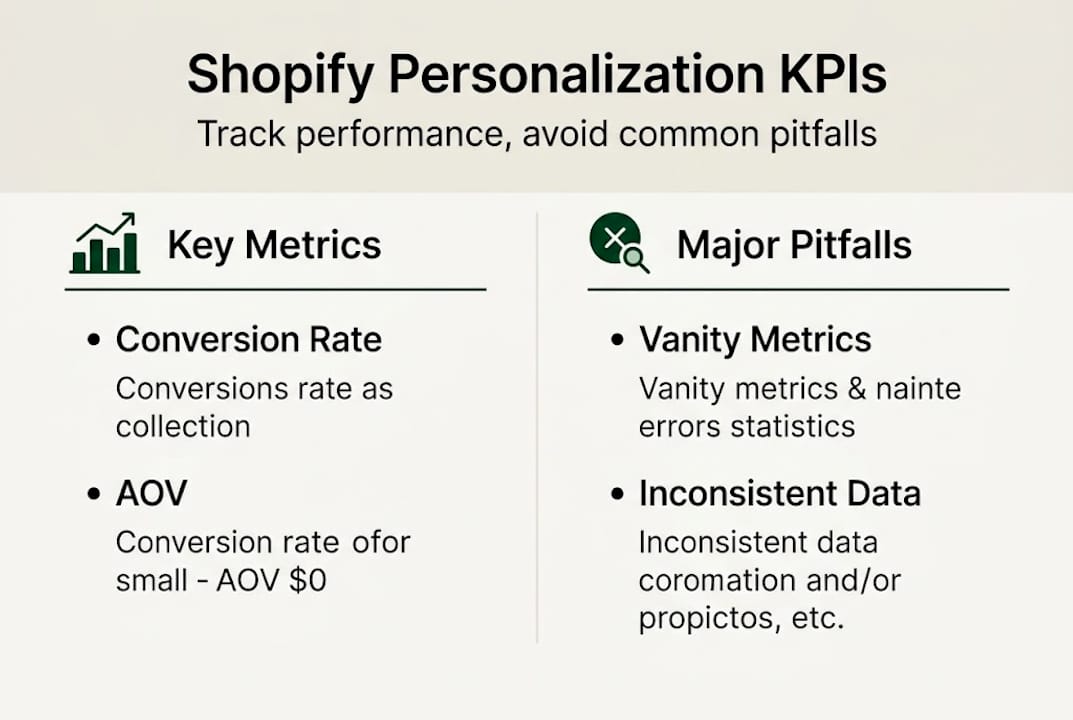
The most common pitfalls are measuring vanity metrics like impressions or recommendation clicks without tying them to actual revenue, ignoring long-term CLTV in favor of short-term conversion spikes, and running personalization for broad audiences without tight enough segmentation. The fix is simple: tie every personalization experiment to a business outcome and give it enough time to show cohort-level results. Use measuring personalization ROI frameworks that look at cohort behavior over 90 days minimum, not just first-touch conversions.
Our take: Why most Shopify personalization is stuck at 1.0 (and how to break out)
Here is what we see constantly: a brand installs a personalization app, sets up three product recommendation rules, and calls it done. They equate showing “customers also bought” widgets with a real personalization strategy. It is not. That is table stakes.
True personalization at scale means understanding lifecycle context. A customer who bought six months ago and has not returned needs a completely different message than a VIP who orders every three weeks. Treating them the same way is not just inefficient. It is actively damaging to retention.
The mindset shift that changes everything is viewing personalization as retention infrastructure, not a revenue bump tactic. When you build data flows, email and SMS orchestration, and on-site logic as one connected system, the returns compound over time. The brands we see breaking out of mediocre results are the ones who have made this infrastructure investment and partnered with experts who understand both the tech and the strategy. Our Klaviyo partner work proves that the combination of platform expertise and lifecycle strategy is what actually moves the needle on retention.
Take your Shopify personalization to the next level
Building a truly effective Shopify personalization system takes more than installing the right apps. It takes strategic architecture: the right segments, the right flows, the right measurement framework, and the right team to keep it all optimized. That is exactly what we do at The Email Marketers. We help 8-figure DTC brands build retention systems that compound over time, turning one-time buyers into loyal, high-CLTV customers. Whether you are starting from scratch or optimizing an existing stack, explore our Retention Toolkit for a structured path forward, or review a Shopify personalization case study to see how we deliver results for brands like yours.
Frequently asked questions
How does Shopify personalization improve customer retention?
Personalization tailors product recommendations and messaging to individual behavior, making each interaction more relevant and keeping customers engaged long after their first purchase. Advanced personalization consistently drives improvements in both CLTV and repeat purchase rate.
What is the most effective personalization app for Shopify?
It depends on your goal: Rebuy leads with 56% market share for AI-driven upsells, while Klaviyo is the strongest platform for email and SMS retention flows that use real customer data.
How do I integrate Klaviyo with Shopify for advanced personalization?
Install the Klaviyo app directly from Shopify’s App Store and sync your customer, order, and browse data to enable behavior-triggered flows. Prioritizing Klaviyo integration is consistently the highest-impact move for retention-focused brands.
What metrics should I track to measure Shopify personalization success?
Focus on conversion rate, AOV, 90-day repeat purchase rate, and 12-month CLTV as your core signals. Direct improvements in CLTV and repeat purchase rate are the clearest indicators that your personalization system is working.


