.png)


How to Improve Customer Lifetime Value in 2026

TL;DR:
- Customer lifetime value (CLV) is the total net revenue expected from a customer over their relationship with a brand, crucial for sustainable e-commerce growth. Effective strategies include layered personalization, behavior-triggered engagement, rapid feedback responses, and loyalty programs focused on emotional connection; these actions significantly boost retention and revenue. Most CLV improvements succeed when brands simplify, start small, and quickly act on customer signals while consolidating data and building foundational processes.
Customer lifetime value (CLV) is defined as the total net revenue a business can expect from a single customer account over the entire duration of their relationship. For e-commerce brands, CLV is the single most important metric for sustainable growth because it determines whether your acquisition spend is actually profitable. Healthy DTC brands target a 3:1 LTV-to-CAC ratio, meaning every dollar spent acquiring a customer should return three in lifetime revenue. Brands like Untuckit have demonstrated that targeted friction reduction and personalization can increase repurchase rates by 33%, proving that retention investment pays off faster than most operators expect. This guide covers the specific strategies, tools, and program designs that e-commerce managers use to improve customer lifetime value in 2026.
What are the most effective personalization strategies to improve customer lifetime value?
Personalization is the highest-leverage CLV driver available to e-commerce brands today, but most teams are only using a fraction of its potential. The majority of brands still segment by purchase history alone. The real opportunity lies in what practitioners call personalization architecture: layering transactional data (what customers buy), behavioral data (how they browse and engage), and declarative data (what they explicitly tell you) into a unified customer model.
Effective personalization means moving beyond spend-based segmentation to real-time, multi-data-layer architectures that feed first-party data back into every channel. Dietly, a meal-kit subscription brand, achieved 3.6x higher CLV for loyalty members by implementing exactly this kind of layered personalization. That result is not an outlier. It reflects what happens when you stop treating every customer the same.
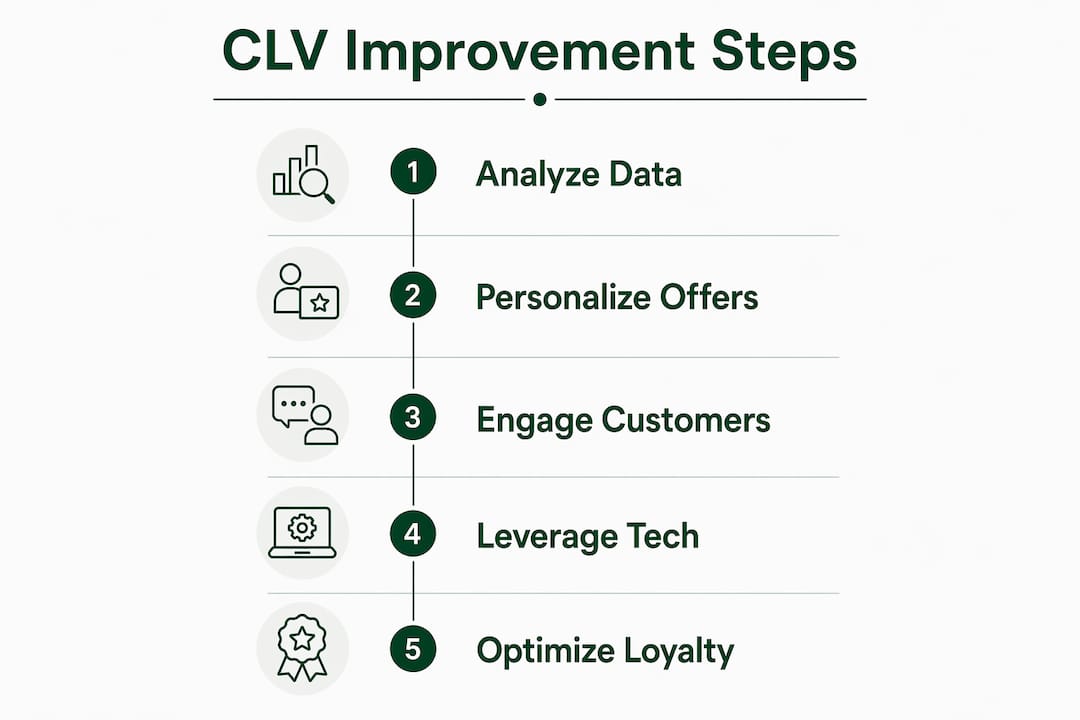
Here is how to build a personalization architecture that actually moves CLV:
- Collect zero-party data actively. Reward customers for sharing preferences, dietary restrictions, anniversaries, and product interests. This data fuels personalization that no algorithm can infer from purchase history alone.
- Segment by behavior, not just spend. A customer who browses frequently but buys rarely needs different messaging than a high-frequency buyer. Behavioral triggers produce more relevant outreach.
- Use real-time triggers. Abandoned cart, post-purchase follow-up, and browse abandonment sequences should fire based on what a customer just did, not on a fixed weekly schedule.
- Maintain omnichannel consistency. A customer who receives a personalized email should see the same product recommendations when they open your app or visit your site. Inconsistency breaks trust.
Pro Tip: Start with just two or three personalization layers before scaling. A brand that personalizes by purchase category and engagement frequency will outperform one that tries to build a 12-variable model from day one and never ships it.
Explore advanced segmentation techniques to see how leading e-commerce brands are structuring their personalization programs in 2026.
How can customer engagement strategies boost retention and lifetime value?
Customer engagement is not a feeling. It is a measurable set of behaviors: email opens, repeat purchases, review submissions, referrals, and support interactions. When those behaviors increase, CLV increases with them. The connection is direct and quantifiable.
85% of consumers cite a smooth experience as a key factor in repeat purchases, and 65% expect faster service than they did five years ago. Those numbers tell you that engagement quality is now a baseline expectation, not a differentiator. The brands that win on CLV are the ones that go further: they build engagement systems that adapt to individual behavior rather than broadcasting to everyone on the same schedule.
Here is a structured approach to optimizing your customer engagement strategy:
- Map your engagement touchpoints. List every moment a customer interacts with your brand, from the first ad impression to the fifth repeat purchase. Identify where engagement drops off.
- Build behavior-triggered communication flows. Replace fixed-schedule email blasts with sequences that fire when a customer takes a specific action or goes quiet for a category-specific period.
- Send milestone messages. Birthday emails, purchase anniversaries, and loyalty tier upgrades create emotional connection that generic promotional emails cannot replicate.
- Close feedback loops within 48 hours. Only 48% of organizations consistently respond to negative feedback within 24 to 48 hours. Doing so converts at-risk customers into advocates more reliably than any discount.
- Use cross-channel sequencing. A customer who ignores an email may respond to an SMS. Coordinate your channels so they reinforce each other rather than repeat the same message.
Pro Tip: Use your customer behavior data to define “going quiet” thresholds specific to your product category. A skincare brand might trigger a re-engagement campaign after 45 days of inactivity. A furniture brand might wait 180 days. Fixed calendar schedules ignore this entirely.
For a deeper look at building retention email flows that respond to behavior rather than the calendar, The Email Marketers has published a practical breakdown worth reading.
What tools and technologies help e-commerce brands increase CLV?
Technology does not create CLV. It removes the friction that prevents CLV from growing. The right stack lets your team act on data faster, personalize at scale, and track the metrics that actually matter.

Companies use an average of 6.3 distinct CX tools fragmented across platforms, and 81% of CX leaders identify data silos as a limiting factor in engagement performance. Consolidating that data into a unified customer data platform (CDP) is the single highest-impact infrastructure decision most mid-market e-commerce brands can make.
| Tool Category | Primary Function | CLV Impact |
|---|---|---|
| Customer Data Platform (CDP) | Unifies behavioral, transactional, and declarative data | Enables accurate segmentation and personalization at scale |
| Accelerated Checkout (e.g., Shop Pay) | Reduces purchase friction at checkout | Untuckit saw a 33% repurchase rate increase after adoption |
| Email and SMS Automation (e.g., Klaviyo) | Delivers behavior-triggered retention sequences | Outperforms fixed-schedule campaigns on repeat purchase rate |
| Predictive Analytics Tools | Identifies churn risk before customers leave | Allows proactive re-engagement before revenue is lost |
| Loyalty Program Software (e.g., Yotpo, LoyaltyLion) | Manages points, tiers, and zero-party data collection | Drives repeat purchases and preference data simultaneously |
Beyond the CDP, accelerated checkout tools like Shop Pay directly reduce the friction that kills repeat purchases. 123 Baby Box increased CLV by 40% after restructuring its subscription tiers, a result that required both the right technology and the right offer architecture working together.
AI-powered predictive tools are now accessible to brands well below the enterprise tier. Platforms like Klaviyo and Attentive include predictive churn scoring that flags customers likely to lapse before they actually do. Acting on that signal with a targeted offer or personalized message is far cheaper than re-acquiring a churned customer.
Which loyalty program designs most effectively increase customer lifetime value?
Most loyalty programs are discount programs with a points wrapper. They reward purchases, not relationships, and they attract deal-seekers rather than brand advocates. The programs that actually increase CLV are designed differently from the ground up.
Customers who are emotionally connected to a brand deliver 306% higher lifetime value than customers who are merely satisfied. That gap is enormous, and it cannot be closed with a 10% discount. Emotional loyalty comes from recognition, relevance, and reciprocity, not from points balances.
The most effective loyalty programs share these characteristics:
- They collect zero-party data as a core function. Every preference quiz, birthday field, and style survey is a data collection moment that feeds personalization. Brands that reward zero-party data sharing build richer customer profiles than any third-party data purchase can provide.
- They recognize milestones beyond purchases. Rewarding a customer on their one-year anniversary with your brand, or acknowledging their 10th order with a handwritten note, creates emotional memory that discounts cannot.
- They use tiered structures to increase purchase frequency. Visible progress toward the next tier motivates incremental purchases without requiring a price reduction.
- They close negative feedback loops fast. A loyalty member who has a bad experience and receives a personal response within 24 hours is more likely to increase their spend than a non-member who had a perfect experience. Recovery moments are loyalty moments.
- They measure emotional engagement, not just redemption rates. Net Promoter Score, repeat purchase rate, and average order value per loyalty member are better indicators of program health than points issued.
A 5% increase in customer retention can boost profits by 25 to 95%, according to Bain & Company. That figure reframes loyalty investment from a cost center to a profit driver.
What common mistakes undermine customer lifetime value growth?
The most expensive CLV mistakes are not dramatic failures. They are quiet, structural problems that compound over months and years before anyone notices the revenue impact.
Here are the most common pitfalls and how to correct them:
- Running calendar-based automations instead of behavior-triggered ones. Sending a “we miss you” email 30 days after purchase regardless of what the customer has done since is lazy and ineffective. Behavior-triggered automations that respond to actual engagement signals consistently outperform fixed-timeline sequences.
- Ignoring data silos. If your email platform, CRM, and e-commerce backend do not share data, your personalization is built on an incomplete picture. Consolidating CX tools into a unified system is the prerequisite for everything else on this list.
- Measuring satisfaction instead of emotional engagement. A customer who rates their experience 4 out of 5 stars is not loyal. They are neutral. Brands that track emotional loyalty metrics, including referral behavior and unsolicited brand mentions, catch churn risk that CSAT scores miss entirely.
- Delaying feedback loop closure. Every hour after a negative interaction that passes without a response reduces the probability of recovery. Build a process that flags dissatisfied customers for same-day outreach.
- Treating all customers identically. Your top 20% of customers by CLV likely generate 60 to 80% of your revenue. They deserve a different experience, not just a higher discount threshold.
“The brands that grow CLV fastest are not the ones with the most sophisticated technology. They are the ones that act on customer signals within hours, not weeks.”
Key takeaways
Improving CLV requires personalization architecture, behavior-triggered engagement, and loyalty programs designed to build emotional connection rather than just reward transactions.
| Point | Details |
|---|---|
| Personalization architecture drives CLV | Layer transactional, behavioral, and declarative data to personalize at scale across every channel. |
| Behavior-triggered engagement outperforms calendars | Replace fixed-schedule campaigns with flows that fire based on what customers actually do. |
| Emotional loyalty multiplies lifetime value | Customers emotionally connected to a brand deliver 306% higher CLV than satisfied-but-neutral ones. |
| Feedback loop speed is a retention lever | Closing negative feedback within 48 hours converts at-risk customers into long-term advocates. |
| Data consolidation is the prerequisite | Unified customer data platforms remove the silos that make personalization and CLV tracking impossible. |
Why most CLV strategies stall before they scale
I have worked with enough e-commerce brands to recognize the pattern: a team reads about personalization, builds a complex segmentation model, and then spends six months trying to get their data infrastructure to support it. By the time the first campaign goes live, the momentum is gone and the results are underwhelming because the data was never clean enough to begin with.
The brands that actually move the needle on CLV start smaller and ship faster. They pick one behavior trigger, one segment, and one channel. They measure it, learn from it, and expand. Dietly did not build a 3.6x CLV improvement in a single sprint. They built it through incremental personalization improvements over time.
The other thing I see consistently underestimated is the feedback loop. Most brands have a process for collecting customer feedback. Almost none have a process for acting on it within 48 hours at scale. That gap is where loyalty is lost. A customer who complains and hears nothing within two days has already mentally churned, even if they have not unsubscribed yet.
If I were advising an e-commerce brand starting from scratch on CLV improvement today, I would tell them to do three things before anything else: unify their customer data, define their “going quiet” thresholds by product category, and build a 48-hour feedback response protocol. Everything else, including loyalty programs, personalization layers, and predictive AI, builds on that foundation. Without it, you are optimizing on top of noise.
For brands that want to explore relationship marketing tactics that complement these retention fundamentals, there are strong external frameworks worth reviewing alongside your internal data.
— Melanie
How The Email Marketers can help you maximize customer lifetime value
The Email Marketers specializes in building the retention systems that e-commerce brands need to grow CLV without increasing acquisition spend. From behavior-triggered email and SMS flows to advanced segmentation strategies and loyalty program integration, the team at The Email Marketers has helped 8-figure DTC brands and VC-backed retailers turn one-time buyers into repeat customers. If you want to see what a data-driven retention program looks like in practice, explore the Retention Lab to see the frameworks and tools used with real clients. You can also review client results to understand the revenue impact these strategies deliver. For brands ready to build a personalized email strategy from the ground up, The Email Marketers is the partner built for that work.
FAQ
What is a good customer lifetime value benchmark for e-commerce?
Healthy DTC brands target a 3:1 LTV-to-CAC ratio, meaning lifetime revenue should be at least three times the cost to acquire that customer. Customer acquisition costs typically range from $127 to $462 depending on the industry.
How does personalization increase customer lifetime value?
Personalization increases CLV by making every interaction more relevant, which drives repeat purchases and reduces churn. Dietly achieved 3.6x higher CLV for loyalty members through layered personalization using transactional, behavioral, and declarative data.
How much does improving retention actually affect profits?
A 5% increase in retention can increase profits by 25 to 95%, according to Bain & Company. This makes retention investment one of the highest-ROI decisions available to e-commerce operators.
What is the fastest way to reduce churn in e-commerce?
The fastest churn reduction lever is closing negative feedback loops within 24 to 48 hours of a bad customer experience. Speed of response matters more than the resolution detail itself, and most brands still take days or weeks to follow up.
How do loyalty programs improve CLV beyond discounts?
Loyalty programs improve CLV by collecting zero-party data that fuels personalization and by creating emotional connection through milestone recognition. Customers emotionally connected to a brand deliver 306% higher lifetime value than those who are merely satisfied with their purchase experience.


