.png)


Email Strategy for D2C Brands: 2026 Retention Guide

TL;DR:
- Automated lifecycle flows generate most D2C email revenue, with smart sending being more effective than increased volume. Segmentation based on engagement levels preserves deliverability and boosts campaign results by targeting active and warm subscribers only. Focusing on list hygiene and behavioral personalization significantly improves inbox placement, open rates, and customer loyalty.
An email strategy for D2C is a systematic plan that uses automation, segmentation, and personalization to drive repeat purchases and maximize customer lifetime value. Retention marketing through email is the highest-ROI channel available to direct-to-consumer brands, with platforms like Klaviyo, Mailchimp, and Salesforce enabling brands to build sophisticated lifecycle programs at scale. The brands winning on email in 2026 are not sending more. They are sending smarter, with automated lifecycle flows generating the bulk of revenue from a fraction of total sends.
Which automated email flows generate the highest revenue for D2C?
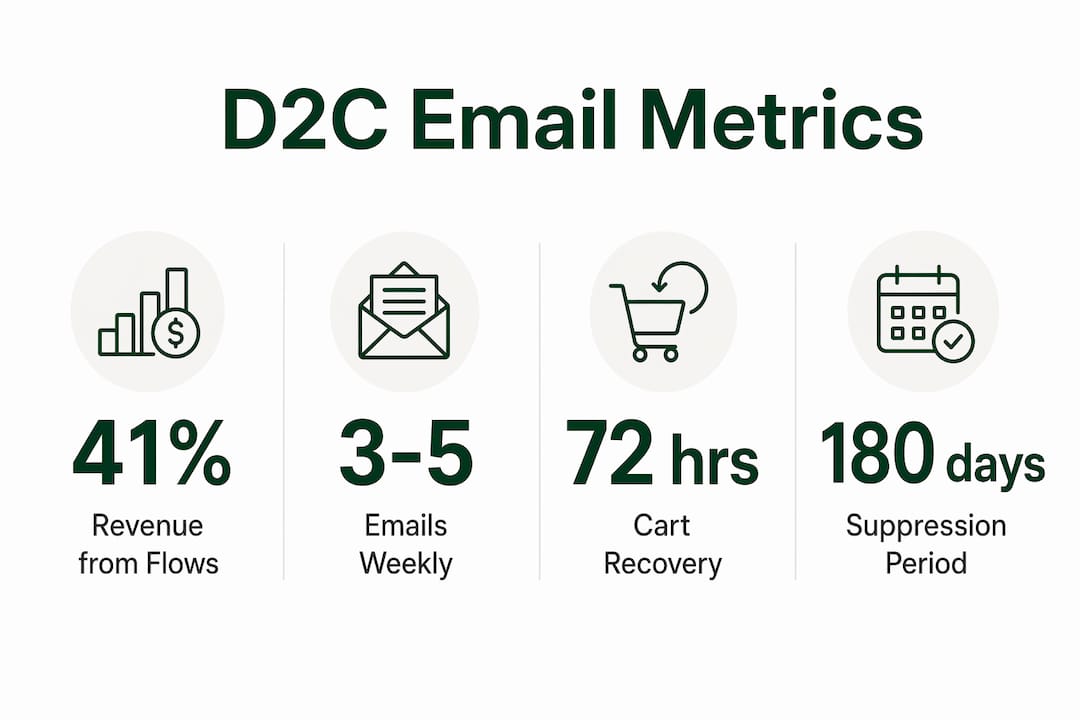
Automated lifecycle flows are the single most efficient revenue source in D2C email marketing. Automated flows generate 41% of total email revenue from only 5.3% of total sends. That ratio means every hour you spend building a flow pays back far more than any broadcast campaign.

Welcome series
The welcome series is the highest-leverage flow you can build. A 3-5 email welcome series delivered over 7–10 days, with storytelling before offers, achieves 15–22% higher conversion rates than single-email welcomes. Between 30–50% of first purchases happen within the welcome window. Lead with your brand story and values in emails one and two. Introduce a conversion offer only in email three or later, once trust is established.
Cart abandonment
Cart abandonment is the most direct revenue recovery flow. A 3-step sequence sent at 1 hour, 24 hours, and 72 hours after abandonment recovers 10–15% of lost purchases with a 45% average open rate. The first email within 60 minutes is the most critical send. That first touchpoint catches the customer while the purchase intent is still high. Delay it past an hour and recovery rates drop sharply.
Post-purchase and win-back flows
Post-purchase flows protect your acquisition investment. A well-timed post-purchase sequence confirms the order, sets expectations, and introduces complementary products before the customer has time to feel buyer’s remorse. Win-back flows target lapsed customers who have not purchased in 90–180 days. They work best with a direct subject line that acknowledges the gap, followed by a strong offer or new product reveal. Both flows are non-negotiable components of any complete D2C email automation program.
Pro Tip: Build your cart abandonment flow before your welcome series if you already have an existing list. Recovered revenue funds the creative investment needed for a high-quality welcome sequence.
How does segmentation improve D2C email performance?
Segmentation is the practice of dividing your list into groups based on behavior, purchase history, or engagement level, then sending each group relevant content. Segmented campaigns generate roughly 30% more opens and 50% more clicks than mass emails. That gap widens the longer you run a program.
The four core segments every D2C brand needs
The most effective segmentation model for D2C brands uses four buckets:
- Active: Opened or clicked within the last 30 days. Send 3–5 times per week. These customers are engaged and ready to buy.
- Warm: Engaged within the last 31–90 days. Send 1–2 times per week. Maintain contact without overwhelming them.
- Cold: No engagement in 91–180 days. Send once per week maximum. Use re-engagement content, not promotional blasts.
- Lapsed: No engagement beyond 180 days. Run a dedicated win-back sequence, then suppress if unresponsive.
Only Active and Warm segments should receive your regular campaign sends. Sending to Cold and Lapsed at full frequency damages your sender reputation and hurts deliverability for everyone on your list.
List hygiene and deliverability
List hygiene is not a quarterly task. It is an ongoing practice that directly affects how many of your emails reach the inbox. 1 in 6 legitimate marketing emails fails to reach the inbox as of 2025. That means a brand sending 100,000 emails loses roughly 16,000 to spam filters or blocking before a single person reads them. Suppressing inactive subscribers, removing hard bounces immediately, and monitoring complaint rates are the three non-negotiable hygiene practices. For a deeper look at building these systems, the advanced segmentation guide from Theemailmarketers covers the full framework.
Pro Tip: Set up an automated suppression flow that moves any subscriber with zero engagement over 180 days into a final win-back sequence. If they do not respond to three emails, suppress them permanently. Protecting your sender reputation protects your revenue.
| Segment | Engagement window | Recommended send frequency |
|---|---|---|
| Active | Last 30 days | 3–5 times per week |
| Warm | 31–90 days | 1–2 times per week |
| Cold | 91–180 days | Once per week maximum |
| Lapsed | 180+ days | Win-back sequence only |
What personalization tactics work beyond first-name insertion?
Real personalization is behavioral, not cosmetic. Inserting a first name into a subject line is table stakes. The brands driving the highest engagement use behavioral triggers, dynamic content blocks, and predictive send-time optimization. Behavioral personalization can increase open rates by 20–30% with predictive send-time optimization. Personalization beyond first-name insertion drives 3–6x higher conversion rates. Those numbers reflect a fundamental shift in what customers expect from brands they buy from directly.
The most effective behavioral triggers for D2C brands include:
- Browse abandonment: Triggered when a customer views a product page but does not add to cart. Send within 2 hours with the exact product viewed.
- Purchase frequency: Triggered when a customer’s purchase cadence drops below their historical average. A timely re-engagement email with a relevant offer can restore the pattern.
- Category affinity: If a customer consistently buys from one product category, dynamic content blocks show them new arrivals in that category first.
- Location and time-based content: Seasonal product recommendations based on the customer’s geographic location increase relevance without requiring complex data infrastructure.
Smaller email lists can outperform large ones when personalization is strong. A list of 5,000 highly engaged customers receiving conversational, plain-text style emails often generates more revenue per send than a list of 50,000 receiving generic branded templates. This is especially true during early list-building phases, when a more personal tone builds community faster than polished design. The personalized email strategy guide from Theemailmarketers details how to build these systems using zero and first-party data.
Pro Tip: Use a plain-text email once per month to your most engaged segment. Write it like a personal note from the founder. No images, no buttons. These emails consistently generate reply rates and social shares that branded templates never achieve.
How do you implement a D2C email program that actually performs?
Execution is where most D2C email programs fail. The strategy looks right on paper, but the operational details break down. Each campaign or flow needs one clear goal: revenue, retention, activation, or reactivation. Mixing goals within a single email splits attention and reduces conversion.
Authentication and deliverability setup
Authentication is the foundation of inbox placement. SPF, DKIM, and DMARC records tell inbox providers that your emails are legitimate. Skipping authentication is the fastest way to land in spam, regardless of how good your content is. Set up all three before you send a single campaign. Monitor your complaint rate weekly. Gmail and Yahoo enforce strict complaint thresholds, and exceeding them triggers filtering that is difficult to reverse.
Content planning that earns opens
Every email needs a clear hierarchy: one primary message, one primary call to action, and a subject line that delivers on what the email contains. Brands that write subject lines as clickbait and then fail to deliver in the body train their subscribers to ignore future sends. Earning opens consistently requires giving subscribers a reason to look forward to your emails. That means useful content, early access, or exclusive offers, not just promotional noise.
Measuring what actually matters
Open rates are unreliable as a primary diagnostic metric. Apple’s Mail Privacy Protection inflates open rates artificially, making them misleading for decision-making. Track revenue per flow, revenue per segment, and click-to-conversion rate instead. Build dashboards that show results by flow type and campaign category. That view tells you which automated sequences are working and which need rebuilding. For a complete marketing automation checklist covering setup steps for each flow type, the framework applies directly to D2C email programs.
Pro Tip: Run a monthly revenue audit by flow. List every active automated flow, its revenue in the last 30 days, and its last optimization date. Any flow that has not been updated in 90 days is likely underperforming against its potential.
Key takeaways
A winning D2C email program requires automated lifecycle flows, precise segmentation, behavioral personalization, and clean deliverability practices working together from day one.
| Point | Details |
|---|---|
| Automate lifecycle flows first | Automated flows generate 41% of email revenue from just 5.3% of sends. |
| Segment by engagement level | Active and Warm segments only should receive regular campaign sends. |
| Personalize beyond the name | Behavioral triggers and predictive send-time lift open rates by 20–30%. |
| Protect deliverability actively | 1 in 6 emails misses the inbox; authentication and list hygiene prevent this. |
| Measure revenue, not just opens | Track revenue per flow and per segment to make decisions that actually improve results. |
Deliverability is the revenue lever most D2C brands ignore
I have worked with D2C brands that had beautiful email templates, a full suite of automated flows, and a list of 200,000 subscribers. Their revenue from email was flat. When we audited the program, 40% of their list had not engaged in over a year. They were sending to a dead audience and paying for the privilege. Their sender reputation had degraded to the point where even their best customers were not reliably receiving emails.
The uncomfortable truth is that deliverability is not a technical checkbox. It is a revenue decision. Every inactive subscriber you keep on your list is a liability. They drag down your engagement rates, which signals to inbox providers that your emails are not wanted, which means fewer of your emails reach the people who actually want to buy from you. The math is brutal and most brands do not see it until the damage is done.
What I have found actually works is treating list quality as a KPI equal to revenue. When you suppress inactive subscribers aggressively, your metrics improve across the board. Open rates go up. Click rates go up. Revenue per send goes up. And the emails you send to your real customers start feeling like a conversation instead of a broadcast. That shift in tone, from brand-to-mass to brand-to-person, is what builds the kind of community that drives repeat purchases without constant discounting.
The brands that win on email in 2026 are not the ones with the biggest lists. They are the ones with the most trusted relationships with the right customers.
— Melanie
How Theemailmarketers helps D2C brands build retention-first email programs
Theemailmarketers works with 8-figure D2C brands and growth-focused e-commerce retailers to build email programs that drive measurable retention and repeat purchase revenue. The Retention Lab service covers automated flow builds, segmentation architecture, and deliverability audits, giving brands the infrastructure to generate consistent revenue from email without relying on constant new acquisition. For brands that want a faster start, the Email Marketers Retention Toolkit provides a ready-to-deploy framework for lifecycle flows and list management. If you want to see what this looks like in practice, the client results show the revenue impact across real D2C programs.
FAQ
What is the most important automated flow for D2C email?
The cart abandonment flow delivers the fastest revenue return. A three-step sequence at 1 hour, 24 hours, and 72 hours recovers 10–15% of lost purchases with a 45% average open rate.
How often should D2C brands email their list?
Send frequency depends on segment. Active subscribers can receive 3–5 emails per week. Cold and Lapsed segments should receive no more than one email per week, within a re-engagement sequence only.
What does good D2C email personalization look like?
Effective personalization uses behavioral triggers like browse abandonment, purchase frequency drops, and category affinity. These tactics drive 3–6x higher conversion rates compared to static first-name personalization.
How do I know if my email deliverability is hurting revenue?
Track your inbox placement rate alongside revenue per send. If revenue is flat or declining while your list is growing, poor deliverability is likely the cause. Audit authentication records and suppress inactive subscribers immediately.
Should I focus on growing my email list or improving it?
Improving list quality delivers faster revenue gains than raw list growth. Smaller, well-maintained lists with high engagement consistently outperform large lists with poor hygiene on revenue per send.


