.png)


Email Outreach Process: A 6-Step Guide for Marketers

TL;DR:
- Effective email outreach combines technical setup, targeted list building, reply-focused copy, and structured sequencing to generate meaningful engagement. Monitoring reply rates, managing deliverability, and ensuring compliance with laws like CAN-SPAM are crucial for sustained success. Most failures occur due to poor domain warm-up, unverified lists, or overlooking reply management workflows before scaling campaigns.
The email outreach process is the structured, repeatable sequence marketers and business owners use to send personalized, targeted emails that start valuable conversations and drive measurable revenue. In practice, it covers six distinct stages: deliverability setup, list building, copywriting, sequencing, volume management, and compliance. Done right, a cold email outreach campaign can achieve reply rates of 3–8%, which is a strong return for a channel with near-zero media spend. Tools like Microsoft Sales Copilot and frameworks like the CAN-SPAM Act shape how modern teams execute this process, and understanding both the technical and creative sides is what separates campaigns that book meetings from ones that get ignored.
What are the essential steps in a modern email outreach process?
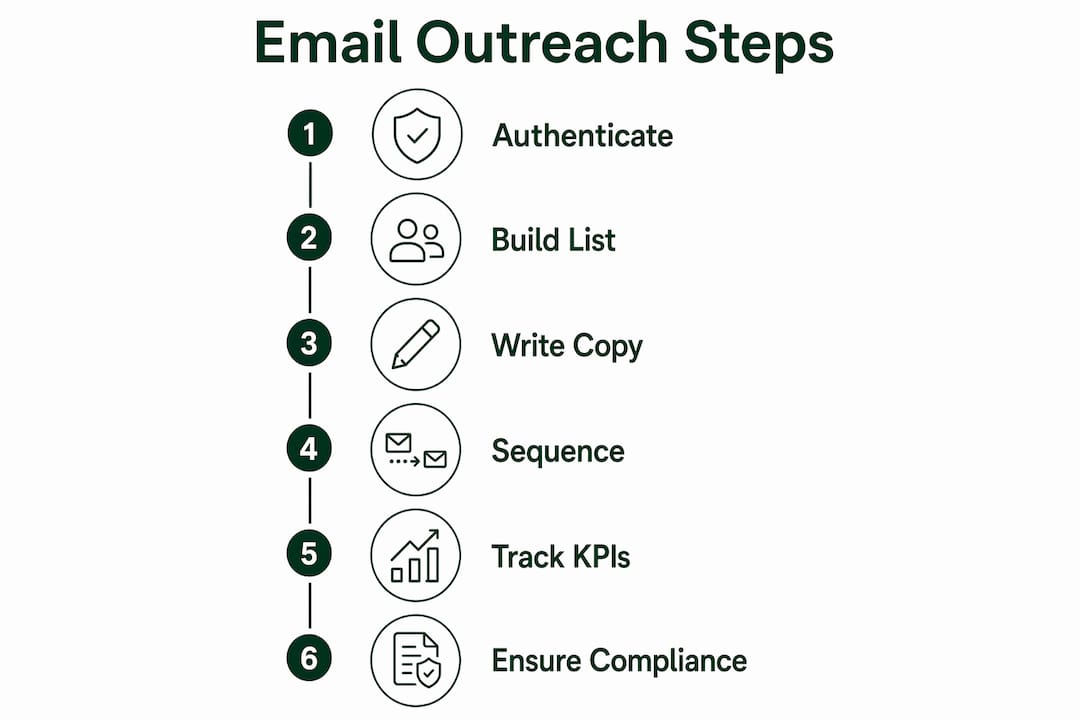
A six-step outreach framework covers every phase from technical setup to legal compliance. Each step builds on the last, and skipping any one of them creates a gap that undermines the whole campaign.
Step 1: Configure deliverability authentication
Before you send a single email, your sending domain needs SPF, DKIM, and DMARC records properly configured. These three protocols tell receiving mail servers that your emails are legitimate. Without them, your messages land in spam regardless of how good your copy is.
Step 2: Build a verified, ICP-based list
Your Ideal Customer Profile (ICP) defines exactly who belongs on your list. Verify every address before sending to keep bounce rates under 2%, which is the threshold that protects your domain health. A smaller, tightly targeted list consistently outperforms a bloated one.
Step 3: Write reply-oriented copy
Short, plain-text emails with a single clear call to action outperform designed newsletters in cold outreach. Aim for under 100 words per email and one low-friction ask per message.
Step 4: Build a multi-touch sequence
A single email rarely converts. Structure a sequence of 3–4 emails spaced 2–3 days apart, with each message taking a distinct angle. Follow-up emails generate more than half of replies, making sequence design one of the highest-leverage decisions in your campaign.
Step 5: Manage volume and track KPIs
Pace your sending volume per inbox to avoid triggering spam filters. Track reply rate, bounce rate, and meeting booking rate weekly. These numbers tell you whether your targeting, copy, or timing needs adjustment.
Step 6: Enforce compliance
Every email must include a working unsubscribe link, honest sender information, and a physical postal address under the CAN-SPAM Act. Honor opt-out requests within 10 business days, no exceptions.
Pro Tip: Set up a dedicated subdomain for outreach (for example, outreach.yourdomain.com) from day one. This protects your primary domain’s reputation if a campaign gets flagged.
How do deliverability and technical setup impact outreach success?
Deliverability is the foundation of any effective email outreach strategy. You can write the best email in your industry, but if it never reaches the inbox, the rest of your work is wasted.
SPF (Sender Policy Framework) authorizes which servers can send on your domain’s behalf. DKIM (DomainKeys Identified Mail) adds a cryptographic signature that verifies the message hasn’t been tampered with. DMARC (Domain-based Message Authentication, Reporting, and Conformance) ties the two together and tells receiving servers what to do with messages that fail authentication. Practitioners monitor aggregate DMARC reports continuously before moving to strict policies, because rushing to a “reject” policy without reviewing alignment data can block legitimate mail.
Using separate subdomains and multiple mailboxes limits risk to your primary domain and makes reputation management far more controllable. If an outreach subdomain gets flagged, your core business email stays unaffected.
Domain warm-up is equally non-negotiable. New domains need 8–12 weeks of gradual volume increases before they can handle full campaign loads. Start with 10–20 emails per day and increase slowly. Critically, domain warm-up is not a one-time task. Sustained inbox placement requires ongoing engagement maintenance, not just a setup sprint.
Key deliverability metrics to monitor continuously:
- Bounce rate: Keep below 2% to protect sender reputation
- Spam complaint rate: Anything above 0.1% signals a targeting or messaging problem
- Inbox placement rate: Use tools like Google Postmaster Tools or MxToolbox to track where your mail lands
- Authentication alignment: Confirm SPF, DKIM, and DMARC are all passing before scaling volume
“Deliverability is not a one-time configuration. It is an ongoing discipline that determines whether your outreach investment reaches its audience or disappears into the void.”
What best practices improve personalized email outreach copy and sequencing?
Personalized email outreach is where most campaigns either win or lose. The technical setup gets you to the inbox. The copy determines whether the recipient replies.
The most effective cold email copy follows a four-part structure: signal, opener, hook, and ask. The signal is a specific, relevant reason you are reaching out (a funding announcement, a job posting, a piece of content they published). The opener connects that signal to the recipient personally. The hook explains the value you offer in one sentence. The ask is a single, low-friction question that requires only a yes or no answer. This four-part formula keeps emails under 100 words and dramatically improves reply rates compared to long, feature-heavy pitches.
For sequencing, apply these principles:
- Vary the angle with each touch. Email 1 leads with the signal. Email 2 might share a relevant case study. Email 3 could ask a direct question about a pain point. Never repeat the same message with a “just following up” opener.
- Space emails 2–3 business days apart. Tighter spacing feels aggressive; wider spacing loses momentum.
- Use plain text formatting. Heavy images, HTML templates, and attachments trigger spam filters and reduce deliverability in cold outreach contexts.
- Keep subject lines under 7 words. Short, specific subject lines outperform vague or clever ones in cold email.
- End your sequence with a breakup email. A final message that acknowledges this is your last outreach often generates replies from prospects who were interested but distracted.
Pro Tip: AI tools can accelerate personalization at scale. Theemailmarketers covers how to use an AI email generator to draft signal-based openers without sacrificing quality or authenticity.
The role of AI in marketing strategies has expanded significantly, and outreach personalization is one of the clearest use cases. AI can pull signals from LinkedIn, news feeds, and CRM data to generate contextually relevant openers at a scale no human team can match manually.
Which metrics should marketers track for effective email outreach?
Open rate is the most commonly reported email metric and the least reliable one for cold outreach. Apple Mail Privacy Protection pre-loads tracking pixels, which inflates open rates and makes them statistically meaningless for diagnosing campaign performance. Reply rate and meeting booking rate are the metrics that actually indicate whether your outreach is working.
Here are the KPIs that matter and what they tell you:
| Metric | Benchmark | What it signals |
|---|---|---|
| Reply rate | 3–8% (top quartile: 6%) | Overall message resonance and targeting accuracy |
| Positive reply rate | 1–3% | Actual interest and pipeline potential |
| Bounce rate | Under 2% | List quality and domain health |
| Meeting booking rate | 0.5–2% | End-to-end campaign effectiveness |
| Sequence completion rate | Above 60% | Whether prospects are engaging before opting out |
Smaller, highly targeted campaigns consistently outperform broad ones. Campaigns targeting 100–250 recipients achieved a median reply rate of 6.8%, compared to 2.9% for campaigns exceeding 2,500 recipients. This data makes a strong case for prioritizing list quality over list size.
When diagnosing a struggling campaign, use metric combinations rather than single numbers. Low reply rate combined with low open rate points to a deliverability or subject line problem. Low reply rate with acceptable open rate points to a copy or targeting problem. High bounce rate signals a list quality issue that needs fixing before any other optimization matters.
Review your KPIs on a weekly cadence. Monthly reviews are too slow to catch deliverability degradation before it damages your domain reputation.
How can marketers ensure compliance in their email outreach campaigns?
The CAN-SPAM Act sets the legal baseline for commercial email in the United States. Unlike GDPR, which requires explicit opt-in consent before sending, CAN-SPAM permits unsolicited commercial email as long as specific requirements are met. Understanding the difference matters because many marketers mistakenly apply GDPR rules to U.S. campaigns or assume CAN-SPAM compliance covers European recipients.
CAN-SPAM requires every commercial email to include:
- A working unsubscribe mechanism that functions for at least 30 days after sending
- Honest sender information in the “From,” “To,” and “Reply-To” fields
- A physical postal address for the sending organization
- A subject line that accurately reflects the email’s content
- Opt-out requests honored within 10 business days
For campaigns reaching European contacts, GDPR applies instead, requiring documented consent before any commercial email is sent. Running a mixed list without segmenting by geography is a compliance risk that can result in significant penalties.
The practical fix is to build compliance checks directly into your campaign workflow. Before any sequence launches, verify that your unsubscribe link is functional, your sender information is accurate, and your list has been segmented by geography where GDPR applies. For a deeper breakdown of what the CAN-SPAM Act requires, Theemailmarketers has a dedicated resource on CAN-SPAM compliance that covers edge cases most marketers miss.
Key takeaways
A successful email outreach process requires technical authentication, precise targeting, reply-focused copy, structured sequencing, metric-driven optimization, and strict legal compliance working together as a single system.
| Point | Details |
|---|---|
| Authentication comes first | Configure SPF, DKIM, and DMARC before sending a single outreach email. |
| Target small, targeted lists | Campaigns under 250 recipients achieve 6.8% median reply rates versus 2.9% for large lists. |
| Follow-ups drive replies | More than half of all replies come from follow-up emails, not the first message. |
| Track reply rate, not open rate | Apple Mail Privacy Protection makes open rates unreliable; reply rate is the true engagement signal. |
| Compliance is non-negotiable | CAN-SPAM requires opt-out mechanisms, honest sender info, and a physical address in every email. |
Why most email outreach fails before the first email is sent
After working with dozens of e-commerce and B2B brands on their outreach programs, the pattern I see most often is this: teams invest heavily in copy and templates, then wonder why their campaigns underperform. The real problem is almost always upstream. Domains that were never properly warmed up. Lists that haven’t been verified. Authentication records that were set up once and never checked again.
The second most common mistake is optimizing for open rate. I have seen marketing teams celebrate a 45% open rate on a campaign that generated zero replies. That number is noise, not signal. The only number worth celebrating is a reply from a qualified prospect.
What actually works is treating outreach as an end-to-end system rather than a collection of individual tactics. The B2B email best practices that drive retention also apply to outreach: consistent messaging, precise segmentation, and a clear next step in every communication.
One more thing most guides skip: build your reply management workflow before you scale. Inbound reply handling workflows need to be in place before volume increases, because a campaign that generates 50 replies per day with no system to route and respond to them is just as broken as one that generates zero. Scale the infrastructure first, then scale the volume.
— Melanie
How Theemailmarketers can power your next outreach campaign
Theemailmarketers builds and manages email and SMS campaigns for 8-figure DTC brands, VC-backed companies, and growth-focused retailers that need more than a template and a send button. The agency’s team handles everything from technical deliverability setup and ICP-based list strategy to personalized copy, automated sequences, and KPI reporting. If you want to see what a fully optimized campaign looks like in practice, the client results page shows real outcomes across industries. For marketers who want to build deeper retention into their outreach strategy, the Retention Lab offers advanced frameworks designed specifically for brands that need to convert first-time contacts into long-term customers.
FAQ
What is the email outreach process?
The email outreach process is a structured sequence of steps including deliverability setup, list building, copywriting, sequencing, volume management, and compliance that marketers use to send targeted emails and generate replies or meetings from prospects.
What reply rate should I expect from cold email outreach?
Good cold email reply rates in 2026 range from 3–8%, with a median around 2.5% and top-performing campaigns reaching 6% or higher. Smaller, highly targeted lists consistently achieve above-average results.
Why is open rate unreliable for measuring outreach performance?
Apple Mail Privacy Protection pre-loads email tracking pixels, which artificially inflates open rate data. Reply rate and meeting booking rate are more accurate indicators of actual engagement and campaign effectiveness.
How many emails should a cold outreach sequence include?
A standard sequence includes 3–4 emails spaced 2–3 business days apart, with each message taking a distinct angle. Follow-up emails generate more than half of all replies, so stopping after one send leaves significant pipeline on the table.
What does CAN-SPAM require for cold email campaigns?
CAN-SPAM requires every commercial email to include a working unsubscribe link, honest sender information, and a physical postal address. Opt-out requests must be honored within 10 business days of receipt.


