.png)


B2B email marketing best practices to boost retention

B2B email marketing delivers an impressive $36 to $46 return for every dollar spent, outperforming most digital channels. Yet many e-commerce brands struggle to translate this potential into consistent customer retention and revenue growth. The challenge lies not in the channel itself but in applying the right strategies tailored to B2B dynamics. This guide walks you through proven best practices that enhance engagement, nurture lifecycle relationships, and maximize ROI. You will discover key benchmarks, advanced segmentation techniques, AI-powered personalization tactics, and how B2B differs from B2C email marketing. By the end, you will have a clear roadmap to transform your B2B email campaigns into powerful retention engines.
Table of Contents
- Key takeaways
- Understanding B2B email marketing benchmarks and why they matter
- Core best practices: segmentation, personalization, and cadence for maximum impact
- Emerging trends and AI-powered personalization shaping B2B email marketing
- B2B vs B2C email marketing: key differences and what e-commerce brands should know
- Boost your e-commerce B2B email marketing with expert help
- Frequently asked questions
Key Takeaways
| Point | Details |
|---|---|
| High B2B ROI | B2B email delivers a strong return on investment and generally outperforms most digital channels. |
| Advanced segmentation | Segment by ideal customer profile, role, industry, and engagement level to reach the right person at the right time. |
| Personalization beyond names | Personalization should reference specific pain points and ROI outcomes relevant to the buyer and their stage in the journey. |
| AI powered personalization | AI powered personalization tailors content and recommendations to increase relevance and engagement. |
| Lifecycle and cadence | Lifecycle nurturing and cadence optimization drive retention and revenue growth in B2B campaigns. |
Understanding B2B email marketing benchmarks and why they matter
Knowing where your campaigns stand against industry standards helps you set realistic goals and identify improvement opportunities. B2B email benchmarks provide a data-driven foundation for measuring success. Open rates average between 36.7% and 42.35%, with top-performing campaigns exceeding 50%. These figures reflect strong subject line relevance and audience targeting. Click-through rates typically range from 2% to 4%, though elite campaigns push past 10% by delivering hyper-relevant content. Click-to-open rates fall between 6% and 10%, signaling how effectively your message converts initial interest into action.
Bounce rates and unsubscribe percentages serve as critical health indicators for your list quality. A bounce rate above 2% suggests outdated contacts or poor list hygiene. Unsubscribe rates exceeding 0.5% often point to frequency issues or misaligned messaging. Meanwhile, B2B email marketing ROI averages $36 to $42 per dollar spent, consistently beating social media, paid search, and display advertising. This exceptional return stems from direct communication with decision-makers who have already expressed interest in your solutions.
Understanding these metrics allows you to diagnose campaign weaknesses and allocate resources strategically. For example, a low CTOR despite high opens suggests your content fails to inspire action. Conversely, strong CTR but poor conversion rates may indicate landing page friction. Track these email marketing benchmarks monthly to spot trends early and adjust tactics before performance erodes.
Key benchmark ranges to monitor:
- Open rate: 36.7% to 42.35% (aim for top quartile above 50%)
- Click-through rate: 2% to 4% (elite campaigns exceed 10%)
- Click-to-open rate: 6% to 10% (measures message effectiveness)
- Bounce rate: below 2% (signals list health)
- Unsubscribe rate: below 0.5% (indicates relevance and frequency balance)
- ROI: $36 to $42 per dollar (track multi-touch attribution for accuracy)
Pro Tip: Segment your benchmark tracking by industry vertical and company size. Enterprise accounts often show lower open rates but higher conversion values, while SMB segments may engage more frequently but with smaller deal sizes. This nuanced view prevents misleading averages from distorting your strategy.
Core best practices: segmentation, personalization, and cadence for maximum impact
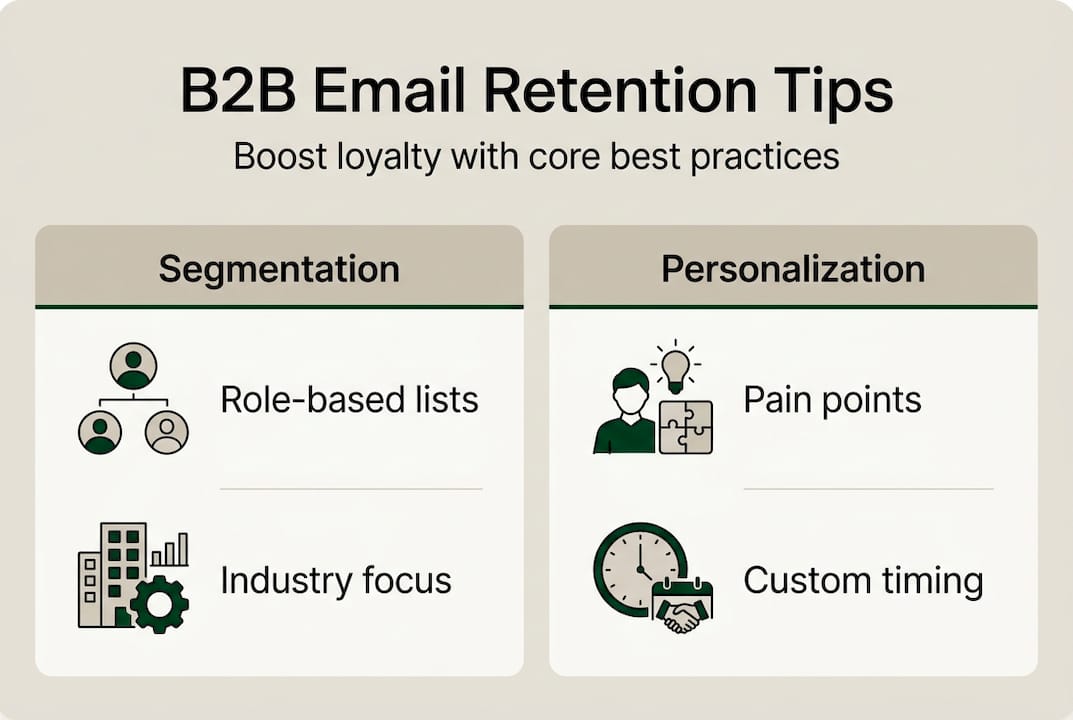
Segmentation forms the foundation of effective B2B email marketing. Advanced segmentation by ideal customer profile, role, industry, and engagement level ensures your message reaches the right person at the right time. A CFO evaluating cost savings needs different content than a CMO assessing brand impact. Grouping contacts by engagement history lets you re-engage cold leads with tailored win-back campaigns while nurturing hot prospects with case studies and demos.
Personalization extends far beyond inserting first names into subject lines. Reference specific pain points your prospect has mentioned, highlight ROI outcomes relevant to their industry, and tailor calls to action based on their position in the buyer journey. Early-stage contacts benefit from educational content and thought leadership, while late-stage prospects need pricing details, implementation timelines, and customer testimonials. Personalize email content by mapping each segment to distinct lifecycle stages and crafting messages that address their immediate concerns.

Lifecycle-driven email flows automate nurturing while maintaining relevance. Welcome sequences introduce new subscribers to your value proposition. Educational drip campaigns build authority and trust over weeks. Trigger-based messages respond to specific behaviors like content downloads or demo requests. Re-engagement campaigns revive dormant contacts before they decay into dead weight. Each flow should guide recipients toward the next logical step without overwhelming them.
Cadence matters enormously in B2B contexts. Sending 1 to 2 emails per month strikes the optimal balance between staying top of mind and avoiding unsubscribe triggers. Weekly sends work for high-value educational content, but daily emails alienate B2B audiences accustomed to thoughtful, strategic communication. Test frequency by monitoring engagement patterns and unsubscribe rates across different segments.
Optimize templates for both mobile and desktop viewing since decision-makers check email across devices throughout the day. Use responsive design, keep subject lines under 50 characters, and place your primary CTA above the fold. Avoid image-heavy designs that load slowly or trigger spam filters. Plain-text emails often outperform elaborate HTML in B2B contexts because they feel personal and direct.
Essential segmentation criteria:
- Company size and revenue tier
- Industry vertical and sub-niche
- Job title and decision-making authority
- Engagement score based on opens, clicks, and website visits
- Lifecycle stage from awareness to decision
- Previous purchase history or demo attendance
Pro Tip: Throttle your sends to avoid overwhelming inbox algorithms. Sending 10,000 emails simultaneously can trigger spam filters and reduce deliverability. Spread large sends over several hours, prioritizing your most engaged segments first. This approach also lets you monitor early performance and adjust messaging for later batches if needed. Building quality B2B email lists with verified contacts improves deliverability and engagement from the start.
Emerging trends and AI-powered personalization shaping B2B email marketing
AI-driven personalization has moved from experimental to essential in 2026. Sixty-four percent of B2B marketers now use AI to tailor message content, subject lines, and send times based on individual recipient behavior. Machine learning algorithms analyze past engagement patterns to predict which offers, content formats, and CTAs will resonate most with each contact. This level of customization boosts click-through rates by surfacing the exact information each prospect needs at their current journey stage.
Interactive email elements transform static messages into engaging experiences. Embedded surveys, accordion menus, and clickable product carousels let recipients explore content without leaving their inbox. These features increase time spent with your message and provide valuable behavioral data. A prospect who expands multiple FAQ sections signals higher intent than someone who skims and closes. Use this insight to prioritize follow-up efforts and refine your scoring models.
Semantic inbox ranking represents the biggest shift in email deliverability strategy. Gmail, Outlook, and other major providers now use AI to predict which emails a user will engage with and surface those prominently. Volume-based tactics that worked in the past now backfire. Relevance and quality determine placement, meaning every send must justify its existence. Low engagement signals train algorithms to deprioritize future messages, creating a downward spiral.
This evolution favors brands that prioritize list hygiene, segment rigorously, and craft genuinely valuable content. Sending fewer, better-targeted emails often yields higher total engagement than blasting large lists with generic messages. Focus on maintaining high open and click rates within each segment rather than maximizing raw send volume. Clean your list quarterly, removing hard bounces and contacts who have not engaged in six months.
“AI personalization adoption reached 64% in 2026, delivering measurably higher engagement and ROI by matching content to individual recipient preferences and behaviors. Brands using AI-driven tactics report click-through rate improvements of 30% or more compared to static campaigns.”
Adoption of AI tools is accelerating as platforms integrate machine learning capabilities directly into email service providers. Predictive send time optimization, dynamic content blocks, and automated A/B testing reduce manual workload while improving results. Even small teams can now execute sophisticated personalization strategies that previously required dedicated data science resources. Explore email marketing trends to stay ahead of evolving best practices and technology developments.
Key AI and trend applications:
- Predictive content recommendations based on past behavior
- Automated send time optimization for individual recipients
- Dynamic subject line generation tailored to segment preferences
- Interactive elements like surveys and expandable content blocks
- Semantic relevance scoring to prioritize high-engagement sends
B2B vs B2C email marketing: key differences and what e-commerce brands should know
B2B and B2C email marketing operate under fundamentally different dynamics. B2B sales cycles stretch from 60 to 120 days or longer, requiring sustained nurturing across multiple touchpoints. B2C purchases often happen within hours or days of initial interest. This extended timeline demands patience and a content strategy that educates and builds trust over months rather than pushing for immediate conversion.
Tone and messaging diverge sharply between the two approaches. B2B communications adopt a formal, value-driven style that emphasizes ROI, efficiency gains, and strategic outcomes. B2C emails lean casual, emotional, and benefit-focused, highlighting convenience, enjoyment, or status. A B2B prospect evaluating enterprise software wants case studies, implementation details, and total cost of ownership analysis. A B2C shopper browsing fashion needs compelling imagery, limited-time offers, and social proof.
Decision-making structures add complexity to B2B campaigns. Six to ten stakeholders typically influence B2B purchases, each with distinct priorities and concerns. Your email strategy must address multiple personas within the same account, from end users focused on usability to executives evaluating financial impact. B2C decisions involve one or two people at most, simplifying messaging and reducing approval layers.
Frequency expectations differ dramatically. B2B audiences tolerate 1 to 2 emails per month without fatigue, while B2C subscribers often engage with weekly or even daily messages. Exceeding this threshold in B2B contexts triggers unsubscribes and damages sender reputation. The longer consideration period means each email carries more weight and must deliver substantial value to justify inbox space.
Performance metrics shift focus from opens to deeper engagement indicators. B2B success hinges on reply rates, meeting requests, and multi-touch revenue attribution rather than simple open or click metrics. A campaign generating three qualified sales conversations delivers more value than one producing 500 opens with no downstream action. Track how email influences pipeline progression and closed deals, not just top-of-funnel vanity metrics.
| Dimension | B2B Email Marketing | B2C Email Marketing |
|---|---|---|
| Sales cycle length | 60 to 120+ days | Hours to days |
| Tone and style | Formal, value-driven, strategic | Casual, emotional, benefit-focused |
| Decision-makers | 6 to 10 stakeholders | 1 to 2 individuals |
| Email frequency | 1 to 2 per month | Weekly to daily |
| Key success metrics | Reply rate, meetings, pipeline influence | Open rate, click rate, conversion rate |
| Content focus | ROI, case studies, implementation | Offers, imagery, social proof |
Understanding these distinctions helps e-commerce brands adapt their retention strategies when targeting B2B buyers. B2B email marketing requires different tactics than B2C email marketing, even when both aim to maximize customer lifetime value. Tailor your approach to match the buying context, decision complexity, and engagement expectations of your target audience.
Critical B2B adaptations for e-commerce brands:
- Extend nurture sequences to 90+ days with educational content
- Create persona-specific tracks for different stakeholder roles
- Emphasize ROI calculators, case studies, and implementation support
- Reduce send frequency to monthly or bi-monthly cadence
- Measure success through sales conversations and pipeline impact
Boost your e-commerce B2B email marketing with expert help
Applying these best practices consistently requires specialized expertise and dedicated resources. The Email Marketers brings deep B2B email marketing experience tailored specifically for e-commerce brands focused on retention and ROI growth. Our team builds sophisticated segmentation strategies, develops lifecycle nurture flows, and implements AI-driven personalization that transforms prospects into long-term customers. We go beyond generic tactics to create campaigns aligned with your unique buyer journey and business goals.
Explore our retention lab to see how we have helped brands increase repeat purchase rates and customer lifetime value through strategic email marketing. Review a detailed case study showcasing measurable results from our retention-focused approach. Access our retention toolkit for frameworks and resources that accelerate your B2B email marketing success. Let us handle the complexity while you focus on growing your business.
Frequently asked questions
What is the ideal email frequency for B2B campaigns?
Sending 1 to 2 emails per month maintains engagement without triggering unsubscribes in most B2B contexts. This lower frequency respects the longer sales cycles and decision-making processes typical of business buyers. Test different cadences by monitoring response rates and unsubscribe patterns within each segment. High-value educational content may support weekly sends, while promotional messages should remain monthly.
How can AI improve B2B email personalization?
AI analyzes individual recipient behavior to tailor subject lines, content recommendations, and send times for maximum relevance. Machine learning algorithms identify patterns in engagement data that humans miss, predicting which offers and formats will resonate with each contact. This precision boosts click-through rates by 30% or more and helps prioritize recipients most likely to convert. AI also automates A/B testing and dynamic content insertion at scale.
What metrics matter most in B2B email marketing ROI measurement?
Reply rate, meeting requests, and multi-touch revenue attribution provide better ROI insights than opens or clicks alone. These deeper engagement indicators show how email influences pipeline progression and closed deals. Monitor bounce rates below 2% and unsubscribe rates below 0.5% to maintain list health. Track cost per qualified lead and customer acquisition cost to understand true campaign profitability beyond surface-level engagement metrics.
How does B2B email marketing differ from B2C?
B2B uses formal tone, longer sales cycles of 60 to 120+ days, and lower email frequency of 1 to 2 sends per month. Group decision-making involving 6 to 10 stakeholders requires multi-persona messaging and extended nurture sequences. Success metrics focus on reply rates and sales conversations rather than immediate conversions. B2C campaigns prioritize speed, emotion, and individual purchase decisions with higher send frequency and casual messaging.


