.png)


Email marketing impact: Boost e-commerce retention & ROI

TL;DR:
- Automated lifecycle flows generate significantly more revenue per recipient than campaign blasts, especially when optimized.
- Building and testing core flows before increasing campaign volume delivers higher ROI, retention, and long-term revenue.
Automated lifecycle emails account for just 5.3% of all sends yet generate nearly 41% of total email revenue for e-commerce brands. That ratio should stop you cold if your team is still chasing campaign volume as the primary measure of email performance. Most DTC (direct-to-consumer) brands pour resources into broadcast campaigns and newsletter calendars while their automated flows sit underbuilt, under-tested, and drastically underleveraged. This guide breaks down where email impact actually comes from, how to measure it with confidence, and what operational levers most brands completely overlook.
Table of Contents
- What actually drives email marketing impact in ecommerce
- How email marketing fuels retention and ecommerce ROI
- Deliverability, list hygiene, and regulation: Hidden levers of email impact
- Measuring email marketing impact: Benchmarks, nuance, and pitfalls
- The uncomfortable truth about email marketing impact for DTC: Less volume, more orchestration
- Enhance your email marketing outcomes with expert support
- Frequently asked questions
Key Takeaways
| Point | Details |
|---|---|
| Automated flows outperform campaign blasts | Lifecycle email automations drive vastly higher revenue and engagement than batch campaigns for DTC ecommerce brands. |
| Retention fuels e-commerce ROI | A small segment of repeat buyers generates a disproportionate share of revenue, and email is vital for nurturing high-value customers. |
| Hygiene and compliance are mission-critical | List hygiene and regulatory policies directly affect deliverability, engagement, and bottom-line email impact. |
| Measurement requires nuance | ROI calculations can be misleading; brands should rely on conversion and retention attribution, not just engagement metrics. |
| Orchestration beats incremental optimization | Improving flow coverage and sequence orchestration drives more impact than subject-line tweaks or campaign frequency increases. |
What actually drives email marketing impact in ecommerce
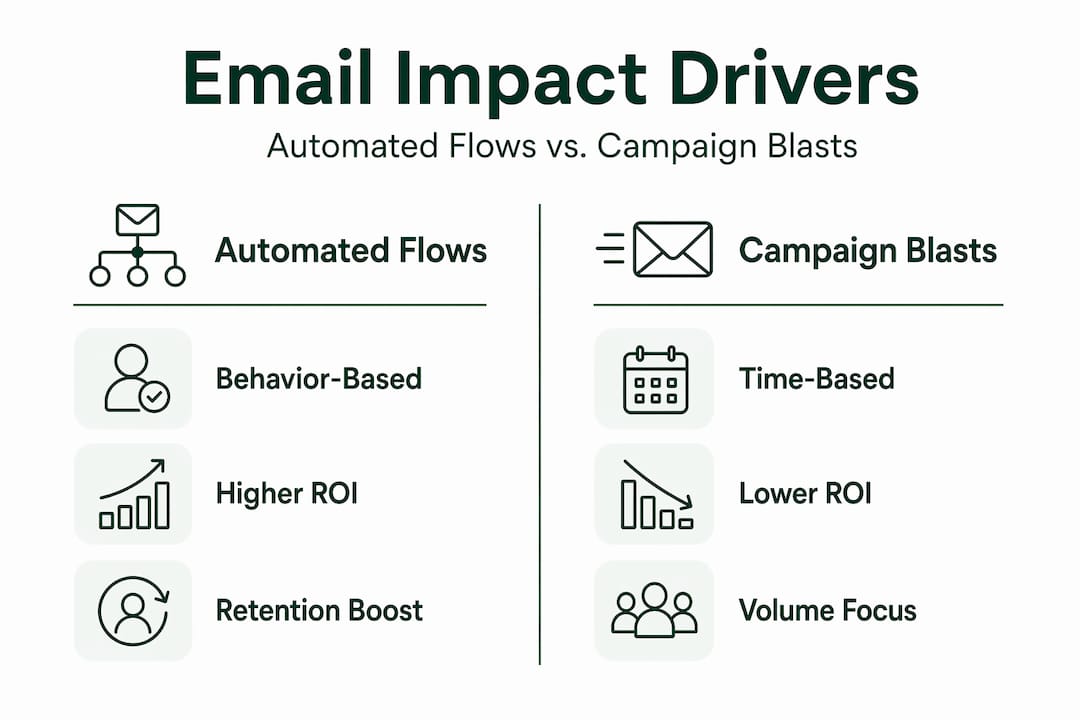
Clarifying the difference between campaigns and flows is the single most important conceptual shift a DTC marketer can make. Campaign emails are one-time broadcasts, sent to a list or segment at a scheduled time: promotions, product launches, seasonal sends. Flows (also called automations or triggered sequences) fire automatically based on subscriber behavior, like joining a list, abandoning a cart, or completing a purchase.
The performance gap is not subtle. Flows generate nearly 18× higher revenue per recipient than standard campaign blasts. That is not a marginal difference. It reflects the fundamental advantage of relevance: flows reach subscribers at the exact moment their behavior signals intent or risk.
Lifecycle automations drive retention impact far more effectively than batch campaigns because they respond to where customers are in their journey. The five flows every DTC brand should have fully optimized before scaling campaign volume are:
- Welcome series: Sets expectations, introduces brand values, and drives a first purchase from newly subscribed contacts
- Cart abandonment: Recovers revenue from high-intent visitors who did not complete checkout
- Browse abandonment: Re-engages visitors who showed product interest but never added to cart
- Post-purchase sequence: Builds loyalty, encourages repeat buying, and reduces refund requests through proactive communication
- Winback flow: Targets lapsed customers before they become permanently inactive
For more on sequencing and structure, email flows to boost engagement and email automation tips offer detailed tactical breakdowns.
| Factor | Automated flows | Campaign blasts |
|---|---|---|
| Trigger | Behavior-based | Time-based |
| Revenue per recipient | Up to 18× higher | Baseline |
| Relevance to customer | High | Medium to low |
| Ongoing effort required | Low once built | High, ongoing |
| Personalization potential | Very high | Moderate |
Pro Tip: Before you add another campaign to your calendar, audit your five core flows. If any of them are missing, have fewer than three emails, or have not been tested in the past six months, that is your highest-ROI opportunity, not more campaign sends.
Understanding cost-effective email marketing also helps frame why orchestration beats volume: the marginal cost of sending one more campaign is almost zero, which tricks teams into over-sending while underdeveloping the automated infrastructure that actually converts.
How email marketing fuels retention and ecommerce ROI
Email’s role in retention is not just about keeping subscribers on a list. It is about systematically increasing the number of times a customer buys from you, which has a compounding effect on overall business health. The economics are stark: repeat customers represent just 21% of a typical brand’s customer base but account for 44% of total revenue.
That imbalance should reframe your entire retention strategy. Most DTC brands spend the majority of their marketing budget acquiring new customers, but the existing buyer who has already trusted you once is exponentially easier to convert again. Email is the most direct, permission-based, and scalable channel for activating that relationship.
“Email marketing delivers an ROI of $36 to $40 for every $1 spent, making it the highest-performing digital marketing channel available to e-commerce brands.” Omnisend, 2026
That ROI figure only holds if you are using email correctly. Brands that rely heavily on promotional campaigns and discount-driven blasts see their repeat purchase rates stagnate because they condition customers to wait for sales rather than building genuine loyalty. The brands that use email to educate, celebrate, and add value between purchases see materially different outcomes.
Practical ways to improve retention through targeted email strategy:
- Segment post-purchase sequences by product category to deliver relevant cross-sell recommendations
- Build a VIP tier flow that rewards high-frequency buyers with early access and exclusive content
- Trigger a mid-loyalty check-in email at day 45 post-purchase, before typical churn risk increases
- Personalize winback flows with the exact product the customer last purchased
- Use post-purchase surveys via email to gather zero-party data (information customers give you voluntarily) and improve future targeting
A personalized email strategy is not just about inserting a first name into a subject line. It means matching message content to purchase history, browsing behavior, and lifecycle stage. Brands that implement behavioral segmentation consistently outperform those running the same content to their full list.
For DTC brands managing high-value segments, how to personalize ecommerce emails offers specific segmentation frameworks worth applying directly. Proven customer retention strategies also align closely with email lifecycle design.

Pro Tip: Build your retention flows before you scale campaign volume. A well-built post-purchase and winback sequence will consistently outperform any amount of incremental campaign optimization on a monthly basis.
Deliverability, list hygiene, and regulation: Hidden levers of email impact
You can have the most strategically sophisticated email program in your industry, and it means nothing if your emails land in spam. Deliverability, meaning the percentage of your emails that actually reach the inbox, is the operational foundation everything else rests on. It is also the most commonly neglected lever by growth-stage DTC brands.
Dotdigital’s 2026 benchmark puts the industry delivery rate at 99.21% for high-performing senders. If your delivery rate sits below 95%, you are effectively burning a portion of your entire email budget. Every subscriber who never sees your carefully crafted flow email represents lost revenue and a missed retention touchpoint.
List hygiene is the practice of regularly auditing and cleaning your subscriber database to maintain deliverability. It is not a one-time task. The core hygiene practices every DTC brand should have operating on a recurring schedule include:
- Suppress hard bounces immediately: Hard bounces signal invalid addresses and hurt your sender reputation fast
- Monitor complaint rates weekly: Gmail and Yahoo now enforce sub-0.1% complaint thresholds for bulk senders
- Apply sunset policies to inactive contacts: Remove or suppress subscribers who have not engaged in 90 to 180 days rather than continuing to send and accumulate negative signals
- Validate new subscribers at point of entry: Use double opt-in or real-time email validation to prevent fake addresses from entering your list
- Segment by engagement before major sends: Warm up large seasonal sends by starting with your most engaged segments first
Regulatory pressure is also increasing, which directly affects deliverability and campaign impact. New 2025 and 2026 email regulations from inbox providers like Google and Yahoo now mandate DMARC authentication, one-click unsubscribe functionality, and spam complaint rate thresholds. Failure to comply does not just risk legal exposure; it can trigger domain-level filtering that tanks deliverability across your entire program.
Good email list hygiene and understanding what email list hygiene actually requires in practice are foundational to any serious email program. Competent email marketing management treats deliverability as a continuous process, not a quarterly cleanup.
Strategies for growing an email list also matter here: how you acquire subscribers directly affects the quality of your list and your long-term deliverability health.
Pro Tip: Set a calendar reminder every 90 days to review your sunset policy. Segment contacts who have not opened or clicked in 120 days, send a re-engagement sequence, and suppress non-responders before they drag down your sender score.
Measuring email marketing impact: Benchmarks, nuance, and pitfalls
Here is where most DTC email programs run into trouble. Measurement feels straightforward until you dig into attribution, and then it gets complicated fast. Less than half of email senders can confidently measure their ROI, and many report low confidence in whether their promotional or transactional emails are actually performing as they believe.
Klaviyo’s performance data shows flows consistently outperforming campaigns on click rates, order rates, and conversion rates across industries. But benchmarks only tell part of the story. Engagement metrics like open rates are notoriously noisy now that Apple Mail Privacy Protection (Apple’s email privacy feature that pre-loads tracking pixels) inflates open rates for large portions of most brand lists.
Key metrics worth trusting for high-confidence email impact measurement:
- Revenue per recipient (RPR): Divides total attributed revenue by the number of emails delivered in a flow or campaign
- Placed order rate: The percentage of recipients who complete a purchase within a defined attribution window
- Flow coverage rate: The percentage of your subscriber lifecycle stages that have an active, optimized automation running
- List growth rate vs. churn rate: Net subscriber growth shows whether acquisition is outpacing unsubscribes and suppressions
- Repeat purchase rate by channel: Isolates the contribution of email to driving second and third orders from existing customers
Attribution complexity means that engagement metrics can be misleading and that ROI multipliers applied to email programs may overstate actual impact significantly. The fix is not abandoning measurement, but building a smarter attribution model.
Three steps for smarter email attribution:
- Set a consistent attribution window: Decide whether revenue counts within 24 hours, 5 days, or 30 days of an email click or open, and apply it consistently across all flows and campaigns. Changing windows mid-analysis invalidates comparisons.
- Use click-based attribution over open-based: Given the noise in open rate data post-Apple Mail Privacy Protection, attributing revenue to clicks rather than opens produces far more reliable signals.
- Compare flow revenue share to campaign revenue share monthly: Monitoring the ratio over time tells you whether your orchestration is improving or whether campaign volume is masking underlying flow gaps.
Improving email ROI optimization and applying strong email design best practices both contribute to conversion improvements that show up clearly in RPR and placed order rates. Marketing analytics ROI frameworks can also help structure your measurement approach.
The Klaviyo benchmark insight that consistently stands out: improving flow coverage and orchestration moves significantly more revenue than incremental campaign optimization. You get more leverage fixing a broken winback flow than you get from A/B testing your next broadcast subject line.
Pro Tip: Instead of asking “what is our email ROI?” ask “what percentage of our customers’ lifetime journey is covered by an active, tested flow?” That question leads to faster, more impactful decisions.
The uncomfortable truth about email marketing impact for DTC: Less volume, more orchestration
Most DTC brands we work with arrive with the same pattern: a dense campaign calendar, an inbox full of subject line A/B tests, and flows that were set up once, never revisited, and are quietly underperforming. The effort-to-impact ratio is completely inverted from where it should be.
The conventional belief that more emails mean more revenue made sense in an era of lower inbox competition. In 2026, it is a liability. Sending more campaigns to a disengaged list does not drive revenue. It drives unsubscribes, spam complaints, and deliverability erosion that undermines every future send.
The shift that actually moves the needle is building airtight lifecycle coverage before anything else. When your best email flows are fully instrumented, tested, and updated quarterly, they work around the clock without additional send volume. They reach customers at moments of peak relevance. They build the kind of habitual buying behavior that turns a one-time purchaser into a brand loyalist.
The hard-won lesson from building retention programs for 8-figure DTC brands: when you fix the orchestration layer first, the campaign performance problems often solve themselves.
A personalized email strategy guide should form the backbone of annual planning, not a promotional calendar. Flow coverage across every lifecycle stage, combined with behavioral segmentation that keeps messaging relevant, produces compounding returns that campaign blasts simply cannot replicate.
Reset how you plan. Instead of building a 12-month campaign calendar first, start with a flow coverage audit. Map every lifecycle stage. Identify gaps. Fill them before you touch your broadcast schedule. The brands doing this consistently are the ones seeing email drive 30% or more of total revenue, not because they send more, but because they send smarter.
Enhance your email marketing outcomes with expert support
If the strategies in this guide resonate but your current program still relies heavily on campaign blasts and underbuilt flows, you are not alone, and the gap is closeable faster than you might think. At The Email Marketers, we build the kind of orchestrated, lifecycle-driven email programs described here for DTC brands that are serious about retention. See how brands boosted email impact with real results from programs we have built and scaled. Our Retention Lab gives your team access to proven frameworks, flow templates, and segmentation strategies designed specifically for growth-stage e-commerce brands. And if you want a structured starting point, the Retention Toolkit delivers everything you need to audit your current program and prioritize the highest-impact improvements immediately.

Frequently asked questions
What types of emails typically generate the most revenue for DTC brands?
Automated lifecycle flows like cart abandonment, welcome series, and winback sequences generate 18× higher revenue per recipient compared to broadcast campaigns, making them the highest-impact email type for DTC brands.
How should I measure email marketing impact efficiently?
Track placed order rates, revenue per recipient, and repeat purchase rates attributed to email flows, since flows consistently outperform campaigns on every conversion metric and provide cleaner attribution signals than broadcast sends.
How does email deliverability affect overall marketing impact?
Poor deliverability means a significant share of your emails never reach the inbox, directly reducing engagement and revenue. Dotdigital benchmarks a 99.21% delivery rate for top senders, and regular list hygiene is what separates high performers from the rest.
What regulations might impact my email campaigns in 2026?
DMARC authentication, mandatory one-click unsubscribe, and strict spam complaint thresholds are now enforced by major inbox providers, and 2026 regulations require DTC brands to conduct regular compliance audits to protect deliverability.
If my ROI calculations seem inflated, what could be the cause?
Noisy engagement metrics and inconsistent attribution windows frequently overstate email ROI. Focus on click-based attribution and placed order data rather than open-rate-driven estimates, since email ROI claims often lack precision without a rigorous measurement framework.


