.png)


DTC Lifecycle Marketing Process: Your 2026 Guide
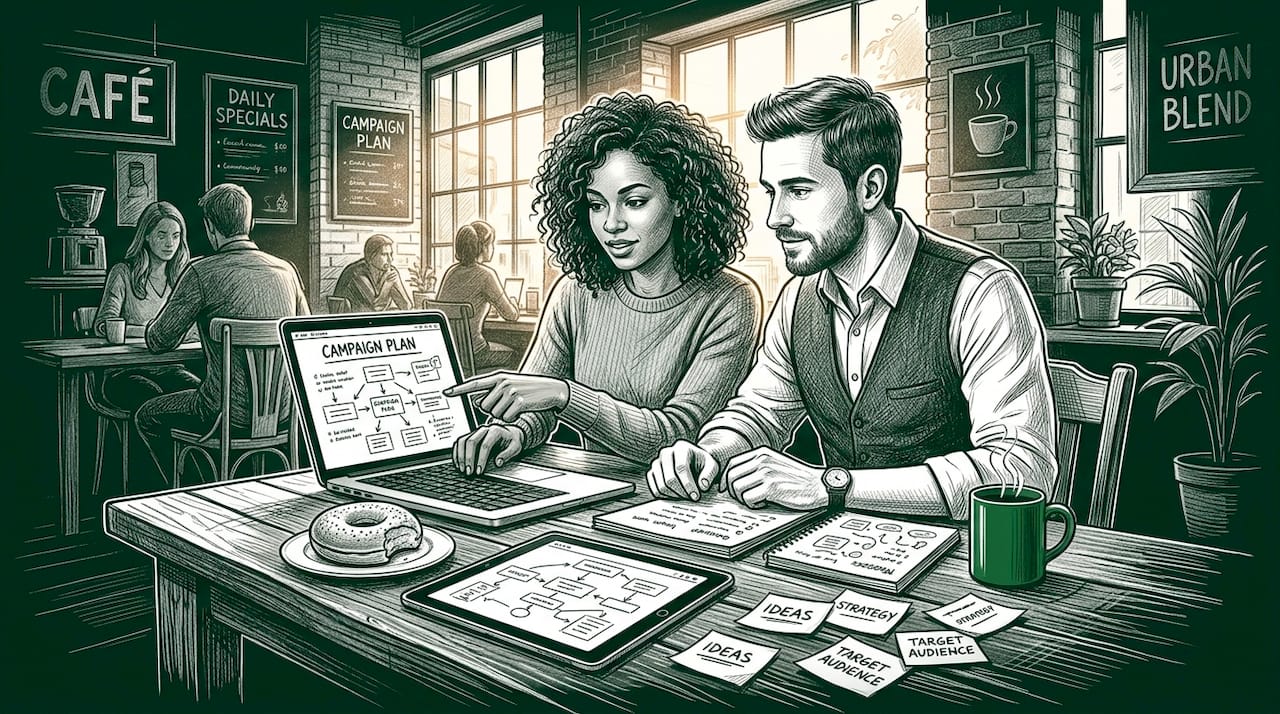
TL;DR:
- Customer acquisition costs have surged by 60% since 2020, prompting brands to focus on long-term lifecycle marketing instead of solely relying on new customer acquisition. Effective DTC strategies involve evolving, data-driven, personalized communication across stages like awareness, engagement, retention, and advocacy, continually updating journeys and integrating loyalty and zero-party data. Measuring full customer journeys and adapting campaigns accordingly are essential to optimize ROI and build sustained brand loyalty.
Customer Acquisition Costs have increased by 60% since 2020, and the brands that keep betting on acquisition alone are slowly losing the margin war. The dtc lifecycle marketing process offers a better path: treat every customer as a long-term asset, not a one-time transaction. This guide walks you through the exact stages, the preparation you need, the execution tactics that move the needle, and the metrics that tell you whether it’s working. If you manage retention, email, or growth for a DTC brand, what follows is worth your full attention.
Table of Contents
- Key takeaways
- Understanding the DTC lifecycle marketing process
- What you need before you start
- Executing lifecycle campaigns step by step
- Measuring success and fixing what breaks
- My take on what actually moves the needle
- Take your lifecycle marketing further with Theemailmarketers
- FAQ
Key takeaways
| Point | Details |
|---|---|
| Lifecycle stages connect | Awareness through advocacy form a continuous loop, not a one-way funnel. |
| Data infrastructure matters first | Unified customer data platforms are the prerequisite for any effective personalization at scale. |
| Post-purchase flows drive revenue | A structured 7-email post-purchase sequence can generate 18-24% of total email revenue. |
| Static journeys underperform | Lifecycle programs must be updated quarterly to reflect shifting customer behavior. |
| Measurement must be unified | Single-channel attribution misleads budget decisions; full-journey analytics reveal true impact. |
Understanding the DTC lifecycle marketing process
Lifecycle marketing in a direct to consumer context means delivering the right message, to the right customer, at the right stage of their relationship with your brand. It is not a campaign. It is an operating system for your customer relationships.
Most brands think in terms of a DTC sales funnel, where customers drop in at the top and ideally convert at the bottom. The lifecycle model is more accurate and more useful. It is circular. A customer who becomes an advocate pulls new customers into the awareness stage, which restarts the loop.
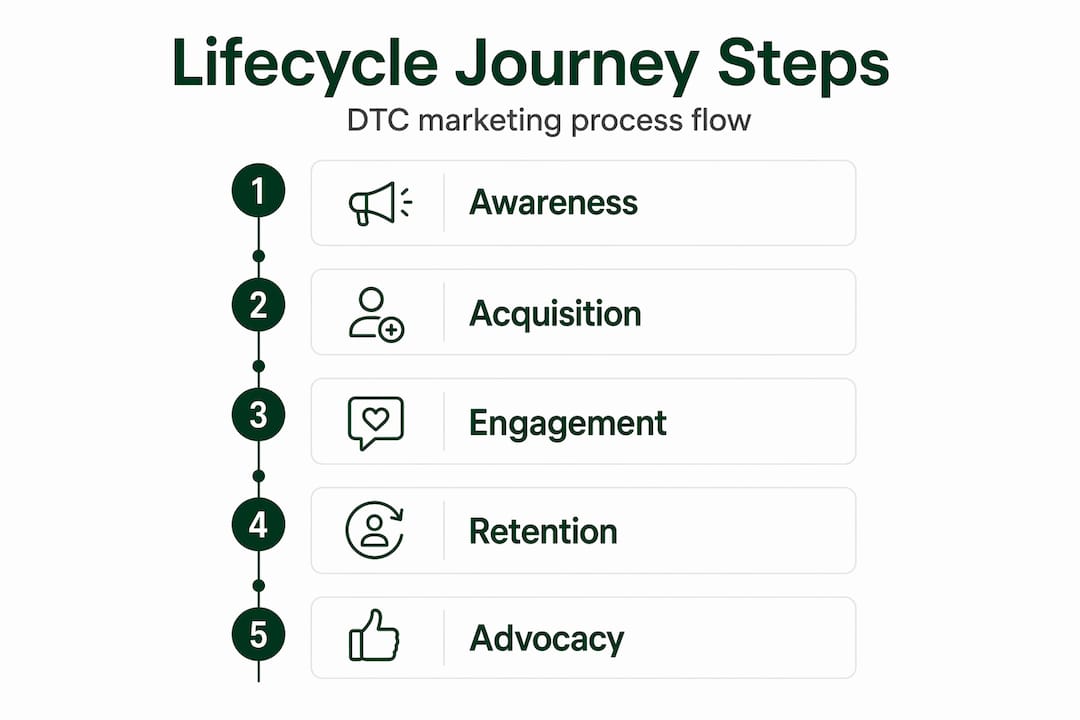
The five core stages of the DTC lifecycle marketing process look like this:
- Awareness: The customer discovers your brand through paid, organic, or social channels.
- Acquisition: They convert, typically on a first purchase or email opt-in.
- Engagement: Post-purchase experiences deepen the relationship and drive repeat behavior.
- Retention: You actively reduce churn and increase purchase frequency through personalized communication.
- Advocacy: Loyal customers refer others, create user-generated content, and publicly champion your brand.
Here is what separates this from a standard product lifecycle view:
| Customer lifecycle | Product lifecycle |
|---|---|
| Tracks the individual’s relationship with the brand | Tracks the market performance of a product |
| Requires adaptive, personalized messaging | Follows predictable introduction, growth, and decline phases |
| Never truly ends if managed correctly | Has a defined endpoint |
| Fueled by behavioral and zero-party data | Fueled by sales and market share data |
What most brands miss is that messaging must evolve as customers move through stages. A first-time buyer needs reassurance and onboarding. A six-month customer needs reasons to reorder. A lapsed customer needs reactivation with a specific incentive. Sending the same promotional email to all three groups is one of the most common and costly mistakes in direct to consumer marketing.
Modern lifecycle journeys also reject the idea of static stages. Lifecycle programs must evolve with customers, adapting to new behaviors and segments over time. A customer who buys once a year is not in the same retention stage as someone who orders monthly, even though both sit in the “retention” bucket.
What you need before you start
Getting the dtc lifecycle marketing process right requires more than good copywriting. The infrastructure has to come first.
Build on unified customer data
On average, companies use 6.3 distinct CX tools, and 81% report that consolidating data into a single system directly improves engagement. If your email platform, SMS tool, loyalty program, and e-commerce data all live in separate silos, you are flying blind. A Customer Data Platform (CDP) pulls these signals together so you can see a complete customer profile before you send a single message.
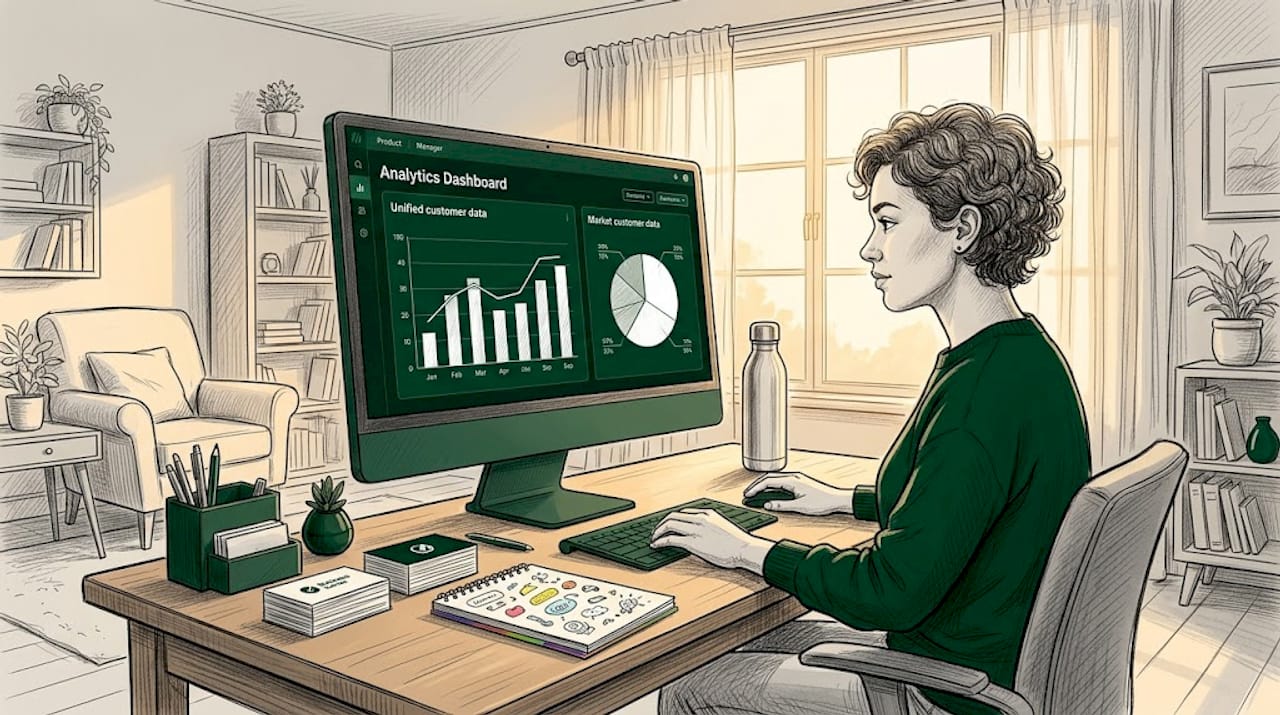
Loyalty programs should be integrated into central customer data platforms rather than managed as standalone silos. This matters because verified loyalty data, including purchase history, points balance, and product preferences, is the fuel that makes personalization credible.
Leverage zero-party data
Zero-party data is information customers give you deliberately: quiz answers, preference surveys, product feedback. This data is more reliable than third-party cookies and more specific than behavioral signals alone. Build collection mechanisms into your onboarding flow and post-purchase experience.
Pro Tip: Run a short preference quiz immediately after the first purchase while engagement is at its peak. Ask about product goals, usage frequency, and communication preferences. This single touchpoint can transform every subsequent lifecycle message.
Align your teams and channels
Here is a practical checklist for preparation:
- Consolidate your CX stack into one analytics view before launching any new lifecycle flows
- Assign clear channel roles: push for urgency, email for value delivery, SMS for time-sensitive updates
- Set shared KPIs across acquisition, retention, and loyalty teams so no team optimizes at another’s expense
- Define your lifecycle stage criteria in data terms (e.g., “engaged” = two purchases within 90 days)
- Map your current automation gaps by auditing which stages receive zero automated communication
| Channel | Primary role in lifecycle | Ideal stage |
|---|---|---|
| Value delivery, education, offers | Acquisition, retention, advocacy | |
| SMS | Timely updates, urgency triggers | Engagement, retention |
| Push notifications | Urgency, real-time re-engagement | Retention, reactivation |
Executing lifecycle campaigns step by step
With your data infrastructure in place, you can build campaigns that actually reflect where each customer is in their relationship with your brand. Here is how to do it with precision.
Step 1: Map stage-specific messaging
Write out what each lifecycle stage needs to feel like from the customer’s perspective. A new buyer needs to feel confident in their purchase. A repeat buyer needs to feel recognized. A lapsed customer needs to feel like coming back is worth the effort. Every automation you build should start with that emotional brief.
Step 2: Build the post-purchase email flow
This is where most DTC brands leave serious money on the table. Structured 7-email post-purchase sequences drive 18-24% of total email revenue. The sequence typically moves from order confirmation to shipping update, product education, review request, complementary product recommendation, loyalty program introduction, and finally a replenishment reminder timed to product usage cycles.
Step 3: Segment with precision
Do not rely on demographic segments alone. Behavioral triggers produce far better results. Use advanced email segmentation strategies that activate based on:
- Days since last purchase
- Category affinity (what product lines a customer gravitates toward)
- Engagement level with previous emails (opens, clicks, time spent)
- Loyalty tier or points threshold
Step 4: Inject personalization that goes beyond a first name
True personalization adjusts product recommendations and messaging tone using verified identity data, not just name placeholders. If a customer has identified as a competitive athlete through a quiz, every email in their lifecycle flow should reflect that context, from product selection to language to imagery.
Step 5: Make communication two-way
Effective engagement requires audience-centric, responsive communication rather than one-way promotional blasts. Ask questions. Invite replies. Use post-purchase surveys that feel like a conversation, not a form. This produces qualitative data you cannot get from click rates alone, and it builds the kind of relationship that leads to advocacy.
Email design best practices can reinforce this two-way dynamic. Simple design choices, like including a visible reply prompt or a preference update link, signal that you are listening.
Step 6: Integrate user-generated content
User-generated content closes the loop between advocacy and acquisition. When you feature a real customer photo or review in a retention email, you accomplish two things simultaneously: you validate the purchase decision for existing customers and you create social proof that acquired customers can share externally.
Pro Tip: Build a UGC request into your email flow at day 14 post-purchase, when product satisfaction is high but the novelty has not worn off. Incentivize with loyalty points, not discounts. Discount-trained customers optimize for deals; loyalty-trained customers optimize for relationship.
Multi-channel orchestration assigns specific roles to each channel, and this principle applies to your UGC strategy too. Collect reviews via email, amplify them via SMS with a link, and use push notifications to alert customers when their review earns a reward.
Measuring success and fixing what breaks
Execution without measurement is just guessing with extra steps. The verification phase of your dtc lifecycle marketing process requires a clear framework for what to track and when.
The single biggest mistake brands make here is relying on last-click or single-channel attribution. Single-channel attribution misleads budget allocation because customers interact across push, email, SMS, and paid media before converting. Unified analytics that trace the full customer journey give you a far more accurate picture of which touchpoints actually drive incremental revenue.
Pro Tip: Set up a holdout group for each major lifecycle flow. A 10% holdout that receives no automation lets you measure the true incremental lift of your campaigns rather than crediting automation for purchases that would have happened anyway.
Key metrics to track at each stage:
- Acquisition: Cost per acquired customer, email opt-in rate, first-purchase conversion rate
- Engagement: Open rate, click-to-purchase rate, time to second purchase
- Retention: Repeat purchase rate, churn rate, customer lifetime value against CAC
- Advocacy: Referral rate, UGC submission rate, net promoter score
Common failure patterns also need to be on your radar. Frozen journeys are the most frequent culprit: a lifecycle flow built in 2023 that has never been updated despite three product launches and two major market shifts. Updating lifecycle journeys quarterly aligned with behavioral shifts and seasonal trends drives measurably higher engagement. Set a calendar reminder. Treat it like a financial quarter close.
Siloed loyalty programs are the second biggest problem. When loyalty data does not feed back into your email and SMS platforms, you send irrelevant messages to customers whose status you do not actually know. A platinum-tier customer receiving a “first-time buyer discount” is a relationship-damaging error, not just a missed opportunity.
AI and predictive analytics are now practical tools for solving both problems. Churn prediction models can flag at-risk customers before they go quiet, giving you a window to reactivate with a well-timed offer. You can also find resources on proven retention strategies that pair well with predictive modeling.
My take on what actually moves the needle
I have spent years watching DTC brands build what they call lifecycle marketing programs that are actually just promotional calendars with nicer segmentation. Here is what I have learned: the brands that win are the ones that treat lifecycle marketing as a listening system, not a sending system.
The biggest misconception I see is that more automation equals better lifecycle marketing. It does not. What matters is whether your automation reflects where each customer actually is, not where your flow diagram assumes they should be. A customer who bought five times in six months and then went quiet is not the same as a customer who never came back after their first purchase. Same “lapsed” label. Completely different reasons. Completely different responses needed.
The brands I have seen get this right do three things consistently. They integrate loyalty data into every communication so every message is informed by what that customer has actually done and earned. They measure incrementality, not just revenue totals, so they know what their lifecycle program is truly responsible for. And they build in two-way communication at every stage, which gives them qualitative signals that no open rate can provide.
The uncomfortable truth is that most lifecycle programs are built for the brand’s convenience, not the customer’s journey. Fix that inversion, and the results follow.
— Melanie
Take your lifecycle marketing further with Theemailmarketers
Understanding the dtc lifecycle marketing process is one thing. Building, automating, and continuously optimizing it at scale is another. That is exactly where Theemailmarketers comes in.
Theemailmarketers works with 8-figure DTC brands, VC-backed e-commerce companies, and subscription retailers to build retention programs that compound over time. Through the Retention Lab, the team tests and refines lifecycle flows using real behavioral data, identifying exactly where customers drop off and what messaging brings them back. The Retention Toolkit provides ready-to-deploy templates and frameworks so your team can move fast without starting from scratch.
For brands that want to see what results-driven lifecycle marketing looks like in practice, the client case studies show the specific strategies and revenue outcomes across industries. If you are ready to stop guessing and start scaling, visit theemailmarketers.com to explore what a real retention partnership looks like.
FAQ
What are the stages of the DTC lifecycle marketing process?
The core stages are awareness, acquisition, engagement, retention, and advocacy. These stages form a continuous loop rather than a one-directional funnel, with advocacy feeding back into awareness for new customers.
How much revenue can post-purchase email flows generate?
Structured 7-email post-purchase sequences drive 18-24% of total email revenue for DTC brands, making them one of the highest-return automation investments available.
How often should lifecycle journeys be updated?
Lifecycle journeys should be reviewed and updated at minimum on a quarterly basis to reflect shifts in customer behavior, seasonal trends, and product catalog changes.
What data do I need to personalize lifecycle marketing effectively?
You need unified customer data combining purchase history, behavioral signals, loyalty status, and zero-party data such as quiz answers and stated preferences. A CDP that consolidates these sources is the most reliable foundation.
What is the biggest mistake in DTC lifecycle marketing?
The most damaging mistake is running static, frozen journeys that were built once and never updated. Combined with siloed loyalty data and single-channel attribution, static journeys cause brands to send irrelevant messages and misallocate marketing spend.


