.png)


Benefits of Email Marketing for Business Growth in 2026

TL;DR:
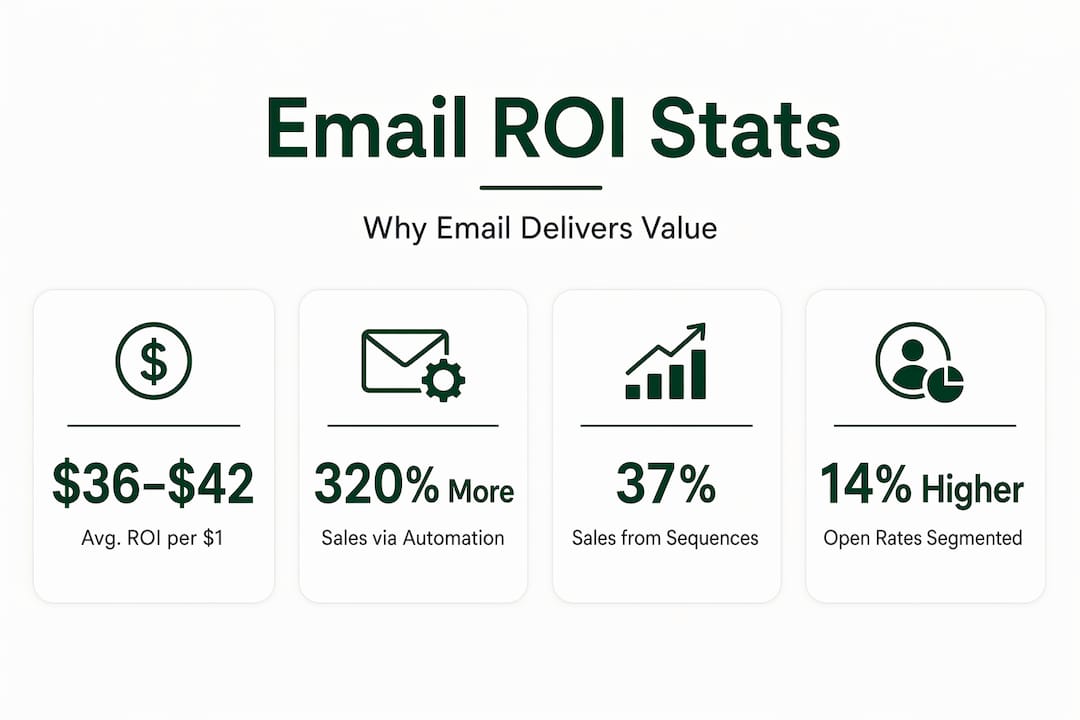
- Email consistently offers unmatched ROI, generating $36–$42 per dollar spent and outperforming paid channels.
- Personalization, segmentation, and automation significantly amplify email revenue and engagement, especially when integrated.
- Maintaining compliance and list hygiene improves deliverability, fosters trust, and stabilizes long-term customer relationships.
Email is the channel that keeps outperforming everything else, and most businesses are still not using it to its full potential. The core benefits of email marketing come down to one undeniable fact: no other digital channel consistently returns $36 to $42 for every dollar spent, with top performers clearing $70. And yet, many marketing teams are still treating email as an afterthought while pouring budget into paid ads and social media. This guide breaks down exactly why email deserves the top spot in your strategy and how to make it work harder starting now.
Table of Contents
- Key takeaways
- The real benefits of email marketing: ROI and cost-effectiveness
- Personalization, segmentation, and AI
- Compliance and list hygiene as performance drivers
- Email’s strategic role in customer engagement and brand loyalty
- Practical steps to unlock email marketing benefits
- My honest take on email marketing in 2026
- How The Email Marketers can help you grow faster
- FAQ
Key takeaways
| Point | Details |
|---|---|
| Unmatched ROI | Email consistently returns $36–$42 per dollar spent, outperforming paid search and social media. |
| Personalization multiplies results | Segmented, behavior-based emails can increase revenue by up to 760% versus generic blasts. |
| Compliance builds performance | GDPR and CAN-SPAM compliance improve deliverability, reduce spam complaints, and build subscriber trust. |
| Automation does the heavy lifting | Automated sequences generate 37% of all email revenue while accounting for just 2% of send volume. |
| Email is an owned asset | Unlike social media, your email list belongs to you and cannot be taken away by an algorithm change. |
The real benefits of email marketing: ROI and cost-effectiveness
No other marketing channel delivers returns at this scale with this level of cost control. The average marketing professional can send thousands of emails for pennies per message, and the math is almost unfair compared to paid acquisition channels.
The core reason the ROI is so high is the near-zero marginal cost per additional email sent. Once you have your content, your list, and your platform in place, scaling from 1,000 sends to 100,000 sends does not cost 100x more. Paid search and social media, by contrast, charge you for every single impression or click. That cost structure makes email uniquely profitable as your list grows.
| Channel | Average ROI per $1 spent |
|---|---|
| Email marketing | $36–$42 (top performers: $70+) |
| Paid search (PPC) | ~$2–$4 |
| Social media advertising | ~$2.50–$5 |
| Display advertising | ~$2 |
E-commerce brands tend to sit at the top end of that range. E-commerce email ROI frequently exceeds $45 per dollar, and 18% of companies report returns above $70. The difference between average and top-tier results almost always comes down to two things: automation and segmentation.
Automated email sequences generate 37% of all email sales while making up just 2% of total send volume, driving 320% more revenue than non-automated sends. That ratio is the clearest argument for investing in proper automation infrastructure. A well-built welcome series or abandoned cart flow works while your team sleeps.
Pro Tip: Before investing in new tools, audit your existing automation flows. Most brands have gaps between their welcome series and their first promotional email. Filling that gap with a three-step educational sequence alone can meaningfully move your revenue numbers.
Personalization, segmentation, and AI
Generic email blasts are not just ineffective, they actively damage your sender reputation and train subscribers to ignore you. The effectiveness of email campaigns today is directly tied to how well you use the data you already have.
Segmented email campaigns produce 14% higher open rates and 100% higher click-through rates compared to unsegmented sends. Personalization at the transaction level lifts conversion rates by 6x. These are not marginal gains. They represent the difference between a channel that breaks even and one that funds your entire growth strategy.
Here is what separates surface-level personalization from the kind that actually moves revenue:
- First-party behavioral data: Triggering emails based on what someone browsed, purchased, or abandoned is far more powerful than using their first name in a subject line.
- Contextual relevance: Showing a repeat buyer product recommendations based on their purchase history, rather than your bestsellers catalog, creates a noticeably different experience.
- Send-time optimization: AI-driven tools now identify the exact hour each subscriber is most likely to open, lifting open rates without changing a word of copy.
- Dynamic content blocks: A single email template can display different products, offers, or messaging to different segments simultaneously, cutting production time while increasing relevance.
Full AI workflow integration, combining segmentation with content personalization and send-time optimization, produces a 41% revenue increase over manual programs. Isolated AI features alone yield 8 to 14%. The compounding effect only kicks in when all three components work together.
If you want a practical framework for implementing this, the email personalization guide from The Email Marketers walks through exactly how to build contextual content strategies for e-commerce.
Pro Tip: Start segmenting by purchase frequency before you tackle anything more complex. Separating first-time buyers from repeat customers and lapsed buyers gives you three distinct audiences with very different needs, and that alone can double your campaign engagement.
Compliance and list hygiene as performance drivers
Most marketers treat compliance as a legal checkbox. The ones generating the best ROI treat it as a deliverability strategy.
GDPR and CAN-SPAM are not just about avoiding fines. They force you to build a cleaner, more engaged list. When you require explicit opt-in, suppress inactive contacts regularly, and honor every unsubscribe request immediately, you are also improving your sender reputation with every major inbox provider. Compliant senders consistently see higher inbox placement and lower spam complaint rates.
Here is the authentication foundation every sender needs before worrying about anything else:
- SPF (Sender Policy Framework): Authorizes which servers can send email on your domain’s behalf.
- DKIM (DomainKeys Identified Mail): Adds a cryptographic signature that verifies your messages have not been tampered with.
- DMARC (Domain-based Message Authentication): Tells receiving servers what to do when SPF or DKIM checks fail, and sends you reports on authentication results.
Authentication failures cause emails to be filtered as spam regardless of content quality. You can write the best email of your career and it will never reach the inbox if your domain authentication is broken.
List hygiene has a direct, measurable impact on performance. Removing inactive contacts who have not engaged in 120 days raises average open rates by 20 to 30%. Beyond the open rate boost, a cleaner list also reduces your sending costs on most platforms, since most providers charge by contact count.
56% of marketers reported improved data quality and stronger subscriber trust after GDPR implementation, according to marketing survey data. Regulation, done right, becomes a competitive advantage.
Failing to honor unsubscribe requests creates compounding problems. Deliverability drops, legal exposure rises, and your list fills with disengaged contacts who drag down every metric you care about. Understanding CAN-SPAM requirements is non-negotiable for any business sending commercial email to U.S. subscribers.
Email’s strategic role in customer engagement and brand loyalty
Social media reach is borrowed. Email reach is owned. That distinction matters more than most marketers realize until the day an algorithm change cuts their organic reach by 70%.

Your email list is a transferable, platform-agnostic asset. An email list belongs to you in a way that your Instagram following never will. No platform can take it from you, restrict your access, or charge you to reach it. That ownership is the foundation of every long-term customer engagement strategy that actually works.
The email list growth benefits extend far beyond the size of the list itself. Consider what you can actually do with that owned audience:
- Retention sequences: Automated post-purchase flows that guide new customers through product education reduce returns and increase lifetime value.
- Re-engagement campaigns: A well-timed win-back sequence, sent to subscribers who have not opened in 90 days, consistently recovers 5 to 15% of otherwise lost contacts.
- Surveys and feedback loops: Asking customers what they want creates both data and a sense of being heard. Brands that run regular feedback emails see measurable lifts in repeat purchase rates.
- Exclusive promotions: Early access offers and subscriber-only discounts make being on your list feel valuable, which reduces unsubscribes and builds emotional loyalty.
- Community building: A consistent email presence keeps your brand top-of-mind between purchases in a way that paid ads, which disappear the moment you stop funding them, simply cannot replicate.
Improving customer engagement through email also feeds your other channels. Subscribers who trust your emails are more likely to follow you on social, refer friends, and leave reviews. Email is often the quiet engine behind word-of-mouth growth that brands mistakenly attribute to their social content.
Explore how customer retention strategies through email compare to other methods and why the compounding effect of owned channels outperforms paid acquisition over a 12-month window.
Practical steps to unlock email marketing benefits
Knowing the benefits is one thing. Building a program that actually captures them requires deliberate infrastructure decisions.
- Invest in the right people first. Tools are only as good as the strategy behind them. A skilled email strategist or a specialized agency will consistently outperform a junior marketer with an expensive platform.
- Build your first-party data infrastructure. Connect your e-commerce platform, CRM, and email service provider so behavioral data flows automatically. Manual data imports kill your ability to trigger relevant, timely messages.
- Prioritize automation before scale. Set up your core flows (welcome, abandoned cart, post-purchase, win-back) before growing your list aggressively. Sending unengaged subscribers into a broken flow wastes every dollar spent on list growth.
- Test systematically. Run A/B tests on subject lines, send times, and offer structures. Document what you learn. Over six months, this compounds into a significant performance edge over competitors who rely on gut instinct.
- Monitor deliverability metrics weekly. Watch bounce rates, spam complaint rates, and open rates by segment. Deliverability problems are far easier to fix early than after a sending reputation has been damaged.
Pro Tip: Email frequency is one of the highest-leverage variables most brands ignore. Sending too often accelerates list fatigue and unsubscribes. Review your email cadence and design strategy at least quarterly to find the frequency sweet spot for each segment.
Balancing frequency is not just about reducing complaints. It is about maximizing the attention of the subscribers you have worked hard to acquire. Over-sending to your most valuable customers is one of the fastest ways to burn the asset you spent months building.
My honest take on email marketing in 2026
I have worked with enough brands to say this without hesitation: email marketing for businesses that do it well is still the single most direct and profitable digital channel available. Not because it is flashy, but because it is direct.
What I see trip up most teams is the gap between knowing personalization matters and actually building the infrastructure to deliver it. Everyone says they personalize. Very few have connected their purchase data to their email platform in a way that actually changes what a subscriber receives. That gap is where the 41% revenue lift lives, and most brands leave it on the table entirely.
The compliance piece is where I push back the hardest on clients who see it as overhead. I have watched brands with messy lists, broken authentication, and ignored unsubscribes spend months trying to diagnose why their open rates are declining. The answer is almost always deliverability. Fix your authentication, clean your list, honor every opt-out immediately, and your numbers will improve before you change a single word of copy.
AI accelerates all of this, but only when the data underneath it is clean. Garbage in, garbage out applies to machine learning more than anywhere else in marketing. My recommendation is to prioritize data quality and list hygiene before layering in AI-powered features. The sequence matters.
The 2025 email optimization guide from The Email Marketers is the closest thing I have seen to a practical roadmap for e-commerce brands that want to close the gap between strategy and execution.
— Melanie
How The Email Marketers can help you grow faster
If you have read this far, you already understand the opportunity. The question is whether you have the team and infrastructure to capture it.
The Email Marketers is a retention marketing agency built specifically for e-commerce brands that are serious about maximizing customer lifetime value. From automated flow architecture to AI-driven segmentation and compliance-first list strategy, the team builds systems that generate compounding returns over time.
Explore the client success stories to see what measurable ROI looks like in practice across different verticals. If you want to go deeper on retention strategy, the Retention Lab offers specialized frameworks designed for high-growth DTC brands. For a practical starting point, the retention toolkit gives you the resources to improve repeat purchase rates without starting from scratch.
The brands generating $70 per dollar from email are not lucky. They have a system. The Email Marketers builds that system.
FAQ
What is the average ROI of email marketing?
Email marketing delivers an average return of $36 to $42 for every $1 spent, with top-performing e-commerce brands exceeding $70 per dollar according to 2026 ROI data.
How does segmentation improve email campaign performance?
Segmented campaigns produce 14% higher open rates and 100% higher click-through rates compared to unsegmented sends, and can increase revenue by up to 760% when combined with behavioral targeting.
Why does list hygiene matter for email marketing?
Removing inactive subscribers improves open rates by 20 to 30% and protects your sender reputation, which directly determines how many of your emails actually reach the inbox.
What makes email different from social media marketing?
Your email list is an owned asset that no platform algorithm can restrict or remove. Social media reach is rented and subject to constant policy and algorithm changes beyond your control.
How does compliance help email marketing performance?
GDPR and CAN-SPAM compliance reduce spam complaints, improve deliverability, and build subscriber trust. Surveys show 56% of marketers saw better data quality and stronger engagement after GDPR implementation.


