.png)


What Is an Email Marketing Flow? 2026 Guide

TL;DR:
- Email marketing flows are automated, behavior-triggered sequences that respond in real time to customer actions like cart abandonment or sign-up. They differ from campaigns by timing, personalization, and lifecycle focus, and are essential for effective retention strategies. Building and optimizing these flows continuously enhances customer engagement and long-term revenue.
An email marketing flow is an automated sequence of emails or SMS messages triggered by specific customer actions, such as subscribing to a list, abandoning a cart, or completing a purchase. In the industry, this is also called a triggered email sequence or automated journey. Platforms like Klaviyo, Mailchimp, and Pushwoosh build their entire automation architecture around this concept. Understanding what an email marketing flow does, and how to build one correctly, separates brands that retain customers from brands that lose them after the first sale.
What is an email marketing flow and how does it work?
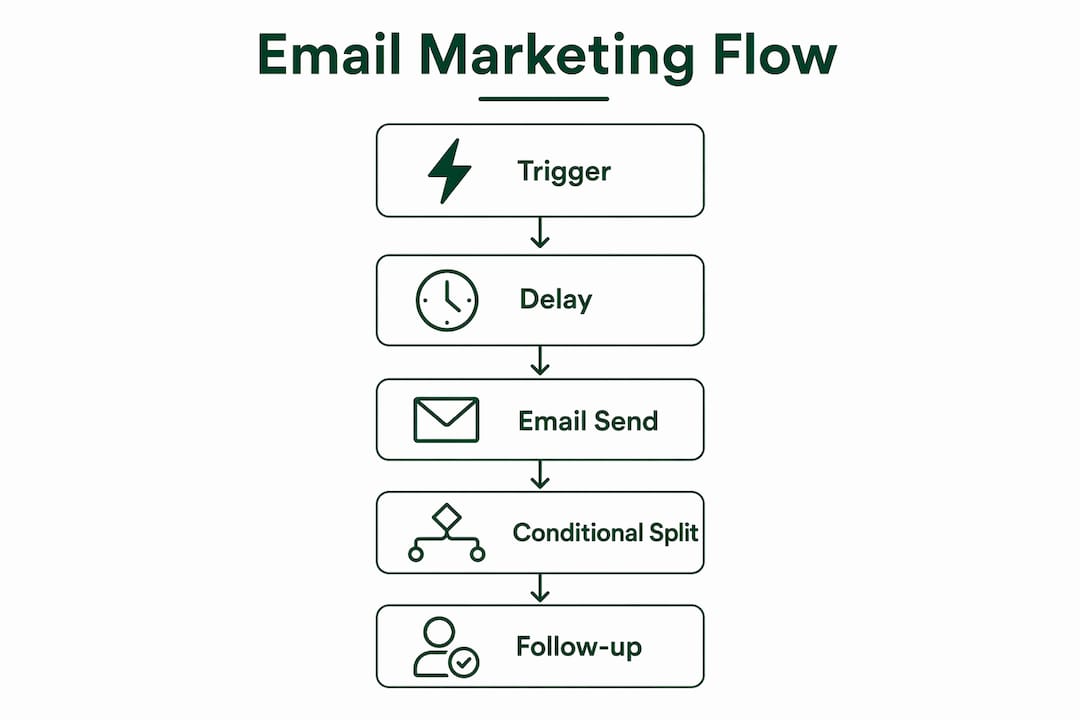
An email marketing flow is, at its core, a set of rules: if a customer does X, send email Y after Z hours. Klaviyo defines flows as sequences of automated email or SMS actions triggered by customer events, with time delays and conditional logic built in at every step. That definition matters because it tells you exactly what separates a flow from a newsletter blast. The flow reacts. The blast ignores.
Every flow starts with a trigger event. Common triggers include:
- A new subscriber joining your list
- A shopper viewing a product but not buying
- A customer abandoning their cart
- A completed purchase
- A lapse in purchase activity over 90 or 120 days
After the trigger fires, the flow executes a sequence of emails with pre-set time delays. A classic abandoned cart flow might send the first email one hour after abandonment, a second with social proof 24 hours later, and a third with a discount offer at the 48-hour mark. Pushwoosh describes this process as capturing user actions in real time, applying segmentation and personalization rules, then sending automatically without any manual intervention.
The most powerful flows also include conditional splits, which are branching logic points that route subscribers differently based on their behavior. If a subscriber opens email one but does not click, they receive a different follow-up than someone who clicked but did not convert. This is what makes flows feel personal at scale.
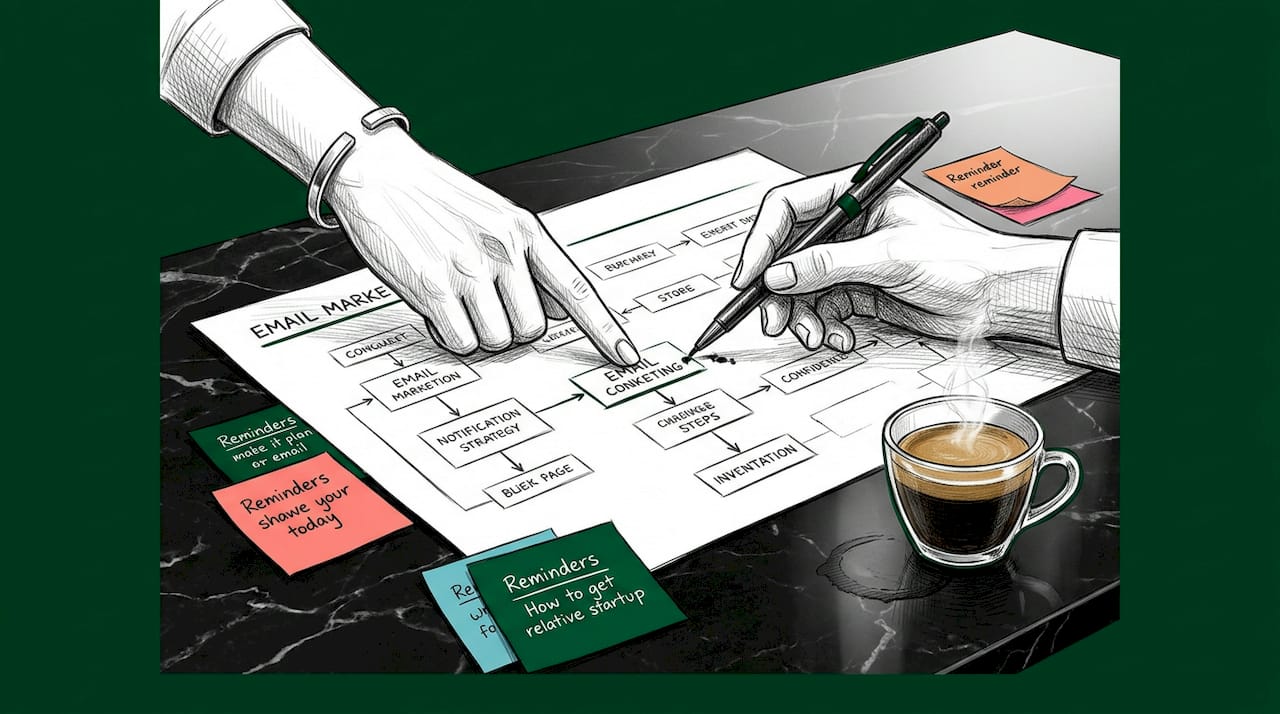
Pro Tip: Before building any flow, map the customer behavior you want to respond to on paper first. Trying to configure logic inside Klaviyo or Mailchimp without a clear decision tree leads to tangled sequences that are nearly impossible to audit later.
How email flows differ from campaigns and transactional emails
The distinction between flows and campaigns is not just technical. It changes how you think about your entire email marketing strategy.
| Dimension | Email flows | Email campaigns |
|---|---|---|
| Trigger | Customer behavior or lifecycle event | Manual send or scheduled date |
| Timing | Real time, automatic | Fixed calendar date |
| Audience | Dynamically filtered by behavior | Static segment at send time |
| Frequency | Continuous, always-on | One-time or recurring blast |
| Personalization | High, based on individual actions | Moderate, based on segment |
Triggered flows fire in real time responding to customer behavior, while batch emails follow a fixed schedule regardless of what the customer has done. That timing difference is the entire competitive advantage. A customer who abandons a cart is most persuadable in the first two hours. A campaign scheduled for next Tuesday misses that window entirely.
Transactional emails sit in a third category. Order confirmations, shipping notifications, and password resets are transactional. They are compliance-driven, not marketing-driven, and misclassifying journey types as marketing when they are transactional creates deliverability and legal compliance problems. Marketing flows must include unsubscribe options and follow CAN-SPAM or GDPR rules. Transactional emails operate under different legal standards.
The practical takeaway: use campaigns for promotions, product launches, and seasonal events. Use flows for every moment where customer behavior should trigger a response. Use transactional emails only for functional, non-promotional communication.
How email flows map to the customer lifecycle
CleverTap explains email funnels as lifecycle-based sequences that continuously move users from awareness through retention. That framing is the right one. Every flow you build should map to a specific stage in the customer journey, with a specific goal attached to it.
| Lifecycle stage | Flow type | Primary KPI |
|---|---|---|
| Awareness | Welcome series | List engagement rate |
| Consideration | Browse abandonment | Click-through rate |
| Conversion | Cart abandonment | Purchase conversion rate |
| Retention | Post-purchase series | Repeat purchase rate |
| Loyalty | VIP or win-back flow | Customer lifetime value |
The welcome series is the highest-leverage flow most brands underinvest in. A subscriber is most engaged in the first 48 hours after joining your list. A three-to-five email welcome sequence that introduces your brand story, bestsellers, and proof points sets the tone for every future interaction. Brands that skip this leave money on the table immediately.
Browse and cart abandonment flows target the consideration and conversion stages. Triggered flows tied to purchase intent achieve notably higher conversion rates than batch emails because they reach customers while intent is still active. Post-purchase flows shift the goal from conversion to retention, delivering onboarding content, cross-sell recommendations, and review requests that build loyalty over time.
Win-back flows target customers who have gone silent, typically 90 to 180 days without a purchase. These flows use a different tone, often acknowledging the gap and offering a reason to return. The lifecycle email marketing approach treats each of these flows as a connected system, not a collection of isolated automations.
Pro Tip: Assign one primary KPI to each flow before you build it. If your cart abandonment flow is trying to recover revenue AND collect reviews AND promote a loyalty program, it will do none of those things well. One flow, one goal.
Best practices for building effective email marketing flows
Building a flow that works in month one is straightforward. Building one that still performs in month twelve requires deliberate architecture from the start.
-
Define your flow type before you build. Decide upfront whether the flow is transactional, single-send, or multi-step marketing. This determines your legal requirements, sending infrastructure, and content rules. Mixing these up creates compliance risk and deliverability damage.
-
Set entry filters that prevent overlap. When multiple flows can trigger on similar behaviors, subscribers can receive conflicting messages simultaneously. Klaviyo’s guidance on overlapping flows recommends using smart entry conditions and sending limits to prevent a customer from being enrolled in a cart abandonment flow and a browse abandonment flow at the same time.
-
Configure exit criteria and re-entry rules. A customer who converts should exit the cart abandonment flow immediately. A new subscriber who completes onboarding should not re-enter the welcome series six months later. Properly configured re-entry rules prevent redundant messaging and reduce unsubscribe risk significantly.
-
Use segmentation inside flows, not just at entry. Conditional splits within a flow let you serve different content to different subscriber types. A first-time buyer and a lapsed customer who both trigger a post-purchase flow should not receive identical emails. Segmentation at the flow level is one of the most underused tactics in email segmentation strategies.
-
Monitor and iterate on a fixed schedule. Pull flow performance data monthly. Look at open rate, click rate, conversion rate, and unsubscribe rate by email position within the flow. If email three in a five-email sequence has a 40% drop-off in opens, that email is the problem. Fix it before optimizing anything else.
A marketing automation checklist can help you audit each of these elements systematically before launching a new flow. The brands that treat flow optimization as an ongoing process, not a one-time setup, consistently outperform those that set flows live and forget them.
Pro Tip: Review your flows every time your product catalog, pricing structure, or brand positioning changes. Flows referencing discontinued products or outdated offers actively damage trust with customers who notice the inconsistency.
Key takeaways
Effective email marketing flows require trigger precision, lifecycle alignment, and continuous optimization to drive measurable retention results.
| Point | Details |
|---|---|
| Flows are behavior-triggered | Every flow starts with a customer action, not a calendar date, making timing and relevance automatic. |
| Flows differ from campaigns | Campaigns are scheduled blasts; flows respond in real time to individual customer behavior. |
| Lifecycle alignment is required | Map each flow to a specific stage: welcome, abandonment, post-purchase, or win-back. |
| Exit and re-entry rules matter | Configure these settings upfront to prevent subscriber fatigue and redundant messaging. |
| Segmentation inside flows | Use conditional splits within flows to serve different content based on individual behavior. |
Why flows are the most underestimated retention tool in e-commerce
I have reviewed email programs for dozens of DTC brands, and the pattern is almost always the same. The brand has a welcome flow, maybe a cart abandonment flow, and a promotional calendar. That is it. The flows were set up two years ago by a contractor, nobody has touched them since, and the brand is leaving a significant share of retention revenue uncollected every single month.
The mistake is treating flows as infrastructure rather than strategy. Flows are not a set-it-and-forget-it system. They are the most direct expression of how well you understand your customer’s behavior. When a post-purchase flow sends a cross-sell recommendation for a product the customer already owns, that is not a minor glitch. It tells the customer you are not paying attention.
What I have found actually works is building flows in layers. Start with the highest-intent triggers: cart abandonment and welcome. Get those performing well before adding browse abandonment, post-purchase, and win-back. Brands that try to build eight flows simultaneously almost always end up with eight mediocre flows instead of three excellent ones.
The future of flow automation is tighter integration between email, SMS, and on-site behavior data. Platforms like Klaviyo are already moving toward real-time predictive triggers that fire based on purchase probability scores rather than simple behavioral events. That shift will reward brands that have clean data, well-structured flows, and a clear lifecycle strategy. The brands still sending weekly blasts to their entire list will fall further behind.
If you want to see what a mature flow architecture looks like in practice, the best email flows for engagement are a strong starting point for benchmarking your current setup.
— Melanie
Build flows that actually retain customers
Theemailmarketers builds automated email and SMS flows for 8-figure DTC brands, VC-backed companies, and growth-focused retailers who need retention marketing that performs. Our team designs, segments, and optimizes every flow from welcome series to win-back, using real behavioral data to drive repeat purchases and lifetime value. If your current flows were set up once and never revisited, you are losing revenue every day. Explore the Retention Lab to see how we architect flows that compound over time, or browse the Retention Toolkit for structured resources you can apply immediately. For proof of results, the case study library shows exactly what optimized flows deliver.
FAQ
What is an email marketing flow in simple terms?
An email marketing flow is an automated sequence of emails sent to a customer based on a specific action they take, such as signing up, browsing a product, or abandoning a cart. Platforms like Klaviyo and Mailchimp manage the timing, logic, and personalization automatically.
How is an email flow different from an email drip campaign?
An email drip campaign typically refers to a time-based sequence sent to all subscribers on a fixed schedule, while an email flow is triggered by individual customer behavior in real time. Flows are more dynamic and personalized because they respond to what each customer actually does.
How many emails should an email marketing flow contain?
The number depends on the flow type and lifecycle stage. A welcome series typically runs three to five emails over seven to ten days, while a cart abandonment flow performs well with two to three emails sent within 48 hours of the trigger event.
What triggers an email marketing flow?
Common triggers include subscribing to a list, viewing a product page, adding items to a cart without purchasing, completing a purchase, or going inactive for a defined period. Klaviyo’s flow architecture supports both event-based and date-based triggers with conditional logic at each step.
What tools are used to build email marketing flows?
Klaviyo, Mailchimp, and Pushwoosh are among the most widely used platforms for building email marketing flows. Klaviyo is the dominant choice for e-commerce brands due to its deep integration with Shopify and its behavioral segmentation capabilities.


