.png)


The Essential SMS Marketing Guide for Health Brands

TL;DR:
- Effective SMS retention in health brands relies on timely, personalized messages that build trust and foster long-term relationships. Compliance with HIPAA and TCPA is essential, requiring explicit consent, clear disclosures, and strict data privacy practices. Combining SMS with email through an omnichannel approach maximizes engagement, loyalty, and repeat purchases over time.
Even the most loyal health and wellness shoppers will drift away if you fail to reach them at the right moment with the right message. Acquiring customers is expensive, and with rising paid media costs squeezing DTC margins across the board, retention is where health brands win or lose. SMS marketing sits at the center of this challenge: it is immediate, personal, and remarkably effective when approached with strategy. This guide gives you a practical, step-by-step blueprint for building an SMS retention program that keeps health shoppers coming back, spending more, and telling their friends.
Table of Contents
- Why SMS retention matters for health brands
- Setting up SMS for compliance and trust
- Building your retention SMS playbook: Segmentation, automation, and moments that matter
- Nailing the timing and frequency: Keeping subscribers, not losing them
- Testing and benchmarking: Proving retention impact and optimizing
- What most health brands miss in SMS retention (and how to get it right)
- Take your health brand’s retention to the next level
- Frequently asked questions
Key Takeaways
| Point | Details |
|---|---|
| Retention-first SMS strategy | Treat SMS as a relationship channel powered by segmentation, automation, and lifecycle flows. |
| Compliance is critical | Separate service from marketing, get explicit opt-ins for promos, and always protect privacy. |
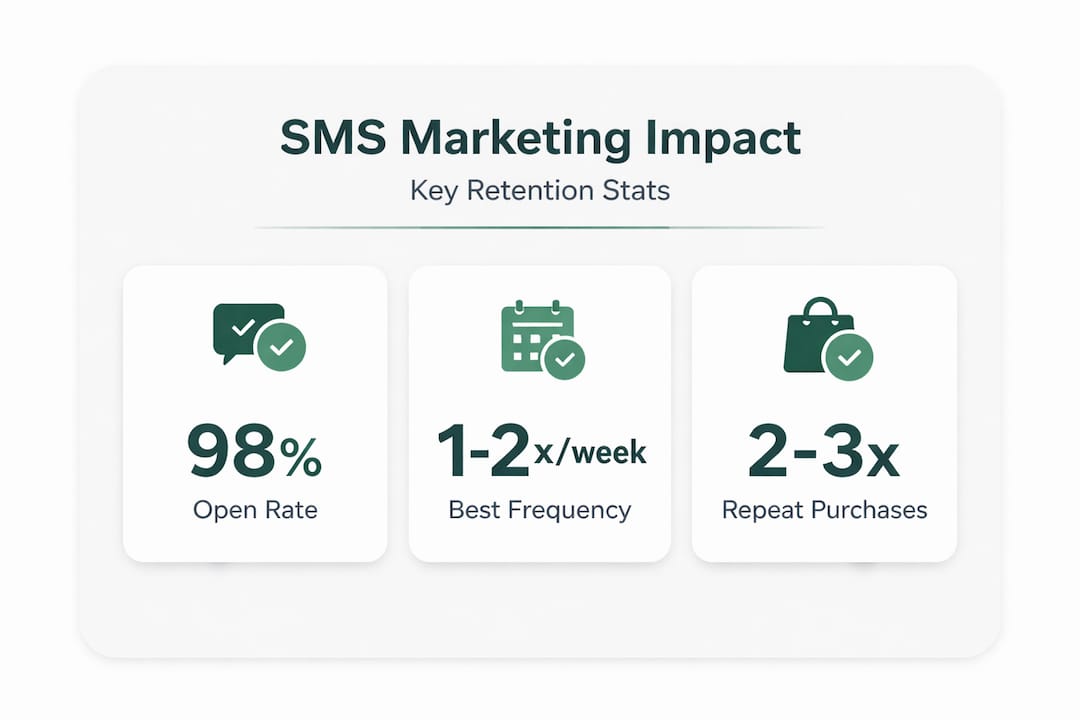
| Optimize timing and cadence | Send messages 1–2 times per week, prioritizing optimal windows to avoid list fatigue and maximize revenue. |
| Track, test, refine | Benchmark performance and A/B test flows to continuously improve SMS retention impact. |
| Go omnichannel | Integrate SMS with email and other channels for the strongest customer retention results. |
Why SMS retention matters for health brands
Health and wellness is a repeat-purchase category by nature. Supplements run out. Skincare routines need restocking. Fitness programs evolve. The opportunity to turn a first-time buyer into a subscriber for life is enormous, but only if you stay connected between purchases. Email does a solid job of nurturing, but SMS brings a different level of urgency and intimacy that health brands cannot afford to ignore.
The numbers tell the story clearly. SMS messages carry open rates that consistently outperform email, often approaching 98%, and most are read within three minutes of delivery. That immediacy is uniquely valuable when you need to deliver a replenishment reminder before a shopper buys from a competitor, or when you want to recognize a milestone in their wellness journey.
What separates high-performing health brands from average ones is how they position SMS in their overall strategy. The most effective SMS retention strategies treat the channel as a relationship builder inside the broader e-commerce funnel, not as a promotional broadcast system. Klaviyo’s research on the health and beauty funnel reinforces this directly: lifecycle automations and segmentation are what drive actual retention and repeat purchases, not one-off campaign blasts.
Here is what that relationship-first approach looks like in practice:
- Transactional touchpoints: order confirmations, shipping updates, and delivery notifications that build trust immediately after purchase
- Educational content: tips on how to use a supplement protocol, a skincare layering guide, or a workout recovery sequence
- Community moments: early access, loyalty rewards, and anniversary messages that make customers feel valued
- Re-engagement nudges: timely replenishment reminders timed to actual product usage cycles
“SMS marketing is most powerful in health e-commerce when it functions as a loyalty and relationship channel, not a coupon delivery system. Automation and segmentation are the engines that make it work.”
It is also worth noting what makes SMS uniquely suited for health brands versus other retail categories. Health purchases are often habitual and emotionally charged. Customers feel a connection to brands that help them feel better. A well-timed wellness check-in or a personalized reorder reminder hits differently than a generic promo code. Pair this with strong wellness email best practices and you have the foundation for a retention engine that compounds over time.
Setting up SMS for compliance and trust
Understanding the relationship benefits of SMS, the next step is ensuring your outreach is compliant, private, and ethical. This is especially critical in health and wellness, where customer data is sensitive and regulatory stakes are higher than in almost any other e-commerce category.
Two regulatory frameworks define the landscape for health brands in the United States: HIPAA (Health Insurance Portability and Accountability Act) and TCPA (Telephone Consumer Protection Act). Understanding both is non-negotiable before you send your first text.
HIPAA considerations for wellness brands: Even if you are selling supplements or fitness gear rather than providing clinical care, HIPAA awareness matters. The moment your messaging touches health conditions, personal health data, or treatment-adjacent content, you enter sensitive territory. HIPAA-safe practices require you to keep texts “minimum necessary,” meaning you do not include more personal health information than the message absolutely requires. Service messages (order confirmations, shipping updates, usage reminders) are treated separately from marketing messages, and any vendor that handles protected health information needs a Business Associate Agreement in place.
TCPA compliance for marketing texts: The TCPA governs automated marketing messages in the U.S. The TCPA rules include a narrow healthcare exemption, but that exemption evaporates the moment your message includes any promotional, upsell, or billing content. If you are running marketing campaigns, including replenishment promotions and loyalty offers, you need prior express written consent from each subscriber, and you must honor opt-out requests immediately.
Here is a practical compliance checklist before your first send:
- Collect explicit opt-in at checkout or via a dedicated sign-up form, with clear disclosure that marketing texts will follow
- Include your brand name in every message
- Provide an opt-out keyword (STOP) in every message and act on it within 24 hours
- Never use a shared short code that could create attribution issues
- Keep message content health information-free unless the subscriber has specifically shared that context with you
- Document your consent records with timestamps
Pro Tip: Separate your SMS lists into “transactional” and “marketing” segments at the platform level. This is not just a compliance best practice. It also lets you suppress marketing messages for customers who only want order updates, which protects your SMS marketing compliance posture and reduces opt-outs significantly.
“Compliance in health SMS marketing is not a legal checkbox. It is a trust signal. Subscribers who feel respected are far more likely to stay on your list and buy again.”
Building your retention SMS playbook: Segmentation, automation, and moments that matter
Now that you know what is required for trustworthy, compliant SMS, it is time to design flows and strategies that keep customers engaged for the long term. The brands that win at SMS retention do not just set up a welcome flow and call it done. They map the entire customer journey and identify every moment where a well-timed text could move the needle.
Step 1: Segment your audience before you build any flow. In Shopify and most DTC tech stacks, you can segment by purchase history, product category, days since last order, and lifecycle stage. A first-time buyer of a 30-day supplement supply has completely different needs than a 12-month loyal customer who has bought six times. Treat them differently.

Step 2: Build your core automated flows. Attentive’s case study with Puresport, a health and wellness brand, demonstrates that welcome flows, cart abandonment sequences, and browse abandonment journeys with genuine personalization drive measurably higher engagement. The core flows every health brand needs are welcome series, post-purchase education, replenishment reminders, and win-back sequences.
Step 3: Layer in VIP and milestone moments. This is where health brands separate themselves from commodity retailers. When a subscriber hits their 90-day loyalty anniversary or their fifth purchase, a personalized text acknowledging that milestone creates an emotional connection that no discount can replicate.
You can explore advanced SMS retention tips and a deeper SMS ecommerce playbook to build out each of these flows in detail. For now, here is a quick comparison of basic versus optimized approaches:
| Flow type | Basic approach | Optimized approach |
|---|---|---|
| Welcome series | One text with a discount code | Three-message series: brand story, product education, social proof |
| Post-purchase | Generic “thanks for your order” | Usage tips tailored to the specific product purchased |
| Replenishment | Sent at a fixed 30-day interval | Timed to actual product usage cycle using order data |
| Win-back | Broad “we miss you” campaign | Segmented by lapsed days, product affinity, and past engagement |
| VIP/loyalty | Annual birthday message | Milestone-triggered texts at key loyalty thresholds |
Review health e-commerce SMS examples to see how top brands in this space structure these flows with real messaging.
Pro Tip: Build your replenishment reminder around the actual product run-out date, not a calendar interval. If your collagen powder lasts 25 days, trigger the reminder on day 21. That precision dramatically increases conversion because the timing feels helpful rather than pushy.
Nailing the timing and frequency: Keeping subscribers, not losing them
Having mapped out your sequence and flows, refining message timing is your next lever to maximize retention without burning out your audience. Get timing wrong and even great content will drive unsubscribes.
Attentive’s analysis of 25 billion messages identifies that the highest revenue-per-send window is typically between 4 p.m. and 7 p.m. in the subscriber’s local time zone. This aligns with post-work, pre-dinner behavior when people are relaxed, browsing, and receptive to brand communication. Early morning sends (before 9 a.m.) and late evening sends (after 9 p.m.) consistently underperform and risk regulatory violations in some states.
Frequency is just as important as timing. Here is what the data shows:
| Messages per week | Typical effect on retention |
|---|---|
| 1 per week | Strong retention, minimal fatigue risk |
| 2 per week | Optimal for most health brands, highest revenue |
| 3 per week | Marginal gains, measurable opt-out increase |
| 4+ per week | Significant list erosion, reputation risk |
Key signals that your frequency is too high:
- Opt-out rate climbs above 0.3% per campaign send
- Reply rates and click rates decline week over week despite consistent content quality
- Revenue per recipient drops while send volume stays flat
- Customer service receives complaints about too many texts
Review your SMS timing trends data regularly and adjust send windows by segment. A subscriber in California and a subscriber in New York experience very different daily rhythms, and local time zone delivery is a baseline expectation, not an advanced tactic. Pairing smart timing with strong retention optimization practices can compound your results significantly across a full-year program.
Testing and benchmarking: Proving retention impact and optimizing
Finally, you need ongoing feedback loops so you can verify what is driving retention and keep raising the bar. A/B testing and benchmarking are not optional extras for serious health brands. They are the mechanism through which you prove ROI and identify what to scale.
Simple A/B tests that deliver clear insights:
- Test send time: split your list 50/50 and send the same message at 12 p.m. versus 5 p.m. to identify which window produces higher RPR in your specific audience
- Test message length: short (under 60 words) versus medium (100 to 130 words) for educational content flows
- Test offer framing: “Your collagen is running low” versus “Reorder now and save 10%” for replenishment reminders
- Test personalization depth: first-name only versus first-name plus product-specific reference
- Test CTA style: link-only versus conversational reply prompt (“Reply YES to reorder”)
Industry benchmarks matter because they tell you whether your retention program is performing, underperforming, or punching above its weight. Klaviyo’s SMS benchmark data shows that the top 10% of SMS campaigns drive materially higher revenue per recipient than the average, and health and beauty categories consistently sit above the all-industry mean when segmentation and automation are in place.
Track these metrics weekly as your core performance indicators:
- Revenue per recipient (RPR): the clearest measure of campaign efficiency
- Click-through rate (CTR): signals message relevance and offer strength
- Opt-out rate per send: your early warning system for frequency and content issues
- Conversion rate by flow: identifies which automations are driving actual purchases versus engagement only
Use SMS benchmarking insights to contextualize your numbers against industry performance and identify the gaps worth closing first.
What most health brands miss in SMS retention (and how to get it right)
Here is the uncomfortable truth: most health brands that “have an SMS program” are essentially running a slightly more personal email newsletter via text. They set up a welcome flow, send a campaign once a week, and wonder why their retention numbers plateau after six months.
The brands that break through that ceiling treat SMS as one piece of a coordinated retention system, not a standalone channel. When you pair SMS with email, the two channels reinforce each other in ways that neither can replicate alone. Attentive’s 2025 omnichannel research confirms that SMS paired with email outperforms SMS in isolation for retention outcomes. Subscribers treat SMS as immediate and action-oriented, while email supports deeper discovery and education. Together, they cover the full spectrum of how health shoppers want to engage.
The deeper issue is mindset. Brands that view SMS purely as a revenue-extraction tool will always cap out. Brands that use it to genuinely serve their customers, to remind them before they run out of a supplement, to teach them how to get more from a product, to celebrate their loyalty milestones, build something competitors cannot easily replicate: genuine community. Follow the omnichannel trends to understand how this coordination is evolving in 2026, and start thinking about SMS not as a channel but as a conversation thread that runs alongside every other touchpoint in your customer’s journey.
Take your health brand’s retention to the next level
Building a retention-focused SMS program from scratch, or rebuilding a struggling one, requires more than a platform and a content calendar. It requires deep understanding of your customer lifecycle, your compliance obligations, your audience’s behavior patterns, and the automation logic that ties it all together. That is exactly what we build at The Email Marketers. Our SMS marketing case study shows how we have helped e-commerce brands turn SMS from an afterthought into a measurable retention engine. If you are ready to stop leaving repeat purchase revenue on the table, our Retention Lab program gives you access to the strategy, execution, and ongoing optimization your health brand needs to build lasting customer loyalty through SMS and beyond.
Frequently asked questions
What are the most common compliance risks for health brands using SMS?
The main risks are sending marketing messages without proper consent, blending service and promotional content in the same message, and failing to keep texts privacy-minimized under HIPAA-safe practices. Keeping your transactional and marketing lists fully separate eliminates most of these risks before they start.
How often should a health brand send SMS to maximize retention?
Research from 25 billion messages shows that 1 to 2 texts per week is the sweet spot for maximizing engagement and revenue while protecting your subscriber list from fatigue-driven opt-outs.
What message types are most effective for driving repeat health and wellness purchases via SMS?
Automated replenishment reminders, post-purchase education flows, and VIP loyalty offers consistently drive repeat purchases when built on segmented automation journeys tailored to product type and lifecycle stage.
Do health brands need different consent for marketing versus transactional SMS?
Yes, marketing texts require explicit opt-in and must honor opt-outs immediately. The TCPA healthcare exemption is narrow and disappears entirely as soon as any promotional content enters the message.
Is SMS enough for health e-commerce retention, or should brands use multiple channels?
SMS alone is not enough. Omnichannel strategies pairing SMS with email consistently outperform single-channel approaches because each channel serves a different role in the customer’s purchase decision and engagement journey.
Recommended
- Marketing by Text Message: A Strategic Approach for E-commerce Brands
- Marketing Basics: 3 SMS Marketing Best Practices & Tips
- How to Use SMS Ecommerce to Supercharge Your Business
- Amplify Your Business: The Many Benefits of SMS Marketing Messages in 2024 and Beyond
- Top email marketing strategies for small business growth


