.png)


Subscription Marketing: Driving Customer Loyalty and ROI

Luxury e-commerce brands in the United States face a unique challenge when one-time purchase behavior no longer guarantees growth or loyalty. The shift toward continuous value propositions is redefining what customer retention means, moving relationships far beyond a simple transaction. With subscription marketing now positioned as a strategic evolution, this guide gives marketing directors actionable insights to transform every subscriber into a committed brand advocate.
Table of Contents
- Defining Subscription Marketing For E-Commerce
- Types Of Subscription Models Explained
- How Subscription Marketing Works
- Personalization, AI, And Retention Strategies
- Financial Impact And Common Mistakes
- Legal, Regulatory, And Compliance Risks
Key Takeaways
| Point | Details |
|---|---|
| Focus on Relationship Building | Subscription marketing prioritizes ongoing customer engagement over individual transactions, fostering deeper connections with the brand. |
| Diverse Subscription Models | Understanding different subscription models—flat-rate, tiered, usage-based, and hybrid—can help businesses cater to customer preferences effectively. |
| Leverage AI for Personalization | Utilizing AI-driven strategies allows companies to create hyper-personalized experiences that enhance customer retention and satisfaction. |
| Monitor Financial Health | Regularly assessing customer acquisition costs, lifetime value, and churn rates is crucial for optimizing performance and ensuring sustainable growth. |
Defining Subscription Marketing for E-Commerce
Subscription marketing represents a transformative approach in e-commerce that shifts businesses from transactional interactions to ongoing customer relationships. Unlike traditional one-time purchase models, subscription marketing focuses on creating continuous value propositions that encourage long-term customer engagement and loyalty.
At its core, subscription marketing is about understanding consumer attachment dynamics that motivate customers to commit to recurring purchases. This model goes beyond simply selling products repeatedly - it’s about building a strategic framework that delivers consistent, personalized experiences that make customers feel deeply connected to a brand.
Key characteristics of effective subscription marketing include:
- Predictable recurring revenue streams
- Enhanced customer lifetime value
- Deeper personalization capabilities
- Improved customer retention metrics
- More stable and sustainable business growth
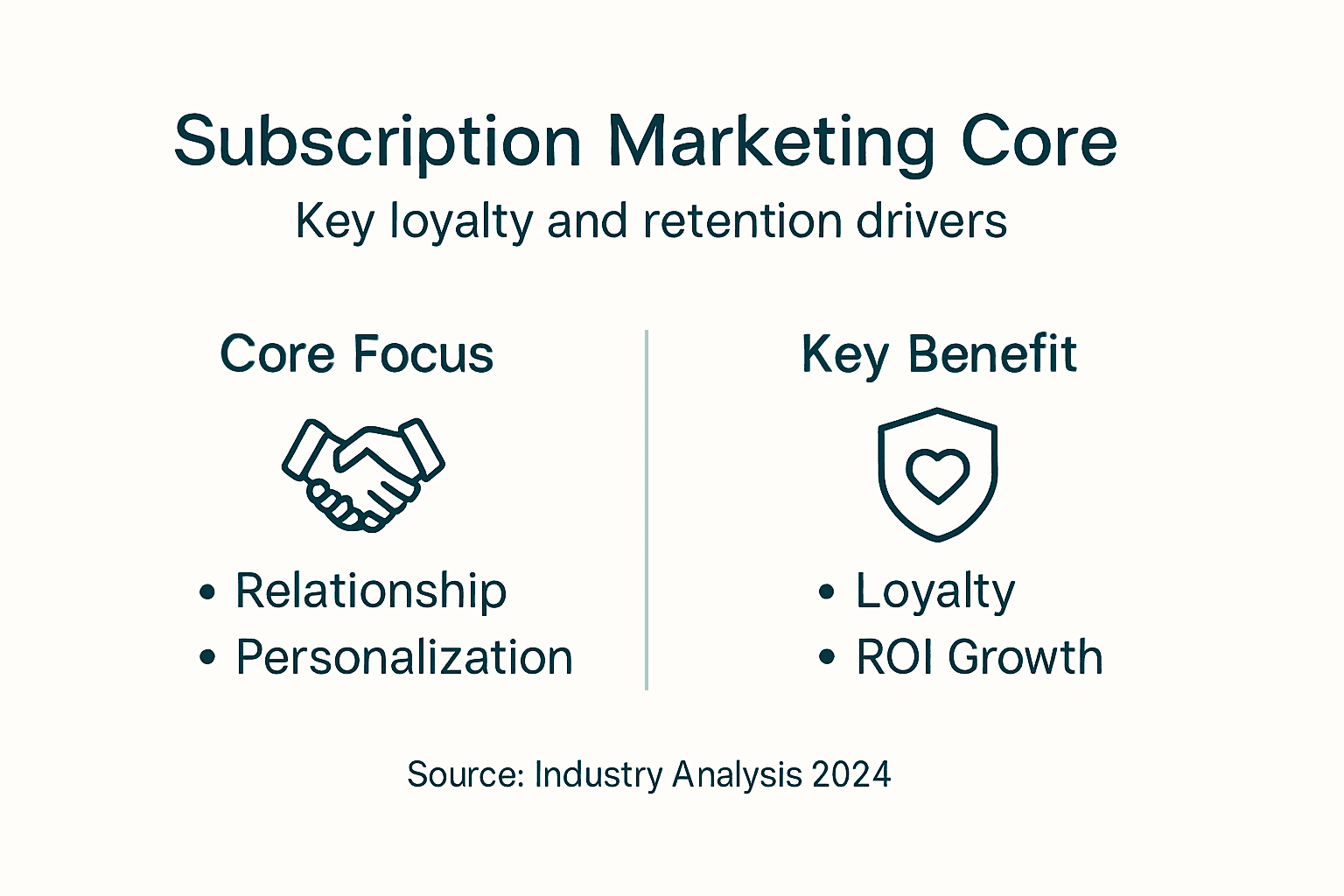
The strategic importance of subscription marketing becomes evident when examining its core components. Relationship building takes precedence over individual transactions, with businesses focusing on creating memorable, tailored experiences that compel customers to remain engaged month after month. Comprehensive research on subscription models reveals that successful implementations transform traditional e-commerce interactions into dynamic, evolving customer journeys.
Pro tip: Develop a subscription strategy that offers genuine value beyond the product itself, such as exclusive content, personalized recommendations, or member-only experiences.
Types of Subscription Models Explained
Subscription models have evolved dramatically, offering businesses diverse strategies to engage customers and generate predictable revenue. Comprehensive research on subscription typologies reveals multiple approaches that cater to different business needs and consumer preferences.
The primary subscription models in e-commerce can be categorized into three main types:
- Flat-Rate Subscriptions: Fixed pricing for consistent access to products or services
- Tiered Subscriptions: Multiple pricing levels with varying features and benefits
- Usage-Based Subscriptions: Pricing determined by actual consumption or service utilization
Each model presents unique advantages for businesses and consumers. Strategic subscription design allows companies to create flexible pricing structures that adapt to customer preferences. Flat-rate models offer simplicity and predictability, while tiered approaches provide scalability and customization options.
Hybrid subscription models are gaining prominence, combining elements from different approaches to create more nuanced and attractive offerings. These innovative models enable businesses to craft personalized experiences that align closely with customer expectations, ultimately driving higher retention and customer satisfaction.
Here’s a look at how different subscription models align with various business goals:
| Model Type | Best For | Complexity Level |
|---|---|---|
| Flat-Rate | Predictable revenue | Low |
| Tiered | Customer choice/flexibility | Medium |
| Usage-Based | Variable consumption needs | High |
| Hybrid | Niche or evolving markets | Medium to High |
Pro tip: Conduct regular customer surveys to understand which subscription model resonates most with your target audience, and be willing to adapt your strategy based on feedback.
How Subscription Marketing Works
Strategic subscription models represent a fundamental shift from traditional product-centric marketing to a more dynamic, service-oriented approach. This transformation requires businesses to reimagine how they create, deliver, and capture value through ongoing customer relationships.
The core mechanics of subscription marketing involve several key operational components:
- Continuous value generation
- Personalized customer experience design
- Predictable revenue forecasting
- Adaptive pricing strategies
- Integrated customer feedback loops
Companies implementing subscription models must develop sophisticated organizational learning processes that enable rapid adaptation to changing customer needs. This involves breaking down traditional departmental silos and creating cross-functional teams dedicated to understanding and enhancing the subscriber experience.

Successful subscription marketing goes beyond simple recurring billing. It requires a holistic approach that treats each customer interaction as an opportunity to demonstrate value, build trust, and create a compelling reason for continued engagement. This means developing advanced data analytics capabilities, creating personalized communication strategies, and continuously refining the value proposition based on real-time customer insights.
Pro tip: Implement a robust customer feedback mechanism that allows subscribers to easily share their experiences and suggestions, and demonstrate that you’re actively listening and evolving.
Personalization, AI, and Retention Strategies
Advanced AI-driven personalization techniques are transforming subscription marketing by enabling unprecedented levels of customer understanding and engagement. Modern businesses can now leverage sophisticated algorithms to create hyper-personalized experiences that anticipate customer needs before they even articulate them.
Key components of AI-powered personalization and retention strategies include:
- Dynamic customer segmentation
- Predictive behavior modeling
- Real-time personalization engines
- Automated customer journey optimization
- Intelligent recommendation systems
Companies implementing machine learning personalization frameworks can dramatically improve customer retention by creating adaptive marketing strategies that respond to individual customer preferences. This approach goes beyond traditional segmentation, using advanced natural language processing and predictive analytics to develop nuanced, individualized marketing approaches.
The most successful subscription marketing strategies now integrate multiple data sources to create a 360-degree view of customer behavior. By combining transactional data, browsing history, engagement metrics, and predictive modeling, businesses can design experiences that feel uniquely tailored to each subscriber’s specific needs and preferences.
To better understand how AI-driven personalization boosts retention, consider these practical applications:
| AI Application | Retention Benefit | Example Use Case |
|---|---|---|
| Dynamic Segmentation | More targeted offers | Segment by behavior patterns |
| Predictive Modeling | Early churn warning | Flag at-risk subscribers |
| Automated Recommendations | Increase engagement | Suggest relevant products |
Pro tip: Implement a continuous learning system that uses AI to analyze customer feedback and interaction data, allowing your personalization strategies to evolve in real-time.
Financial Impact and Common Mistakes
Subscription economy research reveals that recurring revenue models fundamentally transform financial performance for businesses. Unlike traditional sales approaches, subscription marketing creates more predictable revenue streams that can significantly enhance company valuation and attract growth-focused investors.
Common financial mistakes in subscription marketing include:
- Underestimating customer acquisition costs
- Failing to track customer lifetime value
- Overlooking churn rate implications
- Neglecting pricing strategy refinement
- Ignoring customer retention metrics
Consumer behavior in subscription models demonstrates complex financial dynamics. While businesses can benefit from recurring revenue, they must carefully balance aggressive growth strategies with ethical considerations to maintain long-term customer trust and prevent potential regulatory scrutiny.
Successful subscription businesses understand that financial impact extends beyond immediate revenue. They invest in sophisticated analytics, continuously optimize pricing structures, and develop transparent policies that prioritize genuine customer value over short-term financial gains.
Pro tip: Implement quarterly financial audits of your subscription model to identify potential revenue leakage and optimize your pricing strategy based on actual customer engagement metrics.
Legal, Regulatory, and Compliance Risks
Consumer protection frameworks have become increasingly complex for subscription-based businesses, creating a challenging legal landscape that demands meticulous attention to regulatory compliance. Navigating these intricate legal requirements requires a proactive and comprehensive approach to protecting both business interests and consumer rights.
Key legal and regulatory risks in subscription marketing include:
- Transparency in pricing and contract terms
- Data privacy and consent mechanisms
- Compliance with international marketing regulations
- Clear cancellation and refund policies
- Protection against unauthorized billing practices
Cross-border legal challenges demonstrate the critical importance of developing adaptive compliance strategies. Businesses must remain vigilant about evolving regulations across different jurisdictions, understanding that legal frameworks can vary dramatically between regions and require nuanced, localized approaches.
Successful subscription businesses invest significant resources in developing robust legal frameworks that prioritize consumer protection. This involves creating transparent communication channels, implementing comprehensive consent mechanisms, and maintaining flexible systems that can quickly adapt to changing regulatory requirements.
Pro tip: Conduct regular legal audits with specialized compliance experts to ensure your subscription model meets current regulatory standards across all operational markets.
Unlock the Full Potential of Your Subscription Marketing Strategy
Subscription marketing demands more than just recurring sales. The article highlights the challenge of maintaining ongoing customer engagement with personalized experiences and strategic retention tactics. If you are facing hurdles like high churn rates or lack of customer loyalty, it is time to leverage proven solutions that turn subscribers into devoted brand advocates. Key pain points such as delivering continuous value, harnessing AI-driven personalization, and optimizing customer lifetime value require expert execution combined with data-driven insight.
At The Email Marketers, we specialize in retention marketing crafted specifically for subscription-based e-commerce brands. Our strategic email and SMS campaigns focus on building automated flows, dynamic segmentation, and personalized messaging designed to increase repeat purchases and deepen customer relationships. Ready to stop relying on generic communications and start creating high-converting retention programs that truly resonate? Explore how our expertise aligns with your subscription growth goals and take the first step toward maximizing your ROI by visiting The Email Marketers. Don’t wait to transform your subscription business into a thriving community with measurable impact.
Frequently Asked Questions
What is subscription marketing?
Subscription marketing is a business strategy that focuses on developing ongoing relationships with customers through recurring purchases, offering continuous value beyond just one-time transactions.
What are the types of subscription models in e-commerce?
The primary subscription models include flat-rate subscriptions, tiered subscriptions, and usage-based subscriptions. Flat-rate offers a fixed price for consistent access, tiered provides multiple pricing levels with varying features, and usage-based charges based on actual consumption.
How can I improve customer retention in subscription marketing?
To enhance customer retention, implement advanced personalization strategies, utilize AI for predictive modeling, and establish robust customer feedback loops to continuously adapt to subscriber needs and preferences.
What financial metrics should I monitor for my subscription model?
Key financial metrics to track include customer acquisition costs, customer lifetime value, churn rates, and overall revenue generated. Regular audits help identify potential revenue losses and optimize pricing strategies accordingly.


