.png)


Step-by-Step SMS Campaigns That Maximize Retention & ROI

TL;DR:
- Strategic SMS campaigns can generate $42 to $73 per dollar spent with over 93% retention.
- Maintaining compliance with double opt-in and targeted segmentation is essential for list health and deliverability.
- Automated flows like abandoned cart and win-back significantly outperform one-off blasts in engagement and revenue.
SMS campaigns are one of the highest-leverage tools available to DTC brands, yet poor execution quietly drains revenue every single day. Brands that treat SMS as a broadcast channel rather than a precision retention tool leave serious money on the table. When executed strategically, SMS campaigns deliver $42 to $73 per $1 spent and retention rates above 93%. This guide walks your team through every critical step: building a compliant list, deploying smart automations, writing messages that convert, and tracking the metrics that actually matter. If you run an 8-figure DTC brand, this is the playbook you need.
Table of Contents
- Establishing compliance and building your SMS list
- Segmenting and automating for high-impact engagement
- Crafting messages that drive retention and revenue
- Measuring performance, optimizing, and troubleshooting
- What leading DTC brands get wrong about SMS campaigns
- Turn knowledge into revenue with The Email Marketers
- Frequently asked questions
Key Takeaways
| Point | Details |
|---|---|
| Compliance is critical | Getting explicit consent and using double opt-in safeguards deliverability and brand reputation. |
| Automation drives ROI | Automated flows like cart recovery and win-back can lift revenue and repeat purchase rates more than one-off campaigns. |
| Segmentation boosts results | Aggressive segmentation means higher CTRs, conversions, and customer retention. |
| Measure and iterate | Track key metrics and A/B tests to continually optimize SMS performance and avoid costly mistakes. |
Establishing compliance and building your SMS list
Before your first message goes out, your list needs to be built on solid ground. Compliance is not optional, and a poorly constructed list will cost you far more in opt-outs, fines, and lost trust than any short-term gain from cutting corners. Start with explicit opt-in across every major touchpoint: pop-ups, checkout flows, and post-purchase pages. Pair these with exclusive incentives like early access, first-order discounts, or loyalty perks to drive volume without sacrificing quality.
For SMS compliance essentials, double opt-in is your best friend. It confirms subscriber intent, keeps your list clean, and satisfies both TCPA and GDPR requirements. Double opt-in keeps opt-out rates below 2%, which is the threshold that separates healthy lists from ones that spiral into deliverability problems.
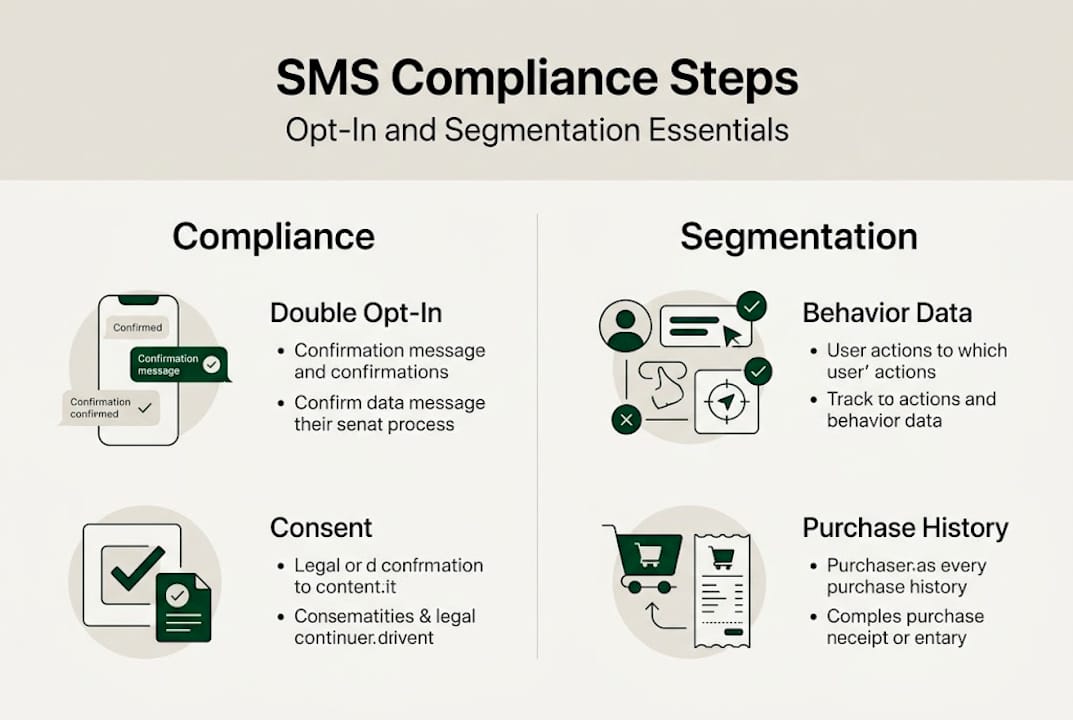
Once subscribers are confirmed, segment them immediately. Do not wait. Use purchase history, engagement signals, and browsing behavior to bucket new subscribers from day one. This early segmentation is what makes your first automated messages feel personal rather than generic. Review our SMS marketing best practices and our ecommerce SMS campaign guide for deeper frameworks on list architecture.
Compliance and opt-in method overview
| Method | Compliance benefit | Best use case |
|---|---|---|
| Pop-up with incentive | Explicit consent captured | New site visitors |
| Checkout opt-in | Purchase-intent audience | High-converting buyers |
| Post-purchase page | Warm audience, low friction | Repeat purchase nurturing |
| Double opt-in confirmation | TCPA/GDPR verified | All markets, required for EU |
Key opt-in best practices to follow:
- Always include clear language about message frequency and opt-out instructions
- Offer genuine value in exchange for consent, not vague promises
- Use a dedicated short code or toll-free number for brand recognition
- Sync your SMS list with your email platform for unified customer profiles
Pro Tip: Test two different incentive offers on your pop-up simultaneously. A 10% discount versus free shipping often yields surprising differences in both opt-in rate and downstream purchase behavior. The winner is not always the bigger discount.
Segmenting and automating for high-impact engagement
With a compliant, segmented list in place, the next move is building the automation architecture that does the heavy lifting for your team. Smart segmentation and well-timed flows are what separate brands generating real retention revenue from those just sending blasts and hoping for the best.
The most effective segmentation logic groups subscribers into VIPs (top 20% by lifetime value), recent buyers (within 30 days), lapsed customers (60 to 90 days inactive), and engagement-based tiers. Each group needs different messaging cadence, tone, and offers. Sending a win-back discount to a VIP who just purchased last week is a waste of margin and a signal that you do not know your customer.
For SMS automation for e-commerce, the five flows every DTC brand should have running are:
- Abandoned cart: Trigger within 30 minutes, follow up at 2 hours if no purchase
- Post-purchase: Confirm order, then upsell or cross-sell at day 3 and day 7
- Browse abandonment: Trigger after 2+ product views with no cart action
- Win-back: Engage lapsed customers at 60, 75, and 90 days with escalating offers
- Back-in-stock: Instant notification to waitlisted subscribers drives urgency purchases
Abandoned cart SMS sees 9 to 17% CTR and 4 to 8% conversion rates, making it the single highest-ROI automation available. That performance gap between automated flows and one-off blasts is significant.

Automated flows versus one-off blasts
| Metric | Automated flows | One-off blasts |
|---|---|---|
| Average CTR | 9 to 17% | 3 to 6% |
| Conversion rate | 4 to 8% | 1 to 3% |
| Opt-out risk | Low (triggered by behavior) | Higher (untargeted) |
| Revenue per message | $0.40 to $1.20 | $0.05 to $0.20 |
Explore advanced SMS automation tips to go deeper on flow architecture and trigger logic.
Pro Tip: Run holdout tests on your automation flows by excluding 10% of eligible subscribers from each flow for 30 days. This reveals the true incremental revenue your automations generate, not just correlation with purchase behavior.
Crafting messages that drive retention and revenue
The best segmentation and automation in the world cannot save a poorly written message. SMS copywriting is a discipline with hard constraints: 160 characters, one clear action, and zero room for ambiguity. Every word earns its place or gets cut.
Personalization is non-negotiable at this level. First name alone is table stakes. Use purchase history, browsing behavior, and loyalty tier to make messages feel like they were written for one person. Personalized SMS with a clear CTA and opt-out language sees CTR of 20 to 35% and conversion rates of 8 to 11%. That is a massive lift over generic copy.
For frequency, the rule is firm: no more than one message per day per subscriber, and no more than 4 to 8 marketing messages per month. Going beyond that threshold is where opt-outs spike and list health deteriorates fast. Review opt-out prevention strategies to understand how leading brands protect their lists.
Creative SMS use cases that drive engagement:
- Flash sales: 4-hour window with a countdown creates real urgency
- VIP early access: Reward top customers before a product drops publicly
- Replenishment reminders: Timed to product usage cycles for consumables
- Loyalty milestone alerts: Notify subscribers when they hit a reward threshold
- Personalized product recommendations: Based on last purchase category
Timing matters as much as content. Schedule messages during your audience’s peak activity windows, typically 10 AM to 12 PM and 6 PM to 8 PM in the recipient’s local time zone. Sending a flash sale at 2 AM is not urgency, it is noise. Use your effective SMS messaging strategies and personalization techniques in messaging to sharpen both timing and copy.
Pro Tip: Use SMS for urgency and time-sensitive offers, and reserve email for storytelling, product education, and longer content. This multi-channel orchestration prevents audience fatigue and makes each channel feel purposeful rather than redundant.
Measuring performance, optimizing, and troubleshooting
Execution without measurement is just guessing. The brands that compound their SMS ROI over time are the ones that treat every campaign as a data source, not just a revenue event.
The core metrics your team should track on every campaign and flow:
- Click-through rate (CTR): Benchmark 9 to 17% for flows, 3 to 6% for blasts
- Conversion rate: Target 4 to 8% for automated flows
- Revenue per message: The truest measure of campaign efficiency
- Opt-out rate: Keep below 2% per send; spikes signal frequency or relevance problems
- List growth rate: Net new subscribers minus opt-outs, tracked weekly
A/B testing variables to run on a rotating basis:
- Message copy (emotional versus functional framing)
- Send time (morning versus evening within the same segment)
- Offer type (percentage discount versus dollar amount versus free shipping)
- CTA phrasing (“Shop now” versus “Claim yours” versus “See the deal”)
- Personalization depth (first name only versus product-specific reference)
When a campaign underperforms, use this troubleshooting sequence:
- Check opt-out rate first. A spike above 2% means frequency or relevance is off.
- Review send time against your audience’s historical engagement windows.
- Audit copy for generic language or missing personalization tokens.
- Verify segmentation logic. Are the right subscribers receiving the right message?
- Confirm link tracking is firing correctly so revenue attribution is accurate.
List health and send frequency are the two levers most brands ignore until it is too late. A shrinking, disengaged list cannot be fixed with better copy. Protect it proactively.
Median SMS ROI is $42 to $73 per $1 spent, with retention above 93% for well-managed programs. Over-sending or poor targeting is the fastest way to erode both numbers. The 98% open rate statistic gets cited constantly, but open rate alone tells you nothing about revenue impact. Focus on advanced SMS retention tips and SMS best practices to build a measurement culture that drives real growth. For a deeper look at campaign-level analysis, explore SMS performance optimization to benchmark your program against industry leaders.
What leading DTC brands get wrong about SMS campaigns
Here is the uncomfortable truth: most 8-figure DTC brands are measuring the wrong things and optimizing for the wrong outcomes. Open rate obsession is the most common trap. SMS open rates are high by default because the channel is intrusive by nature. That number tells you nothing about whether your program is actually building retention or just burning through your list.
The brands that win long-term prioritize CTR and revenue over open rate, blend automated flows with transactional messages, and use holdout tests to prove incremental ROI rather than assuming correlation equals causation.
Exclusive offers also lose their power when overused. If every SMS is a “VIP exclusive,” nothing is exclusive anymore. Smart frequency and genuine value creation are what keep subscribers engaged for years, not months. Explore retention-boosting SMS tips to rethink how you structure value delivery across your list.
Pro Tip: Incorporate two-way conversational SMS replies into at least one flow. Asking a simple question like “Which style are you interested in?” and routing responses to personalized follow-ups can boost engagement by up to 25%.
Turn knowledge into revenue with The Email Marketers
Systematic SMS campaigns are not a nice-to-have for 8-figure DTC brands. They are a core retention engine that compounds over time when built correctly. Every section of this guide represents a decision point where the right execution separates top performers from brands that plateau. If you are ready to move from strategy to results, The Email Marketers builds the exact systems described here, customized for your brand’s customer journey and revenue goals. See SMS campaign results from brands we have scaled, explore our Retention Lab strategies for ongoing optimization, or access our Retention Toolkit to start building immediately.
Frequently asked questions
What are the most essential automations for DTC e-commerce SMS campaigns?
Start with abandoned cart, post-purchase upsell, back-in-stock, and win-back flows. These four automated flows dramatically increase ROI and have the strongest measurable impact on both retention and revenue.
How often should we send SMS campaigns to avoid high opt-outs?
Limit marketing messages to 4 to 8 per month and never exceed one message per day per subscriber. Keeping opt-outs under 2% requires consistent discipline around frequency and relevance.
What ROI benchmarks should DTC brands expect from SMS campaigns?
Well-segmented, optimized SMS programs deliver $42 to $73 per $1 spent with retention rates above 93%. Brands below these benchmarks typically have list health or segmentation issues.
How can we ensure compliance with regulations like TCPA and GDPR?
Use explicit and double opt-in with clear opt-out instructions in every message. These two practices satisfy both TCPA and GDPR requirements and protect your brand from regulatory exposure.


