.png)


Step-by-step SMS campaign setup guide for e-commerce

TL;DR:
- Proper SMS compliance setup is essential to avoid legal fines and protect subscriber trust.
- Automated flows and deep segmentation drive higher revenue than frequent mass campaigns.
- Optimizing key metrics like RPM, CTR, and conversion rates through testing ensures campaign success.
Sending an SMS campaign without the right foundation is one of the fastest ways to burn subscriber trust, trigger legal fines, and leave serious revenue on the table. Brands that skip compliance steps face TCPA violations ranging from $500 to $1,500 per message sent. That adds up fast. This guide walks you through every critical phase: compliance setup, list building, campaign execution, and performance measurement. Whether you’re launching your first SMS program or rebuilding a struggling one, you’ll leave with a clear, actionable roadmap designed specifically for DTC brands that want retention results, not just open rates.
Table of Contents
- Understand SMS marketing compliance essentials
- Prepare your SMS subscriber list and segmentation
- Craft, schedule, and automate SMS campaigns
- Measure success and optimize your SMS campaigns
- A new perspective on SMS campaigns: Rethink retention and revenue
- Accelerate your SMS retention strategy with expert support
- Frequently asked questions
Key Takeaways
| Point | Details |
|---|---|
| Start with compliance | Following TCPA, CTIA, and 10DLC rules is essential to avoid fines and protect your brand. |
| Segment for results | Smart segmentation with automations delivers higher retention and ROI for e-commerce brands. |
| Craft concise messages | Strong, personalized SMS with one CTA and correct frequency earns more engagement and sales. |
| Track real benchmarks | Monitor RPM, CTR, and opt-outs to refine your campaigns and stay ahead of industry standards. |
Understand SMS marketing compliance essentials
Before you write a single message, you need to understand the rules. SMS marketing in the US operates under three overlapping frameworks: the Telephone Consumer Protection Act (TCPA), the Cellular Telecommunications Industry Association (CTIA) guidelines, and 10DLC (10-digit long code) carrier registration. Each one has teeth. Ignoring any of them puts your brand at serious legal and financial risk.
The TCPA requires express written consent before you send any marketing text. That means a subscriber must actively agree to receive messages from your brand, not just hand over their phone number at checkout. The CTIA adds operational requirements around message frequency, content standards, and opt-out handling. 10DLC registration is the carrier-level requirement that ensures your messages actually reach inboxes instead of getting filtered as spam. SMS compliance guidelines from major platforms spell out exactly how to register and stay current.
Required disclosures are non-negotiable. Every opt-in must include your brand name, message frequency, potential carrier charges, a link to your terms of service, a link to your privacy policy, and clear opt-out instructions. These aren’t suggestions. Missing even one can expose you to fines. Following SMS marketing best practices from the start protects your brand and your list.
Always include opt-out language in your initial welcome message. The standard format is: “Reply STOP to unsubscribe. Msg & data rates may apply.”
Compliance requirements vs. consequences
| Requirement | If ignored |
|---|---|
| Express written consent | $500 to $1,500 per violation |
| 10DLC registration | Message filtering and carrier blocks |
| Opt-out mechanism (STOP) | TCPA liability and subscriber complaints |
| Privacy policy disclosure | Regulatory action and platform suspension |
| Quiet hours (8AM to 9PM local) | Carrier violations and list damage |
Essential compliance setup checklist:
- Register your 10DLC brand and campaign with your SMS platform
- Add double opt-in confirmation for any high-risk or age-restricted products
- Include STOP, HELP, and CANCEL keyword auto-responses
- Store consent records with timestamps and source URLs
- Audit your opt-in forms for all required disclosure language
Pro Tip: For brands selling age-restricted products like alcohol or supplements, double opt-in is not just best practice, it’s a liability shield. It creates a second consent touchpoint that strengthens your compliance record significantly.
Prepare your SMS subscriber list and segmentation
A compliant list is only valuable if it’s also well-structured. The quality of your segmentation directly determines how much revenue your SMS program generates. Sending the same message to your VIP buyers and your one-time discount shoppers is a waste of both budget and goodwill.
Start with your acquisition entry points. On-site popups, checkout opt-ins, and keyword triggers (like texting JOIN to a shortcode) are the three most effective channels for building a subscriber list. Pair each entry point with an incentive, whether that’s a discount, early access, or free shipping, and you’ll see meaningfully higher opt-in rates.
List-building sources and expected acquisition rates
| Source | Expected opt-in rate |
|---|---|
| Checkout opt-in | 15 to 25% |
| On-site popup with incentive | 5 to 12% |
| Keyword trigger campaign | 20 to 40% |
| Post-purchase confirmation | 8 to 15% |
Once subscribers are in, segment them immediately. Don’t wait until you have a large list to start organizing it. The three core segments every DTC brand needs are VIP buyers (high AOV, frequent purchasers), lapsed customers (no purchase in 60 to 90 days), and transactional subscribers (engaged but not yet repeat buyers). Each group needs a different message, cadence, and offer strategy.
Setting up your list infrastructure:
- Configure double opt-in confirmation messages with brand name and opt-out language
- Set up keyword triggers in your SMS platform and map them to the correct list segment
- Create custom properties for purchase history, product category, and lifecycle stage
- Build suppression lists for recent purchasers and frequent engagers to prevent fatigue
- Schedule a monthly list hygiene review to remove unengaged subscribers
Automations should be built before you send your first campaign. Abandoned cart flows (triggered within one hour of abandonment), browse abandon sequences, post-purchase shipping updates, and winback flows for lapsed customers are the highest-ROI automations in the DTC playbook. Explore advanced SMS retention tactics to see how top brands layer these flows for compounding impact. A smart text message strategy ties these automations together into a coherent customer journey rather than a series of disconnected blasts. Following SMS segmentation best practices ensures your segments stay clean and actionable.
Pro Tip: Zero-party data, information subscribers voluntarily share through quizzes, preference centers, or surveys, can lift conversion and retention rates by 10 to 15%. Ask early, use it immediately, and update it regularly.
Craft, schedule, and automate SMS campaigns
Now comes the part most brands rush: the actual message. SMS copy is brutally unforgiving. You have 160 characters (or roughly 70 with emojis) to deliver a clear, compelling message with one call to action. Not two. One. Every word has to earn its place.

Personalization is not optional at this level. Using a subscriber’s first name, referencing the product they browsed, or acknowledging their loyalty tier dramatically improves click-through and conversion. Concise, personalized copy with a single CTA consistently outperforms longer, generic messages. Keep your tone conversational, your offer specific, and your link trackable.
Scheduling discipline separates high-performing programs from ones that burn out their lists. Cap promotional sends at one message per 48 hours. Respect quiet hours, which means no messages before 8AM or after 9PM in the subscriber’s local time zone. Suppress anyone who has purchased in the last 24 to 48 hours. These rules protect your list health and your sender reputation. Review the SMS deliverability policy for your platform to stay current on carrier requirements.
Campaign setup steps:
- Build your segment in your SMS platform using purchase history and engagement filters
- Write your message with a personalization token, a clear offer, and a single shortened link
- Set send time within your platform’s quiet hours enforcement
- Enable Smart Sending to suppress recent engagers automatically
- Preview on mobile before scheduling
- Tag the campaign for reporting and A/B test subject variables when volume allows
Automations to prioritize:
- Abandoned cart (trigger within 60 minutes, 2 to 3 message sequence)
- Browse abandon (trigger after 30 minutes of inactivity on a product page)
- Winback flow (trigger at 60 and 90 days post-last purchase)
- Post-purchase shipping and delivery updates
- VIP early access and loyalty milestone messages
Well-built automations generate 3 to 8% conversion rates and can deliver up to 50x ROI on spend. Compare that to one-off campaigns and the case for investing in flows first becomes obvious. Understanding email vs SMS performance helps you allocate resources across channels more strategically.
Pro Tip: Smart Sending is one of the most underused features in SMS platforms. It automatically skips subscribers who received a message too recently, protecting your list from fatigue without requiring manual suppression work.
Measure success and optimize your SMS campaigns
Launching campaigns without tracking the right metrics is like running paid ads without conversion data. You’re spending money with no way to improve. The KPIs that matter most in SMS are revenue per message (RPM), click-through rate (CTR), conversion rate, list growth rate, and list churn rate.
RPM is the most honest measure of SMS program health. It tells you exactly how much revenue each message generates, accounting for both campaign and automation performance. E-commerce benchmarks for 2026 show a median RPM of $0.98, with top performers reaching $4.54. CTR benchmarks sit between 20 and 35%, and conversion rates for flows range from 3 to 8%. If you’re below these numbers, your segmentation, copy, or timing needs work.
Campaign vs. automation performance benchmarks
| Metric | Campaigns | Automations |
|---|---|---|
| Revenue per message (RPM) | $0.50 to $1.20 | $1.50 to $4.54 |
| Conversion rate | 1 to 3% | 3 to 8% |
| CTR | 10 to 20% | 20 to 35% |
| Retention rate | Varies | 93%+ for top programs |
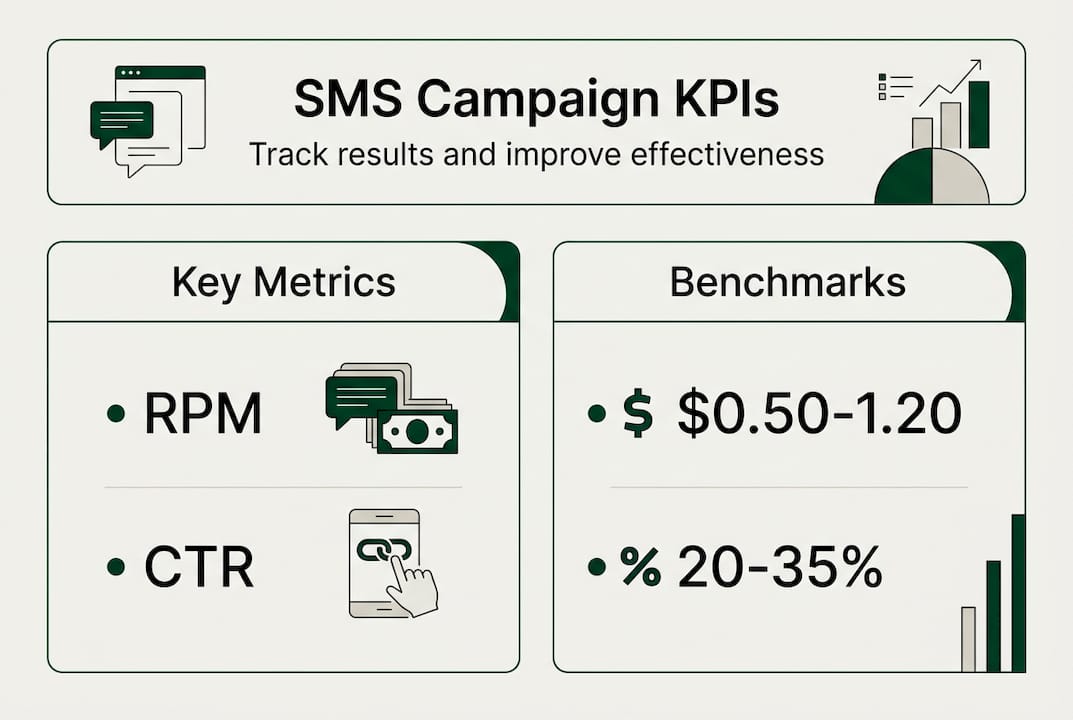
Holdout testing is a technique many DTC brands skip entirely. By holding back a small percentage of your list from a campaign and comparing their purchase behavior to those who received the message, you can measure the true incremental lift of your SMS program. This is far more accurate than simply crediting every purchase to the last message sent. Review SMS performance statistics to see how these benchmarks have evolved. Use SMS campaign optimization tips to build a structured testing calendar. External ROI and KPI data can help you contextualize your results against broader industry performance.
Ongoing optimization best practices:
- Run A/B tests on send time, offer type, and CTA wording monthly
- Review list churn weekly and investigate spikes immediately
- Suppress subscribers with zero engagement over 90 days
- Use cohort analysis to track how different acquisition sources perform over time
Pro Tip: Segment-level analytics reveal patterns that account-level averages hide. A segment that looks average overall might have one sub-group with 6% conversion and another dragging it down to 2%. Cohort analysis lets you find and act on those differences.
A new perspective on SMS campaigns: Rethink retention and revenue
Here’s what most SMS guides won’t tell you: your campaigns are probably not your biggest revenue lever. Your automations are. The brands we see consistently outperforming benchmarks are not the ones sending more campaigns. They’re the ones who built deep automation stacks and then used campaigns selectively to amplify them.
Over-sending is one of the most common and most damaging mistakes in SMS marketing. Each unnecessary message chips away at subscriber trust. Once someone opts out, they’re gone. The cost of rebuilding a list is far higher than the short-term lift from an extra campaign blast.
The other underrated insight is that SMS alone rarely delivers peak results. When SMS is integrated with email into a coordinated retention strategy, performance compounds. Email handles education and nurture. SMS handles urgency and conversion. Together, they cover the full customer decision cycle. Explore retention-boosting tactics that show how elite DTC brands structure this integration.
The bottom line is this: deep segmentation and well-timed automations will always outperform volume. Send less, but send smarter.
Accelerate your SMS retention strategy with expert support
Building a compliant, high-converting SMS program takes more than a platform subscription. It takes strategy, segmentation expertise, and ongoing optimization. At The Email Marketers, we’ve helped 8-figure DTC brands build exactly this, from compliance infrastructure to automation stacks that drive measurable repeat purchase revenue. Explore the Retention Lab for proven frameworks and tools built specifically for retention-focused brands. You can also see real brand results from brands that have transformed their SMS programs with our support. And if you want a structured starting point, the Retention Toolkit gives you the templates and playbooks to move fast without cutting corners.
Frequently asked questions
What is the minimum required for SMS campaign compliance in the US?
You must obtain express written consent, provide disclosures and opt-out instructions, and register your sender ID to comply with TCPA, CTIA, and 10DLC rules. Missing any one of these elements creates direct legal exposure.
How often should I send SMS campaigns to avoid unsubscribes?
Limit promotional messages to one every 48 hours, observe quiet hours between 8AM and 9PM local time, and suppress recent engagers to protect list health.
What benchmarks define a successful SMS campaign in e-commerce?
Strong campaigns achieve a $0.98 median RPM, 20 to 35% CTR, and 3 to 8% conversion rates, with elite brands pushing significantly higher across all three metrics.
What is the main advantage of SMS automations over one-off campaigns?
Automations like abandoned cart flows can drive 5x the revenue compared to standard campaigns, with higher conversion rates and better long-term list retention.
Recommended
- Marketing by Text Message: A Strategic Approach for E-commerce Brands
- Blog
- Personalized Email Strategy Guide For E-Commerce Success
- How to Use SMS Ecommerce to Supercharge Your Business
- Website & Online Store Setup (Theme customization, product listing, payment integration) | Finovate Accounting Services


