.png)


Newsletter design best practices for DTC retention 2026

Most DTC brands assume that flashy visuals and high send frequency are the keys to email revenue. The reality is that well-structured, automated post-purchase flows consistently outperform single-blast campaigns on revenue per recipient, and post-purchase flows can drive 30%+ of total store revenue when designed correctly. Yet many marketing teams still pour time into one-off campaign aesthetics while leaving their core retention architecture underbuilt. This guide breaks down the design principles, segmentation strategies, and flow structures that actually move the needle for mid to large-sized DTC brands in 2026.
Table of Contents
- Why newsletter design matters for DTC retention
- Core design principles for high-performing newsletters
- Segmentation and personalization: designing for the right audience
- Automated flows vs campaigns: which designs win for engagement?
- Our take: What most marketers still miss about newsletter design
- Accelerate your retention with expert-designed newsletters
- Frequently asked questions
Key Takeaways
| Point | Details |
|---|---|
| Design impacts revenue | Clean, well-structured email designs consistently boost DTC retention and sales. |
| Personalization is critical | Segmented, behavior-based content outperforms broad campaigns for engagement. |
| Flows drive retention | Automated flows deliver higher revenue and loyalty compared to generic blasts. |
| Consistency and simplicity scale | Simple, repeatable designs make production faster and reduce fatigue. |
Why newsletter design matters for DTC retention
Let’s be direct: newsletter design is not a creative exercise. It’s a revenue lever. When your email program is optimized, it can account for a significant share of total store income. In fact, email drives 33.7% of total store revenue in top-performing DTC brands. That number alone should reframe how your team prioritizes design decisions.
Retention through email is also dramatically more cost-effective than acquiring new customers. Customer acquisition costs have spiked across paid social and search channels, making your existing subscriber list one of your most valuable assets. A well-designed newsletter that keeps customers engaged and buying again delivers compounding returns without the media spend.
Understanding the newsletter role in email marketing helps clarify why design decisions at the template level ripple through your entire retention program. Every layout choice, color block, and CTA placement either reinforces or undermines your brand’s ability to convert repeat buyers.
Here’s a quick look at how newsletter design impacts key DTC metrics:
| Design element | Impact on retention | Impact on revenue |
|---|---|---|
| Clear CTA hierarchy | Higher click-through rates | More direct conversions |
| Mobile-first layout | Lower bounce rates | Broader audience reach |
| Consistent branding | Stronger brand recall | Higher lifetime value |
| Personalized content blocks | Increased relevance | Better revenue per email |
The brands that win at retention share a few common traits in their email programs:
- They use simple, repeatable templates that scale across campaigns and flows
- They prioritize clarity over complexity in every design decision
- They test systematically rather than chasing visual trends
- They align design choices with specific customer journey stages
“The best email programs aren’t the most beautiful ones. They’re the ones built for scale, consistency, and relevance at every stage of the customer lifecycle.”
Simplicity scales. Complexity stalls. That’s the core business case for rethinking how your team approaches newsletter design.
Core design principles for high-performing newsletters
Now that the stakes are clear, let’s get into what separates high-performing newsletter designs from the ones that get ignored. The principles here aren’t theoretical. They’re drawn from what actually works at scale for DTC brands sending millions of emails per month.
1. Visual hierarchy drives action Every newsletter needs a clear reading path. Your subscriber’s eye should move from headline to hero image to CTA without confusion. Use font size, weight, and spacing to guide attention. If everything competes for focus, nothing wins.
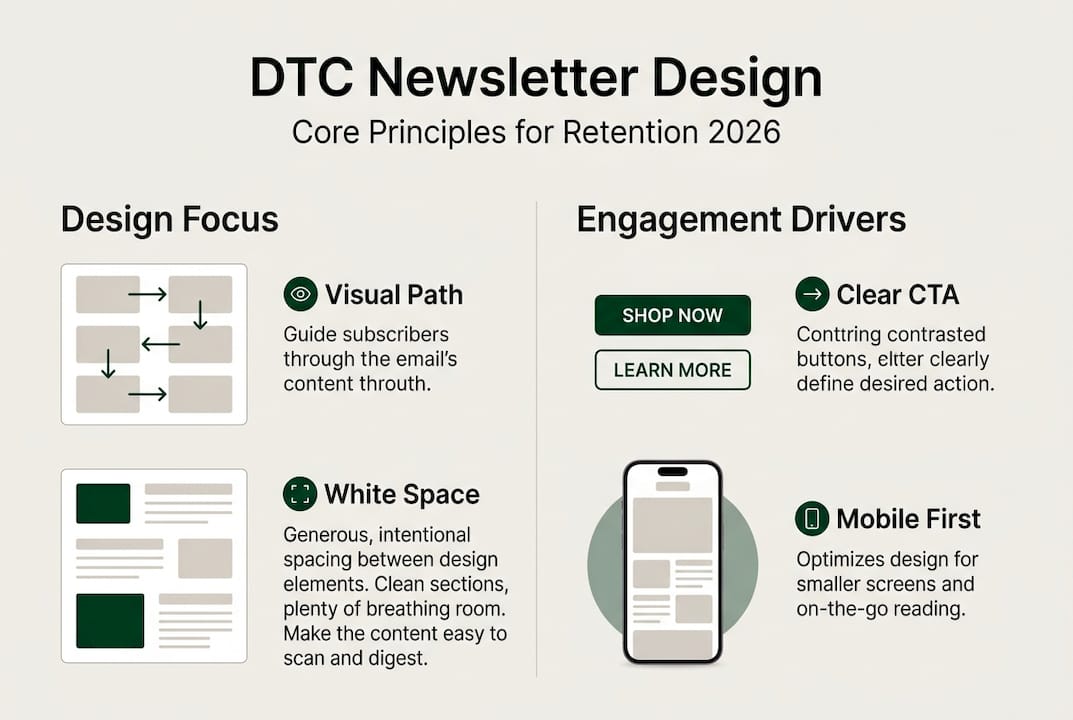
2. Whitespace is not wasted space Whitespace reduces cognitive load and makes your content easier to scan. Dense, cluttered layouts feel overwhelming and drive unsubscribes. Give your content room to breathe, especially on mobile.
3. Mobile-first is non-negotiable Over 60% of email opens happen on mobile devices. Design for the smallest screen first, then scale up. Single-column layouts, large tap targets, and short subject lines are baseline requirements, not optional upgrades.

4. CTAs must be unmissable Your call-to-action (the button or link that tells readers what to do next) should be visually distinct, action-oriented, and placed above the fold when possible. Use contrasting colors and direct language like “Shop now” or “Claim your offer.”
5. Brand consistency builds trust Subscribers should recognize your email in under two seconds. Consistent use of fonts, colors, and logo placement builds the kind of familiarity that drives repeat purchases over time.
For deeper guidance on execution, newsletter best practices for e-commerce cover the tactical layer in detail. You can also explore email design tips and email design basics to build a stronger foundation.
As Adam Kitchen notes, simple, clean designs enable fast production and reduce subscriber fatigue, which is crucial for DTC brands trying to scale their email output without burning out their list.
Pro Tip: Build a modular template library with 3 to 5 reusable layouts. This lets your team produce campaigns faster, test more variations, and maintain brand consistency without starting from scratch every send.
Segmentation and personalization: designing for the right audience
A beautiful newsletter sent to the wrong person at the wrong time is just noise. Segmentation and personalization are what transform a well-designed template into a revenue-generating machine. The design itself needs to account for who is receiving it.
RFM segmentation is a powerful framework here. RFM stands for Recency, Frequency, and Monetary value. It groups your customers based on how recently they bought, how often they buy, and how much they spend. Each segment needs a different design approach, different content, and different offers.
| Segment | Design focus | Content priority |
|---|---|---|
| High-value loyalists | Premium feel, exclusivity cues | Early access, VIP offers |
| At-risk churners | Urgency, re-engagement hooks | Win-back incentives |
| New subscribers | Brand storytelling, social proof | Welcome series, bestsellers |
| Lapsed customers | Nostalgia, bold CTAs | Reactivation discounts |
Personalization goes beyond using someone’s first name. Dynamic content blocks (sections of your email that change based on subscriber data) let you show different product recommendations, offers, or messaging to different segments within a single campaign send. This is where design and data intersect most powerfully.
Behavioral segmentation combined with AI recommendations drives far greater results than broad campaigns. Brands that implement this see measurable lifts in both open rates and revenue per recipient.
For practical implementation, segmentation best practices for e-commerce brands walk through how to structure your audience tiers and map them to design decisions.
RFM segmentation and predictive churn modeling are especially critical for win-back flows, where the design needs to feel personal and urgent rather than generic.
Pro Tip: Audit your current segments quarterly. Customer behavior shifts, and a segment that responded well to discount-led designs six months ago may now need value-driven storytelling to re-engage effectively.
Automated flows vs campaigns: which designs win for engagement?
This is where a lot of DTC brands get the balance wrong. Campaigns (one-time sends to your list) and automated flows (triggered sequences based on customer behavior) require fundamentally different design philosophies.
Automated flows are built around timing and triggers. A post-purchase flow fires when someone buys. A browse abandonment flow fires when someone views a product but doesn’t convert. The design for these emails needs to feel timely and personal, not broadcast-style. Modular block structures work best here because they allow dynamic content insertion based on the trigger event.
Campaigns, by contrast, reach a wider audience with a consistent message. They’re great for product launches, seasonal promotions, and brand storytelling. But they typically carry lower engagement rates because they lack the behavioral context that makes flows so effective.
The data is clear: campaigns account for about 50% of email revenue but have lower click rates, while flows consistently outperform on revenue per recipient.
How to prioritize your design investment:
- Build and optimize your core flows first: welcome series, post-purchase, browse abandonment, and win-back
- Establish a scalable campaign template that can be adapted quickly for different promotions
- Use A/B testing on flow designs before rolling out changes to campaigns
- Review flow performance monthly and campaign performance after each send
Learn more about how post-purchase emails should be structured for maximum retention impact. You can also review retail email examples to see how top brands handle the campaign versus flow balance in practice.
Key stat: Brands that prioritize flow design alongside campaigns consistently report higher customer lifetime value and lower churn rates compared to those that focus solely on campaign output.
Our take: What most marketers still miss about newsletter design
Here’s the uncomfortable truth: most DTC brands spend too much time on how their emails look and not enough on how they work. We’ve seen eight-figure brands with stunning email templates and mediocre retention numbers. We’ve also seen brands with simple, almost plain designs driving 40% of their revenue from email alone.
The difference is almost never the design. It’s the strategy behind it.
Simple, repeatable designs get more tests into market. More tests mean more data. More data means faster optimization. Brands chasing visual trends are often running fewer tests and learning slower than competitors who prioritize operational scale.
Personalization is not a tactic you layer on top of a design. It is the foundation. If your template doesn’t account for behavioral data and segment-specific messaging from the start, you’re leaving revenue on the table regardless of how polished it looks.
As customer acquisition costs continue to climb, email marketing management discipline becomes a genuine competitive advantage. Brands that build retention systems now will outperform those still relying on paid acquisition to drive growth.
Stop chasing the next design trend. Refine what works, automate it, and scale it.
Accelerate your retention with expert-designed newsletters
Putting these principles into practice takes more than a good template. It takes a retention strategy built around your specific customer data, flow architecture, and brand positioning. At The Email Marketers, we’ve helped DTC brands across luxury, apparel, and subscription categories build newsletter programs that drive consistent, compounding revenue from their existing subscriber base.
If you’re ready to move beyond generic campaigns and build a retention engine that actually scales, explore what we’ve built through our Retention Lab program. You can also review the results we’ve delivered for brands we’ve helped to see what’s possible when strategy, design, and data work together.
Frequently asked questions
What is the best design for a DTC e-commerce newsletter?
The best design is simple, mobile-optimized, and uses clear content blocks targeted by behavioral data. Simple, clean designs enable scalability and reduce fatigue, which directly supports long-term retention.
How does segmentation improve newsletter performance?
Segmentation by behaviors and RFM metrics allows newsletters to deliver more relevant offers, producing higher engagement and sales. Behavioral segmentation and RFM increase win-back rates and revenue per recipient across DTC programs.
Should I focus on post-purchase flows or campaigns?
Both matter, but post-purchase flows tend to drive more consistent revenue and retention in DTC brands. Flows drive 30%+ revenue and outperform campaigns on revenue per recipient over time.
How can I prevent newsletter fatigue among subscribers?
Use minimalist, value-driven designs and limit frequency to what’s relevant for each segment. Simple designs and UGC (user-generated content like reviews and photos) limit subscriber fatigue while keeping content fresh and engaging.


