.png)


Maximize customer value with advanced email flows

TL;DR:
- Email flows generate 30-60% of sales by delivering timely, personalized messages triggered by customer actions. Prioritizing abandoned cart, welcome, and post-purchase flows yields the highest ROI and customer lifetime value growth. Continuous iteration, segmentation, and strategic management are essential for maximizing flow performance and revenue.
Most e-commerce marketing managers pour resources into campaigns: broadcast sends, seasonal promos, weekly newsletters. And yet the real revenue engine is quietly running in the background. Flows generate 30-60% of total email revenue from just 5% of sends, with revenue per recipient up to 18x higher than campaigns. That gap is not a coincidence. It’s the result of precise timing, behavioral triggers, and deeply personalized sequences that campaigns simply cannot replicate. The brands winning on retention have figured this out. This guide breaks down how.
Table of Contents
- What are email marketing flows and why do they matter?
- The seven essential ecommerce flows and their benchmarks
- Personalization and decision logic: How advanced flows drive engagement
- Avoiding pitfalls: Frequency, overlap, and maximizing deliverability
- Framework to prioritize flows for rapid ROI
- Why most brands underperform with flows (and how to break the mold)
- Transform your email flows into a growth engine
- Frequently asked questions
Key Takeaways
| Point | Details |
|---|---|
| Flows drive disproportionate revenue | Automated email flows account for up to 60% of e-commerce email revenue from a small fraction of total sends. |
| Seven core flows build retention | Successful brands implement welcome, browse, cart, post-purchase, cross/upsell, win-back, and re-engagement flows to drive the customer lifecycle. |
| Personalization and segmentation matter | Advanced logic, dynamic content, and conditional triggers maximize engagement and customer value. |
| Control frequency and overlaps | Use frequency caps, engagement filters, and suppression logic to avoid email fatigue and protect deliverability. |
| Prioritize flows by ROI and LTV impact | Audit and build flows starting with cart abandonment for immediate results, and sequence next flows for lasting retention gains. |
What are email marketing flows and why do they matter?
Understanding the difference between a flow and a campaign is the first step to building a retention machine. A campaign is a broadcast. You send it to a list. It goes at a scheduled time. The results depend on how relevant it happens to be for each recipient, which is often not very relevant at all.
Flows are the opposite. Email marketing flows are automated sequences triggered by customer behaviors such as sign-ups, browsing, cart abandonment, purchases, or inactivity, forming the core of ecommerce lifecycle marketing. The email arrives because a specific person did a specific thing. That’s why the results are so different.
Here’s what makes flows so valuable for high-growth DTC brands:
- Timing precision: The email lands when the customer is most primed to act, not when you happen to press send.
- Scalability: Once built, flows work for every customer without additional manual effort.
- Personalization depth: Flows can branch based on purchase history, LTV, product category, or engagement level.
- Compounding returns: A well-optimized flow library grows more effective as you gather more behavioral data.
“Flows generate 30-60% of total email revenue, often from just 5% of sends.” That efficiency ratio is nearly impossible to replicate with campaigns alone.
For brands focused on customer lifetime value (LTV, the total revenue generated by a customer over their relationship with your brand), flows are not a nice-to-have. They are the infrastructure. Campaigns can spike revenue. Flows sustain it. If you want to understand ecommerce email best practices at scale, flows are where the conversation starts. And if your click rates are lagging, improving email click rates in your flows will outperform any campaign tweak.
The seven essential ecommerce flows and their benchmarks
Every high-performing e-commerce brand should have these seven flows running before investing heavily in campaign frequency. The seven essential ecommerce email flows are: Welcome series, Browse abandonment, Cart abandonment, Post-purchase, Cross-sell/upsell, Win-back, and Re-engagement/sunset. Each one serves a specific role in the customer lifecycle, and each has measurable benchmarks you should be tracking.
| Flow | Trigger | Primary Goal | Benchmark Open Rate |
|---|---|---|---|
| Welcome series | New subscriber | Brand introduction, first purchase | 50-60% |
| Browse abandonment | Product view, no purchase | Re-engage consideration | 35-45% |
| Cart abandonment | Add to cart, no checkout | Recover lost revenue | 40-50% |
| Post-purchase | Order confirmed | Build loyalty, reduce returns | 45-55% |
| Cross-sell/upsell | Post-purchase window | Increase order value | 35-45% |
| Win-back | 90-180 days inactive | Reactivate lapsed buyers | 20-30% |
| Re-engagement/sunset | Persistent inactivity | Clean list, protect deliverability | 10-20% |
Flows generate higher open, click, and conversion rates than campaigns across every category. That’s the baseline expectation. Here’s what the data says about specific flows:
Cart abandonment is the highest-priority flow to build first. Abandoned cart flows recover 5-15% of abandoned carts, with an industry average of 10-13%. Optimized three-email sequences push recovery rates to 15-25%. Email 1 typically opens at 40-50%, which is remarkable compared to standard campaign averages of 20-25%.

Win-back flows are chronically underbuilt. Win-back flows recover 10-15% of lapsed customers on average, jumping to 15-20% with optimized sequences that include SMS touchpoints and a well-crafted “breakup” email as the final send. The breakup email alone, which signals you’re removing the customer from your list, often generates the highest click rates in the entire sequence simply because it creates genuine urgency.
Key sequencing priorities:
- Build cart abandonment first, always. The ROI is immediate and measurable.
- Layer welcome series next. First impressions drive first purchases.
- Add post-purchase and cross-sell to build LTV before you focus on win-back.
- Win-back and sunset flows come last. They protect deliverability and recapture value from your existing list.
When you’re ready to audit the visual presentation of these flows, studying retail email flow examples from high-performing brands gives you a strong creative baseline. And if your team is working through design decisions, designing effective flow emails is worth reading alongside the benchmarks.
Personalization and decision logic: How advanced flows drive engagement
The difference between a flow that performs at average benchmarks and one that consistently beats them is almost always the logic underneath it. Basic flows trigger, wait, send. Advanced flows trigger, evaluate, branch, personalize, then send the right version.
Here’s the hierarchy of advanced flow mechanics, ordered from foundational to sophisticated:
- Triggers: The action that starts the flow. Product viewed. Cart started. Order placed. These need to be tightly defined. A “viewed product” trigger that fires on a 2-second pageview creates noise. Set minimum engagement thresholds.
- Time delays: How long you wait before sending each email. In cart abandonment, the first email within 1 hour outperforms all other timing combinations. Post-purchase emails sent 2-3 days after delivery see higher engagement than immediate sends.
- Conditional splits: This is where personalization gets powerful. Use conditional splits to branch by first-time vs. repeat buyer, LTV tier, product category, or geographic location. A repeat buyer who abandons their cart doesn’t need brand education. They need a fast, direct recovery offer.
- Dynamic content blocks: Product images, prices, and recommendations pulled in real time based on what the customer actually looked at. A static email that says “You left something behind” converts far worse than one showing the exact product with the exact price.
- Flow filters: Rules that prevent a customer from entering a flow if they’re already in a higher-intent journey. If someone has just placed an order, they should not receive a cart abandonment email for an item they already purchased.
Pro Tip: Add engagement filters to every flow. If a subscriber hasn’t opened an email in 90 days, suppress them from your standard flow emails entirely. This protects your sender reputation and ensures your metrics reflect genuine engagement, not inbox noise.
Expert nuances in cart abandonment include: avoiding a discount in the first email because it trains customers to abandon intentionally to receive a discount. Use Email 2 for objection-handling, address common hesitations like shipping costs, returns, or product questions. Reserve urgency or an incentive for Email 3 only. Apply smart sending with a 16-hour gap between emails to avoid appearing desperate.
A/B testing in flows works differently than in campaigns. Because flows send to smaller audiences over time, you need to run tests for longer periods, typically 30 to 60 days minimum, to reach statistical significance. Focus your tests on subject lines first, then send timing, then offer structure. Small changes compound significantly at scale. For more on personalizing flow emails and advanced segmentation, there’s a lot of tactical depth available. And if you’re looking to boost personalized engagement, the segmentation layer is where most brands have untapped opportunity.
Avoiding pitfalls: Frequency, overlap, and maximizing deliverability
Advanced flow managers know that more emails do not mean more revenue. In fact, unchecked flow growth creates a specific set of problems that erode performance precisely when a brand appears to be doing everything right.
The most common pitfalls experienced marketing teams still encounter:
- The surveillance problem: Browse abandonment flows are effective but risky. If a customer views 10 products in one session and receives 10 separate triggered emails, the experience feels invasive. Browse abandonment flows can feel surveillance-like if not configured with frequency caps and suppression rules.
- Flow collisions: Without proper flow filters, a customer can simultaneously be in a welcome series, a browse abandonment flow, and a cart abandonment flow. That can mean 3-5 emails in a single week from different automated sequences, which drives unsubscribes fast.
- Bot traffic contamination: Bots click links. If your cart abandonment flow triggers on any cart add event without filtering, bot traffic inflates your entry list and skews your recovery metrics significantly.
- Over-discounting: Offering a discount in every recovery or win-back email teaches your audience to wait for one. Discounts erode margins versus non-discount urgency tactics like scarcity messaging, social proof, and time-sensitive bundles.
“Monitor RPR per flow and email, not just opens. Suppress unengaged subscribers to protect deliverability.” That single shift in measurement focus catches underperforming flows that look healthy on open rates but contribute nothing to revenue.
Practical steps to eliminate these issues:
- Set a global frequency cap of one flow email per week per customer, and make that cap a non-negotiable rule across all flows.
- Build a suppression list of subscribers who haven’t engaged in 60-90 days and exclude them from all active flows except your re-engagement sequence.
- Use bot detection filters or exclude cart entries from known bot IP ranges. Most advanced ESP (email service provider) platforms have these options built in.
- Rotate urgency levers: limited stock, expiring bundle offers, member-exclusive access, or a personalized consultation offer. Discounts should be the last tool you reach for, not the first.
For teams looking to tighten up their automation best practices or optimize deliverability, these are the operational levers that separate brands operating at scale from those that are just running a lot of automations.
Framework to prioritize flows for rapid ROI
If you’re building from scratch or auditing an existing flow stack, the order in which you build matters as much as the quality of the individual flows. Here’s a stepwise framework designed for high-growth DTC contexts:
- Audit: Map every existing automated email. Document the trigger, sequence length, current open rate, click rate, and revenue per recipient. Identify which flows have no personalization splits.
- Prioritize: Rank by revenue impact. Cart abandonment first, always. Welcome series second. Post-purchase third. Win-back and cross-sell after the top three are optimized.
- Personalize: Add at least one conditional split to each priority flow. Even a simple first-time vs. repeat buyer split delivers meaningful performance gains.
- Optimize: Run A/B tests systematically. Subject lines, timing, and offer structure. Review performance monthly. Flows are not set-and-forget assets.
| Flow | Revenue impact | LTV uplift | Build priority |
|---|---|---|---|
| Cart abandonment | Very high | Low | 1st |
| Welcome series | High | Medium | 2nd |
| Post-purchase | High | 15-20% uplift | 3rd |
| Cross-sell/upsell | Medium-High | High | 4th |
| Win-back | Medium | Prevents churn | 5th |
| Browse abandonment | Medium | Low | 6th |
| Re-engagement/sunset | Low (list health) | Protects LTV pool | 7th |
Prioritize flows over campaigns for retention because they drive 30-50% of revenue with far better relevance and timing. For DTC brands specifically, the post-purchase flow is the most underrated. Post-purchase flows build LTV with a 15-20% uplift, and when paired with SMS in win-back sequences, you can expect 25-35% CTR improvements. Adding SMS as a channel inside win-back and cart recovery flows is one of the fastest revenue unlocks available right now.
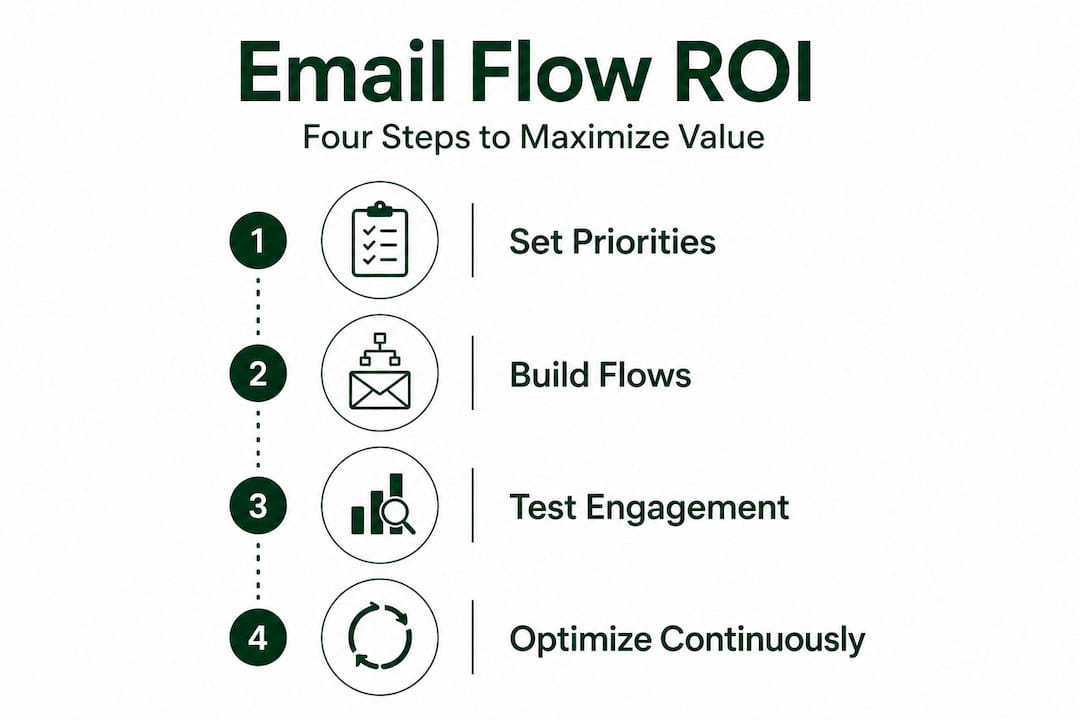
For the strategic layer that ties everything together, the ultimate email strategy gives you a complete lifecycle picture beyond individual flows.
Why most brands underperform with flows (and how to break the mold)
Here’s an uncomfortable truth: most DTC brands that have flows running are not actually managing them. They built a welcome series and a cart abandonment sequence 18 months ago, both look fine in the dashboard, and they haven’t been touched since. That’s the industry norm. And it’s why the performance gap between average brands and top performers keeps growing.
Flows are 3-18x more efficient than campaigns, but that efficiency doesn’t sustain itself. Customer behavior shifts. Product catalogs change. Seasonality affects timing. An abandoned cart flow built when your average order value was $45 may be completely misaligned with the brand experience when your AOV is $120. The messaging, the offer structure, the urgency logic, all of it needs to be recalibrated regularly.
The real competitive edge we see in top-performing brands is not a better welcome series. It’s a culture of continuous iteration. Weekly performance reviews, monthly split-test launches, quarterly flow audits. That cadence is what separates brands that extract 50% of revenue from flows versus those stuck at 20%.
The other pattern we consistently see is brands relying on flows to do the segmentation work that should have happened at the list level. Deep segmentation, built before a customer even enters a flow, makes every flow smarter. When your flows know whether a subscriber is a high-LTV repeat buyer, a deal seeker, or a lapsed gifter, the personalization becomes genuinely meaningful rather than just cosmetic. For teams looking to develop that level of flow sophistication, email marketing tips that go beyond the basics are worth exploring as a starting point. Challenge your team to answer this question honestly: when did we last change something in our flows based on data? If the answer is longer than 90 days, there’s revenue sitting on the table.
Transform your email flows into a growth engine
Building and optimizing a high-performing flow library takes more than a platform and a few templates. It takes a strategic framework, behavioral data, and relentless iteration. That’s exactly what our team at The Email Marketers builds for 8-figure DTC brands and high-growth retailers every day. Whether you need a full flow audit, advanced segmentation architecture, or a complete retention strategy from scratch, we build the systems that drive compounding LTV growth. Explore our case studies to see the real-world results we’ve delivered for brands like yours. Then check out our Retention Lab services for a tailored approach, or start immediately with the Retention Toolkit to benchmark and accelerate your flows right now.
Frequently asked questions
How do email flows differ from bulk campaigns in e-commerce?
Email flows are automated sequences triggered by specific customer behaviors, while campaigns are scheduled, one-off sends to a broad list segment. Flows deliver the right message at the exact moment a customer takes a relevant action, making them fundamentally more targeted and timely.
Which flow should be set up first for quick revenue impact?
Cart abandonment is the highest-ROI starting point. Abandoned cart flows recover 5-15% of lost carts, with optimized three-email sequences reaching 15-25% recovery rates and first-email open rates as high as 50%.
How frequently should customers receive flow emails to avoid fatigue?
Apply a frequency cap of one flow email per week per customer and actively suppress unengaged subscribers to prevent list burnout and protect your sender reputation.
What metrics are most important for measuring flow performance?
Revenue per recipient (RPR) is the most important metric. Monitor RPR per flow and email, not just open rates, alongside click rates and conversion rates to get an accurate picture of actual revenue contribution.
Do I need advanced tools to run effective flows, or is Shopify enough?
Shopify’s native flows handle basic automation, but scaling requires dedicated platforms. Shopify native works below $250k revenue, while Omnisend suits mid-tier brands and Klaviyo is the preferred platform for brands operating at scale and requiring advanced segmentation.


