.png)


Master customer segmentation for e-commerce growth

TL;DR:
- Advanced segmentation uses behavioral signals and lifecycle data instead of static demographics.
- Validating segments with control groups ensures they generate real incremental revenue.
- Continuous refinement of segmentation as customer behavior evolves creates a lasting competitive advantage.
Most e-commerce marketers still treat segmentation as a demographic exercise: age, gender, location, and maybe average order value. That approach leaves serious money on the table. Advanced customer segmentation leverages behavioral signals, purchase history, and lifecycle stage data to reveal who your most valuable customers actually are and what they need next. The result is smarter retention marketing, more relevant touchpoints, and customer lifetime value that compounds over time. This guide breaks down exactly how to build and validate segmentation strategies that turn one-time buyers into loyal advocates and measurably move the needle on revenue.
Table of Contents
- What is customer segmentation in marketing?
- The key types of customer segmentation for e-commerce
- How to power retention marketing with lifecycle segmentation
- Validating your segmentation: Avoiding common pitfalls
- Why most marketers underuse segmentation and how to break through
- Take your segmentation to the next level with expert support
- Frequently asked questions
Key Takeaways
| Point | Details |
|---|---|
| Beyond basic demographics | Modern segmentation relies on behavioral and lifecycle data for deeper insights and results. |
| Lifecycle segmentation boosts retention | Mapping customers to journey stages enables targeted messaging and higher lifetime value. |
| Always validate segments | Use control groups to confirm your segmentation is driving real incremental lift. |
| Combine methods for success | Layering segmentation types and automating by stage drives powerful retention outcomes. |
What is customer segmentation in marketing?
Customer segmentation is the practice of dividing your customer base into distinct groups based on shared characteristics so you can send more relevant messages, trigger the right offers, and allocate marketing spend efficiently. The concept has been around for decades, but what it means in practice has changed dramatically.
Traditional segmentation relied on static attributes: demographics like age and income, or broad geographic regions. Those attributes are easy to collect but tell you very little about intent. Knowing that a customer is a 35-year-old woman in Chicago doesn’t tell you she just browsed your leather handbag collection three times this week, added to cart, and then abandoned. That behavioral signal is infinitely more useful for driving a conversion.
Modern advanced segmentation replaces static labels with dynamic, data-driven groupings built from real customer behavior. This includes:
- Purchase frequency and recency: When did a customer last buy, and how often do they return?
- Category affinity: Do they consistently buy skincare, supplements, or outerwear?
- Engagement signals: Do they open every email, or only click when there’s a discount?
- On-site behavior: Which product pages do they visit, and for how long?
- Referral patterns: Do they bring in new customers through word of mouth?
These behavioral attributes feed into a richer segmentation model that powers genuine personalization at scale. As CDP.com explains, lifecycle marketing operationalizes segmentation by stage (what customers are doing and where they are in the journey) and uses unified profiles plus automated stage assignment to deliver cross-channel messages that maximize lifetime value.
“The goal of segmentation is not to label your customers. It’s to anticipate what they need before they know they need it.”
Leading e-commerce brands like Gymshark, Allbirds, and SKIMS have moved far beyond demographic splits. Their retention teams use real-time behavioral data to group customers dynamically, meaning a customer’s segment can shift within days based on new activity. Understanding what email segmenting really means in the context of your ESP or CDP is the first step toward that level of sophistication. The role of email segmentation extends well beyond open rates. It is the architectural backbone of every retention campaign that actually scales.
The business case is straightforward. When you send more relevant messages, more people engage. When more people engage, repeat purchase rates climb. When repeat purchase rates climb, customer lifetime value grows without increasing your acquisition budget. That compounding effect is what separates brands that scale profitably from those that stay dependent on paid media to survive.

The key types of customer segmentation for e-commerce
With the basics covered, let’s explore the specific segmentation methods that power high-performing e-commerce marketing.
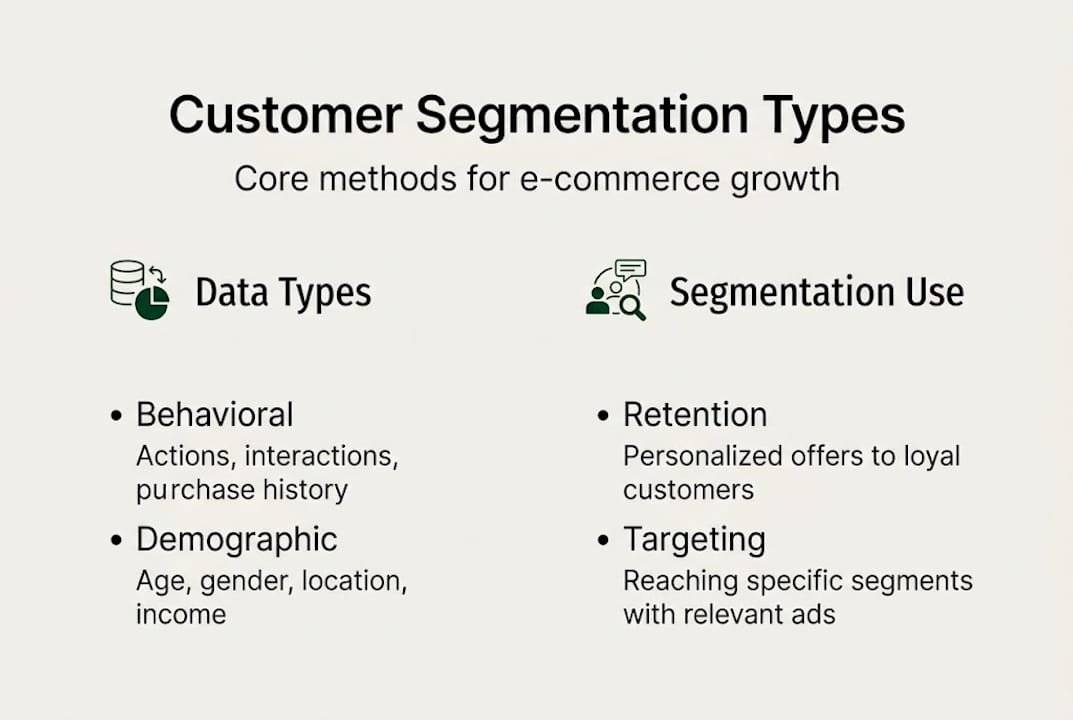
1. Behavioral segmentation This is the most powerful segmentation type for retention. It groups customers by what they actually do: browsing patterns, purchase history, cart behavior, email click-throughs, and product reviews. A customer who bought twice in the last 60 days and opens 80% of your emails is fundamentally different from one who bought once six months ago and never clicked. Behavioral segmentation captures that difference and triggers the right response automatically.
2. Demographic and psychographic segmentation Demographics (age, gender, income) still have a role, but it’s a supporting role. Psychographic segmentation goes deeper by grouping customers based on values, lifestyle, and purchase motivation. A premium outdoor brand, for example, might segment by “sustainability-driven buyers” versus “performance-first buyers,” even if both groups are similar in age and income. This layer adds meaning to behavioral data when crafting messaging and creative.
3. Lifecycle segmentation This is where e-commerce retention marketing becomes sophisticated. Lifecycle segmentation maps customers to specific journey stages: new, active, at-risk, lapsed, and loyal. The lifecycle marketing model relies on behavioral data, purchase history, and engagement signals to assign lifecycle stages, with CDPs supporting unified customer profiles, automated stage assignment, and cross-channel activation.
4. RFM segmentation (Recency, Frequency, Monetary value) RFM is a proven quantitative method. It scores customers across three dimensions and lets you identify your champions (high on all three), at-risk loyalists (high frequency and monetary value but declining recency), and low-value one-time buyers. RFM is particularly useful for prioritizing where to invest retention spend.
| Segmentation type | Data required | Ideal use case |
|---|---|---|
| Behavioral | Browse, purchase, click history | Triggered automations and flows |
| Demographic | Age, gender, location | Creative and offer personalization |
| Psychographic | Surveys, purchase motivation | Brand messaging and tone |
| Lifecycle | Purchase timing, engagement score | Retention and reactivation campaigns |
| RFM | Recency, frequency, spend | Prioritizing retention budget |
The real power comes when you layer these methods together. For example, combining lifecycle stage (at-risk) with behavioral data (category affinity for supplements) and RFM score (historically high value) lets you send a hyper-targeted reactivation message with the exact product category most likely to bring them back. These segmenting tips and tricks are what separate commodity email programs from genuine retention engines.
Pro Tip: Don’t try to layer all five segmentation types at once. Start with behavioral and lifecycle, validate performance, then add RFM and psychographic layers as your data infrastructure matures. Complexity without validation is just noise. A personalized email strategy built on clean segmentation logic will always outperform one built on assumptions.
How to power retention marketing with lifecycle segmentation
Understanding the types, let’s focus on lifecycle segmentation, one of the most effective for e-commerce retention.
Lifecycle segmentation assigns every customer to a journey stage based on their behavior over time. The most common stages for e-commerce brands are: new buyer, active buyer, at-risk buyer, lapsed buyer, and loyal advocate. Each stage requires a different retention tactic, message, and goal.
Here’s what that looks like in practice:
- New buyer: Just completed first purchase. Goal is to drive a second purchase within 30 to 45 days, which research consistently shows is the most critical conversion window for long-term retention.
- Active buyer: Purchasing regularly and engaging with content. Goal is to increase average order value through upsells, bundles, and early access offers.
- At-risk buyer: Engagement and purchase frequency are declining. A win-back sequence with urgency and incentive is critical here.
- Lapsed buyer: Has not purchased in 90 or more days. Requires a stronger reactivation push, often including a significant offer or a compelling content-driven re-engagement campaign.
- Loyal advocate: High purchase frequency, strong engagement, potentially refers others. This segment deserves VIP treatment: early access, exclusive products, and community involvement.
The key to making lifecycle segmentation work at scale is automation. As lifecycle marketing operationalizes segmentation by stage, using unified profiles and automated stage assignment delivers cross-channel messages that maximize lifetime value without requiring your team to manually manage every transition.
| Lifecycle stage | Behavioral trigger | Recommended action | Goal |
|---|---|---|---|
| New buyer | First purchase completed | Welcome flow + second purchase prompt | Drive repeat buy |
| Active buyer | Two or more purchases in 60 days | Upsell and loyalty program invite | Increase AOV |
| At-risk buyer | No purchase in 45 to 60 days | Win-back sequence with offer | Re-engage |
| Lapsed buyer | No purchase in 90+ days | Reactivation campaign + strong incentive | Recover revenue |
| Loyal advocate | High RFM score, strong engagement | VIP program, referral ask | Amplify LTV |
Brands using automated lifecycle flows consistently see meaningful gains in both retention rate and revenue per customer. This isn’t theoretical. The how-to guide to segmentation provides concrete implementation frameworks that translate lifecycle theory into real campaign architecture. Brands that commit to boosting retention with segmentation consistently outpace competitors who rely on batch-and-blast messaging.
The highest-performing retention teams also set clear metrics for each lifecycle stage: second purchase rate for new buyers, purchase frequency for active buyers, and reactivation rate for lapsed buyers. When you track performance by stage, you can identify exactly where your retention funnel leaks and fix it with precision.
Validating your segmentation: Avoiding common pitfalls
Advanced segmentation can supercharge results, but only if you validate your approach to avoid common and costly mistakes.
The most dangerous mistake in segmentation is assuming that because you created segments, they are working. Many marketing teams invest heavily in building sophisticated segment structures, then measure success by vanity metrics like open rate or click rate within the segment. What they don’t measure is whether the segment is actually driving incremental revenue or just redistributing it.
This is where control and test group validation becomes non-negotiable. As incremental lift methodology explains, you must validate that segments drive incremental lift using control versus test groups within segments. Otherwise, you may only be redistributing spend, not generating new revenue.
Here is a clear, step-by-step approach to implementing proper validation:
- Define your segment clearly. Before you run any campaign, document exactly which behavioral or lifecycle criteria define the segment. Vague definitions lead to overlap and measurement errors.
- Split the segment into test and control groups. Randomly assign approximately 10 to 20% of the segment to a holdout (control) group that receives no targeted campaign. The remaining 80 to 90% receives the treatment.
- Run the campaign for a statistically significant period. Depending on your email volume and purchase frequency, this is typically two to four weeks. Shorter windows produce unreliable data.
- Compare revenue and conversion metrics between groups. The incremental lift is the difference in purchase rate or revenue between the test group and the holdout. If the difference is minimal, your segment may not be as predictive as you thought.
- Iterate based on findings. If lift is strong, scale the segment. If lift is weak, investigate whether the segment definition, the offer, or the timing is the problem.
“Segmentation without validation is decoration. Real lift requires a holdout group and honest measurement.”
Common pitfalls to avoid go beyond just skipping holdouts. Many teams over-segment, creating so many micro-segments that each one becomes too small to generate statistically reliable data. Others under-segment, treating all “active buyers” the same when category affinity and purchase frequency within that group vary enormously.
Pro Tip: Validate your highest-priority segment first before scaling spend. A validated segment gives you the confidence to invest in sophisticated automation, while an unvalidated one can silently waste budget for months. Applying strategies for customer loyalty works best when built on a foundation of proven segmentation logic. And when you personalize email content, tie each personalization decision back to a validated segment to ensure relevance is measurable, not assumed.
Validation is also an ongoing discipline. Customer behavior shifts with seasons, promotions, and market conditions. A segment that drove strong lift in Q4 may need to be recalibrated in Q1 when purchase intent patterns change. Build a quarterly validation review into your retention marketing calendar.
Why most marketers underuse segmentation and how to break through
Here’s an uncomfortable truth: most e-commerce teams know segmentation matters, and most still do it poorly. The barrier is not knowledge. It’s organizational habits.
Segmentation is frequently treated as a setup task, something you configure once when you launch your ESP, then leave untouched for months or years. Meanwhile, your customer base is evolving constantly. New buyers are entering the funnel, loyal customers are drifting toward at-risk status, and lapsed buyers are quietly giving their wallet share to a competitor.
The bigger issue is where most teams focus their energy. Acquisition gets the budget, the creative attention, and the executive reporting. Retention segmentation often gets delegated to a junior team member or left on autopilot. That imbalance is exactly why advanced segmentation insights from mature retention programs consistently show that the brands with the highest LTV are not the ones spending the most on acquisition. They are the ones investing in continuous segmentation refinement.
The mindset shift that changes everything is this: think of segmentation as a living feedback loop, not a static framework. Every campaign you send teaches you something about your customers. Their response rates, purchase patterns, and churn signals feed back into your segmentation model, making it sharper with every iteration. Brands that build this loop deliberately create a compounding advantage over time. Your segments get more accurate, your messages get more relevant, and your retention costs go down while LTV goes up. That is not a marginal gain. That is a structural competitive advantage.
Take your segmentation to the next level with expert support
Ready to see real gains from your segmentation work? The Email Marketers builds the kind of lifecycle and behavioral segmentation strategies that turn your customer data into a genuine revenue engine. Whether you’re starting from scratch or refining an existing retention program, our team has the frameworks and hands-on experience to move fast and measure what matters. Explore the Retention Lab to see how we approach segmentation-driven retention at scale, or see real e-commerce results from brands we’ve helped grow. When you’re ready to invest in retention done right, The Email Marketers is the team to call.
Frequently asked questions
What is the difference between behavioral and lifecycle segmentation?
Behavioral segmentation groups customers by their specific actions (browsing, purchasing, clicking), while lifecycle segmentation maps them to journey stages for automated retention. Lifecycle marketing relies on behavioral data, purchase history, and engagement signals to assign those stages.
How can I measure if my segmentation strategy works?
Use control and test groups within segments to measure incremental lift and isolate real performance gains from redistribution effects. Incremental lift methodology requires comparing the test group to a holdout to confirm your segment is genuinely driving new revenue.
What data is most important for effective segmentation in e-commerce?
Behavioral data, purchase history, and engagement signals are the foundation of advanced segmentation that actually impacts retention. These inputs allow lifecycle marketing models to assign stages accurately and trigger the right message at the right time.
Should I prioritize segmentation or personalization first?
Build and validate your segmentation architecture first, then layer in personalization. Personalization without a clean segmentation foundation produces irrelevant messages at scale, which erodes trust rather than building it.


