.png)


Mailchimp best practices: Advanced email strategies for DTC

TL;DR:
- Strategy and segmentation are crucial for successful email marketing in DTC brands.
- Proper deliverability practices and automation optimize customer retention and revenue growth.
- Continuous testing and data-driven segmentation drive long-term email marketing success.
Many DTC brands pour significant budget into email marketing and still see flat results. The culprit is rarely effort. It is almost always strategy. Sending more emails does not mean earning more revenue, and the brands learning that lesson the hard way are often the ones relying on surface-level tactics instead of evidence-backed frameworks. As noted in a breakdown of email marketing for small businesses, many campaigns fail not due to lack of effort, but because of missed strategic opportunities. This guide covers the advanced Mailchimp practices that high-performing DTC brands actually use: segmentation, automation, deliverability, and retention-focused optimization.
Table of Contents
- Understanding Mailchimp’s platform for DTC brands
- Segmentation and personalization: The foundation of email ROI
- Deliverability and compliance: Ensuring your emails reach the inbox
- Automation, testing, and continuous improvement for retention
- What most Mailchimp guides miss (and what actually drives growth)
- Unlocking your retention advantage with expert support
- Frequently asked questions
Key Takeaways
| Point | Details |
|---|---|
| Segment for higher ROI | Dividing your list by behavior and lifecycle yields better engagement and revenue. |
| Prioritize deliverability | Strong sender reputation and compliance practices are vital to inbox placement. |
| Automate retention flows | Automate welcome, post-purchase, and re-engagement emails for sustainable DTC growth. |
| Continuously A/B test campaigns | Regular testing and analytics ensure your strategies evolve with your audience. |
Understanding Mailchimp’s platform for DTC brands
Mailchimp is often dismissed as a “beginner” tool, but that reputation is outdated and, frankly, costly to believe. When configured correctly, it is a serious platform for DTC brands ready to build scalable retention systems. The gap between a casual user and a power user on Mailchimp is enormous, and most brands never close it.
DTC brands have different needs than a local bakery sending a weekly newsletter. You are managing purchase cycles, repeat buyer behavior, seasonal demand, and multi-touch customer journeys. Mailchimp offers automation features specifically tailored for e-commerce growth, including behavioral targeting, automation triggers, and robust analytics that small-business users rarely need at that depth.
Here is how Mailchimp compares to two other popular platforms:
| Feature | Mailchimp | Klaviyo | ActiveCampaign |
|---|---|---|---|
| E-commerce integrations | Strong (Shopify, WooCommerce) | Best-in-class | Moderate |
| Behavioral triggers | Yes | Advanced | Yes |
| Predictive analytics | Basic | Advanced | Moderate |
| Price scalability | Mid-range | Higher cost | Mid-range |
| Ease of use | High | Moderate | Moderate |
Klaviyo edges Mailchimp on predictive analytics and advanced segmentation depth for very large catalogs. But Mailchimp wins on accessibility, cost-effectiveness, and a lower learning curve that lets mid-market DTC teams move fast without heavy technical resources.
For brands using ecommerce marketing strategies built around speed-to-market and iterative testing, Mailchimp delivers real advantages. Key platform capabilities to leverage include:
- Behavioral automation triggers tied to purchase events, browse abandonment, and product views
- Audience segmentation using tags, custom fields, and predicted spend tiers
- Pre-built e-commerce templates designed for product promotion and post-purchase flows
- Analytics dashboards tracking revenue per email, list growth, and click maps
- Native Shopify and WooCommerce sync for real-time customer data
The platform is scalable. The question is whether your strategy matches its capabilities.
Segmentation and personalization: The foundation of email ROI
Mailchimp’s features are most powerful when you leverage them for deep personalization and segmentation. Sending the same email to your entire list is one of the fastest ways to train your audience to ignore you.

Segmented campaigns achieve significantly higher open and click-through rates compared to batch-and-blast approaches. The lift is not marginal. It is the kind of improvement that changes the revenue trajectory of a brand.
Here is what that performance difference looks like in practice:
| Campaign type | Average open rate | Average CTR | Revenue per email |
|---|---|---|---|
| Non-segmented | 18% | 2.1% | $0.08 |
| Segmented | 29% | 5.4% | $0.22 |
| Behaviorally triggered | 41% | 9.8% | $0.61 |
The data is clear: segmentation compounds results. And behavioral triggers are the highest-leverage move available to most DTC teams.
Here is a step-by-step framework for setting up advanced segmentation in Mailchimp:
- Audit your data sources. Connect your Shopify or WooCommerce store to sync purchase history, product categories, and spend data.
- Define your core segments. Start with lifecycle stage (new, active, lapsed) and purchase frequency (one-time vs. repeat buyer).
- Layer behavioral signals. Use email engagement history and on-site browse data to refine each segment.
- Build dynamic segments. Set up auto-updating segments in Mailchimp so contacts move between groups as their behavior changes.
- Create tailored content blocks. Use Mailchimp’s conditional content feature to show different product recommendations or offers based on segment.
Personalization strategies go far beyond first-name tags. Dynamic content blocks that change based on past purchases, location-triggered promotions, and automated product recommendations all drive meaningful lifts. Review your email segmenting basics to build a strong foundation before layering advanced tactics.
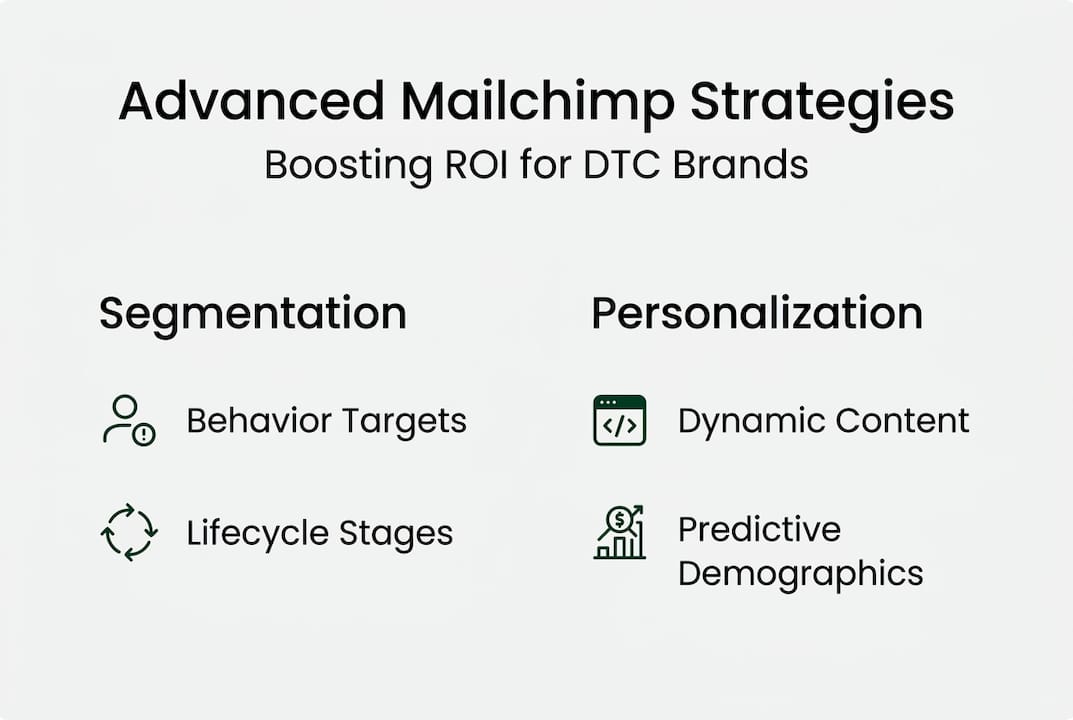
Pro Tip: Mailchimp’s predictive demographics and Mailchimp personalization resources can help you identify high-LTV customer clusters before they self-identify. Build a VIP segment proactively, not reactively, and you will protect your most valuable relationships.
Deliverability and compliance: Ensuring your emails reach the inbox
Higher engagement means nothing if your messages are not landing where they should. Deliverability is the invisible variable that determines whether all your segmentation and personalization work actually pays off.
As improving email deliverability makes clear, even the best campaigns fail if they do not land in the inbox. For DTC brands sending at volume, deliverability is not a technical afterthought. It is a revenue issue.
The core factors that impact deliverability for DTC brands include sender reputation, list hygiene, authentication setup, and engagement rate. A warm, authenticated sending domain with a clean, engaged list will consistently outperform a spammy list with a great-looking template.
Here is a compliance checklist every DTC brand should follow:
- Do: Use confirmed double opt-in to verify subscriber intent
- Do: Include a visible, one-click unsubscribe link in every email
- Do: Honor opt-out requests within 10 business days (CAN-SPAM requirement)
- Do: Clearly identify your brand in the sender name and subject line
- Don’t: Import purchased or scraped lists
- Don’t: Send to unengaged contacts for more than 90 days without a re-engagement campaign
- Don’t: Use misleading subject lines or deceptive preheader text
Authentication is non-negotiable. Setting up SPF (Sender Policy Framework) and DKIM (DomainKeys Identified Mail) records through your DNS provider tells receiving mail servers that Mailchimp is authorized to send on your behalf. Without these, your emails are more likely to be flagged. Review Mailchimp’s deliverability guidance and your own email deliverability basics to get the technical setup right.
Industry benchmarks show that DTC brands with authenticated domains and clean lists achieve inbox placement rates above 90%, while brands without proper authentication often see rates fall below 75%.
Pro Tip: Set up a dedicated sending domain rather than using Mailchimp’s shared domain. Then run seed list tests before major campaign sends. A seed list places test addresses at major ISPs (Gmail, Outlook, Yahoo) so you can see where your emails land before your whole list receives them.
Automation, testing, and continuous improvement for retention
Achieving next-level results means automating and constantly optimizing your campaigns. A one-off email blast, even a well-written one, does not build retention. Lifecycle automation does.
Retention automation and testing are key to sustainable e-commerce growth. The brands winning at retention are not just sending more; they are sending smarter, at precisely the right moment in the customer journey.
Here is how to build a multistage lifecycle automation in Mailchimp:
- Map your customer journey. Identify the five to seven key moments: first purchase, second purchase, 60-day lapse, win-back threshold, and VIP milestone.
- Create the trigger logic. Set Mailchimp automations to fire based on date of purchase, tag assignment, or behavioral event.
- Write sequence-specific content. Each touchpoint needs a distinct message, not a recycled promotional template.
- Set time delays intentionally. Welcome emails fire immediately; post-purchase follow-ups often perform best at 48 to 72 hours.
- Connect automations to segments. Ensure only the right contacts enter each flow by filtering on lifecycle tags.
Once automations are live, the work shifts to optimization. Key metrics to monitor include:
- Open rate by automation step to find drop-off points
- Click-to-open rate (CTOR) to measure content relevance
- Revenue per recipient across each flow
- Unsubscribe rate as a signal of message fatigue
- Repeat purchase rate as the ultimate retention indicator
Use Mailchimp’s built-in A/B testing guide to run systematic tests on subject lines, send times, and content structure. Review your A/B testing basics to structure tests that give you clean, actionable data rather than inconclusive results. And use the boost email marketing framework to prioritize which experiments deliver the highest retention impact.
Pro Tip: Stop measuring email success campaign by campaign. Measure retention rate, repeat purchase frequency, and customer lifetime value monthly. When those numbers move, your automation strategy is working.
What most Mailchimp guides miss (and what actually drives growth)
Most Mailchimp tutorials focus on open rates and subject line tricks. Those things matter at the margins. What actually compounds over time is a commitment to treating every campaign as a retention experiment, not a one-off revenue grab.
The brands we see growing consistently are not the ones with the cleverest copy. They are the ones who obsess over customer data, build tighter segments every quarter, and treat automation as a living system that gets smarter with each cycle. They understand that a 2% improvement in retention rate can drive more long-term revenue than a 20% lift in a single campaign.
Conventional advice tells you to focus on the next send. The smarter play is to ask what that email teaches you about your customer. Use your strategy case studies to benchmark your approach against brands that have already cracked this. Every touchpoint is data. Every data point is an opportunity to improve the next one.
Unlocking your retention advantage with expert support
For DTC marketers ready to shift from tactics to outcomes, the right partner offers a shortcut to success. The Email Marketers specialize in building exactly the kind of retention-first Mailchimp systems this guide covers, from advanced segmentation and lifecycle automation to deliverability optimization and continuous testing. Explore our case studies to see how brands like yours have achieved measurable lifts in repeat purchase rate and customer lifetime value. Access the Retention Lab for proven playbooks, or start with our Retention Toolkit to identify the highest-impact opportunities in your current email program. Book a strategy session and get a clear path from where you are to where you want to be.
Frequently asked questions
What are the most effective Mailchimp automation workflows for e-commerce retention?
The most effective Mailchimp automations for DTC retention are welcome series, post-purchase follow-ups, abandoned cart recovery, and re-engagement campaigns. Lifecycle automations like post-purchase and re-engagement flows are foundational for sustained retention.
How can I improve the deliverability of my Mailchimp email campaigns?
Authenticate your sending domain, use confirmed opt-ins, and regularly clean your list to maximize inbox placement. List hygiene and authentication are the two highest-leverage actions you can take before anything else.
Is Mailchimp suitable for scaling DTC brands, or does it cap growth?
With advanced segmentation, automation, and analytics, Mailchimp is fully capable of supporting fast-growing DTC brands. Mailchimp’s e-commerce tools enable robust growth and complex workflows for scaling brands that configure the platform correctly.
How should I use segmentation in Mailchimp to boost my email ROI?
Segment by purchase behavior, engagement level, and customer lifecycle stage to deliver targeted, high-converting content. Segmentation improves open and click rates, which directly drives higher ROI across every campaign type.
What’s the best way to A/B test emails in Mailchimp?
Test subject lines, send times, and content blocks one variable at a time, then iterate with winning elements for ongoing improvement. Continuous A/B testing leads to more effective campaigns because it builds cumulative knowledge about what your specific audience responds to.
Recommended
- Email marketing design best practices for ecommerce 2026
- Master email marketing frequency for better retention
- Email design best practices to boost engagement in 2026
- Email Marketing Management: Must-Do Best Practices for 2022
- Optimize customer conversation management workflow: 5 steps | SuperSocial Blog


