.png)


Lifecycle marketing steps: a complete guide to maximize retention
TL;DR:
- Most e-commerce brands fail to retain loyal customers because they focus too heavily on acquisition rather than continuous optimization of lifecycle marketing. Building a systematic, data-driven retention program with ongoing iteration and cross-functional ownership is essential to turn one-time buyers into brand advocates. Regularly analyzing key metrics and adapting flows ensures sustained growth and maximizes revenue from existing customers.
Retention is where real revenue lives, yet most e-commerce brands keep pouring budget into acquisition while loyal customers quietly drift away. A well-executed lifecycle marketing program fixes that. It turns one-time buyers into repeat customers, and repeat customers into brand advocates who spend more, refer others, and churn far less. This guide walks you through every foundational step, from building the right infrastructure to measuring and iterating on results, so you can build a retention engine that compounds over time instead of stalling the moment paid media slows down.
Table of Contents
- What you need to get started with lifecycle marketing
- Step-by-step: The five key stages of lifecycle marketing
- Troubleshooting and optimization: Avoiding common lifecycle marketing pitfalls
- Verification: Measuring success and iterating your lifecycle programs
- Why most lifecycle marketing programs fall short—and what actually works
- Ready to unlock real retention growth?
- Frequently asked questions
Key Takeaways
| Point | Details |
|---|---|
| Automation is critical | Building lifecycle journeys on automated flows outperforms traditional batch campaigns for revenue and engagement. |
| All stages matter | Retention gains come from optimizing every phase, not just acquisition—especially post-purchase and loyalty. |
| Feedback fuels results | Continuous feedback loops allow you to quickly spot issues and improve campaigns for better retention outcomes. |
| Data-driven decisions | Use real-time measurement and AI-powered tools to track, analyze, and rapidly optimize your lifecycle marketing. |
| Iterate relentlessly | The best retention teams revisit and refine their flows regularly instead of relying on set-and-forget tactics. |
What you need to get started with lifecycle marketing
Before you send a single triggered email or SMS, you need the right foundation in place. Lifecycle marketing is not a tactic. It is a systematic approach to engaging customers at every stage of their relationship with your brand, using the right message, channel, and timing. Without proper infrastructure, even well-designed campaigns will fall flat.
The core technology stack includes an email service provider (ESP), a CRM or customer data platform, a behavioral analytics tool, and an automation platform that ties everything together. Data connectors ensure your store data, purchase history, and engagement signals flow cleanly between systems. If your data is siloed, your personalization will be generic, and generic messaging does not move retention metrics.
Understanding your customer journey essentials is equally important. You need to map behavioral signals: when someone browses without buying, abandons a cart, makes a first purchase, or goes quiet for 60 days. These signals are the triggers that make lifecycle automation powerful. They allow you to respond to what customers actually do, not what you assume they will do.
Team readiness matters too. Lifecycle marketing works best when marketing, data, creative, and customer success teams are aligned. Someone needs to own the strategy, someone needs to execute flows, and someone needs to analyze results and push changes through. Cross-functional buy-in is not optional at scale.
As Braze notes, “lifecycle (retention) programs should be built as automated, multi-step ‘journeys’ triggered by lifecycle moments,” which means your team must shift from thinking in one-off campaigns to thinking in ongoing, mastering lifecycle email flows that evolve with the customer.
Core lifecycle marketing requirements checklist
| Requirement | Tool/Resource example | Team owner |
|---|---|---|
| Email/SMS automation | Klaviyo, Postscript | Marketing ops |
| Customer data platform | Segment, Bloomreach | Data/Engineering |
| Behavioral analytics | GA4, Triple Whale | Growth/Analytics |
| CRM or loyalty platform | Gorgias, Yotpo | CX/Marketing |
| Creative templates | Internal or agency | Creative team |
| Flow ownership | Documented SOPs | Retention lead |
Understanding marketing automation basics will help newer team members get up to speed without slowing your rollout timeline.
Pro Tip: Do not try to build every flow at once. Start with the three that generate the most immediate revenue: welcome series, abandoned cart, and post-purchase. These three alone can account for the majority of your automated email revenue. Get them performing well before expanding.
Step-by-step: The five key stages of lifecycle marketing
With your foundation in place, you are ready to implement the full lifecycle. Each stage requires distinct objectives, triggers, and content strategies. Skipping stages or treating them as optional is one of the most expensive mistakes a retention team can make.
Klaviyo maps the e-commerce lifecycle into five core stages that span from first awareness to long-term loyalty, and each stage demands a tailored set of automated flows and messaging.
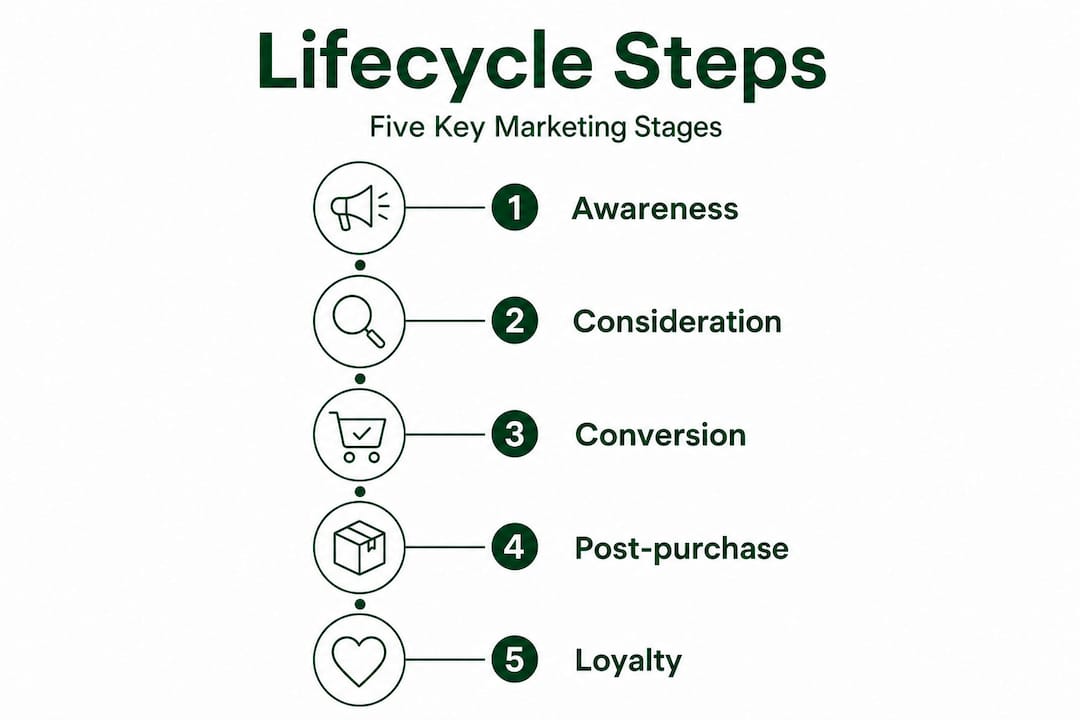
Stage 1: Awareness The objective here is to capture attention and collect opt-ins from potential customers. Flows include pop-up lead capture sequences and paid social retargeting integrated with email. Your success metric is list growth rate and cost per subscriber.
Stage 2: Consideration Prospects know your brand but have not purchased yet. Your automation should include browse abandonment flows, product interest sequences, and educational content that reduces purchase hesitation. Conversion from list to first buyer is the key metric here.
Stage 3: Conversion This is where you turn interested contacts into paying customers. Abandoned cart flows are your highest-leverage tool at this stage. A three-email sequence over 24 to 48 hours, with a soft reminder, a value-focused follow-up, and a final incentive, consistently outperforms single-message sends.

Stage 4: Post-purchase Most brands underinvest here. Post-purchase flows should include order confirmations with cross-sell recommendations, onboarding sequences for first-time buyers, product usage education, and review requests. This stage builds the habit of buying from you again.
Stage 5: Loyalty Repeat buyers and VIP customers deserve a different experience. Loyalty flows include early access announcements, exclusive offers, referral invitations, and re-engagement sequences for customers who have gone quiet. This is where customer lifetime value really accelerates.
Here is a comparison of what batch campaigns deliver versus behavior-triggered flows at each stage:
| Lifecycle stage | Batch campaign result | Behavior-triggered flow result |
|---|---|---|
| Awareness | Generic welcome blast | Personalized intro based on source |
| Consideration | Newsletter to full list | Browse-based product recommendations |
| Conversion | Promo email to all | Abandoned cart with timing logic |
| Post-purchase | One transactional receipt | Multi-step nurture with cross-sells |
| Loyalty | Seasonal discount | VIP recognition + early access trigger |
Flows generate nearly 41% of total email revenue from just 5.3% of sends, according to Klaviyo’s 2026 benchmarks. That ratio alone should shift how your team allocates resources between batch campaigns and automated journeys.
Pro Tip: Post-purchase and loyalty flows are where most teams leave serious money on the table. The first 30 days after a purchase are the most influential window for driving a second order. If you do not have an automated sequence that educates, cross-sells, and re-engages within that window, you are losing repeat buyers to competitors who do.
A repeat purchase flow might look like this as an ordered sequence:
- Send order confirmation with product education and related item suggestions (Day 0)
- Deliver a product use tip or tutorial email (Day 3)
- Request a review with an incentive tied to the next purchase (Day 7)
- Send a cross-sell recommendation based on the purchased product category (Day 14)
- Trigger a win-back or VIP upgrade if they have not bought again (Day 30)
For deeper execution guidance, review best performing email flows and your automation campaign primer to align your tech with this framework. You can also explore email marketing tactics for additional channel-level context.
Troubleshooting and optimization: Avoiding common lifecycle marketing pitfalls
With your new lifecycle steps in play, it is crucial to address the challenges that trip up even well-resourced teams. Building flows is the easy part. Keeping them optimized over time is where most programs lose momentum.
The most common execution errors include relying on calendar-based triggers instead of behavioral ones, measuring only lagging KPIs like total revenue rather than leading signals like open rate trends or cart recovery rate, skipping feedback loops entirely, and allowing manual reporting bottlenecks to delay course correction by weeks or months.
Here are the most frequent pitfalls and what to do instead:
- Relying only on calendar triggers: Replace date-based sends with behavior triggers. If a customer just purchased, do not send them a “buy now” email three days later because your campaign calendar says so.
- Ignoring lagging KPIs: Track leading indicators like email click rates, product page visits after a flow email, and repeat purchase rate within 30 days, not just end-of-month revenue.
- Skipping feedback collection: Build review requests, NPS surveys, and preference center updates into your flows. Customers will tell you what they need if you ask at the right moment.
- Manual reporting bottlenecks: If your team spends more time pulling reports than acting on them, automate your dashboards and set alerts for metric drops.
- Over-messaging without relevance: Sending too many emails or SMS messages to the same segment without personalization erodes engagement and accelerates unsubscribes.
- Neglecting dormant segment reactivation: Customers who have not engaged in 90 or 120 days need a different approach, not the same general newsletter your active buyers receive.
“Measuring success is still a nightmare for 48% of marketers,” according to Customer.io’s 2025 lifecycle marketing research, which also found that operational friction and poor data integration are the top barriers to effective lifecycle execution.
Braze also emphasizes that reactivation and repeat purchase messaging should be driven by recency and engagement signals, not calendar rules alone. This edge-case distinction matters enormously at scale.
Your retention optimization guide covers the mechanics behind incremental retention lifts, and your retention best practices resource outlines the current standards for 2026 execution.
Verification: Measuring success and iterating your lifecycle programs
After troubleshooting, the final component is verification. Tracking performance at each lifecycle stage and iterating based on what the data tells you is what separates brands that grow retention year over year from those who plateau after initial setup.
Here is a numbered framework for verifying your lifecycle programs are working:
- Track leading metrics by stage: Open rate, click rate, and conversion rate for each individual flow, not just aggregate metrics. A drop in your abandoned cart open rate tells you something specific.
- Monitor revenue per stage: Measure the revenue attributed to each lifecycle stage monthly. This tells you where your flows are performing and where they are leaking.
- Survey customers after milestones: Send a simple NPS or satisfaction survey after a purchase, after product delivery, and after a loyalty milestone. This qualitative data surfaces issues your analytics will not catch.
- Use AI for pattern detection: Modern platforms can flag anomalies in your flow performance before they become significant revenue problems. Use AI-assisted insights rather than waiting for manual reports to surface the issue.
- Run structured A/B tests: Test one variable per flow at a time, subject line, send time, offer type, or email length. Document what you test and what you learn so institutional knowledge builds over time.
- Set a monthly review cadence: Review all key flows at least monthly. Look for drops in engagement or revenue, changes in customer behavior, or shifts in acquisition channel mix that might affect how new subscribers enter your lifecycle.
Customer.io’s 2025 survey data found that 72% of marketers who adopted AI for copywriting and data analysis reported getting more than 20% of their time back, which they reinvested into strategy and creative iteration.
Braze highlights that building genuine feedback loops into your lifecycle is a key retention mechanic for 2025 and beyond. Feedback is not just about satisfaction scores. It is about closing the loop with a follow-up action that shows the customer their input mattered.
Pro Tip: Automate your feedback requests, but make the follow-up feel human. If a customer gives you a low NPS score, trigger a personal outreach from your CX team within 48 hours. That kind of responsiveness builds loyalty faster than any promotional offer.
Your AI and automation tools guide walks through practical implementation for e-commerce teams, and exploring revenue-boosting strategies will help you connect your verification work to measurable revenue outcomes.
Why most lifecycle marketing programs fall short—and what actually works
Here is something most guides will not tell you: the biggest lifecycle marketing failures we see are not caused by bad strategy. They are caused by good strategy that was built once and never touched again.
Launching a welcome flow and an abandoned cart sequence is table stakes in 2026. The brands that consistently outperform on retention are not the ones with the most sophisticated initial setup. They are the ones that have built a culture of iteration around their lifecycle programs. They review metrics weekly. They test something new every month. They act on customer feedback within days, not quarters.
Too many e-commerce marketing teams are acquisition-first in their thinking, even when they describe themselves as retention-focused. They will spend weeks optimizing a new customer acquisition campaign and leave their post-purchase flow untouched for a year. That imbalance is exactly where retention gaps form.
What actually moves the needle is operationalizing the feedback loop. Not just collecting data, but building clear internal processes for who reviews it, when they review it, and what decisions they are empowered to make based on what they find. When that process is absent, even the best-designed flows become stale. Customer behavior changes. Offer relevance fades. Engagement drops. And because no one is watching closely, it takes months to notice.
Our experience with proven lifecycle case studies consistently shows that the most transformative retention gains come from rapid course correction, not from perfect initial execution. Brands that ship, measure, and improve fast outperform those who spend months perfecting a flow before launch.
The uncomfortable truth is that lifecycle marketing success is 20% strategy and 80% discipline. Discipline to test. Discipline to measure honestly. Discipline to prioritize post-purchase and loyalty mechanics even when the acquisition team is asking for more support. If your lifecycle program is not growing smarter every month, it is falling behind.
Ready to unlock real retention growth?
If you have worked through the steps in this guide and are ready to accelerate execution, The Email Marketers brings the strategic depth and hands-on expertise that high-performing e-commerce brands need. We specialize in building and optimizing full lifecycle programs for 8-figure DTC brands, VC-backed retailers, and subscription businesses that take retention seriously. From automated flow builds to segmentation strategy and ongoing iteration, we do the work that actually moves customer lifetime value. Explore what is possible through our Retention Lab, review real client results from brands we have scaled, and download the Retention Toolkit to start building your retention engine today.
Frequently asked questions
What’s the difference between batch campaigns and lifecycle flows?
Batch campaigns are one-off sends delivered to a broad list on a set schedule, while lifecycle flows are automated sequences triggered by specific customer behaviors at key moments in their journey. Flows generate nearly 41% of total email revenue from just 5.3% of sends, making them far more efficient per message.
Which lifecycle stage drives the most retention benefit for e-commerce?
Post-purchase and loyalty stages deliver the highest retention gains because they target customers at their most engaged moment and build the habits that drive repeat purchases. Klaviyo’s lifecycle framework specifically identifies these stages as central to long-term retention-oriented messaging strategies.
How does AI help with lifecycle marketing in 2026?
AI accelerates campaign setup, data analysis, and performance monitoring so teams can identify what is working and iterate faster without manual overhead. Customer.io’s research found that 72% of marketers using AI for copywriting and data analysis reported recovering more than 20% of their time for higher-value work.
What’s the most common mistake teams make with lifecycle marketing?
Most teams over-invest in acquisition-stage messaging and under-build their post-purchase and loyalty mechanics, leaving their highest-potential revenue stage largely unattended. Triple Whale notes that later lifecycle stages need dedicated retention mechanics and should never be treated as secondary priorities.
How often should I update or review my lifecycle marketing flows?
Review your key flows at least monthly, and always audit after major promotions, product launches, or significant changes in your acquisition channel mix. When any core metric, such as open rate, cart recovery rate, or revenue per flow, drops by more than 10% week over week, treat it as an immediate signal to investigate and adjust.


