.png)


Klaviyo AI: Smarter Automation for E-Commerce Retention

TL;DR:
- Klaviyo AI integrates predictive, generative, and orchestration tools directly into the platform, enhancing personalization and automation. Successful use depends on strategic data management, active human oversight, and deliberate testing, not just technology. Companies leveraging AI effectively build stronger customer journeys and achieve significant revenue growth through skilled strategy and oversight.
Most e-commerce marketers assume AI in their email platform means faster subject line suggestions. That assumption is costing them real revenue. K:AI positions AI agents for both marketing and customer service inside Klaviyo’s B2C CRM, with humans in the loop and every decision powered by live customer profile data. This guide breaks down what that actually means in practice: predictive intelligence that forecasts churn before it happens, agentic automation that builds full campaigns from a plain-language prompt, and channel orchestration that decides whether email, SMS, or push will win the conversion for each individual customer.
Table of Contents
- What is Klaviyo AI and how does it work?
- Core features: Predictive, generative, and agentic automation
- Next-level retention: Orchestrating customer journeys with Klaviyo AI
- Custom skills and human guardrails: Trust and safety in Klaviyo AI
- The reality of Klaviyo AI: What most marketers miss
- Next steps: Elevate your retention with expert Klaviyo AI partners
- Frequently asked questions
Key Takeaways
| Point | Details |
|---|---|
| All-in-one AI engine | Klaviyo AI blends predictive, generative, and agentic automation for retention and revenue lift. |
| Journey-based orchestration | Smart sequencing and real-time personalization increase engagement across email, SMS, and push. |
| Human guardrails matter | Automation is always paired with human oversight to maintain brand safety and compliance. |
| Measurable revenue impact | Leading brands see campaign revenue grow by 25% to 53% using AI-powered flows and optimization. |
| Custom skills and extensibility | You can expand the AI agent’s capabilities and integrate Klaviyo AI with your wider tech stack. |
What is Klaviyo AI and how does it work?
With the misconceptions out of the way, let’s break down exactly what Klaviyo AI can do and how its building blocks fit together.
Understanding Klaviyo marketing fundamentals is helpful context here, because Klaviyo’s AI is not a bolt-on feature. It is woven directly into the platform’s customer data layer. Every AI action, whether it is predicting a purchase date or generating email copy, draws from a live profile that updates in real time as customers browse, buy, and interact.
Klaviyo AI personalizes sends using the real-time customer profile and positions both a marketing agent and a customer agent powered by K:AI. The marketing agent helps teams build, optimize, and orchestrate campaigns. The customer agent handles post-purchase conversations, manages returns, and surfaces personalized recommendations, all within guardrails your team defines.
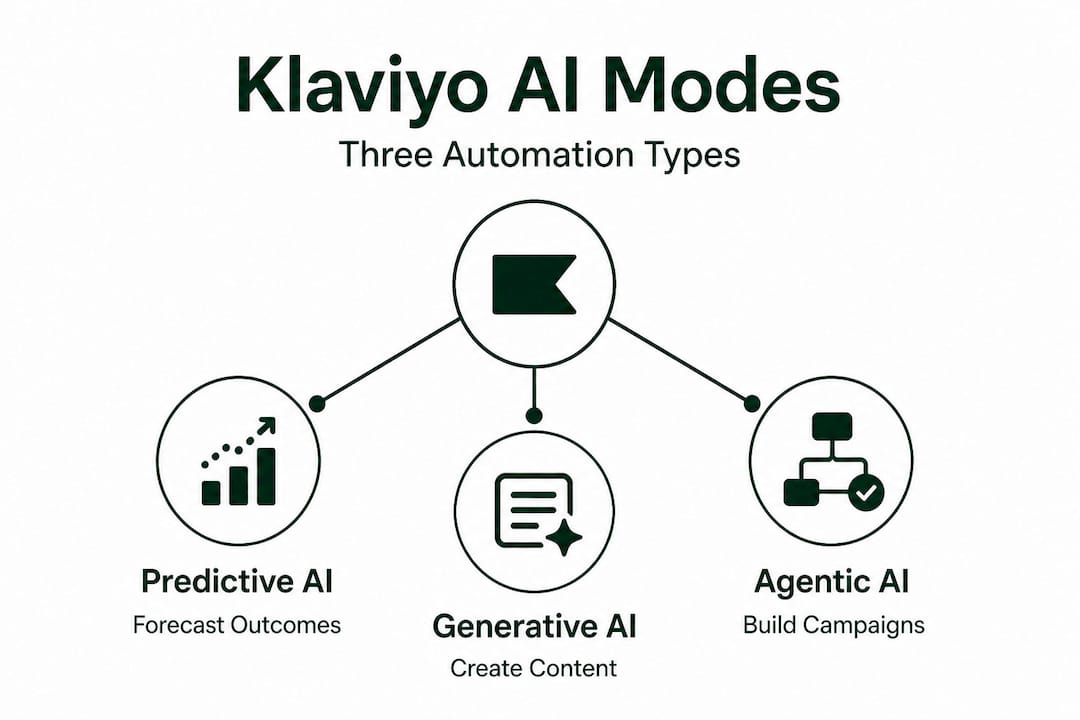
Here is how the three core AI types work together:
| AI type | What it does | E-commerce example |
|---|---|---|
| Predictive AI | Forecasts outcomes from historical patterns | Predicts churn risk, next purchase date, lifetime value |
| Generative AI | Creates content from marketer input | Drafts on-brand email sections, subject lines, SMS copy |
| Orchestration AI | Sequences actions across channels | Decides whether to send email, SMS, or push based on engagement signals |
Everything sits atop real customer behavior. That means flows are not static rule sets built in a spreadsheet. They adapt based on what each customer actually does, which products they browse, how frequently they buy, and which channel they respond to best.
“The real power of Klaviyo AI is not in any single feature. It is in the way predictive, generative, and orchestration capabilities combine into a unified intelligence layer across the entire customer journey.”
Key building blocks worth understanding:
- Profile-driven personalization: Every AI output is grounded in the individual customer’s actual history, not segment-level averages.
- Human-in-the-loop design: Agents act on your behalf but require your oversight and approval for major decisions. No black-box automation.
- Integrated Klaviyo email automation: AI features work inside the same flows editor you already use, lowering the learning curve for teams.
- Always-on optimization: Klaviyo benchmarks your performance against anonymized peer data, surfacing improvements you might otherwise miss.
This architecture matters because it means AI is not a separate tool you connect via API. It is embedded in the decisions your campaigns make every day.
Core features: Predictive, generative, and agentic automation
Understanding the types of AI is helpful, but knowing what they do for marketers in practice is what unlocks real value. Let’s examine the core features and results.
Predictive AI: See what is coming before it happens
Predictive AI forecasts likely outcomes based on patterns in historical customer data, and it is what separates Klaviyo from platforms that only react to customer behavior. Instead of triggering a replenishment email 30 days after purchase because someone once told the system to, predictive AI calculates when that specific customer is actually likely to run out of product. It forecasts next purchase dates, predicts churn probability, estimates customer lifetime value, and identifies which customers are about to lapse versus which ones look disengaged but are actually fine.
For a skincare brand with a 60-day product cycle, predictive timing might surface that one cohort buys again at 45 days while another waits 75 days. Sending the same replenishment email to both cohorts on day 50 means you are too early for some and too late for others. Predictive AI solves that automatically, and the revenue impact is real. Brands have reported boosting revenue from flows 25% year over year after adjusting replenishment timing and growing campaign revenue 53.1% half-over-half in their first six months using predictive analytics.
Generative AI: Create content that sounds like your brand
Klaviyo’s Email AI lets marketers type their campaign goals directly into the drag-and-drop editor, then generates an on-brand section and multiple draft options immediately. This is not generic content. The system adapts to your brand voice over time, which means the fifth campaign it helps you write sounds more like your brand than the first.
For SMS, generative AI shortens the content loop dramatically. Writing a compliant, punchy 160-character message that still feels personal is genuinely hard. AI drafts options, you approve or refine, and you move on. Variant testing becomes something you can run on every campaign instead of reserving for quarterly experiments.
Agentic AI: Build full campaigns from a prompt
Klaviyo’s Composer generates and coordinates complete campaigns from plain-language prompts, selecting audiences, channels, message timing, and content decisions using long-running performance intelligence. You type something like “create a win-back sequence for customers who haven’t purchased in 90 days” and Composer builds the flow, selects the audience, recommends timing, and drafts the content based on what has performed historically.
The numbered workflow for using Composer effectively looks like this:
- Define your campaign goal in plain language (the more specific, the better)
- Review the audience Composer selects and adjust if needed
- Approve or refine channel and timing recommendations
- Edit generated content to match current brand priorities
- Activate and let Composer continue optimizing based on results
Pro Tip: Use generative and predictive features together. Predictive AI tells you who to target and when. Generative AI tells you what to say. Using them in isolation means you are getting half the retention lift you could be capturing.
A useful side-by-side comparison for teams choosing where to focus first:
| Feature | Primary benefit | Best for |
|---|---|---|
| Predictive send time | Higher open rates via timing optimization | High-volume lists with variable engagement patterns |
| Churn prediction | Early intervention before customers lapse | Subscription brands and repeat-purchase categories |
| Email AI content drafts | Faster campaign production with brand consistency | Teams producing 10 or more campaigns per month |
| Composer (agentic) | Full campaign automation from a prompt | Growth teams without large dedicated copy resources |
You can also explore AI email generator options in depth to understand how Klaviyo stacks up against standalone tools. Spoiler: the integrated data advantage is hard to replicate outside the platform. For a broader platform comparison, the Klaviyo vs MailChimp breakdown makes the AI capability gap concrete.
Next-level retention: Orchestrating customer journeys with Klaviyo AI
It is one thing to have strong standalone AI tools. It is another to orchestrate full journeys. Let’s look at how Klaviyo helps you deliver coordinated, retention-focused experiences.
Journey orchestration means your flows do not run on static logic. They adapt to what each customer does, which channel they engage with, what time they typically open messages, and how close they are to churning. This is where leveraging automation to maximize impact becomes a real competitive advantage rather than a table-stakes checklist item.

Channel affinity: Let the data decide
Klaviyo defines channel affinity as AI predicting which channel, email, SMS, or push, is most likely to drive engagement for each individual customer. This is a significant shift from the way most teams manage cross-channel messaging. Instead of defaulting to email first with SMS as a backup, channel affinity scoring sends each customer down the path that matches their own historical engagement pattern.
A customer who opens every SMS but ignores your emails gets the SMS version of a win-back sequence. A customer who clicks email consistently but has never engaged with a text message gets the email. The result is higher engagement rates without adding send volume or increasing unsubscribe risk.
Personalized send time: The 2 AM problem solved
Send time optimization has existed for years, but most versions calculate the best time for a segment. Klaviyo’s personalized send time calculates the best time for each individual, based on their specific open history. At scale across a list of 100,000 subscribers, this means emails arrive at 100,000 optimized moments rather than one averaged moment for the whole list.
Key benefits of activating AI-powered journey orchestration:
- Reduced unsubscribe rates because messages arrive at the right time on the right channel
- Higher repeat purchase rates driven by well-timed replenishment and win-back sequences
- Better zero-party data collection through AI-integrated SMS tools that run conversational flows and gather preferences organically
- More efficient list management as AI surfaces segments most likely to respond before you spend send credits
- Faster learning loops because the system updates predictions with every interaction
Pro Tip: Activate at least two channels and configure sending windows before turning on orchestration AI. Single-channel setups limit the system’s ability to route messages intelligently. A two-channel minimum lets affinity scoring actually work.
Working with a Klaviyo-specialized agency helps you configure these settings correctly from the start, which matters because poorly configured orchestration can train the AI on the wrong signals early and take months to correct.
Custom skills and human guardrails: Trust and safety in Klaviyo AI
Advanced automation creates new opportunities, but trust and brand safety matter. Let’s see how Klaviyo balances power with human control and customization.
One of the most significant recent developments is Custom Skills for Customer Agent, which lets brands extend the AI agent’s tasks beyond out-of-the-box capabilities and connect it to systems already in their tech stack. If your brand uses a custom loyalty platform, a third-party returns system, or a subscription management tool, Custom Skills creates a bridge between those systems and the AI agent’s decision-making.
Here is what Custom Skills actually enables:
- Custom task definitions: Write plain-language instructions that define new agent behaviors specific to your workflows
- Tech stack integration: Connect the agent to external systems so it can pull real data when responding to customer inquiries
- Governance control: Every skill operates within your approved guardrails, not autonomously beyond them
- Managed beta access: Early adopters can shape how these features evolve, giving forward-thinking brands a testing advantage
The human oversight design is not just a safety feature. It is strategically central to how K:AI works. Agents execute within approved brand guardrails and require your governance at key decision points. This matters especially for large-scale automation where a single misconfigured rule can affect tens of thousands of customers at once.
“Brands that treat human oversight as a constraint are thinking about it backwards. Oversight is what makes autonomous AI trustworthy enough to scale.”
Understanding email automation best practices and email design best practices gives your team the foundation to evaluate AI outputs critically rather than approving everything at face value. That critical eye is exactly the human-in-the-loop behavior Klaviyo’s design depends on.
Pro Tip: Document what “autonomous” means for your organization before activating advanced AI features. Define which decisions need human approval, which can run automatically, and what triggers a manual review. Then build those rules into your approval workflows.
The reality of Klaviyo AI: What most marketers miss
At this point, you have the full playbook on Klaviyo AI’s mechanics. It’s time to ask what really separates winning teams from the rest, and where this can go off the rails.
Here is the honest take after working with high-growth e-commerce brands on AI-powered retention: the technology is not the hard part. Most marketing teams can learn the features within a few weeks. The real differentiator is what you bring to the table before you turn any of it on.
Conventional wisdom about AI in email marketing stops at content generation. That is the smallest part of the value. The brands extracting the most from Klaviyo AI are doing three things that others are not. First, they are feeding the system clean, well-structured segmentation. Garbage segments produce garbage predictions, regardless of how sophisticated the algorithm is. Second, they are running relentless flow testing, treating every AI recommendation as a hypothesis to validate rather than a conclusion. Third, they are maintaining genuine human oversight at the campaign level, not just at the legal-compliance level.
The riskiest move a marketing team can make is treating Klaviyo AI as a set-and-forget system. Revenue gains flow to brands that balance automation with active supervision. We have seen brands whose AI-generated win-back flows were technically running but quietly eroding customer trust because nobody reviewed what the content actually said at month three. AI moves fast. Your oversight needs to move just as fast.
The deeper point is this: Klaviyo AI is most powerful when guided by in-house expertise and proven frameworks. The platform gives you extraordinary leverage, but leverage amplifies whatever strategy is underneath it. Strong strategy plus AI equals compounding results. Weak strategy plus AI equals compounding problems. Choosing the right Klaviyo agency partner matters precisely because of this. You need people who understand both the technology and the marketing strategy well enough to know when to let AI run and when to intervene.
The brands building real competitive moats are not just using Klaviyo AI. They are using it smarter, with better data, tighter testing cycles, and more deliberate human oversight than their competitors are willing to invest in.
Next steps: Elevate your retention with expert Klaviyo AI partners
Klaviyo AI’s capabilities are only as valuable as the strategy behind them, and that is where expert execution makes the difference between incremental gains and transformative growth. The Email Marketers works with 8-figure DTC brands and VC-backed e-commerce companies to build the AI-powered retention systems that predictive flows, channel orchestration, and agentic automation make possible. Explore our client case studies to see what results-driven Klaviyo strategy actually looks like in practice. If you want a structured program for building retention infrastructure, Retention Lab is designed for exactly that. Ready to start with a strategy conversation? Our team of Klaviyo AI experts is ready to audit your current setup and identify the highest-leverage opportunities for your brand.
Frequently asked questions
What are the top measurable wins from using Klaviyo AI?
Many brands see 25% or greater revenue growth from flows and more than 53% campaign revenue growth using predictive analytics and AI optimization tools. Results vary by brand maturity and setup quality.
Is human oversight required for Klaviyo AI automation?
Yes, all Klaviyo AI agents are designed with humans in the loop, meaning agents act within approved guardrails and key decisions require marketer review and approval.
How does Klaviyo AI personalize email and SMS campaigns?
Klaviyo uses channel affinity prediction alongside real-time customer profile data to individualize content, sending time, and channel selection for every recipient.
What is the difference between predictive, generative, and agentic AI in Klaviyo?
Predictive AI forecasts outcomes based on historical data; generative AI creates on-brand content from marketer input; agentic AI coordinates complete campaigns and journey orchestration from plain-language prompts.
Can I customize Klaviyo AI to fit my existing systems and workflows?
Yes, Custom Skills for Customer Agent lets brands define new agent tasks in plain language and connect the AI to their existing tech stack and third-party tools.
Recommended
- Automated Email Campaigns: Everything You Need to Know
- Klaviyo Email Marketing
- What Is Klaviyo Email Marketing? (And Why Your Business Needs It)
- 3 Emails That Show Why The Email Marketers Earned the Title of “Klaviyo Partner”
- AI Marketing Examples That Boost ROI by 75% in 2025 - Palmador Blog
- Proven ways to boost online sales for ambitious e-commerce brands - Nu Life Digital


