.png)


How to Improve Email Retention for E-Commerce Brands

TL;DR:
- Email retention involves engaging subscribers through lifecycle-focused strategies that foster repeat purchases and loyalty. Post-purchase flows, behavior-based triggers, and non-discount promotions significantly boost retention and margins. Marketers should continuously test and personalize email frequency and timing to optimize long-term customer value.
Email retention is the practice of keeping subscribers engaged over time through targeted email marketing that drives repeat purchases and long-term loyalty. For e-commerce marketers, it is one of the highest-ROI activities available. Email flows generate 41% of total revenue from only 5.3% of sends. That ratio alone tells you where to focus your effort. Knowing how to improve email retention means moving beyond batch-and-blast sends and into behavioral, lifecycle-driven programs that compound over time.
What are the most effective email retention strategies?
Post-purchase flows are the single most powerful tool for subscriber retention. Post-purchase emails achieve 40–45% open rates and 10–15% repeat purchase rates, which is roughly six times the transaction rate of general campaigns. Most brands treat order confirmations as logistics. That is a missed opportunity.

A proper post-purchase retention flow runs at least six emails. It includes usage tutorials, brand storytelling, and a feedback request. A six-email post-purchase sequence built around value-added content drives significantly higher lifetime value than a single shipping notification. Think of the first email as the start of a relationship, not a receipt.
Replenishment timing is the next lever. Mapping your replenishment cycle with actual cohort data rather than averages produces far more accurate send timing. A skincare brand selling a 30-day moisturizer should not send a replenishment email at day 30 for every customer. Cohort analysis may show that heavy users deplete the product in 22 days while light users take 45. Sending at the right moment for each segment is what drives the repurchase.
Behavior-based triggers are the mechanism that makes this work. Behavior-based replenishment triggers outperform calendar-based sends by 2.5x, generating 320% more revenue. The reason is simple: they fire at the actual depletion signal, not a fixed date on a spreadsheet.
| Trigger type | Timing basis | Revenue impact | Best use case |
|---|---|---|---|
| Calendar-based | Fixed date after purchase | Baseline | Low-data environments |
| Behavior-based | Purchase frequency, usage signals | 2.5x higher | Consumables, subscriptions |
Pro Tip: Segment your post-purchase flow by product category. A supplement buyer and a one-time gift buyer need completely different email sequences. Mixing them into one generic flow destroys relevance.
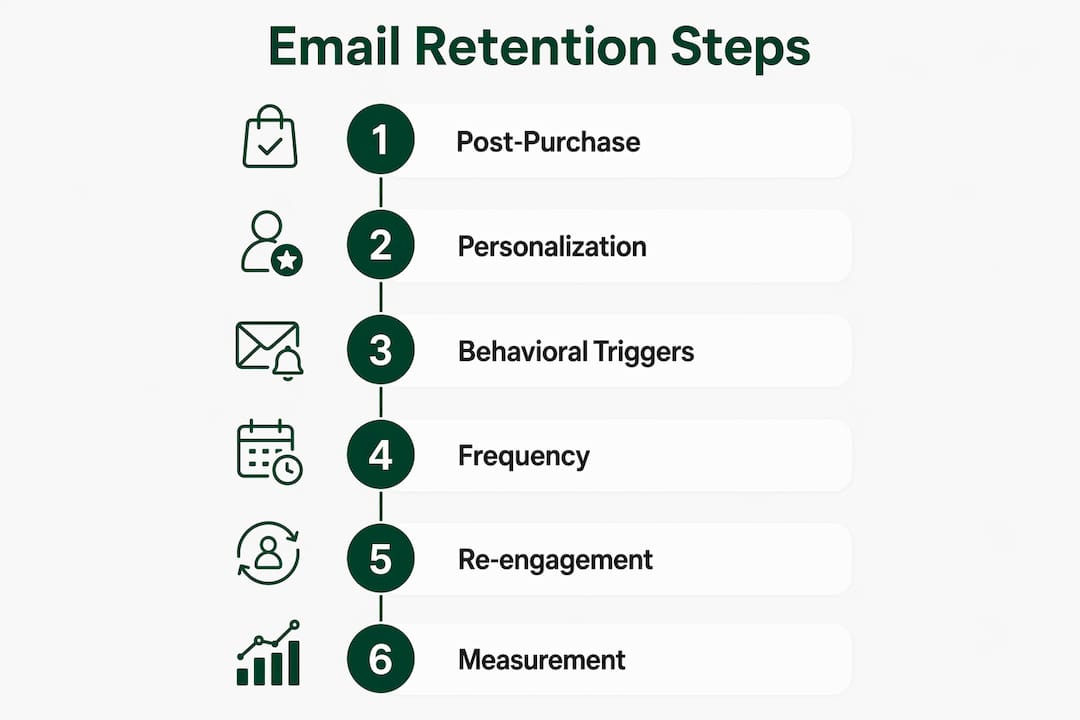
Personalization beyond first-name tokens matters here. Segmented retention campaigns targeting new, active, and at-risk customers consistently outperform one-size-fits-all approaches. Tailor the message tone, the CTA, and the offer to where each customer sits in their lifecycle.
How to optimize email frequency and cadence for retention?
Send frequency is where most e-commerce brands make their biggest retention mistakes. Sending too often burns out your list. Sending too rarely lets customers forget you exist. Neither extreme builds loyalty.
The correct approach is incremental testing. Start with your current cadence, increase by one send per week for a defined segment, and watch three metrics closely: open rate, unsubscribe rate, and revenue per send. If open rates drop below 20% for a segment, do not push harder. Increasing email frequency when open rates fall below 20% accelerates churn rather than reversing it. Reduce frequency instead, or shift that segment to SMS.
Frequency best practices for e-commerce retention programs:
- Send highly engaged subscribers (open rate above 40%) up to 4 times per week without significant churn risk.
- Send moderately engaged subscribers (20–40% open rate) 2 to 3 times per week.
- Move low-engagement subscribers (below 20% open rate) to a reduced cadence of once per week or less.
- Test frequency increases in 4-week increments before drawing conclusions.
- Track unsubscribe rate per send, not just overall list size.
- Use SMS as a secondary channel for subscribers who stop opening emails but remain customers.
Pro Tip: Do not apply a single frequency rule to your entire list. Build engagement-tier segments and assign different send cadences to each. A customer who opens every email wants to hear from you more often than one who opened once three months ago.
Cadence also means timing within the week. Tuesday through thursday mornings consistently outperform monday and friday sends for e-commerce, though your own cohort data should always override general benchmarks. Test send-time optimization quarterly using a structured A/B framework.
How to use re-engagement campaigns effectively to improve retention?
Re-engagement campaigns target subscribers who have stopped opening or clicking your emails. The standard inactivity window is 90 to 180 days of subscriber inactivity before triggering a re-engagement sequence. Starting earlier risks pulling in subscribers who are simply between purchases. Starting later means you have already lost deliverability credibility with inbox providers.
Running a re-engagement campaign effectively follows a clear sequence:
- Define your inactivity threshold. Set 90 days for high-frequency purchase categories (supplements, pet food) and 180 days for lower-frequency categories (apparel, home goods).
- Acknowledge the gap. Open with a direct subject line like “We miss you” or “Has something changed?” Subscribers respond to honesty.
- Lead with value, not a discount. Offer a content piece, a product recommendation based on past purchases, or early access to a new collection before defaulting to a coupon.
- Send a final “last chance” email. Tell subscribers you will remove them from the list if they do not engage. This email often has the highest click rate in the sequence.
- Remove non-responders. Subscribers who do not engage after the full sequence should be suppressed or deleted. Removing unresponsive contacts improves deliverability and protects sender reputation.
| Re-engagement method | Expected outcome | Best for |
|---|---|---|
| Value-led content email | Moderate re-engagement, low cost | Active brand communities |
| Discount offer email | Higher short-term clicks, margin cost | Price-sensitive segments |
| “Last chance” removal notice | Highest click rate in sequence | All inactive segments |
| Channel shift to SMS | Reaches non-email openers | Customers with purchase history |
Data retention rules add another layer. Industry guidance for 2026 recommends deleting or anonymizing inactive subscriber data after 24–48 months, with consent records kept for up to five years. High-value customers can be retained in your database up to 48 months before suppression. Keeping dead contacts beyond these thresholds inflates your list size while damaging your sender score.
What role do non-discount promotions play in retention?
Discount dependency is a margin problem disguised as a retention strategy. When every retention email leads with a coupon, you train customers to wait for the next offer. That behavior compresses gross margins and makes your brand feel transactional rather than valuable.
Non-discount mechanics break that cycle. Reducing discount reliance through alternative promotions protects margins and builds genuine loyalty. The tactics that work best for e-commerce retention include:
- Loyalty point multipliers. Double or triple points on specific products or during defined windows. Customers feel rewarded without you cutting price.
- Limited-edition drops. Exclusive access to a product variant or colorway creates urgency through scarcity, not discounting.
- Free gifts with purchase. A low-cost gift attached to a minimum order threshold drives average order value while feeling generous.
- Early access. Giving loyal subscribers first access to new launches rewards tenure and reinforces the value of staying subscribed.
- Milestone recognition. Celebrating a customer’s one-year anniversary or 10th purchase with a personalized email builds emotional connection.
One case study showed that shifting to non-discount promotions improved gross margin despite a 6% drop in conversion rate. The math works because higher-margin transactions offset the volume difference. Combining these mechanics with paid advertising and email marketing creates a retention ecosystem that does not depend on perpetual discounting.
Retention emails should also nurture active customers to reinforce positive behaviors and celebrate milestones, not just win back inactive ones. The best retention programs treat loyalty as something to be maintained, not just recovered.
How to measure and iterate on your email retention strategy?
Measurement without a testing structure produces noise, not insight. The metrics that matter most for retention are open rate, repeat purchase rate, unsubscribe rate per send, and revenue per email sent. Track these at the segment level, not just the list level.
Structured A/B testing follows a clear hierarchy: test send time first, then subject lines, then email templates, then offer mechanics. Testing frequency should be monthly to bi-weekly for subject lines and quarterly to bi-yearly for templates and full offer structures. Jumping straight to offer testing before fixing send time and subject lines wastes budget.
Common mistakes to avoid in retention optimization:
- Changing multiple variables in a single test, which makes results unreadable.
- Measuring open rates without tracking downstream repeat purchase behavior.
- Abandoning a winning sequence too early because of short-term variance.
- Applying desktop-optimized templates to a list that opens predominantly on mobile.
- Treating unsubscribe rate as a vanity metric rather than a leading indicator of list health.
Hold winning sequences for 3–6 months before replacing them. Compounding results from a proven flow outperform the marginal gains from constant creative refreshes. Use email design best practices to ensure your templates perform across devices before running offer-level tests.
Pro Tip: Set your ROI benchmark per email send before you start testing. Without a baseline, you cannot tell whether a new subject line actually improved performance or whether a seasonal lift did the work for you.
Key takeaways
Effective email retention combines behavioral triggers, lifecycle segmentation, and disciplined testing to drive repeat purchases and protect margins over time.
| Point | Details |
|---|---|
| Post-purchase flows drive revenue | A six-email post-purchase sequence with tutorials and brand story outperforms basic order confirmations. |
| Behavior-based triggers win | Behavior-based replenishment emails generate 2.5x more revenue than calendar-based sends. |
| Frequency must match engagement | Subscribers below 20% open rate need reduced cadence or a channel shift, not more emails. |
| Non-discount promotions protect margins | Loyalty multipliers, free gifts, and limited drops build loyalty without eroding gross margin. |
| Test in hierarchy, hold winners | Follow a structured A/B hierarchy and hold winning sequences 3–6 months for compounding gains. |
What I’ve learned about retention that most brands ignore
I have worked with enough e-commerce brands to know that the most common retention mistake is not a tactical one. It is a data interpretation problem. Brands look at average repurchase rates and build their entire email cadence around that number. But averages hide the customers who matter most.
Your top 20% of customers by lifetime value almost certainly have a completely different purchase frequency than your median buyer. When you build retention flows around the average, you under-serve your best customers and over-send to your weakest ones. The brands that win at retention in 2026 are the ones using cohort-level data to build separate flows for each customer tier.
The other thing I see consistently underused is the milestone email. Brands spend enormous effort on win-back campaigns for inactive subscribers while ignoring the customers who have been buying loyally for 18 months. A personalized anniversary email or a “you’ve ordered 10 times” recognition message costs almost nothing to build and generates outsized goodwill. Retention is not just about recovering lost customers. It is about making sure your best customers never feel taken for granted.
Consumer expectations in 2026 have also shifted. Subscribers expect emails to reflect their actual behavior, not just their demographic profile. If a customer bought a product three weeks ago and you send them a generic “check out our bestsellers” email, you have signaled that you are not paying attention. That signal compounds over time into disengagement. Behavioral relevance is no longer a nice-to-have. It is the baseline expectation.
— Melanie
Theemailmarketers: built for brands that take retention seriously
Theemailmarketers works with 8-figure DTC brands, VC-backed companies, and growth-focused retailers to build email retention programs that drive measurable repeat purchase rates. The agency designs post-purchase flows, builds behavioral trigger sequences, and runs structured A/B testing frameworks that compound over time. If your current email program relies on discounts to drive revenue, or if your flows stop after the order confirmation, there is significant revenue being left on the table. See how Theemailmarketers has applied these exact strategies for real e-commerce clients in the agency case studies, or explore the Retention Lab for a specialized program built around cohort analysis and lifecycle optimization.
FAQ
What is email retention in e-commerce?
Email retention is the practice of keeping subscribers engaged over time through targeted emails that drive repeat purchases and loyalty. It focuses on lifecycle-based messaging rather than one-off promotional sends.
How often should I email my subscribers for better retention?
Send frequency should match engagement level. Highly engaged subscribers can receive up to four emails per week, while low-engagement segments (below 20% open rate) need reduced cadence or a channel shift to SMS.
When should I start a re-engagement campaign?
Start re-engagement sequences after 90 days of inactivity for high-frequency product categories and after 180 days for lower-frequency ones. Remove subscribers who do not respond to protect deliverability.
Do I need discounts to retain email subscribers?
No. Non-discount mechanics like loyalty point multipliers, limited-edition drops, and free gifts with purchase build retention without eroding gross margin. One case showed improved gross margin despite a slight conversion rate drop after removing discounts.
What metrics should I track for email retention?
Track open rate, repeat purchase rate, unsubscribe rate per send, and revenue per email sent. Measure these at the segment level, not just the overall list, to get accurate performance signals.


