.png)


Build an email segmentation workflow that boosts retention

TL;DR:
- Segmented email campaigns generate significantly higher revenue and engagement for DTC brands.
- Focusing on behavioral and RFM-based segmentation provides the best return on investment.
- A simple, continuous testing and refining mindset is essential for successful segmentation.
Most DTC brands send more email than ever and see less return for it. The batch-and-blast era is over, and the numbers prove it: segmented emails generate 760% more revenue than non-segmented campaigns for e-commerce. That gap is not a rounding error. It reflects the difference between brands that treat every subscriber the same and brands that send the right message to the right person at the right moment. This guide walks you through every step of building a segmentation workflow built for DTC retention, from the data you need to the automation that keeps it running without burning out your team.
Table of Contents
- What is email segmentation and why it matters
- Essential data and tools for effective segmentation
- Step-by-step email segmentation workflow for DTC brands
- Troubleshooting, advanced tips, and optimization
- What results should DTC brands expect from world-class segmentation?
- The overlooked truth: Great segmentation is a mindset, not just a workflow
- Ready to level up your retention with smarter segmentation?
- Frequently asked questions
Key Takeaways
| Point | Details |
|---|---|
| Segmentation multiplies revenue | E-commerce brands achieve over 760% more revenue by using targeted segmentation. |
| Prioritize RFM and behavior | Segments based on purchase frequency and customer lifecycle outperform simple demographics. |
| Layer tools with best practices | Combine the right ESP tools, clean data, and exclusion rules for optimal deliverability. |
| Optimize and adapt | Regularly review, test, and update segments to maximize long-term retention impact. |
What is email segmentation and why it matters
Email segmentation divides your subscriber list into targeted groups based on shared criteria, including purchase history, engagement behavior, demographics, and lifecycle stage. Instead of sending one campaign to everyone, you send tailored messages to smaller audiences who are far more likely to act on them. The role of email segmentation in DTC retention is not decorative. It is structural.
The revenue impact is hard to argue with. Segmented campaigns yield 14.31% higher opens and 100.95% higher clicks compared to non-segmented sends. Automated flows built on segmentation logic generate 320% more revenue than standard campaigns. RFM-based segmentation alone can multiply revenue by 760%. These are not edge cases from elite brands with massive budgets. They are achievable outcomes when you match message to audience with intention.
There are several core segmentation types worth knowing:
- Demographic: Age, gender, location, income bracket
- Behavioral: Browse history, cart abandonment, product views, purchase frequency
- Engagement: Email opens, clicks, last active date
- RFM: Recency, frequency, and monetary value of purchases
- Lifecycle: New subscriber, active buyer, at-risk, lapsed
- Predictive: AI-driven forecasts of future purchase probability or churn risk
A personalized email strategy typically combines two or more of these types for maximum relevance.
| Approach | How it works | Best for |
|---|---|---|
| Rules-based segmentation | Static criteria set manually (e.g., purchased in last 30 days) | Reliable, scalable, easy to audit |
| AI/predictive segmentation | Machine learning identifies patterns and forecasts behavior | High-volume brands with rich data |
Rules-based segmentation is where most DTC brands should start. It is transparent, testable, and effective. AI layers on top once your data foundation is solid.
Having established why segmentation is such a revenue driver, let’s look at what you need to set up your first high-impact workflow.
Essential data and tools for effective segmentation
Segmentation is only as good as the data behind it. Before you build a single segment, you need clean, connected data from the right sources. The most valuable data types for DTC email segmentation include:
- Purchase history: What was bought, when, how often, and at what order value
- Site behavior: Pages visited, products viewed, time on site, cart activity
- Email engagement: Opens, clicks, unsubscribes, and complaint rates
- Demographics: Location, device type, acquisition source
- RFM metrics: Recency of last purchase, frequency of purchases, monetary value per customer
Privacy changes, particularly Apple’s Mail Privacy Protection (MPP), have made open rates unreliable as a primary signal. First-party data collected directly from your customers through purchases, on-site behavior, and SMS opt-ins is now your most defensible asset. Relying on third-party data or open rates alone will steer your segmentation in the wrong direction.
A step-by-step workflow starts with collecting data from your CRM and analytics stack, then using tools like Klaviyo to build and activate segments. Here is how the major platforms compare:
| Platform | Strengths | Best fit |
|---|---|---|
| Klaviyo | Deep e-commerce integrations, RFM built-in, predictive analytics | Shopify and BigCommerce DTC brands |
| Attentive | SMS-first with email capabilities | Brands prioritizing SMS + email together |
| Drip | Visual automation builder, solid segmentation | Mid-market DTC with lean teams |
| HubSpot | CRM-native, strong B2C lifecycle tools | Brands with complex sales or subscription models |
To personalize ecommerce emails effectively, your ESP needs to talk to your e-commerce platform in real time. Gaps in data sync are where segmentation breaks down.

Pro Tip: Start with 3 to 5 segments maximum. Champions, active buyers, at-risk customers, lapsed buyers, and new subscribers cover most of your retention opportunity. Scale complexity only after you see consistent results from these core groups.
Common pitfalls include using incomplete or outdated data, creating segments so narrow they cannot reach statistical significance, and building rules so complex that no one on the team can explain them six months later. Simplicity scales. Complexity stalls.
Now that your data and tools are in place, here is how to architect a segmentation workflow that drives results without overwhelming your team.
Step-by-step email segmentation workflow for DTC brands
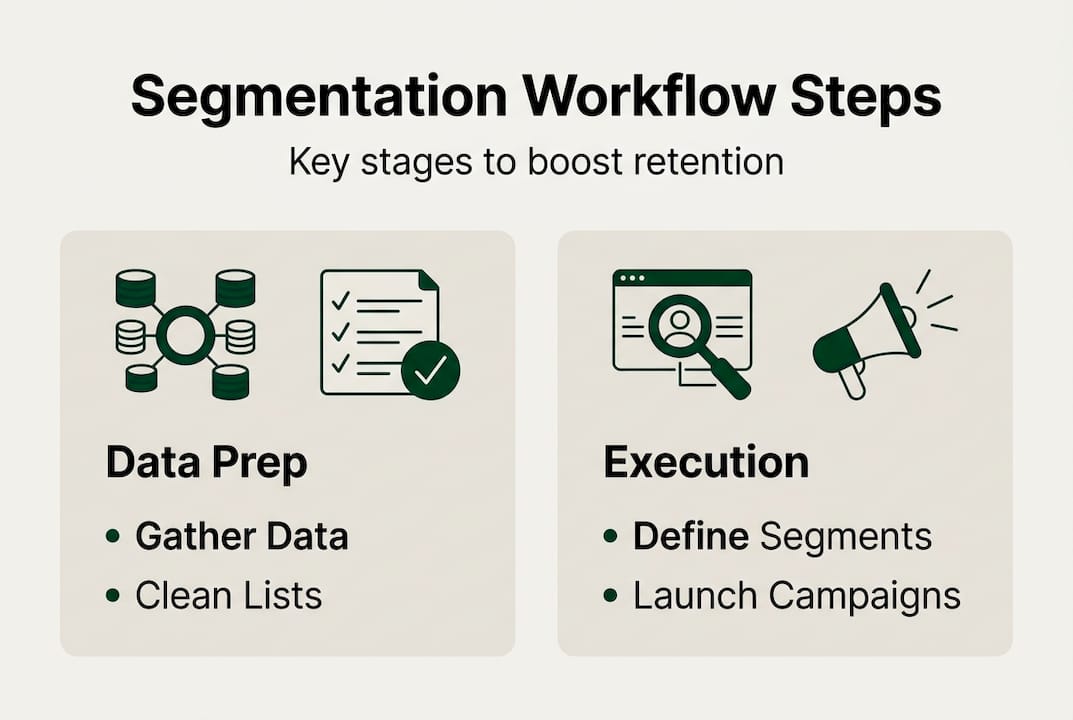
A segmentation workflow that drives consistent results follows a clear sequence: define goals, collect data, start simple, build segments, create campaigns, test, and monitor and refine. Here is how each step works in practice for DTC retention.
- Set your goals. Decide what you are optimizing for: repeat purchase rate, average order value, win-back rate, or churn reduction. Your goal shapes which segments matter most.
- Collect and audit your data. Pull purchase history, engagement data, and behavioral signals. Remove hard bounces, invalid addresses, and duplicate records before you build anything.
- Choose your base segment types. For DTC retention, prioritize RFM and lifecycle segments to target at-risk and high-value customers. These outperform demographic-only approaches every time.
- Build segments in your ESP. Use your platform’s native filters to define each group. Set dynamic rules so segments update automatically as customer behavior changes.
- Create tailored content for each segment. Champions get early access and loyalty rewards. At-risk customers get re-engagement offers. New subscribers get onboarding sequences. Content must match the segment’s context.
- Automate and A/B test. Set up triggered flows for key moments: post-purchase, browse abandonment, replenishment reminders, and win-back sequences. Test subject lines, send times, and offers within each segment.
- Monitor, refine, and repeat. Review segment performance weekly during launch and quarterly once stable.
Exclusions are as important as inclusions. Remove recent buyers from acquisition campaigns, exclude frequent complainers from high-volume sends, and suppress anyone who has not engaged in 180 days or more from your main list.
Pro Tip: Layer behavioral data on top of RFM scores for your most powerful targeting. A customer who is high-value by RFM but has not opened in 60 days needs a different message than one who opened yesterday.
Deliverability warning: Repeatedly mailing non-engagers inflates complaint rates and trains inbox providers to route your domain to spam. Protect your sender reputation by keeping your active segments clean and your suppression lists current.
Explore lifecycle email marketing and email marketing strategy examples to see how these workflows translate into real campaign architecture.
With a workflow mapped out, success depends on proactively navigating common challenges and mastering optimization.
Troubleshooting, advanced tips, and optimization
Even well-built segmentation workflows run into problems. Knowing where things break and how to fix them separates brands that plateau from those that keep improving.
Common issues and how to address them:
- Segments too small to test: Merge narrow groups or broaden criteria. A segment with fewer than 500 contacts rarely produces statistically meaningful data.
- Dirty data skewing results: Audit your list monthly. Remove hard bounces immediately and suppress soft bounces after three consecutive failures.
- Apple MPP inflating open rates: Shift your engagement signals to clicks and purchases, not opens. Rebuild your engagement windows around click activity.
- Over-segmentation: More segments do not mean better results. If your team cannot articulate why a segment exists and what content it receives, collapse it.
- Peak period performance dips: During high-volume seasons like Black Friday, shrink your engagement windows to keep your active segment tighter and protect deliverability.
Basic demographic segmentation is consistently inferior to behavioral and RFM approaches for revenue. Combining AI-driven predictions with rules-based segments produces the strongest outcomes, but AI is additive, not a replacement. Your rules-based foundation must be solid first.
For multi-SKU DTC brands, layer product category data with replenishment timing and lifecycle stage. A customer who bought a 30-day supply 28 days ago and has purchased three times before is a completely different audience than a first-time buyer browsing your catalog. Treat them that way.
Pro Tip: Review and test your exclusion lists every quarter. Suppression lists grow stale. A customer who was non-engaged six months ago may have become active again through a different channel.
For a full breakdown of what to measure and how to improve it, the email marketing optimization guide and email marketing best practices are worth bookmarking.
Next, understand what success looks like and what results to expect when you master segmentation for your DTC brand.
What results should DTC brands expect from world-class segmentation?
Results from segmentation are not hypothetical. Top-performing brands using segmented flows see 14.3% higher opens, 101% more clicks, and flow ROI 320% above baseline, with email returning up to $42 for every $1 spent. These benchmarks are achievable, but they require consistent execution and ongoing refinement.
Here is how segmented performance compares to non-segmented sends:
| Metric | Non-segmented | Segmented | Improvement |
|---|---|---|---|
| Open rate | ~18% | ~20.5%+ | +14.3% |
| Click rate | ~2.5% | ~5%+ | +100.95% |
| Revenue per recipient | Baseline | Up to 7.6x higher | +760% |
| Flow revenue vs. campaigns | Baseline | 320% above | +320% |
Setting realistic targets matters. In the first 90 days of a new segmentation strategy, expect modest gains as your data matures and your content gets calibrated. Months three through six are typically where the compounding effect kicks in.
Quarterly reviews are non-negotiable. Pull your KPIs by segment, compare them to the prior quarter, and identify which groups are drifting. An at-risk segment that is not converting after three win-back attempts needs a different offer, not more of the same email.
Key takeaways for measuring segmentation success:
| What to track | Why it matters |
|---|---|
| Revenue per recipient by segment | Shows which groups drive the most value |
| Click-to-conversion rate | Reveals content and offer relevance |
| Repeat purchase rate | Core DTC retention metric |
| Unsubscribe and complaint rate | Signals list health and relevance |
| Flow vs. campaign revenue split | Indicates automation maturity |
For a broader view of how segmentation fits into your overall program, the ultimate email marketing strategy guide connects these metrics to long-term retention planning.
The overlooked truth: Great segmentation is a mindset, not just a workflow
Here is what most segmentation guides will not tell you: the brands that see the biggest gains are not the ones with the most sophisticated tech stack. They are the ones that treat every segment as a hypothesis worth challenging.
We see marketers spend weeks engineering elaborate segment trees, only to see flat results because their exclusions are wrong or their content is generic. The workflow matters, but ruthless exclusion and genuine content relevance matter more. Sending less to the right people almost always outperforms sending more to everyone.
Privacy shifts like Apple MPP have accelerated a truth that was always there: behavior is a better signal than identity. Where someone clicks and what they buy tells you more than where they live or how old they are. Your personalization strategy should be anchored in those actions, not demographic assumptions.
The best segmentation programs we have seen treat their segments as living things. They test new criteria, collapse segments that stop performing, and constantly ask whether the content actually matches the audience’s current context. Static segments are a slow leak in your retention engine.
Ready to level up your retention with smarter segmentation?
Building a segmentation workflow from scratch takes time, clean data, and strategic clarity most in-house teams are already stretched too thin to deliver. That is where we come in. At The Email Marketers, we work with 8-figure DTC brands to audit existing segmentation, build custom workflows, and run ongoing optimization so your retention program keeps compounding. Whether you want a full strategy overhaul or a focused audit of your current setup, our Retention Lab is built for exactly this. Explore our DTC segmentation case studies to see what results look like in practice, or connect with our email marketing experts to map out your next move.
Frequently asked questions
How many segments should I start with for e-commerce email marketing?
Start with 3 to 5 core segments and expand only as your data and results mature. Overbuilding early creates complexity that slows execution and makes testing harder.
Which segmentation type delivers the highest ROI for DTC brands?
RFM and behavioral segments consistently outperform basic demographic targeting and are the strongest predictors of revenue and retention for DTC brands.
How do I protect deliverability when segmenting?
Exclude recent buyers, hard bounces, and non-engagers from your active sends, and tighten your engagement windows during peak sending periods to keep complaint rates low.
Can AI replace rules-based segments for DTC email?
AI segmentation enhances but does not replace rules-based methods. Predictive models add power when layered on top of a solid manual segmentation foundation.
What benchmarks should I expect from effective segmentation?
Expect 14.31% higher opens and 100.95% more clicks from segmented campaigns, with automated flows generating 320% more revenue than standard unsegmented sends.


