.png)


Email Marketing for Food Delivery: Boost Sales Now

TL;DR:
- Email marketing offers food delivery businesses a high return on investment by targeting customers with automated, behavior-driven campaigns. Effective strategies include welcome series, win-back flows, and VIP loyalty emails, paired with precise segmentation and optimal timing to boost customer engagement. Most operators neglect this channel by relying on generic broadcasts and ignoring automation, missing opportunities to build strong customer relationships and increase revenue.
Email marketing for food delivery is the practice of sending targeted, behavior-triggered campaigns directly to customers to drive repeat orders and build loyalty without relying on third-party platforms. The channel delivers an average return of $36 for every $1 spent, making it the highest-ROI channel available to food delivery operators. Platforms like Klaviyo and Mailchimp give you full ownership of your customer data. That ownership is the core advantage over DoorDash or Uber Eats, where the customer relationship belongs to the marketplace, not to you.
What are the most effective email campaigns for food delivery?
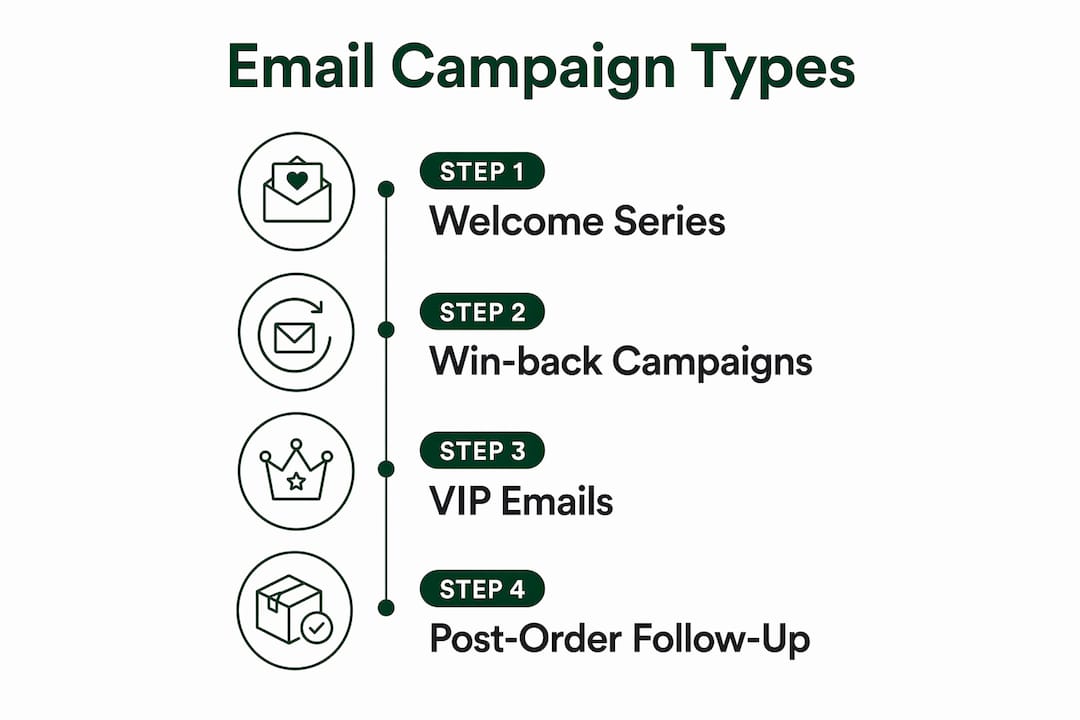
The five campaign types that consistently generate the most revenue for food delivery businesses are welcome series, post-order follow-ups, win-back flows, VIP loyalty emails, and seasonal promotions. Each serves a different stage of the customer lifecycle, and running all five simultaneously is what separates high-performing operators from those sending a monthly newsletter and wondering why it does nothing.
Welcome series
A three-email welcome series is the single best place to start. The first email confirms the subscription and sets expectations. The second introduces your best-selling items or a signature dish. The third offers a first-order incentive. Automated lifecycle emails like this drive 16x more revenue per send than one-time promotional blasts. That gap exists because a welcome series arrives exactly when a new subscriber is most curious about your brand.

Win-back campaigns
Win-back flows target customers who have not ordered in 60 or more days. The most effective structure escalates discounts progressively: start at 5–10% off, then move to 20–30% if the customer still does not respond. This approach recovers customers who would otherwise churn permanently without burning your margin on people who would have reordered anyway. For a deeper look at how win-back flows differ from general re-engagement campaigns, the win-back vs. re-engagement breakdown from Theemailmarketers explains the structural difference clearly.
VIP and loyalty emails
VIP emails reward your top 10–15% of customers by order frequency or spend. These are not discount emails. They are early access announcements, behind-the-scenes kitchen content, and exclusive menu previews. Customers who feel recognized order more often and refer more friends. Treating your best customers like insiders costs nothing extra and pays back in lifetime value.
Pro Tip: Set up a post-order follow-up email to send 90 minutes after delivery confirmation. Ask for a review, suggest a complementary item for next time, and include a one-click reorder link. This single automated email builds habit loops that increase order frequency faster than any promotional blast.
How to grow and segment your email list for food delivery success
A quality subscriber list is built at every touchpoint where a customer interacts with your brand. Collect email addresses through online order confirmations, app registrations, Wi-Fi login pages, reservation systems, and social media lead forms. Each channel captures a different customer type, so using all of them together grows your list faster and with better data attached to each contact.
Segmentation is where most food delivery marketers leave money on the table. The four core segments to build immediately are:
- New customers (first order within the last 30 days): Send a welcome series and a second-order incentive within the first two weeks.
- Repeat customers (2–5 orders): Focus on menu discovery, new item launches, and loyalty program enrollment.
- VIP customers (6+ orders or top spend tier): Send exclusive content, early access offers, and referral programs.
- Lapsed customers (no order in 60+ days): Trigger a win-back flow with progressive discounts.
Automated segmentation connected to POS and ordering data keeps these groups current in real time without manual list management. A customer who places their sixth order automatically moves from the repeat segment to the VIP segment overnight. That precision is impossible to replicate with manual tagging. Tools like Klaviyo and Mailchimp both offer native integrations with major online ordering platforms to make this sync work automatically.
Pro Tip: Add a preference center to your welcome email. Ask new subscribers whether they want weekly deals, new menu alerts, or event announcements. Letting customers self-select their content type reduces unsubscribes and increases click rates significantly.
For operators who want to go deeper on building a high-quality list from scratch, the proven list-building strategies guide covers tactics that apply directly to food delivery and restaurant contexts.
What is the best frequency and timing for food delivery emails?
The optimal send frequency for promotional food delivery newsletters is 1–2 emails per week. Sending more than that increases unsubscribe rates. Sending less than one email every two weeks causes list atrophy, where subscribers forget who you are and your open rates collapse. Automated behavior-triggered emails run continuously on top of this schedule and do not count against your broadcast frequency.
Timing matters as much as frequency. The two windows that consistently outperform others are:
- Late morning (10:30–11:00 AM): Catches customers when they are already thinking about lunch. A well-timed email with a clear offer can convert a browsing moment into an order within minutes.
- Late afternoon (4:00–5:00 PM): Targets the dinner decision window. Most people decide what to eat for dinner between 4:00 and 6:00 PM, so landing in their inbox at 4:30 PM puts you directly in that consideration set.
Split testing send times identifies the best slots for your specific audience. Your customers may skew toward later dinner orders on weekends and earlier lunch orders on weekdays. Testing reveals that pattern within two to three weeks of data.
Behavior-triggered timing outperforms fixed schedules in every scenario. An email sent 24 hours after a customer’s first order performs better than the same email sent on a Tuesday at 10:30 AM with no behavioral context. The trigger creates relevance. The fixed schedule creates noise.
How do you write email content that drives clicks for food delivery?
Subject lines are the single biggest lever on open rates. Subject lines under 45 characters that include the customer’s first name improve open rates by 20–26%. “Maria, your Friday dinner is sorted” outperforms “Check out this week’s specials” every time. Keep the subject line specific, short, and personal.
Content inside the email does not need to lead with a discount to perform well. The food delivery brands with the strongest long-term retention build emails around:
- Kitchen stories and chef introductions that create a personal connection to the food
- Seasonal menu launches with vivid descriptions and high-quality images
- Local sourcing stories that give customers a reason to feel good about ordering from you
- Event announcements like limited-time menu items or community partnerships
AI-generated stylized images of menu items boost click-through rates by 2–3x compared to generic stock photos. A custom visual of your signature dish, rendered with high contrast and styled for appetite appeal, does more work than any discount code. Pair it with one clear call to action per email. Multiple offers in a single email split attention and reduce conversion.
Pro Tip: Write your email as if you are texting a regular customer, not broadcasting to a list. One dish, one story, one offer, one button. That constraint forces clarity and almost always improves performance.
For real-world examples of this approach in action, the email marketing examples for restaurants from Theemailmarketers show exactly how value-driven content outperforms discount-heavy blasts.
Key Takeaways
Email marketing for food delivery works best when automated lifecycle campaigns, precise segmentation, and behavior-triggered timing replace generic broadcast blasts as the core strategy.
| Point | Details |
|---|---|
| ROI is exceptional | Email returns $36 per $1 spent, making it the highest-ROI channel for food delivery operators. |
| Automation beats blasts | Automated lifecycle emails drive 16x more revenue per send than one-time promotional campaigns. |
| Segmentation drives revenue | Targeted, segmented campaigns generate 77% of total email-driven revenue for food businesses. |
| Timing is a conversion lever | Sending at 10:30–11:00 AM for lunch and 4:00–5:00 PM for dinner measurably improves open and click rates. |
| Content quality retains subscribers | Short personalized subject lines and custom food visuals outperform generic discounts for long-term loyalty. |
Why most food delivery operators are leaving their best channel untouched
I have worked with enough food delivery brands to know the pattern: the operator sends a monthly newsletter, gets a 15% open rate, calls email “not worth the effort,” and keeps paying 30% commission to third-party apps. The problem is never the channel. The problem is treating email like a broadcast medium instead of a retention system.
The brands I have seen grow fastest are the ones that connect their email platform directly to their ordering system on day one. That integration is non-negotiable. Without it, you are guessing at who your best customers are. With it, you know exactly who ordered twice last month, who has not ordered in 45 days, and who just crossed into VIP territory. You send the right message to the right person without lifting a finger.
The other mistake I see constantly is discount dependency. Operators train their customers to wait for a coupon before ordering. Once that habit forms, it is expensive to break. The fix is building email content that customers actually want to read, not just scan for a promo code. Kitchen stories, new menu previews, and chef spotlights build genuine affinity. That affinity converts to direct orders at full margin.
The customer retention strategies that work in food delivery are the same ones that work in every subscription-adjacent business: consistent communication, real personalization, and a reason to come back that is not just a cheaper price. Email is the only channel where you control all three.
— Melanie
How Theemailmarketers helps food delivery brands retain more customers
Theemailmarketers builds the automated email systems that food delivery operators need to stop depending on third-party platforms and start owning their customer relationships. The team sets up behavior-triggered flows, real-time segmentation synced to your ordering data, and lifecycle campaigns designed to increase order frequency at every stage. The email marketing case studies show the measurable results these systems produce for food and beverage brands. For operators ready to build a full retention system, the Retention Lab offers the automation infrastructure and strategic support to make it work at scale.
FAQ
What is email marketing for food delivery?
Email marketing for food delivery is the practice of sending targeted, behavior-triggered emails to customers to drive repeat orders and reduce reliance on third-party delivery platforms. It includes automated flows like welcome series, win-back campaigns, and VIP loyalty emails.
How much does email marketing return for food delivery businesses?
Email marketing returns an average of $36 for every $1 spent in the food and restaurant sector. A list of 1,000 subscribers running behavior-triggered campaigns can generate around $10,000 annually before any one-time promotions.
How often should a food delivery business send emails?
The recommended frequency is 1–2 promotional emails per week. Automated behavior-triggered emails run continuously alongside that schedule without counting against your broadcast limit.
What email platform works best for food delivery?
Klaviyo and Mailchimp are the two most widely used platforms for food delivery email marketing. Both offer native integrations with major POS and online ordering systems for real-time customer segmentation.
How do you reduce unsubscribes in food delivery email lists?
Keep send frequency at 1–2 emails per week, personalize subject lines with the customer’s first name, and focus email content on genuine value rather than repeated discount offers. Consistent, relevant messaging is the most effective way to hold subscriber attention over time.


