.png)


Email Delivery Success Rate: What E-Commerce Brands Must Know

TL;DR:
- Your email delivery rate shows acceptance of messages, but it does not guarantee they land in subscribers’ inboxes. Maintaining proper authentication, list hygiene, and monitoring complaint rates are critical for improving actual inbox placement and overall deliverability. Continuous hygiene, strategic segmentation, and reputation management are essential to prevent long-term damage and achieve optimal email performance.
Your email platform says 98% delivered. Your revenue from that campaign tells a different story. That gap is where most e-commerce marketers lose money without realizing it. Your email delivery success rate is not simply how many emails avoided a hard bounce. It measures whether your messages actually land in front of subscribers who can open, engage, and buy. Understanding the real metric, what drives it, and how to protect it is one of the highest-ROI investments you can make in your retention marketing program.
Table of Contents
- Key takeaways
- Understanding email delivery success rate
- Factors affecting email delivery for e-commerce
- How AI is reshaping deliverability optimization
- How to improve your email delivery success rate
- My take on what most brands get wrong
- How Theemailmarketers can strengthen your email deliverability
- FAQ
Key takeaways
| Point | Details |
|---|---|
| Delivery rate ≠ inbox placement | Your ESP reporting 98% delivery only means servers accepted the message, not that anyone saw it. |
| Authentication is non-negotiable | SPF, DKIM, and DMARC alignment directly determines whether Gmail and Outlook trust your sending domain. |
| Complaint rate thresholds are strict | Spam complaints above 0.1% will hurt filtering; above 0.3% triggers severe consequences with major providers. |
| List hygiene drives long-term success | Sending to inactive or invalid addresses compounds reputation damage faster than almost anything else. |
| Reputation repair takes real time | Recovering from a deliverability problem requires at least 30 days of consistent, compliant sending behavior. |
Understanding email delivery success rate
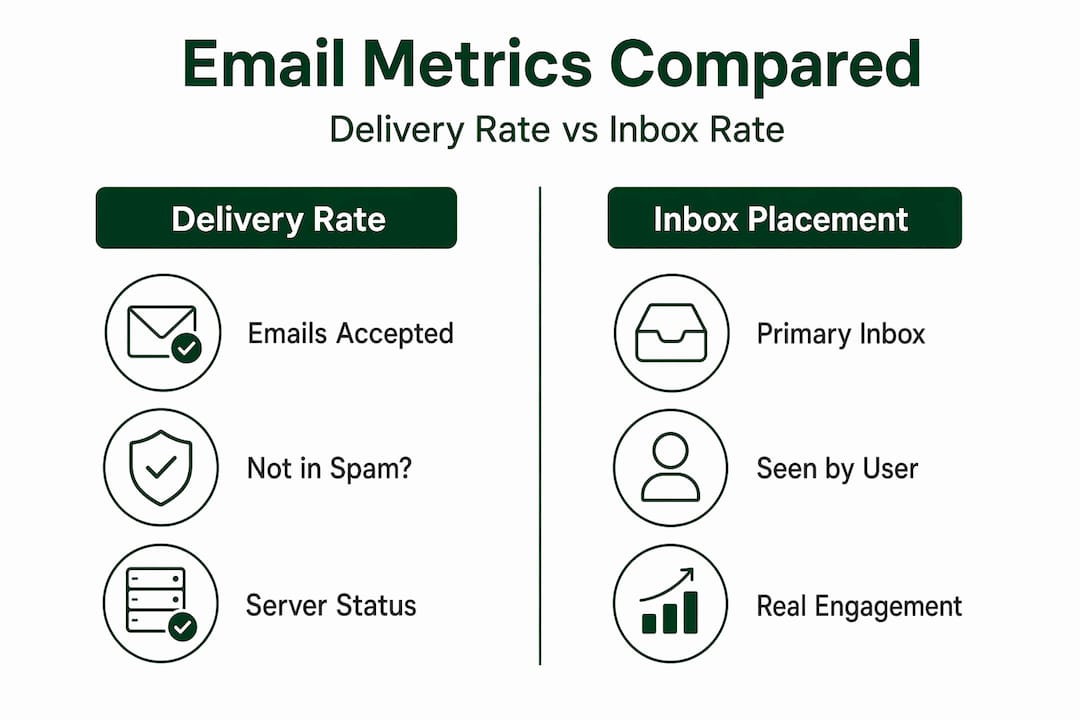
Most email service providers report a delivery rate that hovers around 95 to 99%. That number means mail servers accepted the messages. It says nothing about where those messages went afterward. Spam folders, promotions tabs, and quiet suppression all happen after delivery is logged.
The metric that actually matters is inbox placement rate, calculated as emails landing in the primary inbox divided by total emails sent. That number tells you whether subscribers can realistically find your campaign. The email deliverability rate you should care about is this inbox placement figure, not your ESP dashboard’s acceptance rate.
Here is how the benchmarks break down in 2026:
| Performance Level | Inbox Placement Rate | What It Signals |
|---|---|---|
| Excellent | 95% or above | Strong reputation, clean list, full authentication |
| Good | 90% to 94% | Acceptable but with room for improvement |
| Warning zone | 80% to 89% | Likely engagement or hygiene issues |
| Serious problem | Below 80% | Active reputation damage or blacklisting risk |
The global average inbox placement sits at roughly 83 to 85%, which means a significant portion of senders are operating in the warning zone without knowing it. E-commerce brands running high-volume promotional campaigns are especially exposed because volume amplifies every existing reputation problem.
One more number worth tracking closely: your bounce rate and spam complaint rate. These are the early warning signals that determine whether your email delivery success rate is about to decline before you see it in your open data.
Factors affecting email delivery for e-commerce
Getting emails into inboxes consistently depends on a combination of technical setup, sender behavior, and list quality. Each factor compounds the others.

Authentication protocols
SPF, DKIM, and DMARC are not optional. Authentication passing rates below 90% correlate directly with poor deliverability. Senders with 98 to 99% passing rates consistently see the best inbox placement. DMARC alignment in particular signals to Gmail and Outlook that your sending domain is not being spoofed. If your DMARC policy is still set to “none” on a high-volume sending domain, that is an immediate priority.
Spam complaint rates
Complaint rates above 0.1% will damage your filtering standing. Above 0.3%, Gmail enforces severe filtering and can revoke mitigation privileges entirely. For an e-commerce brand sending a Black Friday campaign to 200,000 subscribers, that 0.3% threshold means just 600 complaints can severely limit your campaign’s inbox reach. Track complaints through Google Postmaster Tools and Microsoft SNDS, not just what your ESP shows.
List quality and engagement
Mailbox providers watch how recipients interact with your mail. Low open rates, high delete-without-reading rates, and sending to addresses that have been inactive for 12 or more months all signal to providers that your list is not well-maintained. Your email open rate success is partly a deliverability input, not just an output.
Provider-specific filtering
Inbox placement varies significantly by provider: Gmail averages around 87 to 95%, Outlook ranges between 75 and 80%, and Apple Mail sits at 76 to 92%. If your list skews heavily toward Outlook addresses and you are reporting overall placement as an average, you may be masking a serious problem on that specific provider. Segment your deliverability reporting by mailbox provider.
Unsubscribe compliance
Gmail requires one-click unsubscribe headers per RFC 8058 for any sender reaching 5,000 messages per day. Burying an unsubscribe link in your email footer is not the same as providing a compliant "List-Unsubscribe` header. Non-compliant bulk senders face server-level rejection, not just filtering.
Pro Tip: Set up Google Postmaster Tools and Microsoft SNDS for every sending domain. These free tools give you direct visibility into how the two largest mailbox providers are scoring your reputation, and they will surface complaint spikes before your ESP does.
How AI is reshaping deliverability optimization
Mailbox providers have moved well beyond keyword-based spam filters. They now use AI and machine learning to evaluate sender reputation holistically, weighing engagement patterns, send frequency, complaint velocity, and content consistency across millions of signals simultaneously.
For e-commerce senders, this shift has two important implications.
First, there is no single fix. Changing your subject line or removing one spam word will not move your deliverability rate if underlying engagement signals are poor. The filters are reading your entire relationship with each recipient over time.
Second, AI-driven tools on the sender side now offer real advantages. The best platforms can detect subtle rises in complaint rates within specific segments before they escalate, automate suppression of contacts showing disengagement signals, and identify segments at risk of contributing to filtering problems. Predictive send-time optimization also plays a role here. Getting your email to a subscriber at the moment they are most likely to engage produces better open rates, and those engagement signals feed back into your reputation score.
“Effective deliverability optimization is not a one-time technical fix. It is a continuous feedback loop between sending behavior, engagement data, and reputation monitoring.” The marketers who win at inbox placement treat deliverability as an ongoing discipline, not a checkbox.
That said, AI tools are only as good as the foundation underneath them. If your authentication is broken or your list is full of stale addresses, no suppression algorithm will save you. The fundamentals still determine your ceiling.
How to improve your email delivery success rate
Knowing what hurts deliverability is useful. Knowing exactly what to do about it is where results come from. Here is a practical sequence for strengthening your email delivery success rate.
-
Audit your authentication records. Pull your SPF, DKIM, and DMARC records today and verify they are publishing correctly and in alignment. Use a tool like MXToolbox or your ESP’s built-in authentication checker. If DMARC is on “none” and you are sending more than 5,000 messages per day, move it to “quarantine” as a next step.
-
Remove inactive subscribers. Segment out any subscriber who has not opened or clicked in the last 90 to 180 days and run a re-engagement sequence before mailing them again. For those with no activity in 12-plus months, suppress them entirely. Sending to a clean, engaged list produces stronger engagement signals and protects sender reputation over the long term.
-
Implement one-click unsubscribe headers. Do not wait for Gmail to force this. Adding proper
List-UnsubscribeandList-Unsubscribe-Postheaders reduces complaint rates and signals to providers that you respect recipient preferences. Subscribers who want out should be able to leave easily. That is better for everyone. -
Set up feedback loops and monitor complaint data daily. Connect your sending domain to Google Postmaster Tools and check your domain and IP reputation weekly at minimum. If complaint rates are climbing, slow your send volume immediately and shift to your most engaged segment only.
-
Warm up new domains gradually. If you are launching a new sending domain or subdomain, do not blast your full list on day one. Ramp up send volume gradually over four to six weeks, starting with your most engaged subscribers. Short pauses in sending, under 30 days, do not reset your reputation. Consistent, compliant sending does.
-
Use seed list testing before major campaigns. Seed list tools let you see where your email lands across providers before you send to your real audience. For high-stakes campaigns like product launches or seasonal sales, this step can save the entire send.
Pro Tip: When diagnosing a deliverability drop, start with your blacklist status and authentication records before touching anything else. Most teams waste hours adjusting content when the real issue is a misconfigured SPF record or an IP that landed on a major blacklist.
Tracking all of this consistently is what separates teams that react to deliverability problems from those who prevent them proactively. The data is available. The question is whether you are looking at it regularly enough.
My take on what most brands get wrong
I have worked with enough e-commerce email programs to recognize a pattern that repeats across brands at every revenue level. Teams look at their ESP delivery rate, see 97 or 98%, and assume everything is working. They are not checking Postmaster Tools. They are not segmenting deliverability by provider. They are not looking at inbox placement at all. They only discover a problem when revenue from email drops and they cannot figure out why.
What I find consistently is that the real damage is cumulative. It is not one bad campaign that tanks your reputation. It is six months of sending to a stale list, combined with a complaint rate that crept from 0.08% to 0.15% unnoticed, combined with an SPF record that was accidentally broken during an ESP migration. Each issue alone might be tolerable. Together, they create a reputation hole that takes a minimum of 30 days of disciplined recovery to climb out of. That recovery timeline is not negotiable, no matter how aggressive your campaign calendar is.
The other thing I want to push back on is the instinct to grow subscriber count at the expense of list quality. Getting strategies to grow your list right matters, but 50,000 engaged subscribers will consistently outperform 200,000 cold or disengaged ones on every metric that feeds deliverability. Revenue per email goes up. Complaint rates go down. Inbox placement improves. Quantity is not the goal. Authentic engagement is.
AI tools help, and I recommend using them. But they surface problems faster. They do not fix underlying sending hygiene. That work still requires human judgment and a willingness to send less to better-segmented audiences.
— Melanie
How Theemailmarketers can strengthen your email deliverability
If your email delivery success rate is not where it needs to be, the cost compounds with every campaign you send. Theemailmarketers works exclusively with e-commerce brands to diagnose and fix exactly these kinds of problems. From full deliverability audits to authentication setup, list hygiene strategy, and ongoing campaign management, the team knows what it takes to move inbox placement rates from the warning zone into the excellent range.
The results speak for themselves. You can review real e-commerce case studies showing how brands have rebuilt sender reputation, increased open rates, and driven measurable revenue growth from the same subscriber list simply by fixing the fundamentals and building smarter segmentation on top. If you are ready to stop guessing and start seeing real numbers move, Theemailmarketers is the partner built for that work.
FAQ
What is a good email delivery success rate in 2026?
A good inbox placement rate for authenticated senders is 90 to 95%, with 95% or above considered excellent. The global average sits at 83 to 85%, meaning many senders are underperforming without realizing it.
What is the difference between delivery rate and inbox placement rate?
Delivery rate measures whether a mail server accepted your message. Inbox placement rate measures whether that message landed in the primary inbox rather than the spam or promotions folder. The two numbers can differ dramatically.
What spam complaint rate will hurt my deliverability?
Spam complaint rates above 0.1% begin to impact deliverability with major providers, and rates above 0.3% trigger severe filtering from Gmail with potential loss of mitigation privileges.
How long does it take to recover from a deliverability problem?
Reputation repair typically takes 30 days or more of consistent, compliant sending focused on engaged subscribers. Short pauses in sending do not reset reputation systems.
Does list size affect email delivery success rate?
Yes. Larger lists full of inactive or unengaged subscribers produce weaker engagement signals and higher complaint rates, both of which damage inbox placement. A smaller, highly engaged list will consistently outperform a large, stale one on deliverability metrics.


