.png)


Email automation guide for higher e-commerce retention

TL;DR:
- Many DTC brands overlook retention revenue, which automation can help recover effectively.
- Building and continuously optimizing key flows like Welcome, Cart Abandonment, and Win-Back boosts loyalty and revenue.
- Ongoing management, segmentation, and avoiding over-discounting are crucial for successful email automation.
Most DTC brands invest heavily in acquisition but leave a significant portion of retention revenue untouched. Without proper email automation, you’re relying on one-off campaigns to do the heavy lifting, and that’s a losing strategy. Automated flows work around the clock, reaching customers at exactly the right moment with exactly the right message. The result is relevance, stronger retention, and compounding revenue growth. This guide walks you through everything: the groundwork you need to lay, the flows that matter most, how to build and launch them correctly, and how to verify they’re actually working.
Table of Contents
- Gather your requirements: What you need to automate email
- Core automations: Lifecycle flows every DTC brand needs
- Step-by-step implementation: Building and launching your flows
- Verify, optimize, and avoid common email automation mistakes
- Why most brands get email automation wrong (and how to do it right)
- Accelerate retention with expert-crafted email automation
- Frequently asked questions
Key Takeaways
| Point | Details |
|---|---|
| Prioritize automation | Behavior-triggered flows drive more revenue and retention than bulk campaigns. |
| Cover key lifecycle stages | Welcome, cart, post-purchase, and win-back flows capture crucial customer moments. |
| Optimize and adapt | Regularly review flows, sunset disengaged subscribers, and refine segmentation. |
| Balance AI and brand | Use AI tools for efficiency, but keep your brand’s voice and customer focus. |
Gather your requirements: What you need to automate email
Now that you see what’s at stake, let’s prepare your brand for automation success. Before you write a single subject line, you need the right foundation in place. Skipping this step is why so many brands end up with broken flows, poor deliverability, and frustrated customers.
Start with your core tools. You’ll need a capable email service provider (ESP) with automation support, a segmentation layer tied to your customer data, a basic analytics setup to track behavior, and creative resources for copy and design. If you’re still fuzzy on the fundamentals, brushing up on ecommerce email basics will give you a clearer starting point.
Essential tools and data requirements:
- ESP with automation: Klaviyo, Omnisend, or similar platforms with trigger-based flow support
- Behavioral data: Browse history, purchase frequency, cart activity, and lifecycle stage
- Segmentation logic: First-time buyers vs. repeat customers, VIPs, and lapsed subscribers
- Creative team: Copywriters and designers who understand mobile-first email design
- Analytics: Open rates, click rates, conversion rates, and revenue per recipient
| Requirement | Why it matters |
|---|---|
| ESP with automation | Powers trigger-based flows without manual effort |
| Customer behavior data | Enables relevant, timely messaging |
| Segmentation rules | Prevents irrelevant sends that hurt engagement |
| Mobile-first templates | Over 60% of emails are opened on mobile devices |
| List hygiene process | Protects sender reputation and deliverability |
This matters more than most brands realize. Automated flows generate 25-45% of total email revenue despite being a fraction of total send volume. That ratio is only possible when your data and tools are dialed in from day one.
For deeper guidance on building a retention-first email program, the email retention best practices resource is worth bookmarking.
Pro Tip: Before activating any automation, audit your existing list. Remove hard bounces, flag unengaged subscribers, and confirm your opt-in data is clean. A dirty list fed into automation will amplify your deliverability problems, not solve them.
Core automations: Lifecycle flows every DTC brand needs
With the groundwork set, it’s time to build automations that address every stage of the customer journey. Not all flows are created equal. Some recover lost revenue immediately. Others build long-term loyalty. The smartest brands run both simultaneously.
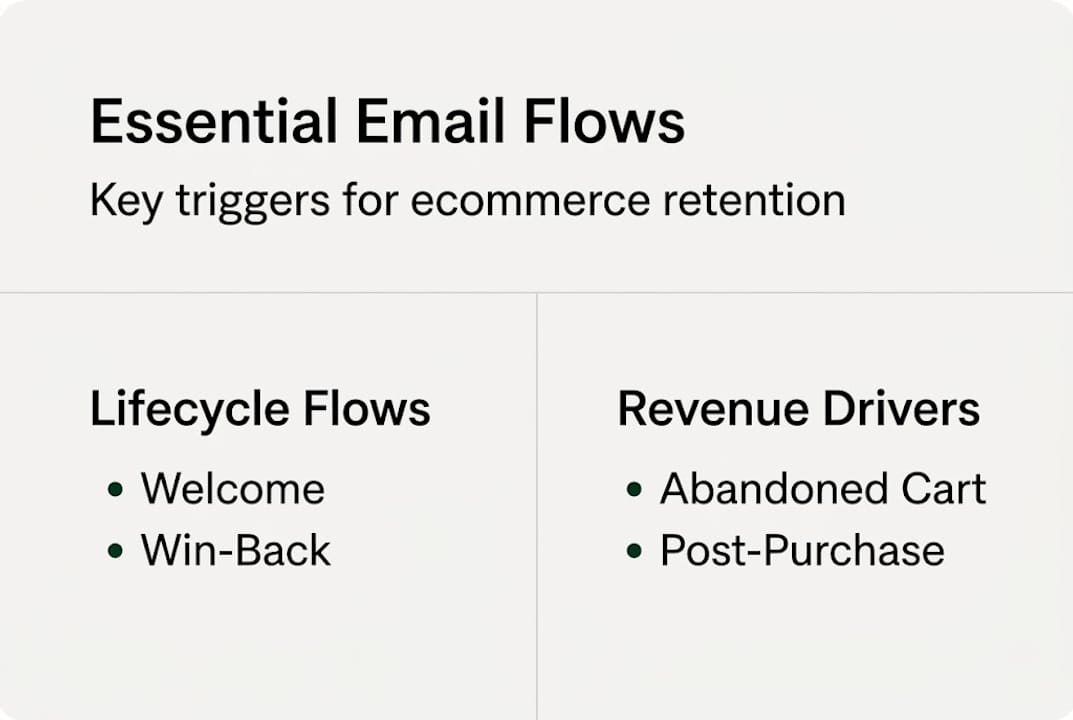
Lifecycle flows like Welcome Series, Abandoned Cart, and Post-Purchase are essential and account for the majority of email automation revenue. Here’s a breakdown of the flows that matter most and what each one is designed to do:
- Welcome series: Introduces your brand, sets expectations, and converts new subscribers into first-time buyers. Trigger: new signup or opt-in.
- Abandoned cart: Recovers shoppers who added items but didn’t complete checkout. Trigger: cart created, no purchase within 1-4 hours.
- Browse abandonment: Re-engages visitors who viewed products without adding to cart. Trigger: product page view, no cart activity.
- Post-purchase: Confirms the order, builds excitement, and sets up the next purchase. Trigger: order confirmed.
- Win-back: Targets lapsed customers who haven’t bought in a defined window. Trigger: no purchase in 90-180 days.
- VIP flow: Rewards high-value customers with exclusive access or early drops. Trigger: lifetime value or order count threshold.
- Sunset flow: Gives unengaged subscribers one last chance before removal. Trigger: no opens or clicks in 180 days.
For a deeper look at which best email flows drive the most engagement, the data might surprise you.
| Flow | Primary goal | Key metric | Benchmark |
|---|---|---|---|
| Welcome series | Convert subscribers | Open rate | 45-60% |
| Abandoned cart | Recover lost revenue | Recovery rate | 5-15% |
| Post-purchase | Build loyalty | Repeat purchase rate | 10-20% |
| Win-back | Re-engage lapsed buyers | Reactivation rate | 5-12% |
| Sunset | Clean list | Unsubscribe rate | Varies |
Welcome series open rates average 45-60%, while abandoned cart recovery sits between 5-15%. Those numbers reflect why flow-generated emails earn significantly more revenue per send than standard broadcast campaigns. For more automation tips tailored to ecommerce, it’s worth exploring what top-performing brands are doing differently.
Step-by-step implementation: Building and launching your flows
Now, see exactly how to set up and deploy each flow with a strategic, step-by-step approach. Implementation is where most brands either get it right or create a mess they’ll spend months untangling.
- Select your flow: Start with Welcome or Abandoned Cart. These deliver the fastest ROI and are easiest to validate.
- Define your trigger: Be precise. A trigger like “cart created, no purchase in 2 hours” is far more effective than a vague time-based send.
- Segment your audience: Separate first-time buyers from repeat customers. The messaging, tone, and offer should differ significantly between these groups.
- Write and customize your emails: Each email in the flow needs a clear job. Email 1 creates urgency. Email 2 handles objections. Email 3 closes with social proof or a final nudge.
- Set exclusion filters: Exclude anyone who purchased in the last 7 days from cart flows. Exclude active support cases from win-back sequences.
- Test before deploying: Send test emails to real devices. Check rendering on iOS and Android. Verify all links, dynamic fields, and merge tags.
- Deploy and monitor: Go live, then watch the first 48-72 hours closely for errors, unsubscribes, or deliverability signals.
For a complete walkthrough of automated email campaigns, the step-by-step breakdown covers edge cases most brands miss. Pairing that with personalized strategies will sharpen your segmentation logic considerably.
Branching logic is one of the most underused tools in email automation. Branch flows by first-time vs. repeat buyers, exclude recent purchasers, and handle support cases carefully in win-back sequences. This alone can lift conversion rates by double digits.
Important: Resist the urge to discount in every flow. Over-discounting trains your customers to wait for deals, erodes your margins, and devalues your brand. Use discounts strategically, not as a default.
Pro Tip: Always QA your flows on both mobile and desktop before launch. Use mobile-first email design principles as your baseline since most of your audience will read on a phone first.
Verify, optimize, and avoid common email automation mistakes
Launching your flows is just the start. Now verify, optimize, and future-proof your automation. The brands that win at retention aren’t the ones who set it and forget it. They’re the ones who treat automation as a living system.
Key metrics to track after launch:
- Open rate (by flow and by individual email)
- Click-through rate (which links are working, which aren’t)
- Conversion rate (revenue generated per flow)
- Unsubscribe rate (a spike signals frequency or relevance problems)
- Revenue per recipient (the most honest measure of flow performance)
| Common mistake | Why it hurts | The fix |
|---|---|---|
| Over-discounting | Trains customers to wait for sales | Use value-led messaging first |
| Ignoring list hygiene | Tanks deliverability | Remove unengaged subscribers regularly |
| Too-frequent cadence | Causes fatigue and unsubscribes | Space flows with send frequency caps |
| No exclusion filters | Sends irrelevant emails | Build exclusion rules into every flow |
| Static segmentation | Misses behavioral shifts | Refresh segments monthly |
To optimize email ROI over time, you need to revisit your flows quarterly. Triggers that worked six months ago may no longer reflect your customer’s actual behavior.
Sunset unengaged subscribers after 180 days; integrate AI for send time optimization and predictive churn. AI tools can now identify which subscribers are likely to lapse before they actually do, giving you a window to intervene with a targeted re-engagement message. To fully maximize automation impact, combining AI-driven timing with smart segmentation is the current best practice.
Pro Tip: For win-back flows, set your trigger at 1.5 times your average order frequency. If your customers typically buy every 45 days, trigger win-back at 67 days. This catches lapsing customers before they’re fully gone.
Why most brands get email automation wrong (and how to do it right)
Here’s the uncomfortable truth: most DTC brands treat email automation like a one-time project rather than an ongoing discipline. They install a welcome flow, set up an abandoned cart sequence, and then walk away. Six months later, they wonder why retention metrics are flat.
The problem isn’t the flows themselves. It’s the mindset. Behavioral automation beats batch-and-blast only when it’s continuously refined. Shallow segmentation, recycled templates, and a reluctance to prune unengaged subscribers are the three most common failure points we see across brands of every size.
Many brands are also hesitant to sunset subscribers because they confuse list size with list health. A smaller, highly engaged list will always outperform a bloated one. Deliverability depends on engagement signals, and sending to people who never open your emails actively hurts your sender reputation.
AI is changing the game, but not in the way most brands expect. AI enhances flows with predictive timing and personalization, but human oversight ensures brand consistency. If you let AI generate every email without reviewing tone and messaging, you risk sounding like every other brand in your customer’s inbox. The competitive edge comes from blending AI efficiency with an authentic, recognizable brand voice.
Real retention is built through constant learning. Review your email best practices regularly, test new angles, and listen to what your data is telling you. The brands that treat automation as a dynamic system rather than a static setup are the ones that consistently outperform.
Accelerate retention with expert-crafted email automation
Ready to take your email automation beyond the basics? Building flows that actually retain customers and grow revenue requires more than plugging in templates. It requires strategy, segmentation expertise, and constant optimization. That’s exactly what we do at The Email Marketers.
We’ve helped 8-figure DTC brands build automation systems that generate consistent retention revenue month after month. From welcome sequences to advanced lifecycle flows, our team handles the strategy, the copy, and the data. Explore our success stories to see real results from brands like yours. When you’re ready to build something that lasts, the Retention Lab and Retention Toolkit are your next steps.
Frequently asked questions
What flows should every ecommerce brand automate first?
Start with Welcome, Abandoned Cart, Post-Purchase, and Win-Back flows. These four cover the highest-revenue moments in the customer lifecycle and account for the majority of email automation revenue.
How often should I clean or sunset my email list?
Audit your list at least quarterly, and sunset subscribers after 180 days of no engagement to protect your sender reputation and improve deliverability.
What is the biggest mistake in automated email flows?
Over-discounting is the most damaging habit. It trains customers to wait for sales rather than buying at full price, which quietly erodes your margins over time.
How does AI improve email automation?
AI optimizes send timing, refines segmentation, and flags subscribers likely to churn. However, human oversight for brand voice remains essential to keep messaging consistent and on-brand.
Recommended
- Complete Guide to the Role of Email Automation
- Personalized Email Strategy Guide For E-Commerce Success
- How to personalize ecommerce emails for higher engagement
- Email Marketing Optimization Guide 2025 for Ecom Brands
- Why Automate Tasks? Unlock More Time and Productivity – Optio Station: Best Project Management App for Prioritization


