.png)


Data-driven email marketing for higher retention and ROI

TL;DR:
- Data-driven email marketing focuses on customer behavior, purchase history, and engagement signals.
- Automated flows outperform campaigns, generating 30-41% of revenue from just 2-5% of sends.
- High ROI is achieved through segmentation, personalization, continuous testing, and AI integration.
Most DTC marketing managers assume sending more emails generates more revenue. The numbers tell a different story. Automated flows outperform campaigns, generating up to 41% of revenue from just 2-5% of total sends. That means the brands winning at email aren’t the ones blasting their lists hardest. They’re the ones sending the right message, to the right person, at exactly the right moment. This article gives you a clear, evidence-based framework for building data-driven email systems that increase retention, reduce churn, and compound your ROI over time.
Table of Contents
- What is data-driven email marketing?
- Segmentation, personalization, and the impact on customer retention
- Automated email flows vs. campaigns: Where the real ROI happens
- Integrating AI and predictive analytics for next-level performance
- Essential metrics, hygiene, and pitfalls of data-driven email strategy
- What most brands miss with data-driven email marketing
- Ready to transform your retention strategy?
- Frequently asked questions
Key Takeaways
| Point | Details |
|---|---|
| Personalized segmentation boosts ROI | Using purchase, behavioral, and RFM data enables highly relevant campaigns that increase retention and ROI for DTC brands. |
| Automation drives revenue | Automated email flows deliver a disproportionate share of total revenue compared to traditional campaigns while improving customer experience. |
| AI offers major uplift | Brands leveraging AI for predictive segmentation and optimization see up to 41% higher revenue but need ample quality data to succeed. |
| Measure what matters | Prioritize core revenue and retention metrics, not just vanity numbers, and maintain strong list hygiene for sustainable growth. |
What is data-driven email marketing?
Volume isn’t the answer. So what is? Data-driven email marketing means every send decision, from who receives an email to what it says and when it lands, is guided by actual customer behavior, purchase history, and engagement signals rather than gut instinct or a publishing calendar.
For fast-growing DTC brands, this approach relies on four core data types:
- Purchase history: What customers bought, how often, and at what price point. This tells you who your loyalists are and what products have repeat potential.
- Behavioral data: Browsing activity, link clicks, and on-site actions that reveal intent before a purchase is made.
- Engagement data: Open rates, click rates, and reply signals that help you gauge where each subscriber is in their relationship with your brand.
- RFM analysis: Recency (when they last bought), Frequency (how often they buy), and Monetary value (how much they spend). RFM scoring gives you a ranked view of your customer base from your highest-value repeat buyers down to at-risk churners.
“Data-driven email marketing for DTC e-commerce relies on advanced segmentation using purchase history, browsing behavior, engagement levels, and RFM analysis.”
When you combine these signals, you stop thinking in terms of list size and start thinking in terms of audience quality. The result is a fundamentally better customer experience and a measurable lift in retention. You can explore specific email personalization strategies to see how leading DTC brands put these data types to work in real campaigns.
The benefits stack quickly. Higher relevance means higher engagement. Higher engagement protects deliverability. Better deliverability means more emails land in the inbox, not spam. And more relevant emails mean customers come back to buy again. That virtuous loop is what separates brands growing their email channel from those watching their list go quiet.
Segmentation, personalization, and the impact on customer retention
Segmentation is the engine. Personalization is the fuel. When you separate your list into meaningful groups and then customize what each group receives, you stop treating a loyal VIP customer the same as someone who bought once six months ago and never returned.
Here’s a look at how segmentation depth affects email performance across DTC brands:
| Segmentation approach | Average ROI per $1 spent | Typical retention lift |
|---|---|---|
| No segmentation (batch and blast) | $36 | Baseline |
| Demographic segmentation | $44 | +8-12% |
| Behavioral segmentation | $58 | +20-30% |
| RFM + AI-driven segmentation | $76+ | +40-50% |
Top DTC performers achieve $76 ROI per $1 spent using AI-driven automation, personalization, and segmentation. That’s more than double the industry average and it’s not accidental. It’s the direct result of treating each customer segment as a distinct audience with distinct motivations.
Consider a practical DTC scenario. A skincare brand launches a post-purchase sequence. Instead of sending every buyer the same “thanks for your order” follow-up, they split the flow. First-time buyers get educational content about product usage and a soft prompt to review. Repeat buyers at the 30-day mark get a replenishment reminder with a loyalty reward. High-value RFM customers get early access to a new launch. Each group receives content that fits their actual relationship with the brand. Retention rates for the repeat-buyer segment increase by over 25% within one quarter.

The behavioral segmentation layer adds even more precision. If a subscriber clicks on a product category repeatedly without buying, that signal tells you they’re interested but not converted. A targeted email sequence with social proof, product education, or a limited-time incentive can close that gap far more effectively than a generic newsletter.
Pro Tip: Start with your top 20% of customers by CLV (customer lifetime value). Build the most personalized flow possible for that segment first. The revenue uplift you see will justify expanding the approach to the rest of your list.
Strategies for optimizing email ROI work best when segmentation is treated as a living system, not a one-time setup. Review your segment performance monthly and refine your criteria as customer behavior evolves.
Automated email flows vs. campaigns: Where the real ROI happens
Segmentation sets the stage, but your automation determines how those segments translate to real results. Most brands treat flows and campaigns as interchangeable tools. They’re not.
Here’s how they stack up:
| Metric | Batch campaigns | Automated flows |
|---|---|---|
| Share of total sends | 95-98% | 2-5% |
| Share of revenue | 59-70% | 30-41% |
| Open rate (2026 avg.) | ~31% | Higher (varies by flow) |
| Placed order rate | ~0.5-1% | Up to 4.3% |
| Click rate | Baseline | 3x higher |
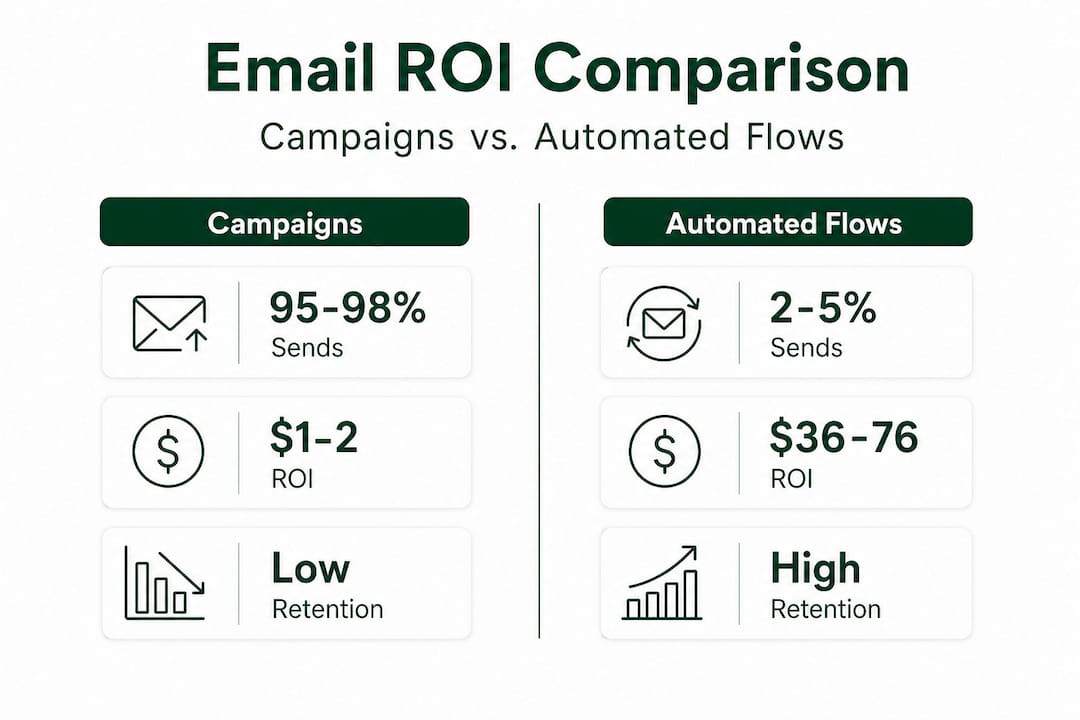
Automated flows generate 30-41% of revenue from just 2-5% of sends, with 13x higher placed order rates and 3x higher click rates than standard campaigns. The 2026 benchmarks confirm this gap is widening, not closing.
The essential automated flows every DTC brand needs are:
- Welcome series: Your first impression is your most important one. A well-built welcome sequence introduces your brand story, sets expectations, and drives the first purchase within days of sign-up.
- Abandoned cart flow: Customers who add to cart and leave have shown strong purchase intent. A two to three email sequence recovering even 10-15% of those sessions pays for your entire email program.
- Post-purchase sequence: This is where retention actually starts. A strong post-purchase flow builds loyalty, drives product education, prompts reviews, and sets up the next purchase.
- Win-back campaign: Subscribers who haven’t engaged in 90-180 days are at serious churn risk. A win-back flow with a compelling offer or story-driven reconnect email can recover a meaningful percentage before you sunset them.
Campaigns still have their place. Launches, seasonal promotions, educational newsletters, and community content all belong in a campaign calendar. But campaigns work best when they’re amplified by the automation layer underneath. Think of your flows as the always-on retention engine and your campaigns as the broadcast layer on top.
When it comes to personalizing email content within flows, dynamic blocks tied to purchase history and browsing behavior make every automated email feel individual rather than automated.
Integrating AI and predictive analytics for next-level performance
To truly lead, high-growth brands now look to AI to intensify the value of their data-driven systems. Artificial intelligence in email marketing isn’t about replacing strategy. It’s about removing the ceiling on what smart segmentation and automation can achieve.
AI brings three specific capabilities to email that manual systems can’t match at scale:
- Predictive segmentation: AI models score each subscriber based on purchase likelihood, churn risk, and category affinity. Instead of grouping customers by past behavior alone, you’re anticipating future behavior and acting on it before the decision happens.
- Send-time optimization: Rather than picking a single send time for your whole list, AI determines the optimal delivery window for each individual based on their historical engagement patterns. This alone can lift open rates by 15-20% for large lists.
- Dynamic content generation: Subject lines, product recommendations, and even email copy can be tested and personalized at scale using AI-driven systems, reducing the manual workload on your creative team.
AI integration delivers 41% higher revenue versus manual email strategies and requires at least six months of historical data before predictive models become reliable. That six-month threshold is critical. Brands that rush AI implementation without sufficient data end up with models that overfit to limited patterns and underperform.
Pro Tip: Before activating AI-driven send-time optimization or predictive segmentation, audit your data quality. Duplicate contacts, incomplete purchase records, and unverified email addresses will degrade your model’s accuracy faster than any algorithmic limitation.
Here’s when AI actually makes sense for DTC email marketers:
- Your list has more than 10,000 active subscribers
- You have at least six months of consistent purchase and engagement data
- Your ESP (email service provider) natively supports predictive analytics or integrates with a tool that does
- Your team has the bandwidth to monitor model performance and adjust segments quarterly
Understanding how to apply AI for email ROI requires pairing the right tools with the right data foundation. AI amplifies good strategy. It cannot fix a broken one.
Essential metrics, hygiene, and pitfalls of data-driven email strategy
Even the smartest strategies falter without measuring what truly matters and keeping your data clean. The metrics most marketing managers watch, open rates and click rates, are useful signals but dangerous scorecards.
The metrics that actually matter for DTC email performance:
- Revenue per recipient (RPR): Total email-attributed revenue divided by number of emails delivered. This tells you the real dollar value of each message you send.
- Conversion rate: The percentage of email recipients who complete a desired action, typically a purchase. It ties your email program directly to business outcomes.
- Customer lifetime value (CLV): The total revenue a customer generates across their entire relationship with your brand. High-performing email programs increase CLV by driving repeat purchases and deepening brand loyalty over time.
Focus on revenue metrics like RPR, conversion rate, and CLV rather than vanity metrics like open rates. Open rates are influenced by Apple Mail Privacy Protection and other tracking limitations, making them unreliable as a primary KPI for high-growth brands.
Two pitfalls destroy otherwise well-built email programs faster than almost anything else:
“Avoid over-discounting; use churn scoring for re-engagement; sunset unengaged subscribers for deliverability.”
Over-discounting is the silent brand killer. When your win-back and abandoned cart flows default to percentage-off coupons every time, you train your customers to wait for discounts rather than buy at full price. Use value-based messaging, story-driven content, and product education as your primary retention tools. Reserve discounts for genuinely lapsed customers who haven’t responded to non-promotional sequences.
List hygiene is the other major pitfall brands ignore until it becomes a crisis. Sending to unengaged subscribers doesn’t just waste budget. It actively harms your sender reputation, which drives your best emails into spam folders and erodes your deliverability across the entire list. Review your key email metrics monthly and run regular suppression reviews. The science of email list hygiene should be built into your quarterly retention calendar, not treated as a one-time cleanup exercise.
Practically, this means setting a 90-day inactivity threshold for flagging subscribers, running a structured sunset sequence for those who don’t re-engage, and suppressing the rest. A smaller, cleaner list will consistently outperform a bloated one.
What most brands miss with data-driven email marketing
Here’s what years of working with high-growth DTC brands have made clear: the brands that struggle aren’t struggling because they lack data. They’re struggling because they have too much of it and no discipline about what to act on.
The trap is real. A new AI tool promises predictive churn scores. Another platform offers 47 segmentation filters. Your ESP releases a dynamic content module. Suddenly your team is three months deep into feature-chasing and your core welcome series hasn’t been updated in a year. This is where data-driven strategy quietly falls apart.
The brands that consistently outperform aren’t using more tools. They’re using fewer, better. They’ve identified the three to five segments that drive 80% of their revenue and built genuinely excellent flows for those groups. They run structured testing email campaigns on a monthly cadence, testing one variable at a time and applying what they learn systematically. They treat their suppression list and sunset policies as a competitive advantage, not a grudging compliance task.
High-quality data beats high-volume data every time. A list of 50,000 highly engaged subscribers with clean purchase records and accurate behavioral signals will outperform a list of 200,000 with stale data, duplicate entries, and mixed attribution signals. The brands that understand this invest in data quality upstream, at the point of acquisition, not downstream when deliverability problems emerge.
The most underrated retention lever in email marketing is the continuous A/B test. Not the occasional test you run before a big send, but a systematic, always-on testing program that accumulates learning over months and years. Subject line formats, send cadence, discount versus non-discount messaging, single product versus curated collection layouts. Each test adds a layer of insight that compounds over time into a significant performance advantage.
Simplicity and consistency win. Every time.
Ready to transform your retention strategy?
If you’re serious about moving from volume-based email marketing to a genuinely data-driven retention system, the frameworks in this article are your starting point. But implementation is where the real work happens. At The Email Marketers, we build the automated flows, segmentation strategies, and AI-powered systems that translate these principles into measurable revenue. Explore our real-world case studies to see how 8-figure DTC brands have increased repeat purchases and CLV through strategic email and SMS. When you’re ready to move fast, our custom retention solutions and retention toolkit give you the infrastructure to scale what’s working and fix what isn’t.
Frequently asked questions
What is the difference between automated flows and campaigns in email marketing?
Automated flows are triggered by user behavior and drive significantly more revenue from fewer sends than broad campaigns aimed at awareness or general promotion. Automated flows generate 30-41% of revenue from just 2-5% of total sends, making them the highest-leverage asset in your email program.
How much ROI can data-driven email marketing deliver for e-commerce brands?
E-commerce brands typically see $36-42 return per $1 spent with a solid email strategy, rising sharply with advanced segmentation and AI. Email marketing ROI reaches $76 per $1 spent for brands using AI-driven automation and deep segmentation.
How long does it take for AI-powered email strategies to deliver reliable results?
Allow at least six months of consistent data collection before AI models can reliably drive segmentation and optimization. AI requires 6+ months of data for predictive models to produce actionable, trustworthy outputs.
What email metrics matter most for high-growth DTC brands?
Focus on revenue per recipient (RPR), conversion rate, and customer lifetime value (CLV) over open and click rates. Revenue metrics like RPR and CLV tie your email program directly to business outcomes rather than surface-level engagement signals.
How do you maintain email list health as you scale your DTC brand?
Set a 90-day inactivity threshold for flagging unengaged subscribers, run structured sunset sequences, and suppress non-responders before they damage your sender reputation. Sunsetting unengaged subscribers protects deliverability and keeps your active list focused on high-quality, revenue-generating contacts.
Recommended
- Email marketing best practices to boost retention in 2026
- Optimize Email ROI 2025: Proven Tactics for E-Commerce Brands
- Leverage automation to maximize email marketing impact
- How to Personalize Email Content for High Conversions
- Email marketing how to: boost engagement and sales in 2026 – Lind Creative


