.png)


Customer Lifetime Value: Unlocking E-Commerce Growth

Every ambitious American direct-to-consumer brand faces the challenge of moving beyond short-term transactions to build lasting customer value. As competition increases and acquisition costs rise, understanding and optimizing Customer Lifetime Value becomes the key to sustainable growth and profit. This overview explores the core elements and models that define CLV, offering practical insights for brands aiming to refine campaigns and drive stronger retention through data-backed strategies.
Table of Contents
- Defining Customer Lifetime Value in E-Commerce
- Types and Calculation Models for CLV
- Strategic Benefits of Increasing CLV
- ROI Impact of CLV Versus Acquisition
- Common CLV Pitfalls and Optimization Strategies
Key Takeaways
| Point | Details |
|---|---|
| Understanding CLV | Customer Lifetime Value is essential for assessing total revenue from a customer over time, guiding strategic decisions in e-commerce. |
| Impact of Retention | Focusing on customer retention is often more cost-effective than acquisition, leading to higher profitability and marketing efficiency. |
| Advanced Models | Utilizing machine learning and comprehensive data integration enhances CLV calculations, allowing for better predictions of customer behavior. |
| Strategic Resource Allocation | Awareness of customer value empowers businesses to tailor marketing strategies and improve resource allocation, fostering growth. |
Defining Customer Lifetime Value in E-Commerce
Customer Lifetime Value (CLV) represents a critical metric that transcends simple transaction tracking in the e-commerce ecosystem. At its core, CLV measures the total revenue a business can reasonably expect from a single customer account throughout their entire relationship with a brand. This comprehensive metric goes far beyond immediate sales, providing deep insights into long-term customer behavior.
Understanding CLV involves analyzing multiple strategic dimensions:
- Total revenue generated per customer
- Frequency of repeat purchases
- Average order value
- Customer retention period
- Cost of acquiring and maintaining the customer relationship
E-commerce brands leverage CLV to make critical strategic decisions. By quantifying a customer’s potential value, businesses can:
- Prioritize high-value customer segments
- Design targeted retention strategies
- Optimize marketing spend
- Predict future revenue streams
The technological evolution of digital marketing has transformed how companies calculate and interpret CLV. Modern analytics platforms enable unprecedented granularity in tracking customer interactions, allowing for more precise predictive modeling.
CLV represents the financial blueprint of customer relationships, revealing not just what customers spend today, but their potential value over time.
Customer acquisition cost and retention rates become pivotal metrics when calculating CLV. Businesses that effectively manage these factors can dramatically increase their profitability and sustainable growth potential.
Pro tip: Track your customer lifetime value monthly and segment customers by their predictive long-term worth to optimize your marketing strategies.
Types and Calculation Models for CLV
Customer Lifetime Value (CLV) calculation models have evolved dramatically with technological advancements, offering businesses increasingly sophisticated approaches to understanding customer potential. Supervised learning methods have revolutionized traditional CLV prediction techniques, enabling more accurate and nuanced customer value assessments.
Primary CLV calculation models include:
- Historical Model: Calculates past customer spending patterns
- Predictive Model: Uses machine learning to forecast future value
- Regression-based Model: Analyzes statistical relationships between customer attributes and spending
- Probabilistic Model: Estimates likelihood of future purchases
Each model offers unique insights into customer value:
Here’s a summary highlighting the main CLV calculation models and their practical focus:
| Model Type | Predictive Power | Data Requirements | Typical Use Case |
|---|---|---|---|
| Historical | Limited, backward-looking | Past purchase records | Baseline value assessment |
| Predictive | High, future-focused | Transactional & behavioral | Revenue forecasting |
| Regression-based | Moderate, statistical | Customer demographics | Attribute impact analysis |
| Probabilistic | Variable, risk-based | Purchase frequency & value | Purchase likelihood estimation |
- Historical models provide baseline understanding
- Predictive models offer forward-looking projections
- Regression models reveal complex spending correlations
- Probabilistic models assess purchase likelihood
Machine learning techniques have transformed traditional CLV calculations. Advanced algorithms can now integrate multiple data points, including:
- Purchase frequency
- Average transaction value
- Customer engagement metrics
- Behavioral patterns
- Demographic information
Advanced CLV models don’t just measure spending—they predict potential, transforming customer data into strategic insights.
The most sophisticated CLV calculation approaches combine multiple methodological strategies, creating comprehensive customer value assessments that go beyond simple financial metrics. These models help businesses understand not just current value, but potential future contributions.

Pro tip: Implement a hybrid CLV calculation approach that combines historical data with machine learning predictive models to achieve the most accurate customer value insights.
Strategic Benefits of Increasing CLV
Increasing Customer Lifetime Value (CLV) represents a transformative strategy for e-commerce businesses seeking sustainable growth. Customer experience optimization becomes a critical driver of long-term success, enabling companies to move beyond transactional interactions toward meaningful, profitable customer relationships.
The strategic benefits of improving CLV are multifaceted:
- Reduced customer acquisition costs
- Enhanced customer loyalty
- More predictable revenue streams
- Increased marketing efficiency
- Higher profit margins per customer
Companies can unlock significant advantages by focusing on CLV:
- Create more targeted marketing strategies
- Develop personalized customer experiences
- Allocate resources more effectively
- Build stronger customer retention programs
Resource allocation becomes dramatically more strategic when businesses understand their customers’ true long-term value. Advanced analytics allow companies to identify and nurture high-potential customer segments, transforming traditional marketing approaches.
CLV isn’t just a metric—it’s a comprehensive framework for understanding and maximizing customer relationships.
By implementing sophisticated CLV strategies, businesses can create a virtuous cycle of continuous improvement. Organizational productivity increases as data-driven insights enable more precise customer engagement, ultimately driving sustainable revenue growth.
Pro tip: Develop a comprehensive CLV tracking system that integrates multiple data points to create a holistic view of customer value and potential.
ROI Impact of CLV Versus Acquisition
E-commerce businesses face a critical strategic decision when comparing Customer Lifetime Value (CLV) against traditional customer acquisition strategies. Maximizing return on investment reveals that retention often proves more financially advantageous than continuous new customer pursuit.
The financial implications of CLV versus acquisition are stark:
- Acquiring a new customer costs 5-25x more than retaining an existing one
- Existing customers spend 67% more than new customers
- Retention rates can increase profits by 25-95%
- Customer loyalty translates directly into higher profit margins
- Reduced marketing expenses with repeat customers
Companies can quantify the ROI difference through key metrics:
- Calculate customer acquisition cost (CAC)
- Measure average customer lifetime value
- Compare retention versus acquisition expenses
- Track long-term revenue per customer segment
Marketing efficiency dramatically improves when businesses shift focus from constant acquisition to nurturing existing customer relationships. Advanced analytics enable precise tracking of these financial dynamics, transforming how companies approach growth strategies.
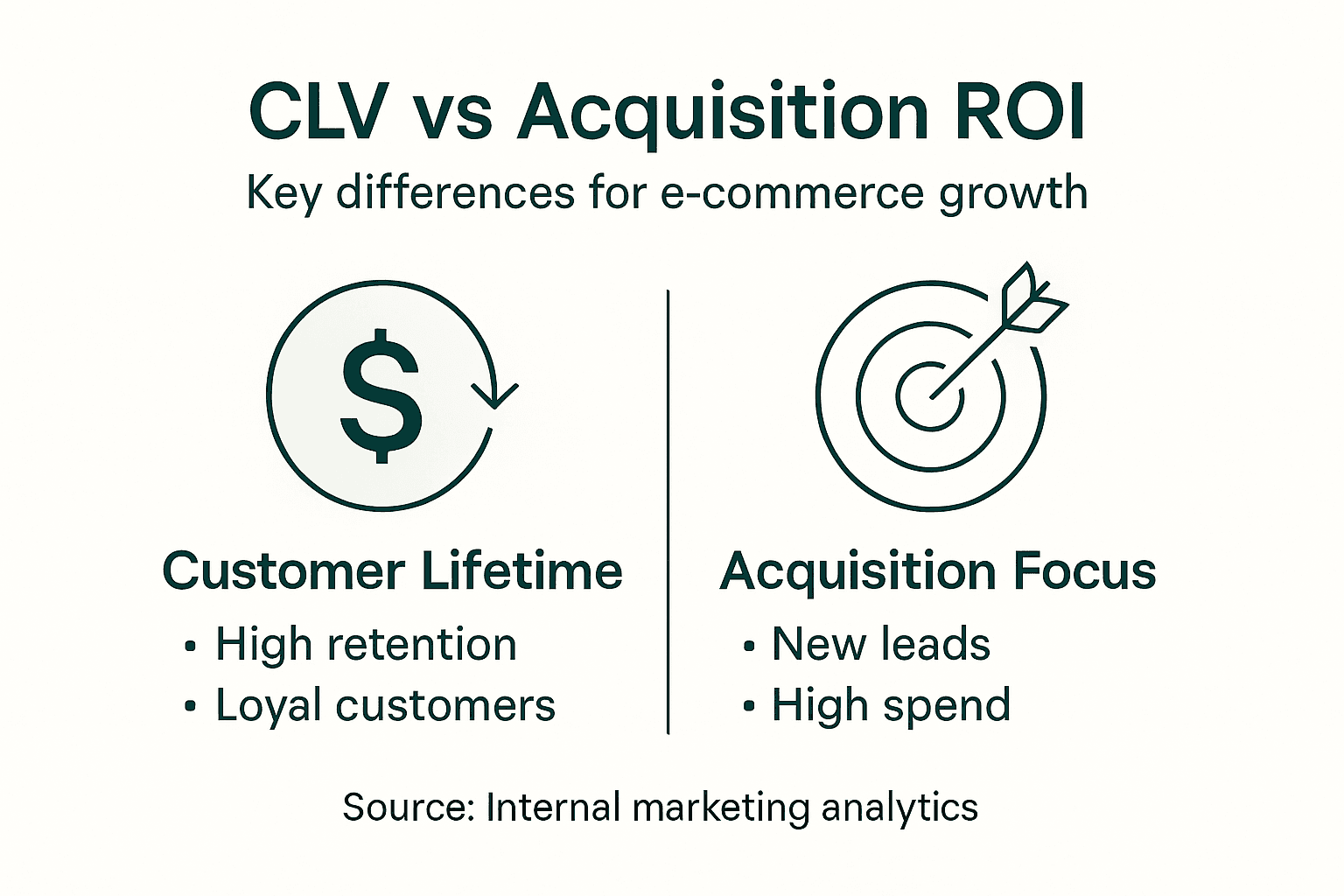
This table contrasts ROI factors between prioritizing customer retention and acquisition:
| Metric | Retention Focus | Acquisition Focus |
|---|---|---|
| Customer Cost | Much lower, efficient spend | High, repeated investments |
| Revenue Growth Potential | Consistent and scalable | Volatile, less predictable |
| Profit Margin | Typically higher | Often diluted |
| Marketing Efficiency | Targeted, data-driven | Broad, less precise |
Investing in customer retention isn’t an expense—it’s a strategic revenue multiplier.
By understanding the nuanced economics of customer value, businesses can create more sustainable and profitable growth models. Retention strategies become a powerful alternative to the expensive and often less effective traditional acquisition approaches.
Pro tip: Develop a comprehensive customer retention dashboard that tracks lifetime value metrics and compares acquisition costs against retention investments.
Common CLV Pitfalls and Optimization Strategies
Navigating the complex landscape of Customer Lifetime Value (CLV) requires a nuanced understanding of potential challenges and strategic approaches. Supervised learning methods have revealed critical insights into overcoming common CLV modeling limitations.
Common CLV pitfalls include:
- Relying on limited or outdated data sources
- Ignoring multi-channel customer interactions
- Using simplistic churn prediction models
- Overlooking customer behavior variability
- Failing to segment customer groups effectively
Strategic optimization approaches involve:
- Implementing advanced machine learning techniques
- Integrating diverse data sources
- Creating dynamic customer segmentation
- Developing predictive churn models
- Personalizing marketing interventions
Data integration represents a critical strategy for improving CLV accuracy. Modern businesses must move beyond siloed information, creating comprehensive views of customer interactions across multiple touchpoints.
Effective CLV modeling transforms raw data into actionable customer insights, turning potential weaknesses into strategic opportunities.
Advanced analytics enable more sophisticated approaches to understanding customer value. Predictive modeling allows businesses to anticipate customer behavior, design targeted interventions, and maximize long-term revenue potential.
Pro tip: Invest in machine learning infrastructure that can continuously learn and adapt your CLV models based on emerging customer interaction patterns.
Maximize Your Customer Lifetime Value With Strategic Retention Marketing
The article highlights the challenge many e-commerce brands face when trying to accurately measure and boost Customer Lifetime Value (CLV). With key pain points like inefficient retention strategies, a lack of personalized customer segmentation, and the heavy costs tied to customer acquisition, it becomes clear that optimizing CLV is essential for sustainable growth and improved ROI. Concepts such as predictive CLV models, advanced segmentation, and retention over acquisition underscore the importance of smarter marketing investments.
At The Email Marketers, we specialize in turning these challenges into your greatest opportunities. Our AI-driven email and SMS marketing campaigns focus directly on increasing CLV by developing tailored automated flows and segmentation strategies. We help you reduce costly acquisition efforts while increasing repeat purchases and customer loyalty through personalized messages that resonate deeply. Whether you want to implement predictive CLV approaches or create retention programs that truly work, our expert team provides the strategic partnership your brand needs.
Ready to transform customer relationships into lasting revenue? Discover how our retention marketing solutions at The Email Marketers align perfectly with advanced CLV optimization techniques. Take the first step toward measurable growth and higher profitability by exploring our strategic email and SMS campaigns that drive repeat business. Don’t wait another quarter to unlock your customers’ full value—contact us today and start boosting your e-commerce growth.
Frequently Asked Questions
What is Customer Lifetime Value (CLV) in e-commerce?
Customer Lifetime Value (CLV) is a metric that measures the total revenue a business can expect from a single customer throughout their entire relationship with the brand. It provides insights into long-term customer behavior beyond immediate sales.
How can businesses calculate Customer Lifetime Value?
Businesses can calculate CLV using various models, including historical, predictive, regression-based, and probabilistic models. Each model uses different data and approaches to assess customer value, often leveraging machine learning for enhanced accuracy.
Why is increasing Customer Lifetime Value important for e-commerce growth?
Increasing CLV is crucial as it leads to reduced customer acquisition costs, enhanced customer loyalty, more predictable revenue streams, and higher profit margins. It allows businesses to focus on nurturing existing relationships rather than continuously acquiring new customers.
What are some common pitfalls when calculating CLV?
Common pitfalls include relying on limited data, ignoring multi-channel interactions, using simplistic churn models, and failing to effectively segment customer groups. Addressing these issues involves using advanced analytics and diverse data sources.
Recommended
- The Online Shopping Statistics You Must Know in 2023
- What Is E-Commerce Email Strategy? Complete Overview
- 3 Examples of an Amazing Email Marketing Strategy for Ecommerce Businesses
- Top 6 Ways to Build a High-Converting Email List for Your E-Commerce Business
- Free Customer Lifetime Value Calculator | Sorbey | Sorbey


