.png)


Customer journey map templates for DTC retention

TL;DR:
- Customer journey mapping is a practical, low-cost tool to enhance retention and lifetime value.
- Mapping involves visualizing stages from awareness to loyalty, focusing on actionable touchpoints.
- Regular updates and team involvement are essential for sustained success in using journey maps.
Most DTC marketing managers assume customer journey mapping is a six-figure consulting project reserved for enterprise brands with dedicated research teams. It is not. The right template turns a complex process into a practical exercise any retention-focused team can complete in an afternoon. Customer journey mapping involves visualizing every stage from awareness to loyalty, using data-driven personas and touchpoints to identify friction and optimize for retention and lifetime value. This guide gives you the templates, frameworks, and implementation steps to build a map that actually drives repeat purchases and measurable LTV growth.
Table of Contents
- What is a customer journey map and why does it matter?
- Essential stages and touchpoints in the DTC customer journey
- Top customer journey map templates for e-commerce
- How to implement your customer journey map for better retention
- Why most customer journey map templates fail (and how to win)
- Accelerate your retention with expert journey mapping support
- Frequently asked questions
Key Takeaways
| Point | Details |
|---|---|
| Visualize key stages | Mapping your customer journey from awareness to loyalty uncovers actionable insights for retention. |
| Use proven templates | Free templates from trusted sources like HubSpot and Shopify simplify the mapping process. |
| Map actionable touchpoints | Focusing on real customer interactions helps identify friction and boost engagement. |
| Update regularly | Quarterly reviews ensure your journey map stays relevant and effective as your business evolves. |
| Connect to retention | Turning journey insights into campaign improvements drives customer lifetime value for DTC brands. |
What is a customer journey map and why does it matter?
A customer journey map is a visual document that traces every interaction a customer has with your brand, from the first ad impression to their fifth repeat purchase. For DTC brands, it is not a theoretical exercise. It is a strategic tool that shows you exactly where customers drop off, where they feel delighted, and where your messaging is missing the mark.
Think of it like a GPS for your retention strategy. Without it, you are guessing which touchpoints need attention. With it, you can see the full picture and make decisions backed by real behavioral data. Understanding the customer journey is the first step toward building campaigns that meet customers where they actually are, not where you assume they are.
The five core e-commerce stages are Awareness, Consideration, Acquisition, Service, and Loyalty. Each stage has distinct customer emotions, questions, and needs. Mapping them forces your team to think from the customer’s perspective rather than the brand’s internal logic.
“A customer journey map is only as powerful as the retention strategy it informs. The map is the diagnosis. Your campaigns are the treatment.”
Here is why journey maps directly impact your bottom line:
- Pinpoint friction: Identify exactly where customers abandon carts, ignore emails, or churn after one purchase.
- Improve personalization: Match messaging to the customer’s current stage rather than blasting one-size-fits-all campaigns.
- Align your team: Give marketing, support, and product a shared view of the customer experience.
- Boost LTV: Loyal customers contribute 44% of revenue despite making up only 21% of the audience.
The misconception that journey maps are only for large companies has cost countless small DTC brands real revenue. A two-person team with a solid template and honest customer data can build a map that outperforms a bloated enterprise deck. Customer-centric marketing best practices start with this kind of structured thinking, not with a massive budget.
Essential stages and touchpoints in the DTC customer journey
Knowing the stages is one thing. Knowing which specific touchpoints live inside each stage is what makes your map actionable. Journey mapping starts with visualizing key stages and data-driven touchpoints that reflect how real customers behave, not how you wish they would.
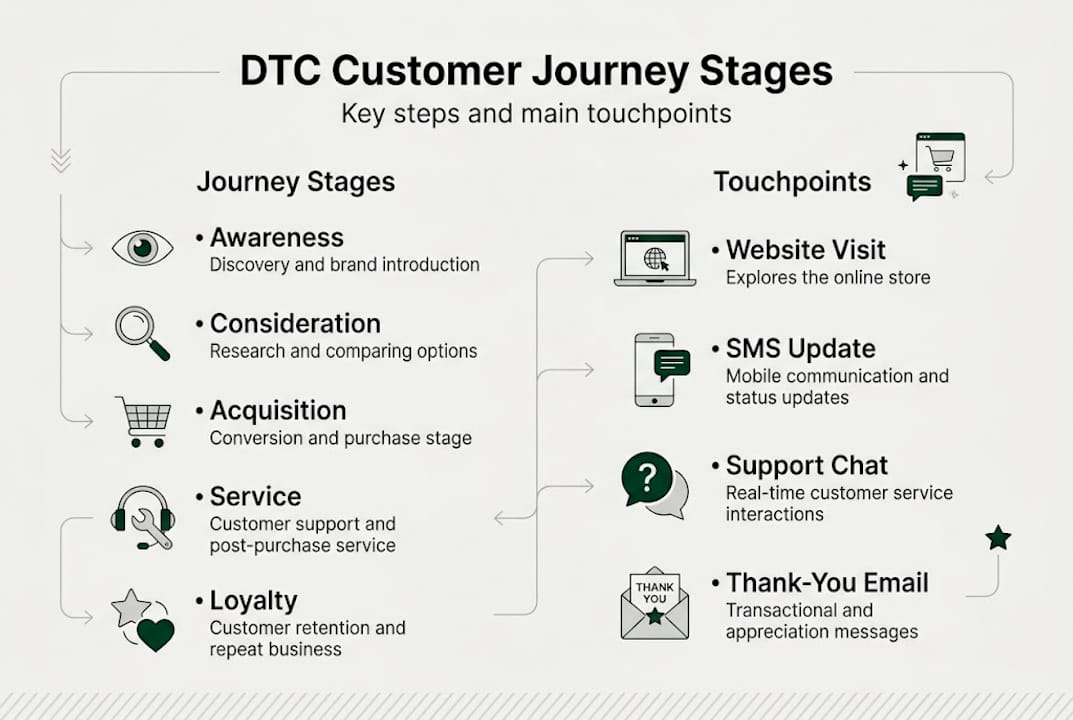
Here is a breakdown of the five stages and their most common DTC touchpoints:
| Stage | Key touchpoints |
|---|---|
| Awareness | Paid social ads, influencer content, SEO blog posts, PR mentions |
| Consideration | Email nurture sequences, retargeting ads, product comparison pages |
| Acquisition | Welcome email series, checkout flow, first-purchase SMS confirmation |
| Service | Post-purchase email, support chat, order tracking, return portal |
| Loyalty | Loyalty program emails, win-back campaigns, UGC review requests, VIP SMS |
To map touchpoints effectively, follow this sequence:
- List every channel your brand uses across email, SMS, social, paid, and on-site.
- Assign each channel to a journey stage based on when customers typically encounter it.
- Identify the customer’s goal and emotion at each touchpoint. What are they trying to accomplish? What are they feeling?
- Flag gaps and redundancies. Are you over-communicating at Acquisition and going silent at Loyalty?
- Prioritize the highest-impact touchpoints for immediate optimization.
Pro Tip: Do not overlook micro-moments. An SMS sent 30 minutes after a first purchase asking “Did everything go smoothly?” can dramatically increase trust and second-purchase rates. Personalized email strategies and SMS messages at these micro-moments outperform batch-and-blast sends by a wide margin.
Emerging channels like support bots, interactive quizzes, and post-purchase video tutorials are now legitimate touchpoints worth mapping. If a customer interacts with your brand there, it belongs on your map. Personalizing customer communications at each stage is what separates brands with 20% repeat purchase rates from those hitting 50%. And lifecycle email marketing gives you the structural framework to automate the right message at the right stage automatically.
Top customer journey map templates for e-commerce
Not all templates are built the same. The format you choose should match your team’s workflow, your data maturity, and the complexity of your customer base. HubSpot and Shopify offer multiple free, proven templates ideal for e-commerce brands at any stage of growth.

Here is a comparison of the most useful options:
| Template | Format | Best use case | Pros | Cons |
|---|---|---|---|---|
| HubSpot Buyer’s Journey | Spreadsheet/PDF | Awareness to conversion mapping | Free, detailed, easy to customize | Requires manual data input |
| HubSpot Current State | Visual diagram | Mapping existing experience gaps | Great for audits | Less forward-looking |
| Shopify Customer Journey | Visual flowchart | DTC-specific stage mapping | E-commerce native | Limited persona depth |
| Miro Journey Template | Collaborative whiteboard | Cross-team workshops | Real-time collaboration | Learning curve for new users |
| Causality Engine Map | Data-integrated dashboard | Advanced, data-driven brands | Connects to analytics | High setup investment |
When selecting a template, consider these criteria:
- Ease of use: Can your team fill it out without a consultant in the room?
- Visual clarity: Does it communicate the customer experience at a glance?
- Data integration: Can you attach real metrics like open rates, churn points, or NPS scores?
- Customizability: Does it flex to fit your specific channels and customer segments?
For most DTC brands, starting with HubSpot’s journey map guide and a plug-and-play format is the right call. Once your team is comfortable with the process, you can layer in more advanced templates that connect directly to your analytics stack. If you run on Shopify, Shopify template expertise can help you map flows that align with your store’s native data. And if you are building out automated sequences, using drip campaigns in the journey is a natural next step once your map is in place.
How to implement your customer journey map for better retention
A journey map sitting in a shared Google Drive folder does nothing. Implementation is where the real retention gains happen. Combining journey map templates with the right retention strategies can substantially boost revenue and LTV when you move from insight to action.
Follow this step-by-step process to put your map to work:
- Audit your current touchpoints. Pull data from your ESP, SMS platform, and support tools. Where are open rates lowest? Where does churn spike?
- Align your map to real segments. Do not build one map for all customers. Create separate maps for first-time buyers, repeat purchasers, and lapsed customers.
- Identify your top three friction points. Focus your first optimization sprint on the stages where customers are most likely to disengage.
- Build or refine campaigns for each friction point. This might mean a stronger post-purchase nurture sequence, a better win-back flow, or a more personalized welcome series.
- Set measurable KPIs for each stage. Track open rates, click rates, repeat purchase rate, and churn rate by segment.
- Review and iterate monthly. Treat your map as a living document, not a finished deliverable.
“The most effective journey maps become living documents driving ongoing retention testing.”
Pro Tip: Schedule a 15-minute weekly team review of one journey stage. Rotating through stages monthly means your entire map gets fresh eyes four times a year without requiring a big quarterly meeting.
Boosting retention with journey insights is not about overhauling everything at once. Small, targeted improvements at high-friction stages compound fast. Re-engagement campaigns for mapped journeys are a prime example: once you know exactly when customers go quiet, you can trigger the right message at the right moment. The retention toolkit resources available to DTC brands today make this kind of precision execution more accessible than ever.
Why most customer journey map templates fail (and how to win)
Here is the uncomfortable truth: most brands build a journey map once, feel accomplished, and never touch it again. That static map becomes outdated within 90 days as new channels launch, customer behavior shifts, and campaigns evolve. A map that does not move with your business is just a pretty slide.
The DTC brands we see winning with journey maps treat them as operational tools, not strategy documents. They update their maps quarterly, tied to product launches, seasonal campaigns, and channel expansions. They involve marketing, customer support, and product in the same room, because the support team hears friction that marketing never sees in open rate data.
The customer-centric mindset required to make journey maps work long-term is a cultural commitment, not a one-time project. Brands that win do not just map the journey. They build systems around continuously improving it. That is what separates a 2x LTV from a 5x LTV over 24 months.
Accelerate your retention with expert journey mapping support
Even the best template needs sharp execution to drive real results. At The Email Marketers, we help DTC brands turn journey map insights into automated flows, precision-segmented campaigns, and measurable LTV growth. Our Retention Lab for advanced mapping gives you the frameworks, tools, and expert guidance to move from theory to revenue fast. Want proof it works? See our DTC case studies to see how brands like yours have transformed retention with strategic journey mapping. Ready to get started? Get the Retention Toolkit and start building campaigns that compound.
Frequently asked questions
What is the best customer journey map template for retention?
HubSpot’s and Shopify’s templates are proven for DTC retention when paired with ongoing customer feedback and segmentation. The Buyer’s Journey and Current State formats are strong starting points for most e-commerce teams.
How often should I update a customer journey map?
Update your map quarterly or whenever you launch new products, channels, or campaigns. Winning DTC brands update journey maps regularly to keep insights aligned with actual customer behavior.
What are the most important stages in an e-commerce customer journey?
The five key stages are Awareness, Consideration, Acquisition, Service, and Loyalty. Each stage requires distinct messaging, touchpoints, and success metrics.
Can journey maps work for small DTC brands, not just large companies?
Absolutely. Journey mapping is crucial for brands of any size. Small teams often see faster wins because they can act on insights without layers of approval slowing them down.


