.png)


Customer journey management: boost e-commerce retention

TL;DR:
- Customer journey management actively orchestrates real-time interactions, unlike static, outdated journey maps.
- Non-linear, intent-driven strategies improve retention metrics and increase lifetime customer value.
- Implementing CJM requires auditing data, integrating cross-channel tools, and focusing on high-impact customer journeys.
Customers don’t follow your funnel. They browse on mobile, abandon on desktop, get distracted by a competitor’s ad, and come back two weeks later through an email they almost deleted. If your brand still relies on a static, linear journey map to guide engagement, you’re planning for a customer who doesn’t exist. Customer journey management (CJM) is the practice that replaces wishful thinking with real-time orchestration, and for e-commerce brands serious about retention, it’s no longer optional. This guide breaks down exactly what CJM is, why old models fail, and how to use it to build loyalty that actually lasts.
Table of Contents
- What is customer journey management?
- Why traditional journey maps fall short in e-commerce
- How customer journey management powers retention marketing
- Implementing customer journey management: Practical steps for brands
- Why intent-driven orchestration beats old school funnel thinking
- Elevate your retention strategy with expert-driven journey management
- Frequently asked questions
Key Takeaways
| Point | Details |
|---|---|
| Journey management, not just mapping | Modern customer journeys require continuous orchestration, not just visual plans. |
| Personalization with care | Balance tailored messaging with timing and suppression to avoid overwhelming customers. |
| Omnichannel context is critical | Retain relevance and context as customers move fluidly across digital platforms. |
| Practical steps yield results | Auditing, integrating, and orchestrating data-driven actions are key to improved retention. |
What is customer journey management?
Most e-commerce teams are familiar with journey mapping. You gather your team, draw out the stages from awareness to purchase, pin up sticky notes, and call it done. The problem is that a map just describes a territory. It doesn’t navigate it for you, and it certainly doesn’t update itself when the terrain changes overnight.
Customer journey management is the active practice of orchestrating, monitoring, and adjusting every interaction a customer has with your brand in real time. It’s not a diagram on a whiteboard. It’s a living system that connects data, channels, messaging, and timing to deliver the right experience at the right moment, based on actual customer behavior, not assumed behavior.
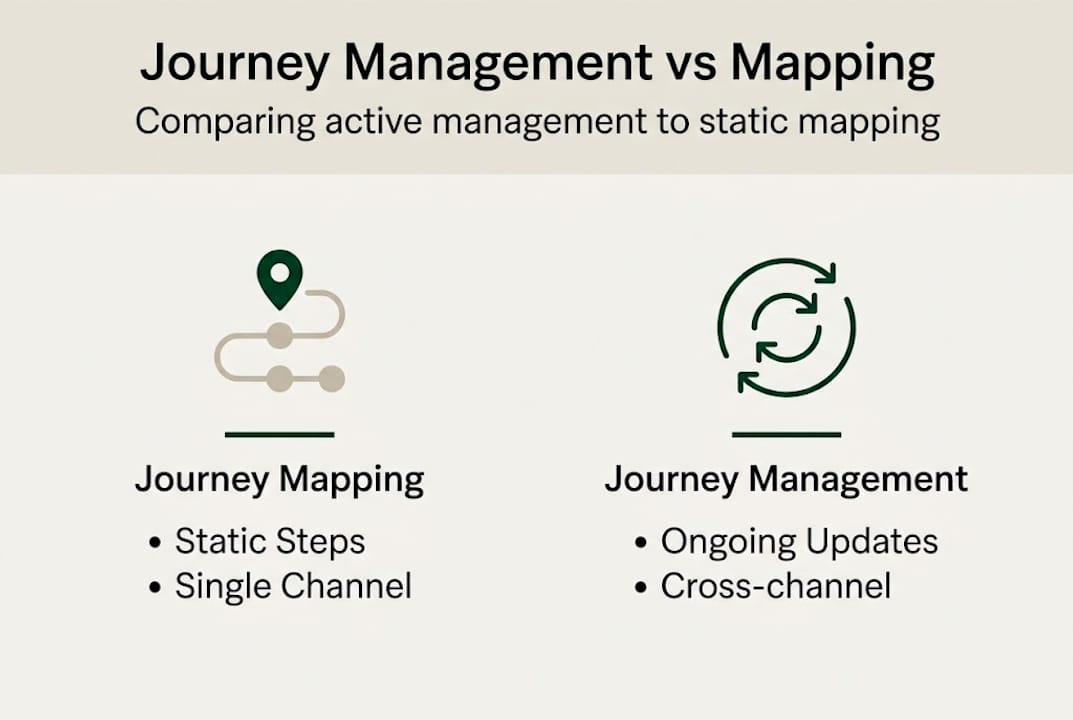
Understanding the customer journey basics is a useful starting point, but CJM goes several steps further. Where mapping identifies what should happen, management responds to what is happening. A customer who browses your sale page three times in a week is signaling intent. A customer who opens four emails but never clicks is telling you something completely different. CJM lets you respond to those signals intelligently.
As modern commerce research confirms, non-linear, intent-driven journeys break the assumption of a single controlled path. Customers loop back, skip stages, and arrive from unexpected directions. Any system built on a predictable sequence will crack under that pressure.
The key components of an effective CJM strategy include:
- Real-time data integration across all channels (email, SMS, social, on-site behavior)
- Behavioral triggers that activate messaging based on actions, not calendars
- Dynamic segmentation that updates as customer intent shifts
- Suppression logic that prevents over-messaging fatigued customers
- Cross-channel context sharing so every touchpoint knows what happened on the last one
- Continuous performance monitoring with rapid iteration loops
“A journey management system is only as strong as its ability to respond to real behavior. Static maps are photographs of a moment. Management is the movie.” This distinction shapes every strategic decision a modern e-commerce brand needs to make.
Pairing CJM with a sharp advertising strategy also ensures that paid acquisition feeds into retention systems from the very first touchpoint, rather than existing as a disconnected silo.
Why traditional journey maps fall short in e-commerce
Static journey maps made sense in an era when customers discovered a product in a catalog, called a phone number, and bought. That world is gone. Today, customers interact with your brand across five to eight touchpoints before converting, and many of those touchpoints happen in an order nobody predicted.
The fundamental flaw of a traditional journey map is the assumption of linearity. It assumes customers enter at awareness, move through consideration, arrive at purchase, and then loop neatly into loyalty. In reality, they re-enter the funnel mid-consideration from a retargeting ad, delay decisions for weeks, switch from mobile to desktop to in-store, and still expect a seamless, consistent experience across all of it.
Non-linear journeys and channel switching mean brands must preserve context and relevance as customers bounce between platforms. A map can’t do that. Only an active management layer can.
Here’s a direct comparison of where traditional mapping stops and journey management takes over:
| Dimension | Journey mapping | Journey management |
|---|---|---|
| Approach | Static, periodic snapshot | Dynamic, real-time orchestration |
| Personalization | Segment-level assumptions | Individual behavioral signals |
| Channel handling | Siloed by channel | Context shared across channels |
| Timing logic | Calendar or batch-based | Trigger and intent-based |
| Optimization cycle | Quarterly or annually | Continuous and iterative |
| Fatigue prevention | Not addressed | Built-in suppression logic |
Effective omnichannel marketing depends entirely on that bottom row. Without suppression logic and shared context, brands end up bombarding customers on one channel while completely ignoring signals from another. That’s how you lose a loyal customer to a competitor who simply sent the right message at the right time.
Understanding the marketing funnel is still useful for organizing broad strategic goals, but the funnel alone won’t tell you what a customer needs right now. That requires a management layer.
Pro Tip: Don’t treat your email, SMS, and social channels as three separate lanes running parallel to each other. Customers move between them constantly, and your orchestration system needs to move with them. A customer who clicks an SMS link and then browses your site should receive email follow-up that references the SMS context, not a generic welcome series.
“Treating every channel as a separate journey is like giving each department of a restaurant its own menu with no shared kitchen. The customer eats the confusion.” The brands that win retention are the ones that unify the experience, not multiply the touchpoints.
How customer journey management powers retention marketing
Acquisition gets the spotlight. Retention builds the business. That tension is real, and CJM is the most powerful lever brands have to tip the scales toward lifetime value rather than one-time purchases.
The connection is direct: when you manage journeys actively, you control timing, relevance, and frequency simultaneously. You stop sending the win-back email to the customer who bought yesterday. You stop promoting a product the customer already owns. You stop sending five messages in three days and then going dark for a month. These aren’t just cosmetic improvements. They compound into measurable lifetime value gains.
Personalization without orchestration can backfire badly. Automation and personalization without timing, suppression, and proper journey logic risks customer fatigue and trust erosion. Brands invest heavily in dynamic content and segmented offers, then undermine all of it by firing them at the wrong moment or too frequently.
CJM-driven tactics that directly boost retention include:
- Next-best-action messaging: Analyzing recent behavior to determine the single most relevant next message rather than sending the next scheduled campaign
- Smart suppression: Automatically pausing outreach to customers who recently purchased, recently complained, or show signs of disengagement
- Re-engagement sequences: Triggered specifically when behavioral signals indicate drift, not based on arbitrary time thresholds
- Post-purchase nurture flows: Designed to drive second purchases through timely education, social proof, and personalized cross-sell logic
- Loyalty milestone triggers: Activating reward offers exactly when a customer is one purchase away from hitting a threshold
The impact is measurable. Here’s what orchestrated versus non-orchestrated strategies typically deliver across common retention metrics:
| Metric | Non-orchestrated | Orchestrated CJM |
|---|---|---|
| Repeat purchase rate | 18 to 22% | 32 to 40% |
| Email open rate (retention) | 18 to 24% | 30 to 38% |
| Unsubscribe rate | 0.5 to 1.2% | 0.1 to 0.3% |
| Customer lifetime value growth | Flat to 5% | 15 to 35% annually |
| Win-back campaign conversion | 3 to 5% | 8 to 15% |
Staying current on retention marketing trends ensures your orchestration logic keeps pace with shifting customer expectations. The tactics that worked in 2023 are already becoming table stakes in 2026.
Knowing that a 5% boost in retention can drive up to 95% growth in profit makes CJM investment easy to justify. It’s not a nice-to-have. It’s a math problem with an obvious answer.
Understanding user retention fundamentals also helps frame the financial stakes clearly for stakeholders who are still focused on acquisition metrics.
Pro Tip: Automation is powerful, but let it serve human connection, not replace it. Brands that build in moments of genuine, unscripted communication (like a personal thank-you after a high-value purchase or a genuine survey request) outperform those running fully mechanized sequences. The automation creates scale; the human touches create loyalty.
Strong retention email strategies sit at the core of any orchestrated CJM approach. The channel isn’t dead. It’s just underutilized by brands that haven’t connected it to real-time behavioral data.
Implementing customer journey management: Practical steps for brands
Knowing the value is one thing. Getting it into practice at an operational level is another. The good news is that CJM doesn’t require a complete technology overhaul on day one. It requires prioritization, clear process, and a commitment to iteration.
Brands with orchestrated omnichannel engagement strategies retain an average of 89% of their customers, compared to 33% for brands with weak cross-channel engagement, according to industry data on omnichannel retention performance. That gap is too wide to ignore.
Effective CJM requires orchestrating across systems and channels while maintaining relevance as customers switch platforms. That’s the operational challenge. Here’s how to approach it:
-
Audit your existing data and touchpoints. Map where customer data currently lives, from your ESP and CRM to your e-commerce platform and SMS tool. Identify gaps in context sharing. If your SMS platform doesn’t know what a customer clicked in your last email, that’s a problem to solve before adding more campaigns.
-
Select and integrate your orchestration infrastructure. Choose tools built for cross-channel orchestration rather than bolting together single-channel point solutions. Look for platforms that support behavioral triggers, real-time segmentation, and suppression rules natively. Explore email automation capabilities that connect seamlessly with your customer data platform.
-
Define your highest-value journeys first. Don’t try to orchestrate everything at once. Identify two or three journeys with the highest impact on revenue or retention, such as post-first-purchase, pre-churn, and re-engagement. Build orchestration for those first, learn from the data, and expand.
-
Build suppression logic before launching new campaigns. Seriously, do this first. Set rules for who should never receive a specific message type based on recent activity, purchase history, or engagement status. Suppression protects both your sender reputation and your customer relationships.
-
Set your KPIs and monitoring cadence. Define what success looks like before you launch. Metrics that matter include repeat purchase rate, days between first and second purchase, email and SMS engagement rates by journey stage, and unsubscribe and complaint rates. Monitor weekly, not quarterly.
-
Run rapid iterations based on behavioral signals. Don’t wait for a quarterly review to fix a broken journey step. If a trigger sequence shows a drop-off at message three, investigate and test a change within two weeks. Speed of iteration is a competitive advantage.
-
Empower your team to respond in real time. Long-term planning matters, but CJM also requires someone watching live performance and adjusting quickly. Build that real-time response capability into your team’s workflow.
Building this kind of customer-centric marketing muscle takes time, but each iteration compounds. Brands that start with disciplined CJM implementation today will have a data advantage over competitors who wait.
Understanding customer acquisition methods alongside retention strategies ensures the full lifecycle is coherent from first touch to long-term loyalty.
Pro Tip: Start with your highest-value customer segment’s journey, not your largest. High-value customers have the most complex and informative journeys. What you learn from orchestrating their experience will translate into improvements for every other segment.
Why intent-driven orchestration beats old school funnel thinking
Here’s the uncomfortable truth most e-commerce strategies won’t say out loud: the funnel is a story brands tell themselves, not a path customers actually walk.
Most brands still operate retention marketing as if customers move in one direction at a predictable pace. They build welcome series for new subscribers, post-purchase flows for buyers, and win-back campaigns for the lapsed. Clean, logical, sequential. And mostly disconnected from what customers are actually doing.
Modern customers re-enter, explore, and delay decisions. Journey management built on intent and context-based orchestration actually serves them. A funnel assumes forward motion. Intent-driven orchestration assumes complexity, and it’s right.
The brands we see driving genuinely strong retention don’t ask “what stage is this customer in?” They ask “what did this customer just do, and what does that signal about what they need next?” That shift in thinking changes everything. It changes which message gets sent, when, on which channel, and with what content.
“Funnels are for water. Customers are not water. They move sideways, backward, and in directions you haven’t modeled yet. Build for that.”
Running thoughtful re-engagement campaigns is one clear example of intent-driven orchestration in action. Instead of triggering a re-engagement flow after 90 days of silence (a calendar rule), intent-driven orchestration watches for a lapsed customer’s first sign of life, a site visit, a social click, an email open, and responds to that signal immediately with a relevant message. The timing is driven by their behavior, not your schedule.
That responsiveness is what builds real loyalty. Customers feel understood rather than marketed to. That feeling is rare and valuable.
Elevate your retention strategy with expert-driven journey management
![cta_image]
Moving from a static journey map to a fully orchestrated CJM system is one of the highest-leverage investments a growth-focused e-commerce brand can make. The gap between brands that map and brands that manage is growing fast in 2026, and it shows up directly in repeat purchase rates, customer lifetime value, and revenue resilience.
The Email Marketers specializes in building the exact orchestration systems that make CJM work in practice. Explore real examples of transformation through our case study portfolio, get hands-on with frameworks inside the Retention Lab, or access the tools and templates in our Retention Toolkit to start orchestrating smarter journeys today.
Frequently asked questions
What is the main difference between journey mapping and journey management?
Journey mapping visualizes touchpoints in a static diagram, while journey management actively orchestrates real-time customer experiences across channels, adapting to actual behavior as it happens.
How can ineffective personalization harm customer retention?
Poorly timed personalization and over-messaging without proper suppression logic causes customer fatigue, erodes trust, and accelerates churn rather than building loyalty.
What’s an example of intent-driven journey management in e-commerce?
An intent-driven system might detect a returning customer browsing a product category three times without adding to cart, then trigger a personalized SMS offer matched to that specific product intent rather than a generic promotion.
Why is cross-channel orchestration important for e-commerce?
It ensures every interaction feels continuous and relevant even when customers switch platforms, preventing the frustrating experience of receiving contradictory or out-of-context messages from the same brand on different channels.


