.png)


Boost email marketing effectiveness for e-commerce ROI

TL;DR:
- Most e-commerce marketers overlook the complexities of accurately measuring email ROI, leading to strategic missteps.
- Effective measurement requires multi-touch attribution, rigorous testing, and tracking key metrics like revenue per email and customer retention.
- Brands that implement precise frameworks and holdout tests often achieve ROI ten times their email spend, moving beyond vanity metrics to real impact.
Most e-commerce marketing managers treat email as a sure bet. The channel has a sterling reputation, the dashboards look busy, and the opens keep rolling in. But many teams aren’t confident they can accurately measure email ROI, and effectiveness is often assumed rather than proven. That gap between assumption and evidence costs brands real money. This article cuts through the noise with actionable strategies to measure, optimize, and prove the true value of every email you send.
Table of Contents
- Why measuring email marketing effectiveness isn’t straightforward
- Key metrics to track for genuine email effectiveness
- Promotional vs. transactional emails: Comparative impact and ROI
- Frameworks and tools to maximize email ROI for retention
- The uncomfortable truth about email marketing effectiveness
- Unlock your next level of email ROI
- Frequently asked questions
Key Takeaways
| Point | Details |
|---|---|
| Measurement is challenging | Most e-commerce teams struggle to accurately measure email marketing ROI across promotional and transactional emails. |
| Focus on meaningful metrics | Track retention and revenue per email, not just open or click rates. |
| Promotional vs transactional differences | Each email type requires distinct measurement frameworks and attribution for accurate effectiveness. |
| Frameworks and tools drive ROI | Adopt analytics tools and proven frameworks like cohort analysis for measurable retention results. |
| Holistic attribution is vital | True email effectiveness should be tied to incremental testing and robust attribution, not simple channel assumptions. |
Why measuring email marketing effectiveness isn’t straightforward
Attribution is where most measurement efforts fall apart. Single-channel attribution, the practice of giving 100% credit for a sale to the last email a customer opened, paints a deeply incomplete picture. A customer might browse organically, see a retargeting ad, and then click an email before buying. The email gets full credit. The other touchpoints get nothing. That distorts your understanding of what’s actually driving revenue.
The broader misconception is that email “always delivers high ROI.” You’ve probably seen the headline numbers circulating in marketing decks. Those figures are real for brands that measure well, but they can be misleading when applied universally. Measuring email ROI requires far more rigor than tracking clicks and assuming purchases follow.
“Less than half could measure ROI for promotional or transactional emails.” This isn’t a small gap. It means the majority of teams are making strategic decisions on incomplete or unreliable data.
The confidence gap is real across both email types. Promotional emails, the campaigns, sales, and product launches, are hard to separate from other simultaneous marketing efforts. Transactional emails, the order confirmations, shipping updates, and account alerts, are often ignored from a measurement standpoint entirely because they’re “operational.” That’s a missed opportunity on both ends.
The key issues that make measurement genuinely hard include:
- Multi-touch attribution: Customers rarely convert from a single email. Giving credit accurately across five or six touchpoints requires intentional tooling.
- List quality decay: Sending to disengaged subscribers inflates your list size but deflates meaningful metrics like conversion rate and revenue per email.
- Blended channel effects: Paid social, SMS, and email often run simultaneously. Isolating email’s contribution without controlled testing is nearly impossible.
- Platform reporting limitations: Native ESP (email service provider) dashboards typically report on opens and clicks, not post-purchase behavior or retention outcomes.
Understanding the average email ROI across industries helps calibrate expectations, but the real goal is understanding your ROI with confidence, not benchmarking against a headline number.
Key metrics to track for genuine email effectiveness
Once you accept that measurement is complex, you can start choosing the right signals. Vanity metrics like open rates and click rates have their place, but they shouldn’t anchor your strategy. What you really need are metrics tied to retention and revenue outcomes.
Here’s what to track with genuine intent:
- Conversion rate by segment: Not overall conversion rate, but broken down by customer segment, lifecycle stage, and campaign type. A 2% conversion rate means very different things for a win-back campaign versus a VIP loyalty send.
- Revenue per email (RPE): This is the single cleanest top-line metric for campaign effectiveness. Divide total revenue attributed to a send by the number of emails delivered. It immediately surfaces which campaigns earn their place.
- Customer retention rate from email cohorts: Track which customers acquired or re-engaged through email continue to purchase over 90, 180, and 360 days. This is where email’s compounding value becomes visible.
- List health score: Monitor your unsubscribe rate, spam complaint rate, and deliverability metrics together. A shrinking engaged list destroys future campaign performance even when current numbers look acceptable.
- Post-click behavior: What do subscribers do after clicking? Time on site, pages visited, and cart abandonment rates all add context to whether your email is attracting genuinely interested buyers or just generating hollow clicks.
Pro Tip: Use cohort analysis to isolate the long-term retention impact of specific email campaigns. Group customers by the first email campaign that drove their second purchase, then track their 12-month lifetime value. You’ll quickly identify which campaign types build loyal buyers versus one-time converters.
The email marketing KPIs worth tracking shift depending on your brand’s growth stage. Early-stage brands should focus on engagement rates to build a warm list. Scaling brands should weight RPE and cohort retention heavily. The most important thing is to stop treating email metrics as a reporting obligation and start treating them as a decision-making tool.
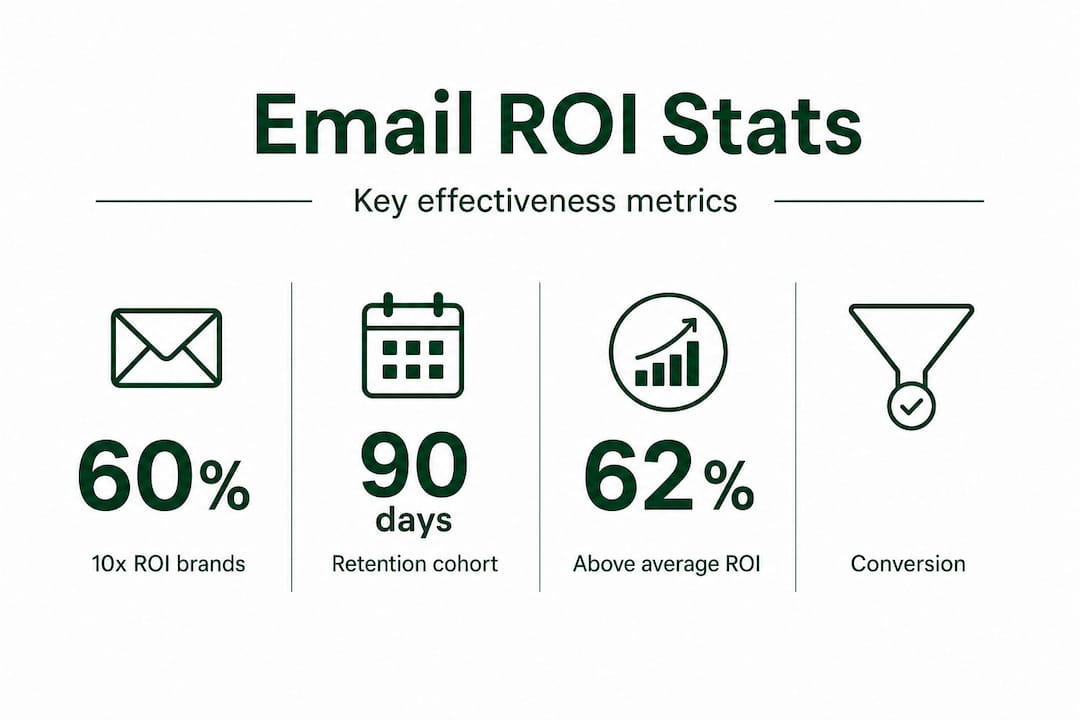
Among brands that do measure email carefully, 60 to 62% report ROI that is tenfold their spend. That’s a compelling number, and it’s achievable, but only when your measurement infrastructure is solid enough to capture it honestly.
Promotional vs. transactional emails: Comparative impact and ROI
These two email types serve very different purposes, but both carry significant revenue potential. The problem is that less than half of teams can reliably measure ROI for either type, which means massive optimization opportunities go untouched.
| Dimension | Promotional emails | Transactional emails |
|---|---|---|
| Primary goal | Drive purchases, engagement, brand awareness | Confirm actions, build trust, reduce friction |
| Typical open rate | 20 to 35% | 45 to 65% (significantly higher) |
| Revenue attribution | Direct but often blended with other channels | Indirect but powerful for upsell and LTV |
| Measurement challenge | Multi-channel overlap, timing effects | Often excluded from marketing analytics entirely |
| Optimization lever | Segmentation, timing, offers | Contextual upsells, post-purchase flows, engagement nudges |
| Retention impact | High when personalized; low when generic | Very high when designed with lifecycle intent |
Transactional emails are dramatically underused as retention tools. An order confirmation that includes a thoughtful product recommendation based on purchase history, or a shipping update that includes a loyalty program invite, can drive real incremental revenue without feeling promotional. The trust is already there because the customer just bought.
Here’s a step-by-step approach to improve measurement and performance across both types:
- Audit your current attribution setup. Identify whether your ESP tracks post-click behavior through your analytics platform. If revenue isn’t flowing back from your store to your email reports automatically, fix that integration first.
- Separate promotional and transactional reporting streams. Most teams lump all email performance into a single dashboard view. Break them out. Each type needs its own benchmarks and optimization cadence.
- Run holdout tests for promotional campaigns. A holdout group (a small percentage of your list that receives no email during a campaign period) lets you measure the true incremental lift your emails generate. This is the gold standard for promotional ROI measurement.
- Add behavioral triggers to transactional flows. Look at your post-purchase sequence. Does the second touchpoint change based on what the customer bought? If not, you’re leaving personalization value on the table.
- Set 30, 60, and 90-day revenue windows. Attribution windows matter enormously. A customer who buys 45 days after receiving a campaign was still influenced by it. Expand your measurement window and you’ll often find more attributable revenue than you thought.
When optimizing email ROI across both email types, the brands that win are those that treat every touchpoint, including the “boring” operational ones, as a relationship moment. And retention best practices consistently show that it’s the post-purchase experience that determines whether a customer comes back.
Frameworks and tools to maximize email ROI for retention

Theory without application doesn’t move numbers. Here are the frameworks and tools that high-performing retention teams actually use to drive measurable results.
| Framework | What it does | Best for |
|---|---|---|
| RFM segmentation (Recency, Frequency, Monetary) | Segments customers by purchase behavior to prioritize outreach | Identifying high-value and at-risk segments |
| Lifecycle automation | Sends targeted emails based on where a customer is in their journey | Welcome, post-purchase, win-back, loyalty flows |
| Incremental testing | Measures true lift by comparing email recipients to a holdout group | Proving causation, not just correlation |
| Cohort retention analysis | Tracks long-term purchase behavior of email-acquired customers | Proving 12-month LTV impact of email investment |
| Predictive send-time optimization | Uses ML to send each subscriber at their peak engagement time | Improving open and conversion rates at scale |
The tools that support these frameworks fall into a few key categories:
- ESP with behavioral tracking: Klaviyo, Attentive, and similar platforms offer native segmentation tied to purchase behavior, which is essential for RFM and lifecycle work.
- Analytics integration: Google Analytics 4 with proper UTM tagging and Northbeam or Triple Whale for multi-touch attribution give you the cross-channel view that ESP dashboards can’t.
- Holdout testing tools: Some ESPs support this natively. Others require a manual list split. Either way, building this habit into your campaign planning is the single biggest measurement upgrade most teams can make.
- Customer data platforms (CDPs): For brands scaling past $10M in annual revenue, a CDP like Segment unifies data across email, SMS, paid, and on-site behavior. This is where truly holistic attribution becomes possible.
Among brands investing in proper measurement, 60 to 62% see ROI at ten times their spend. That figure makes the case for investing in the right tooling. The email benchmark insights available for your vertical can help you set realistic internal targets once your measurement is solid. And if you want proof of the channel’s ceiling, email marketing value stats consistently show it outperforms every paid channel on a cost-per-acquisition basis when run with strategic discipline.
Pro Tip: Integrate attribution modeling directly into your email analytics workflow by tagging every campaign with a consistent UTM structure that includes campaign type, segment, and lifecycle stage. Then build a simple dashboard that shows RPE and 30-day retention rate side by side. That single view will tell you more than any vanity metric report.
The uncomfortable truth about email marketing effectiveness
Here’s what most email marketing content won’t tell you: a lot of brands are not actually proving email works. They’re proving email correlates with revenue, which is a very different thing. Correlation feels like proof until you run a holdout test and realize that half of your “email-driven” buyers would have purchased anyway.
Last-click attribution is the biggest culprit. It inflates email’s perceived value because email is often the final touchpoint before a purchase, not necessarily the influential one. A customer who has seen six social ads, read two blog posts, and received three emails will often click the last email simply because it was convenient. Giving 100% of that sale to the email is analytically wrong and strategically dangerous.
The proof of this measurement gap is that teams cannot accurately measure promotional versus transactional ROI separately. That inability means most brands are optimizing based on assumptions layered on top of other assumptions. The ROI numbers look good because the measurement is loose enough to absorb all revenue that passes through.
What actually works is incremental testing combined with holistic attribution. Run a holdout group. Measure what percentage of revenue is truly driven by your email program. Then look at which campaigns and flows generate the most incremental lift, not just the most attributed revenue. You will likely discover that your automated flows, welcome series, post-purchase sequences, and win-backs drive real incremental value. Some batch-and-blast promotional campaigns may turn out to be generating noise more than signal.
The brands that figure this out move away from volume and toward precision. They send fewer emails to more targeted segments, and they measure what changes as a result. That shift is uncomfortable because it often means acknowledging that some of your “high-performing” campaigns aren’t driving as much real revenue as your dashboard suggests. But it also opens the door to proven email tactics that build lasting retention rather than just attributable clicks.
Focus on impact, not just opens and clicks. The brands that build durable email programs are the ones willing to do harder math.
Unlock your next level of email ROI
If anything in this article made you question how confidently you’re currently measuring your email program, that’s exactly the right reaction. The good news is that the brands who build rigorous measurement frameworks and pair them with smart retention strategies consistently outperform those who don’t. The Email Marketers has helped 8-figure DTC brands do exactly this, and the case study results show what’s possible when strategy meets precision. If you’re ready to move beyond vanity metrics, the retention lab is where to start. And for immediate, actionable tools, the retention toolkit gives you practical frameworks to implement right away.
Frequently asked questions
How do you accurately measure email ROI in e-commerce?
A combination of incremental testing, robust attribution modeling, and tracking revenue per email provides the clearest picture of true ROI, as standard measurement practices leave too many confidence gaps to rely on alone.
What are the most important metrics for assessing email effectiveness?
Conversion rate, revenue per email, and retention rate over 90 to 360 day cohorts matter far more than open or click rates, since ROI tied to retention metrics reflects actual business impact rather than engagement signals.
Why is measuring the ROI of promotional vs. transactional emails so difficult?
Each type requires separate attribution logic and testing approaches, and less than half of teams have the consistent methods in place to measure both reliably. Most analytics setups treat them the same, which distorts performance data.
What frameworks help maximize email-driven retention?
Cohort analysis, RFM segmentation, lifecycle automation, and incremental revenue testing are the four most effective frameworks, and brands using rigorous measurement consistently report ten times their email spend in returns.


