.png)


The Best Retention Marketing Agencies for Ecommerce in 2026
Last updated: October 14, 2026 · By Melanie Balke, Founder & CEO, The Email Marketers
The best retention marketing agency for most 7 to 9-figure DTC brands owns repeat-purchase profit rather than just email sends, staffs your account with senior specialists, and publishes numbers you can audit. Here is the uncomfortable part: most agencies ranking for "retention marketing agency" are email agencies wearing a different hat. I checked all eleven below against that standard today, including us. Only four of the eleven sell anything beyond email and SMS. This guide scores every one on a published 100-point rubric you can re-weight, publishes the 2026 retention benchmarks that actually matter (repeat customer rate, first-to-second order conversion, cohort retention, subscription churn) rather than another list of open rates, and says plainly which of these is a genuine retention partner and which is a very good email shop with better positioning.
Key Takeaways
- A retention agency and an email agency are not the same purchase. Email agencies own campaigns, flows, and deliverability. A retention agency owns repeat-purchase profit and LTV, which pulls in direct mail, subscriptions, memberships, loyalty, and referral. Seven of the eleven below sell only email and SMS. Several are excellent. They are just not what the category name implies.
- Expect $4,000 to $18,000+ per month. There is no real retention agency at $1,500. The "$1,000 minimums" you will find scraped off Clutch profiles are minimum project sizes, not retainers. Only two agencies here publish an actual rate. Ours is one: $4,400/mo to start, $6,500/mo average, $12,999/mo on our largest published package.
- Brands arrive at about 15% of store revenue from email and SMS and should pass 25% by month 6. For subscription or high-repeat products, 30 to 40% is realistic. On a $2M-per-month store, moving from 15% to 25% is $200,000 a month.
- Your Klaviyo revenue share will read higher than the same month in Triple Whale or Northbeam. Klaviyo credits a purchase to email if the customer merely opened within five days. Every percentage in this guide, ours included, is Klaviyo-attributed, so compare agencies like with like and agree the scoreboard tool before you sign.
- The real retention scoreboard is not email-attributed revenue. It is repeat purchase rate, purchase frequency, margin LTV, cohort retention, and subscription churn. Attributed revenue goes on the wall. These go in the monthly report, and we publish the exact ranges we grade accounts against below.
- Roughly 20 to 30% of your customer base should have ordered more than once, 40 to 55% if you sell a consumable. Below 20% you are not running a retention program, you are running an acquisition treadmill.
- On the channel side, our first-party 2026 numbers: 60 to 65% open rates (Apple-inflated, so a health signal), 0.7 to 1.3% click rates after bot filtering, and roughly 70% campaigns to 30% flows in mature accounts, which contradicts the 50/50 rule everyone repeats.
- Ask every agency here when they last spoke to one of their client's customers. We have run customer interviews when the dashboard stopped explaining the drop-off. Almost nobody in this category does it, and it is the difference between fixing the machine and understanding the customer.
- Full disclosure: we publish this guide and appear at #1. The rubric is below with every score and the reason for every gap. Re-weight it and the order changes.

What Is a Retention Marketing Agency, and How Is It Different From an Email Marketing Agency?
An email marketing agency builds and manages a channel. Four things: strategy, lifecycle automations, campaigns, deliverability.
A retention marketing agency has a bigger mandate. It owns the question underneath all of that: how do we grow your profit and your customer lifetime value? How do we bring customers back more often, get them to spend more, and keep them doing it longer? That pulls in direct mail, subscriptions, memberships, referral and loyalty. It also pulls in decisions that are not marketing at all, like which product a repeat buyer sees second, and whether your subscription cadence matches how fast people actually finish the product.
Here is the test I would apply on a sales call. Ask what they would do if email were removed from your program tomorrow. An email agency has no answer. A retention agency has four.
Why Most "Retention Marketing Agencies" Are Really Email Agencies
I ran every agency here through that filter today.
Sell retention channels beyond email and SMS: The Email Marketers (direct mail, subscriptions, memberships, loyalty, referral), Sticky Digital (subscription programs, loyalty points, CRO), DigitsUp (loyalty systems, subscriptions via Recharge, direct mail via PostPilot), Andzen (loyalty programs, messenger). Darkroom half-clears with loyalty program design.
Sell email and SMS, with retention as the framing: Underground Ecom, Chronos, Flowium, FlowCandy, Propel. All five are strong operators. None will build you a membership tier or a direct mail program, and their own service pages say so.
This is not a gotcha, and the honest advice here is not always "hire a retention agency." If email and SMS are genuinely your only focus, and you have an in-house team good enough to dissect the retention data and act on what it says, then hire a great email agency and be happy. Several on this list are excellent at exactly that job, and paying for a broader mandate you will not use is just an expensive way to buy the same campaign calendar.
What you cannot afford is buying one and thinking you bought the other. The category name has drifted so far from the work that "retention marketing agency" in 2026 mostly means "email agency that repositioned in 2023." We know, because we were drawing that line in 2023 while the repositioning was happening, and we built the rest of the mandate instead of renaming the same service. An email agency's ceiling is your email revenue. A retention agency's ceiling is your repeat-purchase economics. Over three years those are very different numbers.
If Retention Is the Mandate, Why Does Everyone Report Email-Attributed Revenue?
Because it is the one number a brand can verify without opening its books, and because it is sitting right there in Klaviyo. That is a real reason, not an excuse. A CEO can look at attributed revenue and know in ten seconds whether the channel is producing.
It is still a channel metric on a retention rubric, so here is the standard we run to and the one you should hold every agency here to. Attributed revenue goes on the wall, because leadership needs a number it can read. Repeat purchase rate, purchase frequency, margin LTV, cohort curves, and subscription churn go in the monthly report, because those are the ones that tell you whether the program compounds. We build the tracking for those when a brand does not already have it, which is most of the time.
Ask about them on the sales call and watch how fluent the answer is. Fluency is very hard to fake for ninety seconds. If you get "we can pull that for you," follow up with when they last pulled it for somebody else.
Your Klaviyo Number and Your Triple Whale Number Will Not Match, and Klaviyo's Is the Higher One
This belongs on the table before you compare anyone's case studies, ours included.
Klaviyo counts a purchase as email-driven if the customer opened or clicked an email inside the attribution window, which defaults to five days. An open alone is enough, whether or not the email is what actually caused it. A marketing mix or multi-touch tool like Triple Whale or Northbeam is answering a different question: given everything that touched this customer, how much credit does email genuinely deserve?
So the same month will show a materially lower email and SMS contribution in Triple Whale or Northbeam than it does in Klaviyo, and the Klaviyo figure is the inflated one. That is not Klaviyo being dishonest. It is a platform measuring its own channel on a five-day open-or-click window, which is exactly what it says it does.
Two things follow when you are hiring. First, every revenue-share percentage in this guide and in every other agency's case studies is Klaviyo-attributed, including ours. Compare like with like: Klaviyo against Klaviyo, never an agency's Klaviyo screenshot against your own Northbeam dashboard, or you will conclude the agency is inflating when it is just a different measurement model. Second, decide which tool is the scoreboard before you sign and put it in the contract. A meaningful number of agency relationships have died because the agency reported a Klaviyo number while the CFO was reading a Northbeam one, and nobody in that argument was lying.
What Good Retention Actually Looks Like in 2026: The Benchmarks
Almost every "2026 benchmarks" section on a retention agency's site is a list of email metrics. Open rates and click rates are not retention metrics. They are channel health. Both matter, so both are below, but in the right order this time.
Source note, because it matters: the channel numbers in the second block are first-party, taken from the accounts we run and audit as of August 2026. The retention ranges in the first block are the ranges we grade an account against when we start an engagement, drawn from working across DTC verticals rather than from one dashboard. Your own baseline matters more than any benchmark on this page. Use these to know whether you are in the room, not to set a target.
The Retention Numbers: Grade Your Program Against These First
Repeat customer rate: 20 to 30% of your customer base should have ordered more than once. This is the number Melanie gets asked about most and the one almost nobody has to hand. It is the share of all customers who have placed a second order, and it varies enormously by what you sell:
- Consumables (supplements, coffee, skincare refills, pet, food): 40 to 55%. If you sell something people finish and you are under 35%, you have a retention problem, not an acquisition problem.
- Apparel and accessories: 25 to 35%.
- Considered and durable goods (furniture, mattresses, hardware, equipment): 10 to 20%, and that is fine. Your LTV comes from accessories, referral, and the second household purchase, so measure those instead.
Below 20% on a consumable, every dollar of growth is a dollar you bought. That is the treadmill.
Revenue from returning customers: 35 to 45% for healthy DTC, 50 to 65% with subscription. Put this one on the wall next to attributed revenue. It is harder to game than any channel number, and it is the closest single figure to "is retention working."
First-to-second order conversion: only 20 to 30% of first-time buyers ever place a second order, but once they place a second, the odds of a third jump to roughly 45 to 60%. This is the highest-leverage fact in retention and most post-purchase programs ignore it. Order two is the hinge. Point your entire post-purchase program at it and stop building elaborate flows for a fifth purchase most of your list will never reach.
Time to second order: measure your own median, then fire before it. Consumables typically land at 30 to 60 days, apparel at 90 to 150, considered purchases at 6 to 12 months. Most brands' post-purchase flows are timed on an agency template rather than on the brand's actual repurchase curve, which is why the replenishment email so often arrives a month after the customer already ran out and bought elsewhere.
Purchase frequency: 1.3 to 1.6 orders per customer per year for most DTC, 2.5 to 4 for consumables. Read it against repeat rate. If repeat rate holds and frequency falls, your reactivation works and your cadence or merchandising does not.
Cohort retention at month 12: 25 to 35% of a monthly cohort ordering again inside a year is healthy outside subscription. This is the one that shows whether a program compounds or just pulls demand forward, and it is why real retention results take three to four quarters to read.
Subscription churn: 5 to 8% monthly is good, over 10% and you are filling a leaking bucket. Split voluntary from involuntary. Failed payments are usually 20 to 40% of total churn and are the cheapest thing in the entire program to fix. A retention agency that has not asked about your dunning setup in the first month is not doing retention.
LTV to CAC of 3:1 on contribution margin, not revenue, with payback inside 12 months. Revenue LTV flatters every discount-heavy program ever built. If an LTV improvement came from a 25% off winback, margin LTV probably went down.
The takeaway: ask any agency here, us included, which of these they will report monthly and get it in writing before you sign. It separates a retention partner from an email vendor faster than any case study.
The Channel Numbers: Email and SMS Health in 2026
These are first-party, from the accounts we run. Screenshot this block. It is the fastest way to grade the channel, or the agency running it.
All of these are Klaviyo-attributed, for the reason set out above. Read them against your Klaviyo, not against your MMM tool.
Where retention revenue share should be, and by when. Brands typically arrive at about 15% of store revenue from email and SMS. Six months in, they should be above 25%. With subscriptions or a high repeat-purchase product, 30 to 40% is realistic. On a $2M-per-month store, moving from 15% to 25% is $200,000 a month of revenue that was already sitting in your customer list. Run that against a $6,500 retainer before you decide premium pricing is expensive.
Open rates: 60 to 65% on well-segmented campaigns. When I started in email, 15% was the number everyone chased. Two things happened at once. Segmentation got dramatically better, and Apple Mail Privacy Protection started auto-opening emails, which inflates opens for every sender alive. Both are true. That is why opens are a health signal and not a success metric.
Click rates: 0.7 to 1.3% is strong now. The old standard was 1 to 3%. Then platforms started filtering bot clicks, the security scanners that "click" every link before a human sees it, and reported rates corrected downward industry-wide. An agency bragging about 3% is cherry-picking a tiny segment or reporting scanner traffic as engagement.
Flows versus campaigns: the common advice is wrong at the top. You will read everywhere that a healthy account runs 50/50. In our most optimized accounts, roughly 70% of revenue comes from campaigns and 30% from flows. Early in an engagement flows carry the program, because fixing broken automations is the fastest money in the building. Gimme Seaweed's flows peaked at 67.3% of email revenue during that rebuild. A mature program does not stay there. Once the foundation is solid, campaign volume becomes the growth engine and the ratio flips. If your account has been "done" for a year and flows still drive most of your revenue, your agency stopped sending.
Email to SMS: about 80/20. SMS earns its keep as a second channel, not a second program.
Campaign cadence: 12 to 30 per month for 7 and 8-figure brands. Four campaigns a month is not a strategy, it is a retainer being underdelivered.
Popup signup rate: 6%+ is the new bar. The old best practice was 3%, still roughly what a standard Klaviyo popup converts at. On Alia, the platform we deploy now, we hold accounts to 6%. On a store doing 100,000 sessions a month that is about 36,000 extra subscribers a year, feeding every flow and campaign afterward.
Takeover to first revenue lift: 2 to 3 weeks. That comes from quick-win campaigns. Any agency quoting six months before you see anything is planning to hide.
Here is the real month-by-month trajectory from our KPI tracker, and it is the same Koala Eco engagement described above, Australian market. Baseline at audit in September 2025: 19.2% of store revenue from email and SMS. It peaked at 35.5% in month 6, sat at 31% in April, which is the figure the partnership review uses, and reached 33.6% by month 8.
Notice it is not a straight line, and notice that the April number is lower than both the peak before it and the month after it. That is what a real account looks like. Month 1 dipped below baseline while we rebuilt foundations. Month 2 spiked on BFCM. Month 3 gave some back. The trend is what compounds, and any agency showing you a straight line is showing you a slide, not a client. It is also why you should be suspicious of any single-month figure, ours included: pick the right month and almost any program looks like a triumph.
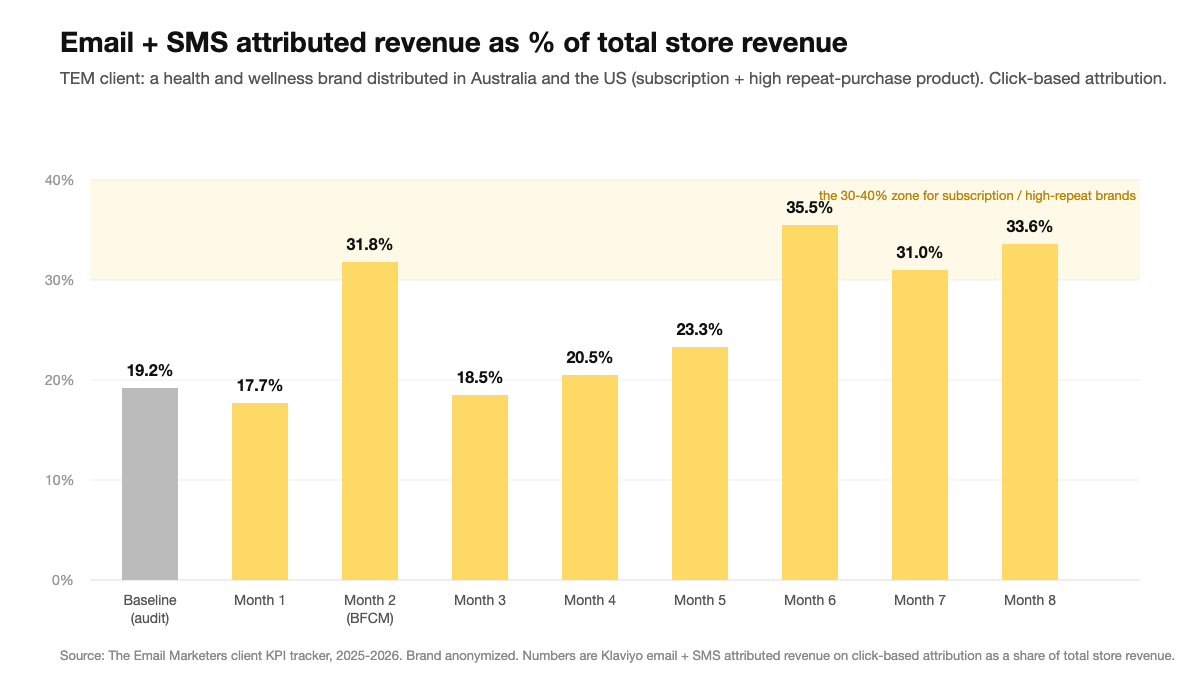
The takeaway: grade every agency here, including us, against these numbers. Current as of August 2026, updated as the accounts move.
How We Scored the Agencies (Check Our Work)
Here is the exact rubric, so you can recalculate any score on this page, including ours.
- Verifiable retention results, 30 points. Named clients, real numbers, dashboards. Case studies reporting only email-attributed revenue are capped, because that is a channel metric on a retention rubric. Unattributed "$100M generated" banners score zero.
- Who actually works your account, 25 points. Senior, accountable, meetable teams score high. Junior, anonymous, or undisclosed delivery scores low.
- Retention mandate breadth, 20 points. Full marks require selling retention levers beyond email and SMS. Email-and-SMS-only agencies max out around 8 to 11, and several excellent operators land there.
- Pricing transparency, 15 points. A published monthly rate on the agency's own site scores full marks. A Clutch project minimum earns partial credit, because it signals scale even though it is not a retainer. "Book a call to find out" scores zero.
- Verified current activity, 10 points. Every agency was checked on August 19, 2026, on its own site, on Clutch, and in Klaviyo's partner directory. The pass mattered, and the findings are research notes rather than accusations: one agency's domain has moved, two have no partner directory listing, two have no Clutch reviews despite being described as reviewed elsewhere, and one is listed under two different headquarters cities on two different platforms. Every one of those is a thing other rankings get wrong, not a mark against the agency.
The scores: The Email Marketers 89, Sticky Digital 71, Underground Ecom 70, Andzen 69, Chronos 68, Hayes Media 68, Flowium 67, FlowCandy 63, DigitsUp 62, Propel 59, Darkroom 58.
That is a 19-point gap to second place, and I want to be precise about where it comes from, because it is not that we are three times better at building a welcome flow. Two criteria, retention mandate breadth and pricing transparency, are ones almost nobody in this category clears. Set pricing transparency to zero and redistribute it, and the gap to Sticky Digital and Underground Ecom closes to single digits. Weight verifiable results at 60 and Underground Ecom and Chronos climb past most of this list on their published client numbers. Weight mandate breadth at 50 and the six email-only agencies collapse to the bottom regardless of how good the work is. Do that math for your own situation. It is more useful than our order.
Why These Scores Do Not Match Our Other Two Agency Guides
If you have read our Klaviyo agency guide or our ecommerce email agency guide, several agencies score differently here. Flowium is 84 there and 67 here. Chronos is 76 there and 68 here. Underground Ecom is 80 there and 70 here.
That is deliberate and it is the point of this page. Those guides score an email rubric, where criterion 3 is retention depth inside the email channel. This one scores a retention rubric, where criterion 3 is how much of your repeat-purchase economics the agency will actually own. Flowium is one of the best email and SMS agencies in the world and it is email and SMS only, so it scores high on one rubric and mid on the other. Both are correct for what they measure. Publishing identical numbers on both pages would have required pretending an email mandate and a retention mandate are the same job, which is the confusion this page exists to clear up. Our own score moves too, from 91 there to 89 here.
Best Retention Marketing Agencies for Ecommerce, Compared
| Agency | Score | Best for | Sells retention beyond email and SMS | Published monthly price |
|---|---|---|---|---|
| 1. The Email Marketers Los Angeles, CA |
89 | 7 to 9-figure DTC brands that want senior-only ownership | Email, SMS, push, direct mail, subscriptions, memberships, loyalty, referral | $4,400 to $12,999 |
| 2. Sticky Digital San Diego, CA |
71 | Beauty, wellness and F&B brands wanting a boutique | Subscriptions, loyalty points, CRO | None published |
| 3. Underground Ecom London, UK |
70 | 8 to 10-figure brands, especially UK and EU | No. Email, SMS, WhatsApp | None published |
| 4. Andzen Sydney, AU |
69 | APAC and European brands wanting CRM strategy | Loyalty programs, messenger | None published |
| 5. Chronos Agency Singapore |
68 | Fast-scaling brands that also want push | No. Email, SMS, push | None. Clutch project min $10,000 |
| 6. Hayes Media United States |
68 | Brands wanting a standalone retention team that can also run acquisition | Partial. Loyalty, subscribe-and-save | $4,000/mo, projects from $2,000 |
| 7. Flowium New York, NY |
67 | Growth-stage brands wanting a systematized program | No. Email and SMS | None published |
| 8. FlowCandy Atlanta, GA |
63 | Brands wanting deep Klaviyo-only specialists | No. Klaviyo email and SMS only | None. Clutch project min $10,000 |
| 9. DigitsUp New York, NY |
62 | Sub-$25M brands adding loyalty and subscriptions | Loyalty, subscriptions, direct mail | None published |
| 10. Propel New York, NY |
59 | Subscription and app brands on non-Klaviyo stacks | Partial. Push and in-app | None published |
| 11. Darkroom Los Angeles, CA |
58 | Brands bundling retention with paid media | Partial. Loyalty program design | None. Clutch project min $5,000 |
Klaviyo partner tiers, checked in Klaviyo's own directory on August 19, 2026: Elite Master for Underground Ecom, Andzen, Chronos and Flowium; Platinum Master for The Email Marketers, Sticky Digital, FlowCandy, DigitsUp and Darkroom; Propel has no listing. Klaviyo writes them "Elite Master" and "Platinum Master," and most agencies invert the words in their own marketing. "Clutch project min" is a minimum project size on a directory profile, not a monthly retainer, and it should never be read as a starting price.
1. The Email Marketers: Best for 7 to 9-Figure DTC Brands That Want Senior-Only Retention Ownership
Bottom line: a Los Angeles retention marketing agency that owns email, SMS, direct mail, subscriptions, memberships, and loyalty and referral programs for 7 to 9-figure ecommerce brands, staffing every account with five senior specialists and no juniors. Despite the name, email is one of eight channels we run: email, SMS, push, direct mail, subscriptions, memberships, loyalty and referrals.
Disclosure first, because it is the only honest way to put yourself at number one: we publish this page and we wrote the rubric. Every score including ours is broken out above so you can recalculate it.
We generated more than $103 million in attributed client revenue in 2025, and we only hire people who have done this before, so there is no junior learning on your account. Grüns, Koala Eco, Gimme Seaweed, Elevate Outdoor Collective (the company behind K2 Skis and Völkl), Open Store, and Outer Furniture have worked with us. What makes this a retention engagement rather than an email one is scope. Most agencies here manage two channels. We run the whole program and keep asking how we grow your profit and your customer lifetime value, which shows up in the deliverables: a monthly revenue forecast, a rolling 90-day roadmap, board-ready reports, and a proprietary performance dashboard. As the team at BodyBio put it: "They are so on top of everything that it's an adjustment, in a good way. Very happy with performance."
Verified results, all case studies public on our site:
- The Freeze Pipe grew attributed email revenue 113% to $894,661 in five months and doubled flow conversion rate (up 107%), with total revenue up 104% year over year to $3.49M. (Case study)
- Llama Naturals went from $8,527 to $79,733 in monthly email revenue in under 60 days.
- Gimme Seaweed lifted email revenue 65%, flow click rate from 3.49% to 5.67%, and opens from 47.9% to 62.7%. (Case study)
- V-Flat World is the one to read if your product is a one-time purchase. Photography equipment, a category where nobody rebuys monthly. First-time customer revenue up 108% year over year in Q4, from $22,660 to $47,178, flow revenue up 61.4%, and average order value up 24.2%, which is the lever that actually moves LTV when repeat frequency is structurally capped. (Case study)

Onboarding: three phases. Weeks 1 to 2 is discovery and strategy, including a testimonial audit where our copywriters read hundreds of your reviews to find the language buyers actually use, and your first quick-win campaigns go live in week two. Weeks 3 to 4 rebuild your first flows and your popup. Weeks 5 to 8 scale what works.
Pricing: published, which is still unusual here. $4,400/month to start, $6,500/month average, $12,999/month on our largest published package. Premium on purpose. It is what an all-senior, US-led, five-specialist team costs. Breakdown in our pricing guide.
The result we are proudest of, and the way we measure it. Koala Eco, the Australian plant-based home and body care brand, came to us in September 2025 doing 12% of US store revenue and 19% of AU store revenue through email and SMS. By April 2026 that was 23% in the US and 31% in Australia, both ahead of the targets we had agreed with them in writing at the start. On a $4,500 per month retainer, the program produced more than $700,000 of revenue above the pre-engagement baseline, which is roughly a 22x return measured incrementally rather than on gross attributed revenue.
That distinction is the whole point of this page. Total Klaviyo-attributed revenue over the same period was $1.4M, and quoting that number instead would have been a much bigger headline and a much worse measurement, because a chunk of it would have happened anyway. We compare against what the account was doing before we touched it. It is not a holdout test, which is still the gold standard and which we will run on winback and post-purchase flows when a brand wants it, but a pre-engagement baseline is a great deal more honest than the attributed-revenue banners this category runs on. Ask any agency on this list what your number would have been without them.
"Over the past six months, the team has been a valued extension of our marketing function, bringing strategic thinking, structure and expertise to our email program. From helping us refine our priorities to developing campaign strategies and optimising our automated flows, they consistently offered big-picture thinking and practical advice. Their collaborative approach, thoughtful recommendations and deep understanding of lifecycle marketing helped us strengthen our email program and build a more considered roadmap for growth. They were always proactive, responsive and invested in achieving the best outcomes for our business."
Claire Dalziel, Director of Marketing and eCommerce, Koala Eco
Where the mandate actually goes further than email: we build and run direct mail alongside the email program, own subscription retention including the dunning and cancel-flow work most agencies never touch, and build membership, loyalty and referral programs rather than pointing at an app and calling it retention. We have run customer interviews for clients when the data stopped explaining itself. And we report repeat purchase rate, cohort curves and margin LTV monthly, building the tracking first when a brand does not already have it, which is most of the time.
To make that concrete rather than a service-page list, here is the actual subscription work from Koala Eco. Only 8.9% of their customers were subscribers, so the real opportunity was never optimising the subscribers, it was the other 91.1% of one-time buyers and moving the subscribe-and-save offer earlier into post-purchase. We rebuilt the cancellation email around a single Delay button instead of a menu of options, because a customer who delays is a customer you keep and most cancellations are just product backlog. We built a subscription loyalty ladder that pays out on the 2nd, 4th and 7th orders with store credit at the 10th, because that is where the repeat-purchase curve actually bends. And we ran the pop-up offer as 20% back on your next order against a straight 15% off, which raises lifetime value through loss aversion and costs less than it looks like, since not all credit gets redeemed. None of that is email work. It is retention work that happens to be delivered partly through email.
Honest fit-notes: the only thing we do not do is acquisition. No paid ads, no SEO, no site development. That is the boundary, and it is worth being precise about it because "not full-service" gets misread as "email and SMS only." It is not. The retention mandate itself is broad: email, SMS, direct mail, subscriptions, memberships, loyalty and referral. If your growth problem is getting new customers through the door, we are the wrong call. If it is everything that happens after they arrive, that is the entire company. Brands under seven figures should not hire us: the retainer eats the ROI at that stage, and our done-with-you Retention Lab is the better buy. On results we scored ourselves 22 of 30 rather than full marks, because our public case studies lead with attributed revenue and flow share, which is what brands approve for a public page. We hold our own marketing to the same standard we applied to everyone else's here.
2. Sticky Digital: Best for Beauty, Wellness, and F&B Brands Wanting a Retention-Only Boutique
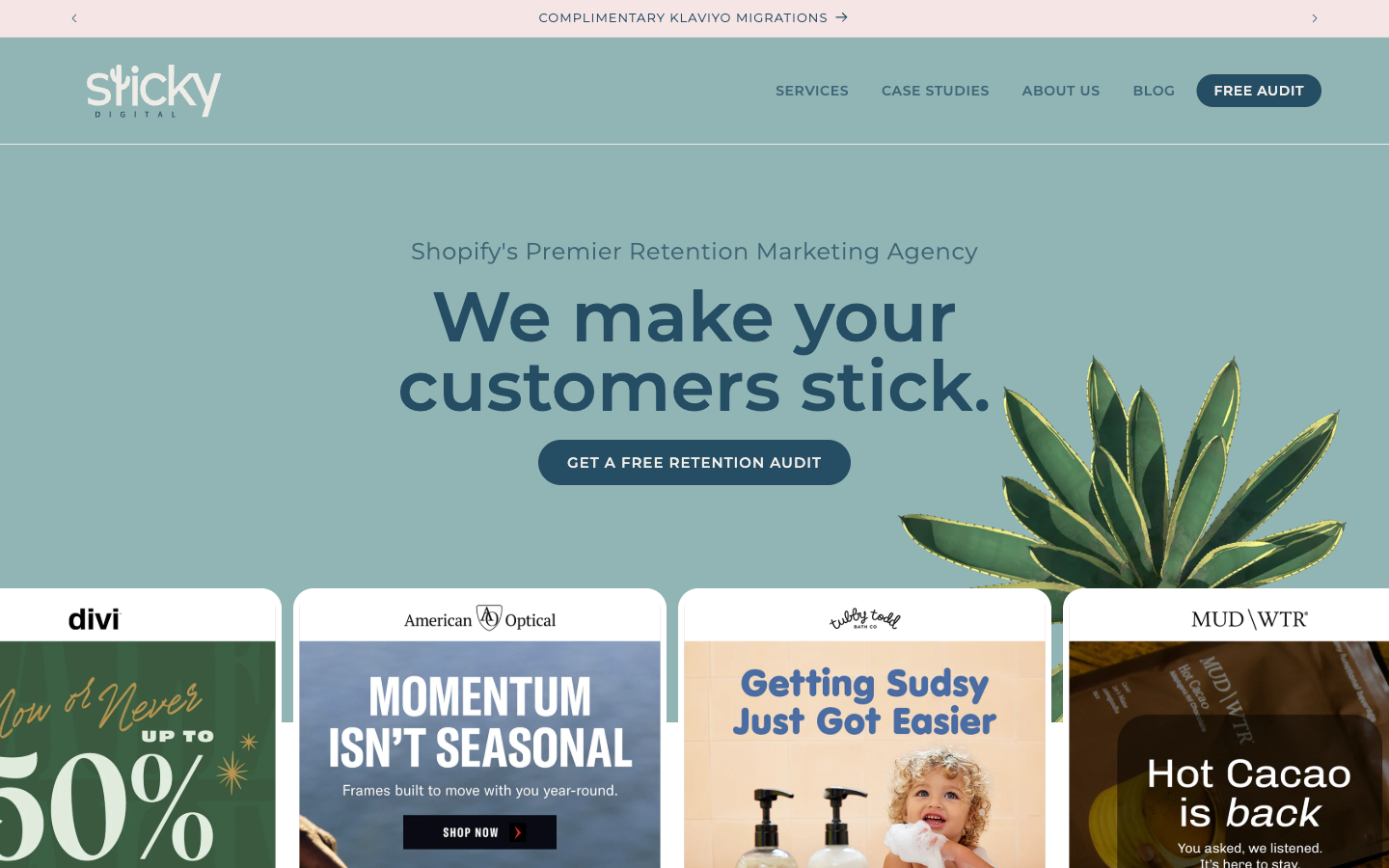
Bottom line: a female-founded California retention boutique at stickydigital.io, co-founded by Nikki Tooman and Mariel Kilroy, positioned on its own homepage as "Shopify's Premier Retention Marketing Agency." Klaviyo lists them Platinum Master in San Diego.
They earn number two on genuine grounds. Their site leads with the exact argument this page makes: "Retention marketing is more than just sending an email." They sell subscription programs, loyalty points, exclusive access tiers, CRO, and Shopify tech stack work alongside email and SMS. That is a real mandate, not a repositioned email service, and the tight vertical focus compounds it. Klaviyo's directory names U Beauty, Nest New York, Deborah Lippman, r.e.m. beauty, Xmondo, and MUD\WTR.
Pricing: $1,000+ minimum on Clutch at $100-149/hour. The most accessible genuine specialist entry point here.
Honest fit-notes: the headline claims are all agency-reported and unattributed. "4200% average return on investment," "voted #1 retention marketing agency in North America 2023 and 2024," and "50+ brands from 1m to 10m" appear with no methodology, no source, and no named brand attached. Their Clutch profile currently shows zero reviews, so there is no third-party base to check either. Ask for direct references instead of leaning on secondhand proof, and know that brands outside those verticals lose the pattern-matching that makes Sticky effective.
3. Underground Ecom: Best for 8 to 10-Figure Brands, Especially UK and EU
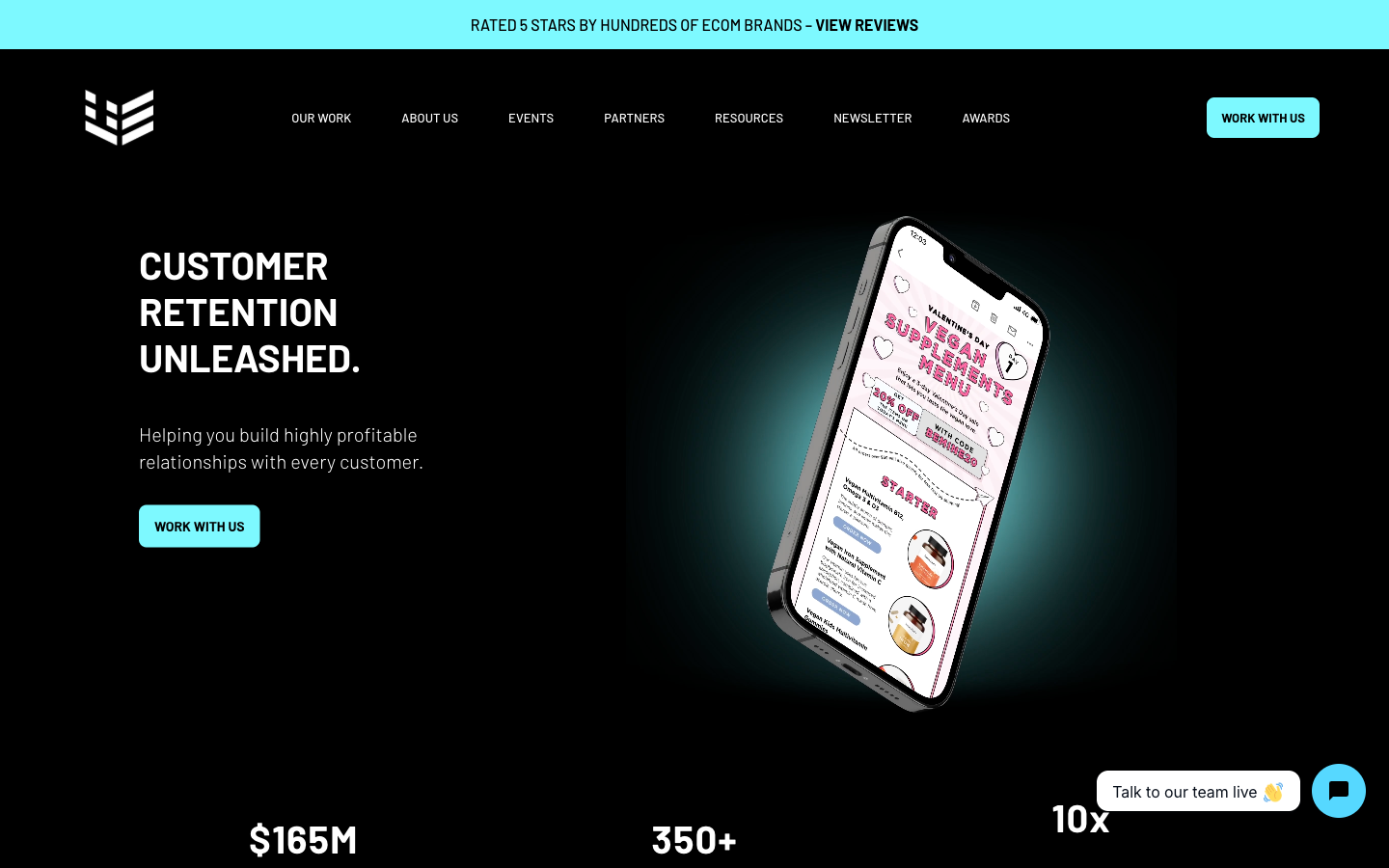
Bottom line: a London retention agency now describing itself as a global team of 120+, leading with "Customer Retention Unleashed," confirmed in Klaviyo's own directory as Elite Master and Agency Partner of the Year 2025.
This is the strongest pure execution engine here at enterprise scale. Accounts get layered support: CRM director, CRM manager, designers, copywriters, plus a senior strategy layer. The homepage claims $165M in trackable sales and 150+ global clients, and Klaviyo names Virgin Experience Days, Osprey, AG1, Wild, Simba Sleep, and Huda Beauty. For enterprise muscle in the UK and Europe, nothing else here matches it.
Pricing: unpublished. Effectively five figures monthly.
Honest fit-notes: the retention positioning is stronger than the retention scope. Their service list is CRM audit, retention strategy, creative and execution, automations, SMS and WhatsApp. No subscriptions, no loyalty, no direct mail. That is an email and SMS agency with excellent framing, which costs them nine points on criterion 3 despite strong scores elsewhere. No public pricing at all costs them nearly the whole pricing criterion, and the layered structure that delivers consistency also puts distance between you and whoever does the work.
4. Andzen: Best for APAC and European Brands Wanting Journey-First CRM Strategy
Bottom line: a customer journey and CRM agency founded in 2012, the first Klaviyo Elite Master partner in APAC and fifth worldwide, listed by Klaviyo in Sydney with operations across the Americas, EMEA, and APAC.
Andzen has the longest track record of any specialist here, and its journey-mapping methodology is genuinely different from calendar-and-flows agencies. It also sells loyalty marketing programs and messenger marketing, which puts real scope behind the positioning. Klaviyo names JULY, Mister Zimi, Lovisa, KSUBI, General Pants Co., and Brown Brothers. Their published results are agency-reported: 25% revenue growth for Rose-Hip Vital post-migration, $148K in monthly flow revenue within 60 days for Chef's Edge, 200% revenue growth for Cheeky Chickadee.
Pricing: unpublished.
Honest fit-notes: as with almost every agency on this page, including us, the case study numbers above are agency-reported rather than third-party audited, so treat them as claims to verify on the call. The core team works Australian hours, which is fine for APAC and EU brands and a real constraint for a US-only team that wants same-day answers. One verification note: their domain is andzen.co, and the old .com redirects to an unrelated company, so half the ranking pages citing them link to the wrong site.
5. Chronos Agency: Best for Fast-Scaling Brands That Want Email, SMS, and Push
Bottom line: a Singapore-headquartered Klaviyo Elite Master agency of 80+ lifecycle specialists founded in 2017, now with an Australian presence, claiming 500+ brands served and $400M+ in client revenue generated.
Chronos does something almost nobody else here does: it lets Klaviyo publish its client numbers with names attached. The directory profile cites The Oodie at 30%+ of total revenue from email, Garvee at $1.6M email-attributed in Q4, Organifi at a 234% increase, and Cadenshae at 46% of revenue from email and SMS across four markets. Named brands with specific numbers on a third-party platform is meaningfully better evidence than a percentage on your own homepage. They also add push notifications, which most email agencies skip.
Pricing: no published rates. Clutch lists a $10,000+ minimum at $100-149/hour. The "$4,000 to $5,000 per month starter retainer" repeated across ranking pages, including ours until this year, does not trace to anything Chronos published.
Honest fit-notes: email, SMS, and push. No subscriptions, loyalty, memberships, or direct mail, so the mandate is narrow on a retention rubric even though execution is strong. Klaviyo lists their target band as $10M to $500M, so smaller brands are out of profile. Delivery is centered in the Philippines and Malaysia and the agency states its client teams work US hours. Credit where due: Chronos' team engaged with an earlier version of this write-up on another page and we sharpened it as a result. The fair question is not where the team lives, it is who your strategist is and what hours they overlap with yours.
6. Hayes Media: Best for Brands That Want a Standalone Retention Team That Can Also Run Acquisition
Bottom line: an eCommerce growth agency running email and SMS retention, plus loyalty and subscribe-and-save programs, with Meta ad creative and media buying available alongside, eight years in, and one of only three agencies on this page that publishes a rate card.
Their own framing is the right one: your repeat customers are the cheapest revenue you have. The Hayes Media retention practice runs flows, campaigns, segmentation and deliverability in Klaviyo for most accounts, builds loyalty and subscribe-and-save programs wired into the same flows, and is sold as a standalone service rather than a bolt-on, which is unusual for an agency that also buys media. Their site reports 57+ ecommerce brands served and $500M+ in client revenue driven.
Why they are worth a call: if acquisition and retention are currently run by two agencies who blame each other on the monthly call, one accountable team across both is a genuine structural fix, and Hayes is the rare version of that where retention is not the afterthought. They also publish their pricing, which on this page puts them in a group of three.
Pricing: published. One-time projects from $2,000, ongoing full management from $4,000 per month, scoped on a call. No onboarding fees and no lock-in contracts.
Honest fit-notes: retention here means email and SMS plus loyalty and subscribe-and-save programs. No direct mail or memberships, so on this page’s rubric they earn partial credit on mandate breadth rather than full marks. Score raised from 66 to 68 on September 29, 2026, after Hayes documented the loyalty and subscribe-and-save work on its own site. The $500M and 15x ROI figures are agency-reported rather than third-party audited, as with almost every agency here including us. They also have no Klaviyo partner directory listing, so the platform-tier signal that anchors most of this list is not available for them; ask directly about Klaviyo certifications on the call.
7. Flowium: Best for Growth-Stage Brands That Want a Systematized Engagement
Bottom line: a Klaviyo Elite Master agency founded in February 2017 by Andriy Boychuk, delivering email and SMS through standardized six-person account pods and tightly documented processes.
The systemization is the whole product. Audits, flow builds, and calendars follow strict repeatable processes, backed by one of the largest educational content libraries in email marketing. Clutch shows 23 reviews at 4.9, a $1,000 minimum, and $100-149/hour, with roughly 80% of the client base midmarket. If you want a proven system rather than a bespoke engagement, this is the safest default here. The $2,500 to $10,000 monthly range quoted everywhere, including in our own earlier pages, traces to Flowium's own blog rather than a rate card.
Honest fit-notes: this is the clearest example of the gap this page is about, and it is why Flowium scores 84 on our email guides and 67 here. Email and SMS only. No subscriptions, loyalty, memberships, direct mail, paid media, CRO, or development. On an email rubric that focus is a strength. On a retention rubric it is a ceiling. The process is also the product, which cuts both ways: brands wanting tailored strategy find the templated cadence constraining. Clutch lists 50-249 employees, so the six-person pod is a delivery structure, not the size of the company you are hiring.
8. FlowCandy: Best for Brands That Want Deep Klaviyo-Only Specialists
Bottom line: a Klaviyo Platinum Master agency founded in 2020, co-founded by Will Evans, described in Klaviyo's own directory as "a Klaviyo-ONLY email and SMS agency built exclusively for eCommerce brands."
The deliberate narrowness is the pitch and it is legitimate. Their tagline is "Klaviyo Experts That Feel Like Your Own Retention Team," and the in-house framing shows up in delivery: monthly performance grading, and explicit transition assistance if you eventually want to bring the capability in-house, which is unusual to put in writing. Klaviyo names Bachan's, Ka'Chava, Momofuku, Colgate, AeroPress, and Duke Cannon, one of the stronger client walls here. Clutch shows 10 reviews at 4.8, 10-49 employees, and a $10,000+ minimum at $100-149/hour.
Honest fit-notes: read the tagline carefully. "Feel like your own retention team" is a claim about how the engagement feels, not about scope. By their own description in Klaviyo's directory this is email and SMS inside Klaviyo, full stop, making it the cleanest example on this list of an email agency using retention language. Two verification notes: the "500+ brands" claim has no source beyond their own homepage, and their headquarters does not agree across platforms. Klaviyo says Philadelphia, Clutch says Atlanta, and their co-founder is Atlanta-based.
9. DigitsUp: Best for Sub-$25M Brands Wanting Lifecycle Systems With Loyalty and Subscriptions
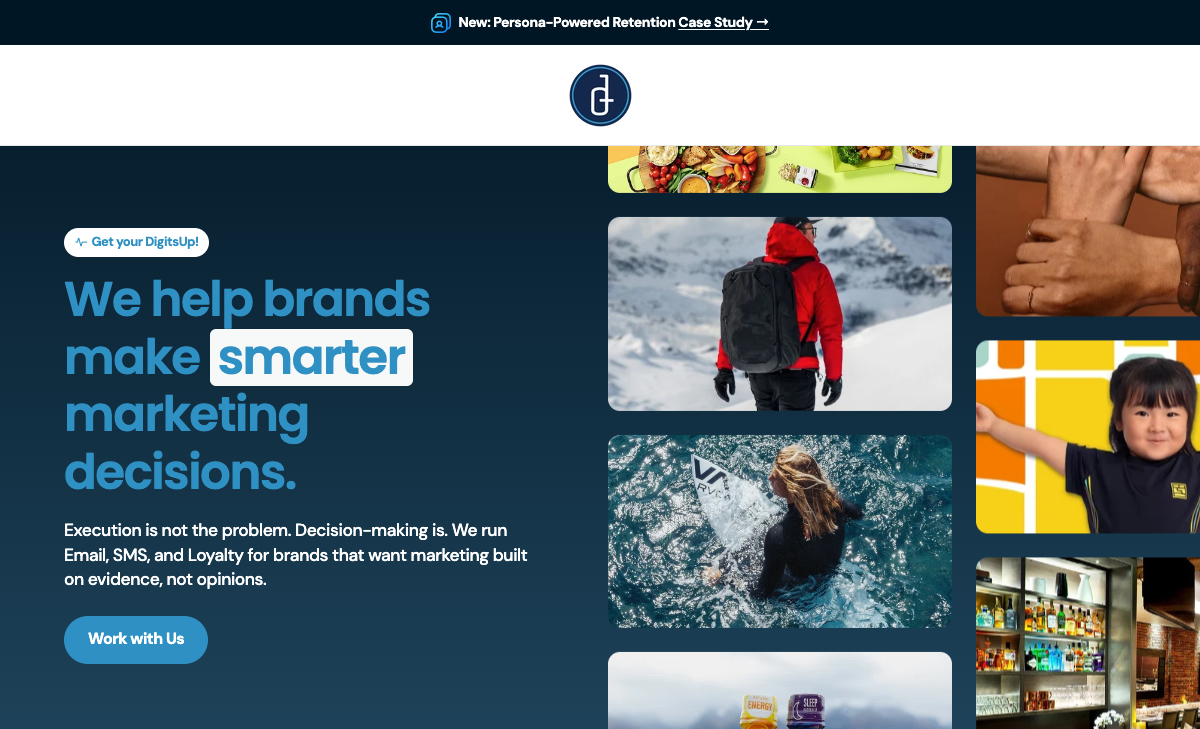
Bottom line: a New York Klaviyo Platinum Master agency that plans, builds, and operates lifecycle marketing systems inside Shopify and Klaviyo, spanning email, SMS, loyalty, subscriptions, and persona analytics.
DigitsUp earns real credit on criterion 3, which is why it ranks above agencies with better track records. The stack is genuinely broader than email: loyalty systems, subscriptions through Recharge, direct mail through PostPilot, persona insights, deliverability. More importantly, their own site states they measure success on revenue influenced, retention, repeat purchase rate, and lifecycle performance, and explicitly treats opens and clicks as diagnostics rather than primary KPIs. That is the correct retention scoreboard, stated publicly, by an agency that is not us. Klaviyo names Liverpool Los Angeles, Riversol, RVCA Clothing, Epicure, and The Miles Market.
Honest fit-notes: pricing is unpublished. The scale is deliberately modest and they say so: 45+ brands scaled and $50M+ revenue influenced, both agency-reported. We could not find a team page, founder names, a disclosed headcount, or a Clutch profile, and digitsup.com/about was returning a 404 when we checked on August 19, 2026. None of that is disqualifying, but it does mean the usual public signals are not available to you, so do the diligence live: ask to meet the operators who would run your account and ask how many accounts each one carries.
10. Propel: Best for Subscription and App-Adjacent Brands on Non-Klaviyo Stacks
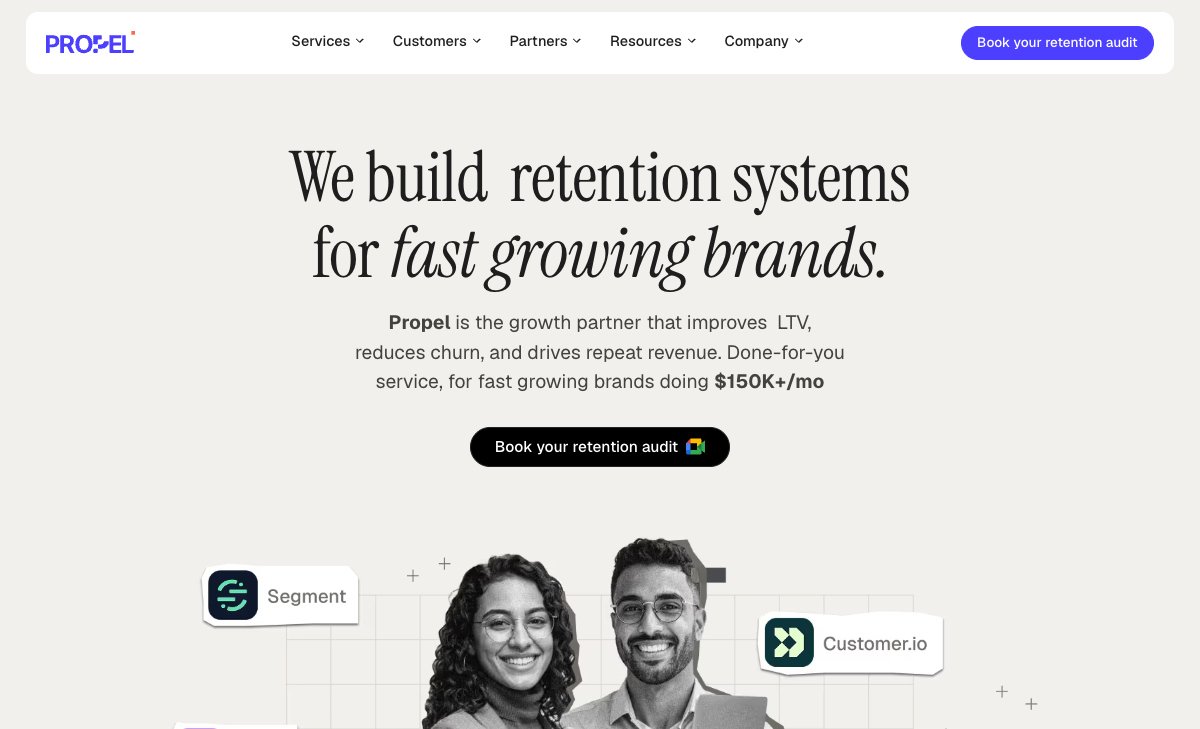
Bottom line: a lifecycle and retention agency with a proprietary AI layer, offices in New York and Bengaluru, founded by Ruturaj Bargal, Jaskaran Lamba, and Mayank Shinde, positioned around turning first-time customers and subscribers into repeat revenue while improving LTV and reducing churn.
Platform range is the real differentiator: Braze, Customer.io, Klaviyo, MoEngage, CleverTap, Iterable. If your stack is Braze or Iterable rather than Klaviyo, most agencies here simply cannot help you and Propel can. Their positioning language is the most retention-native on this list after ours, and services cover lifecycle strategy, campaign analytics, events and attribution, and deliverability across email, SMS, push, and in-app.
Honest fit-notes: pricing is unpublished. The bigger consideration is fit rather than quality: their two headline case studies are 125 win-back conversions in 30 days against $60K of attributed revenue for Kiaora, and a 53% onboarding completion increase for LivWell. Both are real, specific numbers, and both come from health, wellness app, and subscription businesses rather than physical-product DTC at the scale most readers here operate. If you are an app or subscription business on a non-Klaviyo stack, that skew is an argument for them, not against. They have no Klaviyo partner directory listing, which is unsurprising given the multi-ESP positioning, and team size is not disclosed.
11. Darkroom: Best for Brands That Want Retention Bundled With Paid Media and Creative
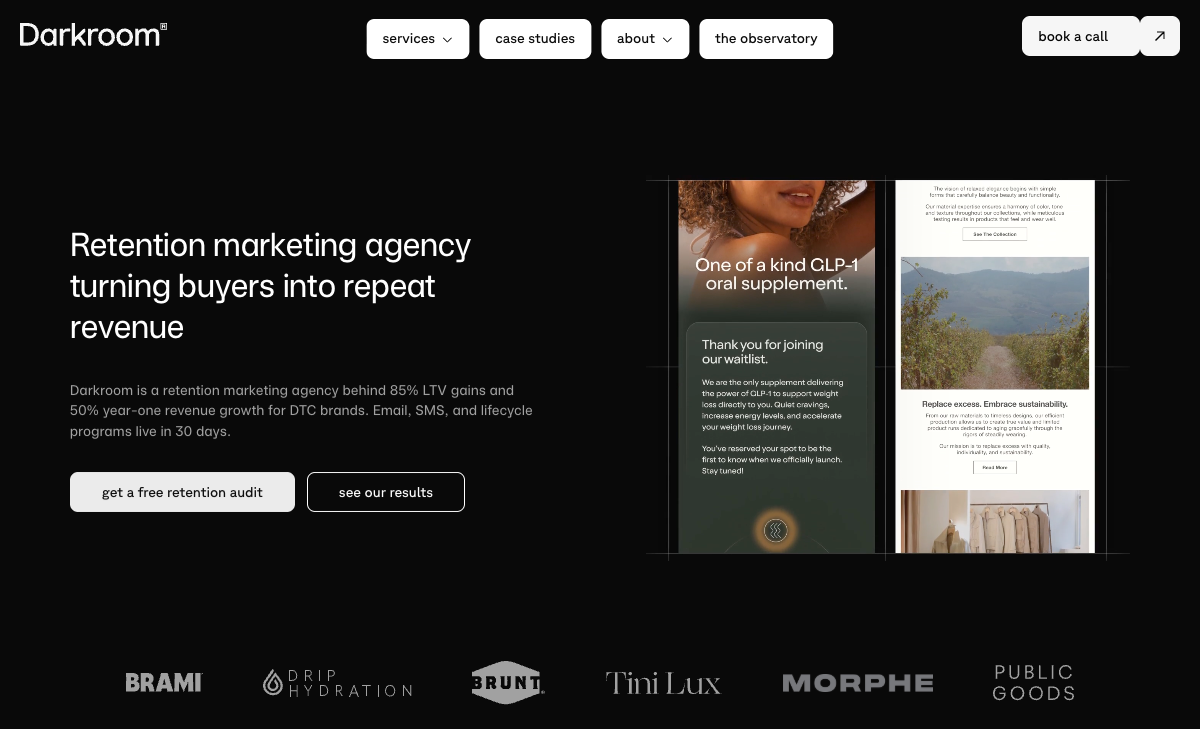
Bottom line: a full-service agency founded in 2017 that calls itself "the first AI-native advertising agency," listed by Klaviyo at Platinum Master in Los Angeles, with a retention marketing service line sitting alongside thirteen other services.
Darkroom is the biggest brand name here and the least retention-focused entry on it. Their catalog runs paid media, performance creative, TikTok Shop, Amazon, AI search, retention, retail media, Shopify development, organic social, design and brand studio, CRO, creator programs, and measurement. They claim over $250M in media managed and 500+ consumer marketing P&Ls reviewed annually. If your actual problem is that acquisition and retention are run by two agencies who blame each other on the monthly call, one accountable partner across both is a genuine structural fix. Their retention page names Drip Hydration, Brunt Workwear, and Laundry Sauce, claiming 85% higher customer LTV and 50% revenue growth in a year. Clutch lists a $5,000+ minimum.
Honest fit-notes: Clutch lists their service mix as Branding 50%, Email Marketing 10%, with CRO, PPC, social, and web design at 10% each. Retention is a tenth of what this agency does, their Clutch profile shows zero reviews, and the LTV and revenue-growth claims are unattributed to any named client. Their headquarters does not agree across platforms either: Klaviyo says Los Angeles, their own site leads with New York, Clutch lists 50-249 staff company-wide with only 10 to 15 in the LA office. If you want a retention specialist, this is not it. If you want a strong full-service agency that can also run lifecycle competently, price it as a bundle.
Agencies We Considered and Left Off, and Why
AURORA (auroralifecycle.com). A UK lifecycle agency operating as Aurora E-Commerce Ltd, listed by Klaviyo at Gold Master in London. Off this list on scale rather than quality: their published Klaviyo dashboards sit in the $35,000 to $232,000 attributed range, which is a real business serving a different size of brand than this guide addresses. Two housekeeping notes if you are researching them, since both trip up other rankings: their domain moved from auroradigital360.com this year, and their tenure is listed differently on their Klaviyo directory profile than in their own site metadata, so ask them directly rather than relying on either.
Tention (tentionmarketing.com). A done-for-you Klaviyo agency led by CEO James Buchok, built around one sharp offer: seven core flows live within 21 days, with a guarantee of 20% revenue attribution in 90 days. It is a well-constructed offer and it will suit some brands. It is off this list on scope: seven flows plus weekly campaigns is an email build rather than a retention mandate, which is the line this guide is drawing. We also could not find a Klaviyo partner directory listing or a Clutch profile. Separately, and this applies to anyone offering an attribution guarantee rather than to Tention specifically, read the guarantee-pricing section below before you sign one.
Homestead Studio. On our ecommerce email agency list and correctly so. Off this one because email is roughly 20% of what they do, and because Verndale acquired them in March 2026 and their homepage now leads with "Homestead Has Joined Verndale."
Put These in the Reporting Agreement Before You Sign
The ranges above are what to measure against. This is the list to hand your agency and ask them to commit to in writing, in the contract, not on the call.
- Repeat purchase rate, by cohort rather than in aggregate. Aggregate lets growth in new customers hide a decline in returning ones, which is how a program looks healthy for two quarters while it rots.
- Purchase frequency and median time between orders.
- LTV on contribution margin, not revenue.
- Cohort retention curves at months 3, 6, and 12.
- Subscription churn split into voluntary and involuntary, plus reactivation rate.
- Revenue from returning customers as a share of total revenue.
- Incrementality via holdout groups on winback and post-purchase flows. Genuinely hard, genuinely worth it, and almost nobody does it.
- Deliverability as a leading indicator: spam complaints under 0.1%, bounces under 2%. Not a retention metric, but the thing that quietly kills all the others.
Two of these are the tell. If an agency cannot produce a cohort retention curve for an existing client, it has never actually been measured on retention. If it proposes a holdout test before you ask for one, it has.
The Thing Almost No Retention Agency Does: Actually Talk to Your Customers
Every number in this guide tells you what is happening. Not one of them tells you why.
We have gone as far as running customer interviews for clients. It is not in our standard scope and we do not pretend otherwise, but we have sat down with real customers to ask two questions the dashboard cannot answer: why did you not buy again, and if you did, what actually brought you back? We have learned genuinely surprising things doing it, and we think every retention agency should be doing it.
What comes back is almost never what the analytics implied. It is rarely price. It is far more often that the product lasted longer than the flow assumed, or that the customer did not know what to buy second, or that the first purchase solved the problem so completely there was no obvious next one, or that they simply forgot and nothing reminded them in a way that felt like it was meant for them. Every one of those is a fixable retention problem. Not one of them is visible in Klaviyo.
Almost nobody in this category does it, for an unglamorous reason: it does not scale and it is awkward to bill. It is easier to send another campaign. But an agency that has never spoken to one of your customers is optimizing a machine it has only ever seen from the outside, and after the first two quarters of obvious wins, that is exactly when programs stall.
Use this as your closing question on every sales call: when did you last talk to one of your clients' customers, and what did you change because of it? The answer will tell you more about what you are buying than any case study on this page.
How Much Does a Retention Marketing Agency Cost?
Between $4,000 and $18,000+ per month in 2026 for a genuine retention mandate, and only three agencies on this list publish anything close to a usable number.
First, kill the low figure you will find everywhere else. Sticky Digital and Flowium both show a $1,000+ minimum on their Clutch profiles, and every listicle that scrapes Clutch turns that into "retention agencies start at $1,000 a month." They do not. A Clutch minimum is a minimum project size and a lead-generation setting on a directory profile, not a monthly retainer. Nobody is running a retention program for a 7-figure DTC brand at $1,000 or $1,500 a month. At that price you are buying one person's campaign calendar with an agency logo on the invoice, and you should evaluate it as a freelancer, not as an agency.
What the tiers actually look like:
- $4,000 to $6,000 a month. The genuine floor. A strategist plus a small pod, email and SMS, campaign calendar and flow maintenance. Workable for a brand doing roughly $200,000 to $500,000 a month.
- $6,000 to $10,000 a month. Senior ownership, a full flow rebuild, real segmentation work, and reporting a board can read. Where most 8-figure brands land.
- $10,000 to $18,000+ a month. The full retention mandate: email, SMS, direct mail, subscriptions, loyalty, and referral, with forecasting and a dedicated senior team.
We publish ours, which is still unusual in this category: $4,400/month to start, $6,500/month average, $12,999/month on our largest published package. FlowCandy and Chronos list $10,000+ project minimums on Clutch, which at least signals the scale they work at. Darkroom lists $5,000+, priced as part of a full-service bundle. Underground Ecom, Andzen, DigitsUp, and Propel publish nothing at all, and "book a call to find out" is a pricing strategy, not a business model.
Why Revenue-Share and Guarantee Pricing Is Usually a Red Flag
An agency paid a percentage of attributed revenue, or one guaranteeing a specific attribution percentage, has a direct incentive to widen your attribution window and count opens rather than clicks. That inflates the exact number its fee or guarantee depends on. Klaviyo will happily tell you "30% of your revenue was driven through Klaviyo," and whether that means anything depends entirely on how attribution is configured. I have opened accounts set to a 14-day window counting anyone who merely opened an email, and Apple auto-opens a large share of email now, so open-based attribution in 2026 is not generous, it is fiction.
To be transparent about our own incentives: if a brand insists on revenue share, we will take that deal, because we would earn more than we do on retainers. That is precisely the problem, and it is why we price on retainers instead. Before believing any attributed-revenue claim from anyone here, ask three questions. What is the attribution window? Does it count opens or only clicks? Does it match how you measure your other channels?
How Long Until a Retention Agency Shows Results?
First revenue impact in 2 to 3 weeks. Sustained improvement by 60 to 90 days. Real retention movement, meaning repeat rate and cohort curves rather than channel revenue, takes 6 to 12 months, because a cohort has to live long enough to be measured. That last point is the one nobody says out loud. If an agency promises to move your repeat purchase rate in 90 days, they are either measuring something else or they do not understand the metric.
What you can move fast is the machinery. Across the audits we run, the same three problems repeat: attribution configured to flatter rather than inform, flows either over-engineered or half-built, and segmentation that is too broad, too narrow, or just not strategic. My favorite example: one account we took over had been carefully engineered with exclusion rules so nobody could ever be in two flows at once. Sounds smart. In practice the exclusions stacked, the logic collapsed, and the large majority of the list received no flows at all. The most sophisticated-looking setup in the account was quietly costing the brand its entire automation revenue. Over-engineering is a failure mode, not a flex.
To make the timeline concrete: Llama Naturals went from about $8,500 to almost $80,000 in monthly email revenue inside a 60-day window.
What Should You Do Next?
If you run a 7 to 9-figure ecommerce brand and email and SMS drive less than 25% of your revenue, the fastest next step is a teardown of your current retention program. Book a 30-minute audit with our CEO, Melanie Balke. You get a personalized retention roadmap whether or not we ever work together.
Earlier stage, or keeping it in-house? Start here:
- The 12 Best Email Marketing Agencies in 2026
- The Best Ecommerce Email Marketing Agencies
- How to Choose the Best Klaviyo Email Marketing Agency
- Email Marketing Agency Pricing: What It Actually Costs
If your store is on Shopify and you suspect the problem is upstream of the marketing, see our guide to email marketing agencies for Shopify stores, which covers the integration failures that make a healthy-looking account underperform.
The attribution point above is not a hunch. We audited our own archive of 109 recorded Klaviyo audits and published what we found: email revenue share ranged from 2% to 49% across brands, and in every account where we could check the configuration, the reported figure was inflated. See The State of Ecommerce Retention 2026.
Shortlisting for a DTC brand specifically? Our guide to the best email marketing agencies for DTC brands uses the same scores and adds a table matching each agency to DTC categories, from subscription brands to one-time, high-AOV products.
Frequently Asked Questions
What is a retention marketing agency?
A retention marketing agency owns your repeat-purchase economics rather than a single channel, which makes it accountable for customer lifetime value, purchase frequency, and repeat purchase rate rather than just email-attributed revenue. That mandate pulls in channels an email agency does not touch: direct mail, subscriptions, memberships, loyalty, and referral, alongside email and SMS. The distinction matters when you hire, because most agencies ranking for "retention marketing agency" in 2026 sell only email and SMS. Ask what they would do for your retention if email disappeared tomorrow, and the answer tells you which kind you are talking to.
What is the difference between a retention marketing agency and an email marketing agency?
An email marketing agency manages a channel: campaigns, lifecycle flows, deliverability, and segmentation inside a platform like Klaviyo. A retention marketing agency manages an outcome, how much profit your existing customers generate over their lifetime, and email is one of several tools it uses to get there. On the list in this guide only four of eleven agencies sell retention levers beyond email and SMS, so the labels are not reliable and you have to read the service page yourself. Neither is better in the abstract, and if your repeat-purchase problem is genuinely an email problem, hire the email agency and pay less.
How much does a retention marketing agency cost in 2026?
Between $4,000 and $18,000+ per month, and only three of the eleven agencies in this guide publish anything resembling a rate. Ignore the $1,000 figures circulating online: those are Clutch minimum project sizes, not monthly retainers, and there is no real retention agency operating at $1,500 a month. The floor for a genuine retention program is around $4,000. Most 8-figure brands land between $6,000 and $10,000, and full scope with direct mail, subscriptions and loyalty runs $10,000 to $18,000+. FlowCandy and Chronos list $10,000+ project minimums on Clutch. The Email Marketers starts at $4,400 per month, averages $6,500, and reaches $12,999 on our largest published package, published on our own site. Underground Ecom, Andzen, DigitsUp, and Propel publish nothing at all, which is worth factoring into how transparent you expect the rest of the relationship to be.
What percentage of my customers should be repeat customers?
Across DTC, 20 to 30% of your customer base having placed a second order is the normal range, and it moves a lot by category. Consumables such as supplements, coffee, skincare and pet should reach 40 to 55%, apparel and accessories 25 to 35%, and considered or durable goods such as furniture and equipment 10 to 20%, where LTV comes from accessories and referral instead. The related number to watch is first-to-second order conversion: typically only 20 to 30% of first-time buyers ever place a second order, but once someone does, the probability of a third rises to roughly 45 to 60%. That is why a post-purchase program should be pointed almost entirely at getting order two, and why a consumable brand sitting under 35% has a retention problem rather than an acquisition problem.
What percentage of revenue should retention drive for an ecommerce brand?
Returning customers should generate roughly 35 to 45% of total revenue for a healthy DTC brand, and 50 to 65% where subscriptions are a real part of the mix. On the channel side, brands typically arrive at about 15% of total store revenue from email and SMS, and six months into a well-run program they should be above 25%. For brands with subscriptions or a high repeat-purchase product, 30 to 40% is the realistic zone. On a $2 million per month store, moving from 15% to 25% is $200,000 per month of revenue that was already sitting in the customer list. Anyone quoting a range without first asking what you sell and how often people rebuy it is guessing, because a furniture brand and a supplement brand have completely different ceilings.
What retention metrics should I hold an agency accountable to?
Repeat purchase rate by cohort, purchase frequency, customer lifetime value calculated on contribution margin rather than revenue, cohort retention curves at months 3, 6, and 12, subscription churn and reactivation rate, time between orders, and deliverability health as a leading indicator. If you can afford it, add incrementality testing with holdout groups on winback and post-purchase flows, which almost no agency in this category does. Email-attributed revenue is still worth reporting because it is the number leadership can follow, but it is a channel metric and should never be the only line on the report. Ask which of these an agency will report monthly and get the answer in writing before you sign.
How long does it take to see results from a retention marketing agency?
First revenue lift typically arrives in 2 to 3 weeks from quick wins: fixing broken flow triggers, repairing deliverability, and reactivating dormant segments. Sustained, compounding improvement takes 60 to 90 days as rebuilt flows and segmentation mature. Genuine retention movement, meaning repeat purchase rate and cohort retention curves rather than channel revenue, takes 6 to 12 months, because a cohort has to live long enough to be measured. Any agency promising to move your repeat purchase rate in 90 days is either measuring something else or does not understand the metric.
Is a guaranteed revenue-attribution percentage a good sign when hiring a retention agency?
Usually the opposite. A guarantee like "20% of revenue from email in 90 days or we work free" sounds like accountability, but the agency helping you configure attribution is also the party the guarantee pays out on, and widening the attribution window or counting opens instead of clicks moves that number without moving your business. The same incentive problem applies to revenue-share pricing, which is why we price on retainers even though revenue share would earn us more. Before accepting any attribution-based promise, ask what the window is, whether it counts opens or only clicks, and who controls that setting.
Should I hire a retention marketing agency if my brand does under $1 million in revenue?
Usually not. Under roughly $1 million in annual revenue, agency retainers eat the return, because the list is too small for flow improvements to compound into meaningful money. A skilled freelancer or a done-with-you program like The Email Marketers' Retention Lab is the better buy at that stage, and ignore anyone selling you a "$1,500 retention retainer," because that price buys a campaign calendar, not a retention program. Revisit full-service retention agencies at $3 to $5 million and above, when your list is large enough that a single percentage point of repeat purchase rate is worth thousands of dollars a month.
About the author
 The Email Marketers" loading="lazy">
Melanie Balke is the founder and CEO of The Email Marketers, a retention marketing agency for 7 to 9-figure ecommerce brands, and host of the No Mild Takes podcast. She has worked retention from every seat: in-house at an ecommerce brand, as a freelancer, inside another agency, and since 2019 running her own. Her team generated over $103 million in attributed client revenue in 2025. Clients include Grüns, Gimme Seaweed, Elevate Outdoor Collective (the company behind K2 Skis and Völkl), Open Store, Outer Furniture, The Freeze Pipe, and Llama Naturals. She has been featured in Business Insider and Authority Magazine. Connect on LinkedIn or X.
Methodology: agencies are scored on a published 100-point rubric (verifiable retention results 30, account team seniority 25, retention mandate breadth 20, pricing transparency 15, verified current activity 10). Every agency was verified as currently operating in its claimed form on August 19, 2026, through a manual visit to its live site, its Clutch profile, and its listing in Klaviyo's partner directory at connect.klaviyo.com. Partner tiers use Klaviyo's own directory wording ("Elite Master," "Platinum Master," "Gold Master"), not the inverted forms most agencies use in marketing copy. Claims sourced only to an agency's own marketing are labeled agency-reported. Because this guide scores a retention mandate rather than an email mandate, several agencies score differently here than on our Klaviyo and ecommerce email guides, and the reason is explained on-page. The Email Marketers publishes this guide and appears at #1; our own score is broken out criterion by criterion and every entry, including ours, carries honest fit-limitations. All revenue-share figures on this page are Klaviyo-attributed (credited on a five-day open-or-click window, so an open alone counts) and will read higher than the same period measured in a marketing mix tool such as Triple Whale or Northbeam; this applies to our own numbers as much as to anyone else's. Channel performance benchmarks (revenue share, open and click rates, flow-to-campaign split, cadence, popup rate) are first-party observations from accounts managed by The Email Marketers as of August 2026. Retention benchmark ranges (repeat customer rate, first-to-second order conversion, time to second order, purchase frequency, cohort retention, subscription churn, LTV to CAC) are the category ranges we grade accounts against at the start of an engagement, and are stated as ranges rather than as measurements of any single account.


