.png)


B2B ecommerce personalization strategies for higher conversions

TL;DR:
- Personalized B2B experiences can increase conversions by up to 80 percent and boost revenue significantly.
- Effective personalization relies on unified data, segmentation, AI recommendations, and ongoing iteration.
- Success depends on understanding buyer needs, maintaining data quality, and continuously refining strategies over time.
B2B ecommerce personalization strategies for higher conversions
Most B2B buyers now expect the same seamless, tailored experience they get on Amazon or Netflix. Yet the majority of B2B ecommerce brands still serve up generic catalogs, flat pricing, and one-size-fits-all messaging. That gap costs real revenue. B2B personalization benchmarks confirm that 73 to 86 percent of B2B buyers now demand B2C-level personalization, and brands that deliver it see conversions jump by as much as 80 percent. This guide breaks down exactly why B2B personalization is non-negotiable, which strategies move the needle fastest, and how to build an engine that scales without misfiring.
Table of Contents
- Why B2B ecommerce personalization matters
- Core personalization strategies for B2B ecommerce
- Challenges and pitfalls of B2B personalization
- How to implement advanced personalization tactics
- Editorial perspective: Why most B2B personalization fails (and how to get it right)
- Maximize B2B personalization with proven solutions
- Frequently asked questions
Key Takeaways
| Point | Details |
|---|---|
| Personalization drives conversions | B2B ecommerce personalization can increase conversions by up to 80% and boost revenue by 5-15%. |
| Data quality is crucial | Success depends on high-quality buyer data more than technology or automation. |
| Start with recommendations and CTAs | Personalized product recommendations and CTAs offer the quickest, highest-impact wins. |
| ROI takes time | Most B2B brands require over six months to see measurable ROI from personalization. |
| Continuous learning prevents pitfalls | Iterating on feedback and avoiding intrusive tactics helps sustain long-term personalization success. |
Why B2B ecommerce personalization matters
With expectations rising, it is crucial to understand how personalization directly impacts business performance.
The business case for B2B personalization is no longer theoretical. Real data shows it reshapes revenue trajectories faster than almost any other investment a brand can make. When a buyer lands on your storefront and sees products, pricing, and content tailored to their industry, company size, or past purchase history, conversion friction drops dramatically. When they see a generic page, they bounce and find a competitor who made the effort.
According to B2B personalization benchmarks, personalized B2B experiences can increase conversions by 40 to 80 percent, lift average order value by 40 percent, grow sales by 19 percent, and drive revenue increases of 5 to 15 percent. Those are not marginal improvements. They are transformational shifts that compound over a customer lifetime.
Fast-growing companies know this. McKinsey research embedded in those same benchmarks shows that leading brands derive 40 percent more revenue from personalization than slower-growing peers. The gap is widening every year as buyer expectations rise and the technical barriers to personalization fall.
The risk of inaction is equally clear. B2B buyers who feel misunderstood or underserved do not write complaint emails. They quietly move their procurement contracts elsewhere. A brand that fails to prioritize personalization does not just miss upside; it actively accelerates churn.
Here is a snapshot of what the data shows:
| Metric | Impact of personalization |
|---|---|
| Conversion rate increase | 40 to 80% |
| Average order value lift | Up to 40% |
| Revenue increase | 5 to 15% |
| Sales growth | Up to 19% |
| Revenue advantage for fast-growers | 40% more than peers |
“Brands that treat B2B buyers like individual decision-makers rather than account numbers are the ones winning contracts and renewals in 2026.”
The core buyer behaviors driving this shift include:
- Procurement teams researching independently before talking to sales, expecting relevant content at every touchpoint
- Repeat buyers expecting the system to remember their preferences, approved vendors, and contract pricing
- New contacts at existing accounts expecting onboarding that reflects their company’s purchase history, not a blank slate
- Multi-stakeholder deals where every decision-maker needs messaging tailored to their specific role and concern
Pairing B2B email marketing strategies with on-site personalization closes the loop between discovery and conversion, making every touchpoint reinforce the last. That integrated approach is what separates retention leaders from brands stuck in acquisition mode.
Core personalization strategies for B2B ecommerce
Now that you see the impact, here are the methods top brands use to deliver B2B personalization.
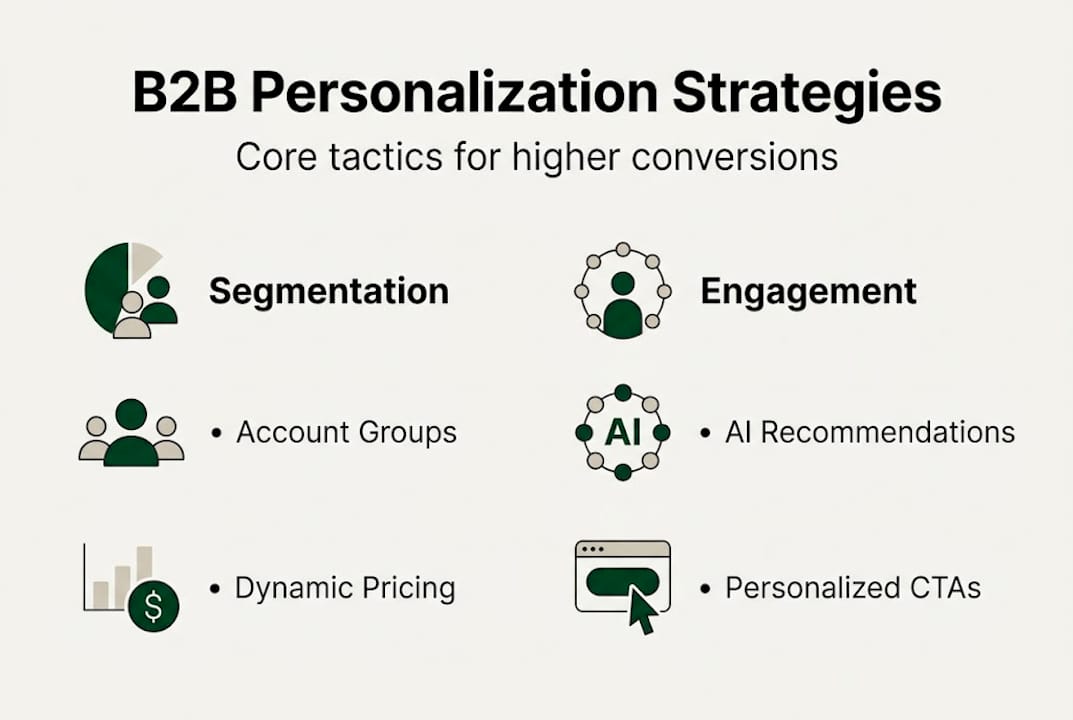
Personalization in B2B ecommerce is not a single feature. It is a layered system of strategies that work together to make every buyer feel like your platform was built specifically for their business. Getting the layers right, and in the right order, determines how quickly you see returns.
1. Account-based segmentation Group buyers by firmographic data such as industry vertical, company size, geographic region, and contract tier. Layer in behavioral data such as category browsing history, repeat purchase patterns, and seasonal buying cycles. Segmentation this granular lets you surface the right products, content, and pricing without requiring a sales rep to intervene on every order.
2. AI-driven product recommendations Algorithmic recommendations powered by machine learning analyze purchase history, browsing behavior, and similar account patterns to suggest the most relevant products. This is the single highest-ROI personalization feature for most B2B ecommerce platforms because it operates at scale and improves automatically over time.

3. Dynamic pricing and contract-specific catalogs B2B buyers frequently have negotiated pricing, volume discounts, or approved product lists. Displaying the correct pricing automatically, without requiring a phone call, removes a massive friction point. Brands that surface contract-specific catalogs by default see significantly higher repeat purchase rates.
4. Personalized calls-to-action Generic “Request a Quote” buttons convert poorly. Personalized CTAs that reflect the buyer’s stage, industry, or past behavior can lift conversions by 202 percent according to published personalization impact data. That number is striking enough that it deserves to anchor your CTA testing roadmap.
| Strategy | Speed to impact | Complexity | Typical lift |
|---|---|---|---|
| Personalized CTAs | Fast | Low | Up to 202% conversion |
| Product recommendations | Fast | Medium | 19 to 40% sales lift |
| Dynamic pricing/catalogs | Medium | High | Significant AOV increase |
| Account segmentation | Medium | Medium | Broad revenue improvement |
| Predictive analytics | Slow | High | 40%+ revenue advantage |
Data quality is the foundation everything else rests on. Poor or fragmented data produces recommendations that feel random and pricing logic that embarrasses your brand. 88% of marketers report measurable improvements from personalization, but only when the underlying data is clean, unified, and regularly audited.
Pro Tip: Start with personalized recommendations and CTAs before investing in complex predictive analytics. These two tactics require less infrastructure, produce measurable results within weeks, and build the organizational confidence needed to invest in more sophisticated layers later.
Connecting your on-site personalization to personalized email strategies creates a consistent buyer experience that reinforces relevance across channels. Pair that with strong email personalization tactics and your messaging becomes a coherent narrative rather than disconnected blasts.
Challenges and pitfalls of B2B personalization
Even with strong strategies, common pitfalls stand in the way of success.
Personalization is genuinely difficult to execute well. The brands that stumble are rarely underprepared in terms of ambition. They are underprepared in terms of data infrastructure, organizational alignment, and patience. Understanding where the traps are lets you route around them before they cost you months of wasted effort.
The delayed ROI problem Personalization is not a switch you flip for instant results. 60 percent of B2B marketers report that it takes more than six months to see measurable ROI from personalization investments. That timeline creates internal pressure to abandon initiatives before they have a chance to compound. Setting realistic expectations upfront with your leadership team is as important as the technical setup.
Irrelevant or intrusive personalization Personalization that feels invasive turns buyers off fast. 73 percent of B2B buyers actively avoid brands that send irrelevant outreach. The irony is that bad personalization is often worse than no personalization. A recommendation that clearly shows you misread the buyer signals that you are paying attention but getting it wrong, which damages trust more than a generic experience would.
Over-reliance on technology AI and automation tools are powerful, but they amplify whatever data quality you feed them. Brands that invest heavily in personalization technology without first fixing their data pipelines end up with sophisticated systems producing irrelevant outputs. The tool is not the strategy. The data and the buyer understanding behind it are.
“The brands that personalize best are not the ones with the most sophisticated tools. They are the ones who genuinely understand what their buyers need at each stage of the procurement cycle.”
Common mistakes that undermine B2B personalization efforts:
- Siloed data across CRM, ERP, and ecommerce platform preventing a unified buyer view
- Ignoring account-level context and personalizing only at the individual contact level
- Personalizing too aggressively too fast before earning sufficient buyer trust
- Neglecting feedback loops that would reveal when personalization is missing the mark
- Treating personalization as a launch, not a process and failing to iterate after go-live
Pro Tip: Build a simple buyer feedback mechanism into your ecommerce experience. Even a brief “Was this recommendation helpful?” prompt generates signal that helps you correct misfires quickly. Aligning your email design personalization with your on-site experience ensures your feedback data reflects the full channel picture, not just one slice of buyer behavior.
How to implement advanced personalization tactics
Having covered pitfalls, here is how to execute high-level personalization that actually delivers business results.
Advanced personalization is not about adding more features. It is about building a system that learns, adapts, and scales without requiring constant manual intervention. The brands that sustain personalization gains over time treat it as an operational capability, not a campaign.
Step 1: Unify your data sources Before any advanced tactic is possible, your buyer data must flow from a single source of truth. Connect your CRM, ecommerce platform, email service provider, and any ERP or order management system into one unified profile per account. Without this foundation, every downstream personalization effort is working with an incomplete picture.
Step 2: Deploy behavioral triggers Behavioral triggers fire personalized experiences based on specific buyer actions. A buyer who views a product three times in two weeks but has not ordered is showing clear purchase intent. A trigger that surfaces a personalized follow-up, a relevant case study, or a dynamic offer at that moment converts significantly better than a scheduled batch campaign.
Step 3: Layer in predictive analytics Once you have clean data and behavioral triggers running, predictive models can anticipate buyer intent before it is explicitly expressed. Churn prediction models identify accounts going quiet. Propensity-to-buy scores surface your warmest prospects for prioritized outreach. Fast-growing brands derive 40% more revenue from personalization precisely because they use predictive intelligence to act on signals before competitors even notice them.
Step 4: Build automated workflows Personalization at scale requires automation. Map out the key moments in your buyer journey such as first order, repeat purchase, contract renewal, and dormancy, then build automated workflows that deliver personalized content, pricing, or recommendations at each stage without human intervention.
Step 5: Test, measure, and iterate Personalization without measurement is guesswork. A/B test recommendation logic, CTA variations, and segmentation rules continuously. Set clear KPIs for each personalization layer and review them monthly. What works for one segment often fails for another.
Operational dos and don’ts:
- Do audit your data quality before investing in new technology
- Do start small, prove ROI, then scale
- Do align sales, marketing, and IT around shared buyer data
- Don’t assume AI will fix bad data or unclear strategy
- Don’t personalize without a feedback and correction loop
- Don’t set and forget automated workflows
Pro Tip: Invest in data literacy training for your marketing team, not just technical tool training. A team that understands what the data means makes better personalization decisions than one that simply knows how to operate the software.
Pairing your implementation with a strong advanced email strategy accelerates results by ensuring your off-site messaging reinforces on-site personalization. Grounding everything in solid email marketing best practices prevents the kind of execution errors that erode buyer trust over time.
Editorial perspective: Why most B2B personalization fails (and how to get it right)
Working with eight-figure DTC and B2B brands, we see the same pattern repeat. A brand invests in a sophisticated personalization platform, spends months on the technical integration, launches with high expectations, and then wonders why results disappoint. The answer is almost never the technology.
The real failure point is almost always a lack of genuine buyer empathy. Brands treat personalization as a data exercise rather than a relationship exercise. They optimize for what the algorithm thinks the buyer wants instead of asking what the buyer actually needs at this specific moment in their procurement process.
The brands that get it right do something almost embarrassingly simple: they talk to their buyers regularly, feed those insights back into their segmentation logic, and treat every personalization misfire as a learning opportunity rather than a system error. They also recognize that newsletter personalization insights and content relevance are as important as product recommendations.
Personalization is never finished. The buyer’s context changes. Their team changes. Their budget priorities change. The brands winning in 2026 are iterating their personalization logic monthly, not annually. That continuous improvement mindset is what separates sustainable performance from a one-quarter spike.
Maximize B2B personalization with proven solutions
Ready to activate advanced personalization strategies? Here are resources to take the next step.
The strategies in this guide work best when supported by a team that has already run this playbook for high-growth brands. At The Email Marketers, we specialize in building retention and personalization engines that turn one-time buyers into long-term accounts. Explore our personalization case study to see how leading brands have put these tactics into practice. For a structured approach to scaling your personalization capability, our retention personalization lab gives you the frameworks and expert support to move fast without the typical missteps. You can also access our retention toolkit to find practical resources built specifically for eight-figure B2B and DTC brands ready to operationalize advanced personalization at scale.

Frequently asked questions
How much revenue boost can B2B ecommerce personalization deliver?
B2B brands typically see a 5 to 15 percent lift in revenue from personalization, while leaders using advanced strategies can generate up to 40 percent more revenue than their slower-growing peers.
Which personalization tactics deliver the fastest ROI for B2B ecommerce?
Personalized recommendations and CTAs consistently deliver the quickest and largest measurable conversion lifts, making them the right starting point before layering in more complex tactics. The impact data is clear on this sequencing.
How long does it typically take to see ROI from B2B personalization?
Most B2B marketers report it takes more than six months to achieve measurable ROI, which makes stakeholder alignment and realistic timeline-setting critical from day one.
How can B2B brands avoid ‘creepy’ or irrelevant personalization?
Focus relentlessly on data quality and build buyer feedback loops that flag misfires early. 73 percent of buyers avoid brands with irrelevant outreach, so testing and correcting regularly is the most reliable protection against this outcome.
What is the most common mistake in B2B ecommerce personalization?
Over-investing in personalization technology before establishing clean, unified buyer data is the most frequent and costly pitfall, because success depends on data quality far more than on the sophistication of the tool.


