.png)


Automate SMS campaigns: step-by-step guide to boost ROI

TL;DR:
- Manual SMS campaigns often underperform compared to automated, triggered flows.
- Triggered SMS flows improve retention, ROI, and customer engagement through personalized messaging.
- Scaling effective automation requires careful platform selection, data hygiene, segmentation, and ongoing optimization.
Manual SMS campaigns are quietly killing your retention numbers. Every time you send a one-size-fits-all broadcast, you’re leaving revenue on the table and frustrating customers who expect relevance. For high-growth DTC brands, the gap between manual outreach and intelligent automation isn’t just an efficiency problem — it’s a competitive disadvantage. Triggered automations deliver a 5x ROI lift compared to broadcast-only strategies. This guide walks you through every stage of SMS campaign automation, from foundational concepts to advanced scaling tactics, so you can build a retention engine that runs and improves on its own.
Table of Contents
- Understanding SMS campaign automation in e-commerce
- Preparing to automate: Key requirements and tools
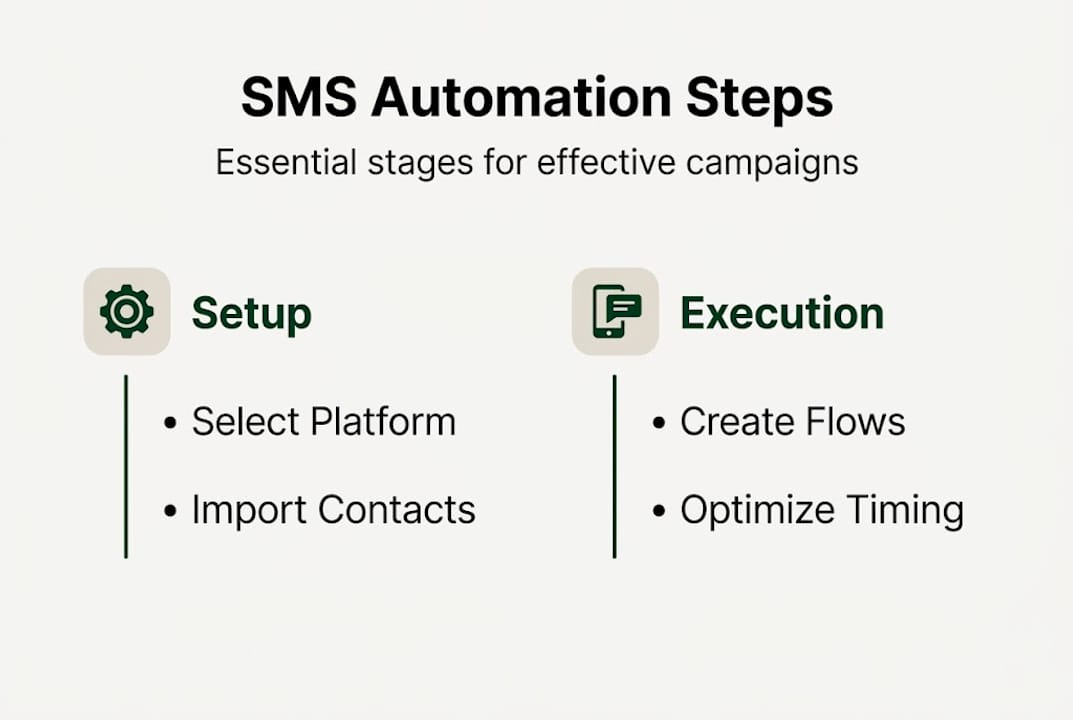
- Step-by-step: Setting up automated SMS flows
- Optimizing and scaling: Advanced automation strategies
- A smarter path: What most brands miss about SMS automation
- Unlock proven retention with expert SMS automation solutions
- Frequently asked questions
Key Takeaways
| Point | Details |
|---|---|
| Focus on triggered flows | Automations based on customer actions drive much higher ROI and retention than generic broadcasts. |
| Start with core flows | Launching welcome, cart abandonment, and confirmation flows creates immediate impact for DTC brands. |
| Optimize with data | Use segmentation and performance analytics to refine SMS campaigns and maximize ROI. |
| Scale with advanced strategies | Browse abandonment, winback, and VIP flows help push automation success even further. |
Understanding SMS campaign automation in e-commerce
SMS campaign automation means sending targeted text messages to customers based on specific triggers, behaviors, or data conditions rather than manually hitting send. Think of it as replacing a single loudspeaker blasting a crowd with a personal conversation that shows up exactly when each customer needs it.
The core distinction worth understanding is the difference between triggered flows and broadcast campaigns. Triggered flows fire automatically when a customer takes a specific action: abandoning a cart, making a purchase, or hitting a loyalty milestone. Broadcast campaigns, by contrast, are one-time sends to a defined audience segment. Both have a role, but automated SMS flows drive stronger retention and measurably better ROI than relying primarily on broadcasts.
The SMS marketing benefits that automation amplifies include open rates that dwarf email (often above 90%), near-instant delivery, and channel intimacy that drives real purchasing decisions. Automation makes those benefits scalable across thousands of customers simultaneously without adding headcount.
Here’s how the two approaches compare at a glance:
| Feature | Triggered flows | Broadcast campaigns |
|---|---|---|
| Timing | Automatic, behavior-based | Manual, scheduled |
| Personalization | High | Low to medium |
| Scalability | Unlimited | Limited by team capacity |
| ROI potential | Very high | Moderate |
| Best use | Retention, lifecycle | Promotions, announcements |
Popular platforms for SMS automation include Klaviyo, Attentive, Postscript, and SMSBump. Each integrates with Shopify and major e-commerce stacks, pulling in customer data to power intelligent segmentation. Choosing the right platform shapes everything downstream, so match platform capabilities to your tech stack and team size.
Key advantages of automation for retention-focused brands:
- Scalability: Messages go out 24/7 without manual effort
- Personalization at scale: Every message can reference purchase history, behavior, or segment data
- Consistency: No gaps in the customer journey due to team bandwidth
- Speed to revenue: Triggered messages reach customers at peak intent moments
- Data accumulation: Every automated interaction feeds back into smarter segmentation
For a deeper look at how to frame your overall channel SMS marketing strategy, it’s worth aligning your automation goals with your broader retention roadmap before building individual flows.
Preparing to automate: Key requirements and tools
Building on automation’s potential, you need a solid foundation before constructing flows. Skipping this stage is the number one reason brands end up with leaky, underperforming automations.

Platform selection is your first decision. Klaviyo is the dominant choice for brands already using it for email, since unified data means tighter segmentation. Attentive leads for brands prioritizing SMS-first growth, while Postscript excels for Shopify-native setups. Evaluate platforms on trigger flexibility, segmentation depth, and analytics granularity.
Compliance is non-negotiable. In the U.S., the Telephone Consumer Protection Act (TCPA) requires explicit opt-in consent before sending marketing texts. If you serve international customers, GDPR and similar frameworks apply. Your platform should handle consent timestamps and opt-out management automatically, but your team must verify these settings before any flow goes live. Following SMS best practices around compliance isn’t just legal protection — it builds subscriber trust that directly affects engagement rates.
Data hygiene matters more than most brands realize. Inaccurate customer profiles produce misfired triggers, irrelevant messages, and wasted spend. Before automating, audit your customer data for duplicate records, missing purchase history, and stale contact info. Integrate your e-commerce platform, loyalty program, and CRM so your SMS tool has a complete customer picture.
Segmentation basics to establish before building flows:
- Purchase frequency (one-time vs. repeat buyers)
- Average order value tiers
- Product category preferences
- Engagement level (active, lapsing, dormant)
- Geographic location for time zone sending
As a starting point, SMS campaigns benefit from focusing on the five core flows that consistently deliver the highest return. Start with 5 core automated flows and add complexity only after each one is performing well. Those five are: Welcome, Cart Abandonment, Order Confirmation, Shipping Update, and Post-Purchase.
Here’s a quick comparison of those flows by priority:
| Flow | Trigger | Primary goal |
|---|---|---|
| Welcome | Opt-in | First purchase conversion |
| Cart abandonment | Cart left unpurchased | Revenue recovery |
| Order confirmation | Purchase completed | Trust building |
| Shipping update | Order shipped | Experience and LTV |
| Post-purchase | Delivery confirmed | Repeat purchase and review |
Pro Tip: Don’t try to automate everything at once. Launching five well-configured flows beats launching fifteen half-built ones. Get your core flows running, measure results for 30 days, then layer on advanced automation.
Step-by-step: Setting up automated SMS flows
With your platform selected and data organized, you’re ready to build. Follow this process for each core flow to reduce errors and ensure every message serves a clear purpose.
-
Define the trigger. Every flow starts with a trigger event. For cart abandonment, the trigger is a cart created but no purchase completed within a set window (typically 30 to 60 minutes). Be specific — overly broad triggers lead to irrelevant messages.
-
Set your audience segment. Apply filters to narrow who enters the flow. For cart abandonment, you might exclude customers who just purchased within 24 hours or who already received a cart message in the last 7 days. This precision prevents over-messaging.
-
Write the message content. Keep SMS copy tight — 160 characters or fewer whenever possible. Lead with value (a reminder, offer, or update), personalize with first name and product data, and include one clear call to action. Ambiguous CTAs kill conversion.
-
Configure timing and frequency. Timing is everything in SMS. Cart abandonment works best within the first hour. Post-purchase follow-ups land better 3 to 7 days after delivery. Avoid sending between 9pm and 9am in the subscriber’s local time zone.
-
Test before launching. Send yourself and a small internal test group every message in the flow. Check personalization tags, link tracking, and opt-out functionality. One broken merge tag in a live flow can create a brand perception problem fast.
-
Monitor and refine. Check click-through rates, conversion rates, and opt-out rates weekly for the first month. Triggered automations consistently outperform generic broadcasts, but only when you actively refine timing, copy, and segment logic based on real data.
For teams ready to move beyond basics, explore advanced SMS retention tactics once your five core flows are stable and converting.
“The brands that win at SMS automation aren’t the ones who send the most messages — they’re the ones who send the right message to the right person at the right moment.”
Common mistakes to avoid: messaging subscribers too frequently in a short window, ignoring time zone settings, using generic copy with no personalization, and skipping A/B testing on subject lines and send times. Each of these erodes trust and subscriber value quickly. Review your SMS ecommerce automation setup regularly to catch drift before it impacts revenue.
Pro Tip: Set a suppression rule for customers who opt out of any flow. Automations that fail to honor opt-outs immediately create compliance exposure and destroy subscriber trust at the worst possible time.
Optimizing and scaling: Advanced automation strategies
Once your core flows are live and generating consistent returns, the next layer of automation unlocks significantly more revenue. Scaling from basic flows to advanced automations improves ROI and retention for brands that approach it methodically.
Advanced flows worth building after your core five are stable:
- Browse abandonment: Triggered when a subscriber views a product but doesn’t add it to cart. Lower intent than cart abandonment, but high volume makes it valuable at scale.
- Win-back: Sent to lapsed customers who haven’t purchased in 60, 90, or 120 days. A strong win-back sequence can recover 10 to 20% of churned buyers.
- VIP segmentation: Automated messages exclusive to your highest-value customers. Think early access, loyalty rewards, and personalized product recommendations.
- Replenishment reminders: For consumable products, trigger a message based on average repurchase cycles. This drives repeat purchases with almost zero friction.
- Post-review request: Sent after confirmed delivery to collect social proof at the moment of peak satisfaction.
Measuring performance requires tracking the right metrics consistently. Stay current with SMS campaign trends to benchmark your results against industry standards.
| Metric | What it tells you | Target benchmark |
|---|---|---|
| Click-through rate | Message relevance and CTA strength | 15 to 30% |
| Conversion rate | Revenue impact per message | 3 to 10% |
| Opt-out rate | Message fatigue or irrelevance | Below 1% |
| Revenue per recipient | Direct ROI per subscriber | Varies by AOV |
| Retention rate | Long-term subscriber loyalty | Improving trend |
Testing variations in your flows is where incremental gains compound into significant revenue. Test one variable at a time: send time, offer type, message length, or personalization depth. Let tests run for at least two to three weeks to reach statistical confidence. Pair that discipline with SMS messaging benefits data to build a performance case internally for continued investment.
Move from manual reporting to automated dashboards as soon as possible. Most platforms offer scheduled performance reports. Set these up so your team gets weekly snapshots without pulling data manually.
A smarter path: What most brands miss about SMS automation
Here’s the uncomfortable reality we see repeatedly with DTC brands: they invest in platform licenses, build out flows, and then underperform because they mistake volume for strategy. Sending more messages is not the same as building better automation.
The brands that sustain strong retention through SMS are the ones that treat every triggered flow as a relationship moment, not a revenue extraction event. Focusing on triggered SMS flows consistently outperforms batch-and-blast thinking, but that requires resisting the temptation to broadcast promotions whenever revenue targets look shaky.
The other gap we see is the “all at once” launch mentality. Brands build twelve flows simultaneously, none get the attention they need, and performance is mediocre across the board. The smarter path is incremental: launch two flows, let them stabilize, analyze ruthlessly, then add the next layer. For DTC brands serious about building durable retention through SMS, explore DTC SMS retention tips that go beyond the basics. Sustainable ROI comes from compounding small wins, not from chasing a perfect launch.
Unlock proven retention with expert SMS automation solutions
If you’ve read this far, you understand that SMS automation done right requires more than a platform subscription. It takes strategic flow architecture, precise segmentation, ongoing optimization, and the experience to know which lever to pull when results plateau. That’s exactly what we do at The Email Marketers. Our team builds and manages retention-focused SMS automations for 8-figure DTC brands that need results, not guesswork. Explore what’s possible through our Retention Lab, review real outcomes in our SMS case studies, or grab actionable resources from our Retention Toolkit to accelerate your next move.
Frequently asked questions
What is the difference between triggered SMS flows and broadcasts?
Triggered SMS flows are automated messages that fire based on specific customer actions, like abandoning a cart or completing a purchase. Broadcasts are one-time bulk messages sent to a defined audience segment. Triggered automations outperform broadcasts consistently for both ROI and retention.
Which SMS automation flows should DTC brands set up first?
Start with welcome, cart abandonment, order confirmation, shipping updates, and post-purchase flows. These five core flows drive higher ROI and cover the most critical moments in the customer journey before you add complexity.
How can I measure the effectiveness of automated SMS campaigns?
Track click-through rate, conversion rate, revenue per recipient, opt-out rate, and retention trends using your platform’s analytics dashboard. Engagement and retention metrics give the clearest picture of which flows are working and which need refinement.
What’s the biggest mistake brands make with SMS automation?
Over-messaging without proper segmentation is the fastest path to subscriber fatigue and opt-outs. Segmentation and message frequency control are the two levers that separate brands with high retention from those constantly rebuilding their lists.


