.png)


What Is Direct Mail? A Marketer's Guide for 2026

TL;DR:
- Direct mail is a targeted marketing method that delivers physical promotional materials to specific audiences to prompt measurable responses. It outperforms digital channels with higher response rates, longer attention spans, and bypasses spam filters, especially valuable for retention strategies. Proper planning, segmentation, and tracking are essential for maximizing its effectiveness and return on investment.
Direct mail is defined as a marketing method where businesses send physical promotional materials, such as postcards, catalogs, letters, or brochures, directly to a targeted audience via postal delivery to prompt a measurable response. Unlike broadcast advertising, direct mail advertising selects recipients based on location, buying patterns, and demographics, making every piece a deliberate outreach rather than a broadcast. Marketers track responses through QR codes, personalized URLs, and dedicated phone numbers, turning physical mail into a measurable performance channel. For e-commerce brands and DTC marketers focused on retention, direct mail fills a gap that digital channels increasingly struggle to cover.
What is direct mail and how does it differ from other marketing?
Direct mail marketing is the practice of delivering physical promotional pieces to a defined list of recipients with the explicit goal of generating a specific, trackable response. The industry term for this category is “direct response marketing,” and direct mail is its oldest and most tangible format. Where digital ads compete for attention in a crowded feed, a postcard lands in a physical space the recipient controls, which is why mail pieces sit on counters for an average of 17 days versus seconds for a marketing email.
The core distinction from general advertising is intent. Direct mail campaigns are built around a single call to action: visit this URL, call this number, redeem this offer. That specificity is what makes attribution possible and what separates direct mail from brand awareness campaigns. Salesforce describes direct outreach as effective precisely because it prompts recipients to take immediate, trackable actions rather than building diffuse awareness.
For retention-focused marketers, this matters enormously. A customer who has already purchased from you is far more likely to respond to a physical piece than a cold prospect, which is why direct mail belongs in any serious lifecycle marketing strategy alongside email and SMS.
What types of formats and materials are used in direct mail?
Direct mail formats range from simple to elaborate, and the right choice depends on your audience, offer, and budget. The most common formats include:
- Postcards: Low cost, high visibility, no envelope required. Ideal for promotions, event announcements, and reactivation campaigns.
- Brochures and flyers: Better for explaining a product or service in detail. Common in financial services, healthcare, and real estate.
- Catalogs: High production cost but high engagement. Retailers like Patagonia and IKEA still use catalogs because they drive extended browsing behavior.
- Coupon envelopes: Bundled offers that create urgency. Frequently used by grocery chains, restaurants, and local service businesses.
- Letters: The most personal format. Nonprofits and financial institutions use letters because they feel like individual communication rather than mass advertising.
Each format carries different finishing options, including paper weight, coating, size, and color, all of which affect both cost and perceived value. A glossy oversized postcard signals premium quality; a plain white envelope with a handwritten font signals personal urgency. Neither is universally better. The format must match what the recipient expects from your brand.
Pro Tip: Match your format to your campaign goal before you design anything. A reactivation offer for lapsed customers works well as a personalized letter. A seasonal sale announcement works better as a bold postcard. Mismatching format and goal wastes budget regardless of how good the creative is.
Industries that use direct mail most heavily include nonprofit fundraising, retail, financial services, insurance, and home services. Each has developed format conventions that recipients recognize and respond to, which means testing against category norms is often more productive than reinventing the format entirely.
How does direct mail marketing work and produce measurable results?
A direct mail campaign follows a defined sequence of steps, and skipping any one of them degrades the final result. Here is the standard workflow:
- Define your audience. Choose between a purchased list, your own customer database, or a geographic route via USPS Every Door Direct Mail (EDDM).
- Develop your offer. The offer is the single most important variable in direct mail performance. Discount, free trial, exclusive access, or urgency deadline all perform differently by segment.
- Design the creative. Headline, imagery, and call to action must work together. The call to action must point to a trackable destination.
- Set up tracking before you print. Build the landing page, activate the unique phone number, and generate the QR code before the piece goes to press.
- Print and prepare. Production timelines vary, but campaign workflows typically run 12 to 20 business days from brief to delivery, including USPS transit of 2 to 4 days.
- Mail and monitor. Once pieces are delivered, responses begin within days. Track inbound activity by channel identifier.
Measurement in direct mail relies on two distinct metrics that marketers frequently confuse. Response rate versus conversion rate are not interchangeable. Response rate measures any inbound action, such as a URL visit or phone call, divided by delivered pieces. Conversion rate measures completed goals, such as a purchase or a signed contract, divided by total responses.
| Metric | Formula | What it measures |
|---|---|---|
| Response rate | (Responses ÷ delivered pieces) × 100 | Inbound interest generated |
| Conversion rate | (Conversions ÷ responses) × 100 | Completed goals from responders |

Treating response rate as a success metric without tracking conversion rate is one of the most common and costly mistakes in direct mail. A 9% response rate with a 2% conversion rate tells a very different story than a 4% response rate with a 12% conversion rate.
Pro Tip: Build your tracking setup before the piece goes to print. A QR code pointing to a generic homepage tells you nothing. A QR code pointing to a campaign-specific landing page with UTM parameters tells you everything.
What are the benefits of direct mail compared to digital marketing?
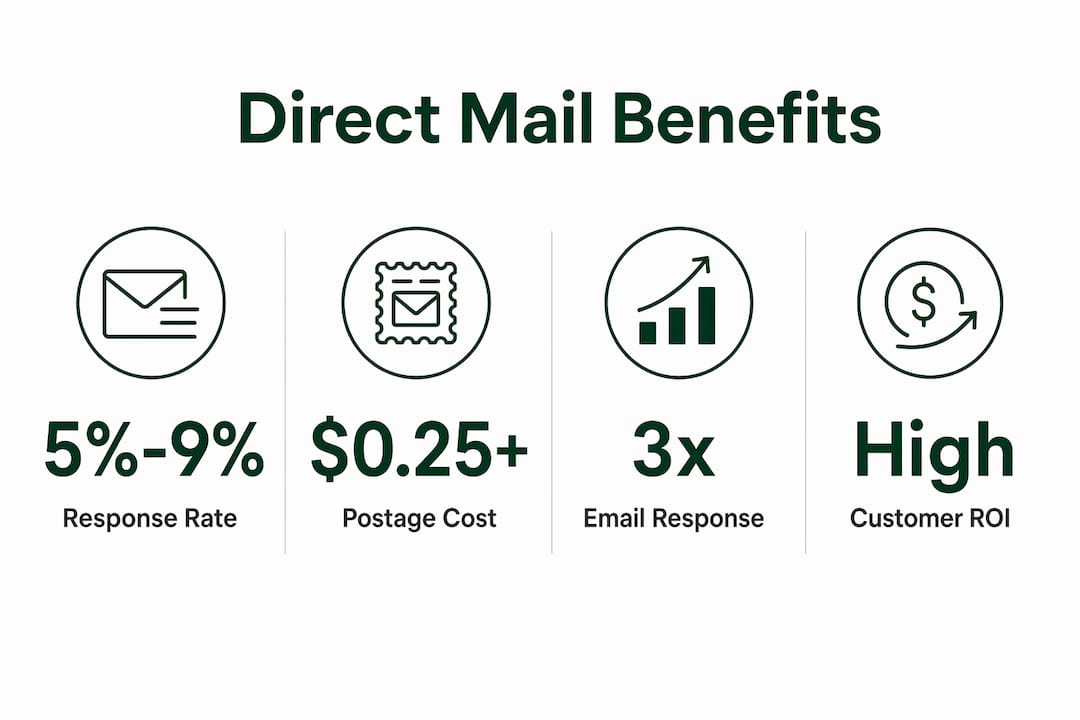
Direct mail delivers response rates that most digital channels cannot match at scale. B2C response rates average 5% for prospect lists and 9% for existing customer lists, compared to roughly 1% for email marketing. That gap is significant when you are calculating expected revenue from a campaign.
| Channel | Avg. response rate | Key advantage |
|---|---|---|
| Direct mail (house list) | ~9% | Physical presence, no spam filter |
| Direct mail (prospect list) | ~5% | Geographic and demographic targeting |
| Email marketing | ~1% | Low cost, high volume |
| Digital display ads | Under 1% | Broad reach, retargeting capability |
Beyond response rates, direct mail offers three structural advantages that digital channels cannot replicate:
- No spam filter or promotions tab. Physical mail reaches the recipient without algorithmic gatekeeping. An email from a brand a customer has not opened in 90 days may never reach the inbox. A postcard always reaches the mailbox.
- Longer attention window. Mail sits in a physical space. Recipients handle it, set it down, and return to it. That extended exposure has no digital equivalent.
- Privacy regulation bypass. As third-party cookies disappear and iOS privacy updates reduce email tracking accuracy, physical mail sidesteps those constraints entirely.
The strongest use cases for direct mail are high-value customer reactivation, geographic targeting for local businesses, compliance-sensitive industries like financial services, and premium product launches where perceived quality matters. You can read more about why direct mail still works for modern retention strategies.
Pro Tip: Combine direct mail with a triggered email sequence for the same audience. Brands that run coordinated mail and email campaigns consistently outperform single-channel campaigns because the physical piece primes the recipient to engage with the digital follow-up.
How much does a direct mail campaign cost?
Postage is the floor cost, not the total cost. USPS EDDM postage runs $0.247 per piece in 2026 for retail EDDM, which is the lowest entry point in direct mail. All-in campaign costs, including design, printing, and list preparation, typically run $0.55 to $0.75 per piece at moderate volume.
| Cost component | Typical range | Notes |
|---|---|---|
| USPS EDDM postage | $0.247/piece | Flat rate, no list required |
| Printing (postcard) | $0.10–$0.25/piece | Varies by size, paper, and quantity |
| Design | $300–$1,500 flat | One-time per campaign |
| List acquisition | $0.05–$0.15/name | Not needed for EDDM |
| Total all-in | $0.55–$0.75+/piece | Scale reduces per-piece cost |
EDDM is worth understanding as a distinct option. EDDM eliminates list purchasing by targeting every address on selected postal carrier routes, which simplifies execution but removes demographic filtering. It works well for local businesses, restaurants, and service providers targeting a geographic radius. It works less well for brands that need to reach a specific customer profile rather than every household in a zip code.
The key budgeting principle is to calculate your break-even response rate before you commit to a print run. If your average order value is $80 and your campaign costs $0.65 per piece, you need one purchase for every 123 pieces mailed to break even. At a 5% response rate and a 20% conversion rate, you need roughly 1,000 pieces to generate 10 purchases. That math should drive your volume decision, not the per-piece cost alone.
Pro Tip: Factor customer lifetime value into your ROI calculation, not just first-order revenue. A customer acquired through direct mail who makes three purchases over 12 months is worth far more than the initial conversion suggests. Tracking marketing metrics across channels helps you see the full picture.
Best practices and common pitfalls in direct mail campaigns
The most preventable mistakes in direct mail share a common cause: treating print like digital, where you can edit after launch. Once a piece is printed and mailed, nothing can be changed. That constraint demands more upfront discipline than most digital marketers are used to.
Build your tracking infrastructure before the design is finalized. Landing pages, UTM parameters, unique phone numbers, and QR code destinations must all be live and tested before the piece goes to press. Discovering a broken link after 10,000 postcards have been mailed is an expensive lesson.
Segment your list with the same precision you would apply to an email campaign. Sending the same offer to lapsed customers and active buyers is a waste of both budget and goodwill. Personalization in direct mail does not require variable printing for every piece. It requires sending the right offer to the right segment, which starts with clean list segmentation.
Avoid confusing response rate with conversion rate when reporting results. A campaign that generates a high response rate but low conversions has a creative or offer problem at the conversion stage, not a mail delivery problem. Separating these metrics points you toward the right fix. You can benchmark your email marketing KPIs alongside direct mail metrics to build a unified performance view.
Plan your timeline backward from your desired in-home date. Production, print, and postal timelines are fixed. A campaign that needs to arrive before a sale ends must be designed and approved weeks earlier than most marketers expect.
Pro Tip: Run a small test batch of 500 to 1,000 pieces before committing to a full print run. Test one variable at a time, whether that is the offer, the format, or the call to action. Direct mail testing is slower than digital A/B testing, but the insights are just as valuable.
Key takeaways
Direct mail delivers measurably higher response rates than email and digital display, making it a high-value channel for retention-focused marketers who build campaigns around precise segmentation and trackable response mechanisms.
| Point | Details |
|---|---|
| Response rates outperform digital | Direct mail averages 5% to 9% response rates versus roughly 1% for email marketing. |
| Tracking must precede printing | Set up landing pages, QR codes, and phone numbers before the piece goes to press. |
| Response rate is not conversion rate | Measure both independently to diagnose where campaigns succeed or fail. |
| EDDM lowers the entry cost | USPS EDDM postage starts at $0.247 per piece, ideal for geographic targeting without list costs. |
| Multi-channel integration amplifies ROI | Pairing direct mail with email follow-ups consistently outperforms single-channel campaigns. |
Why direct mail deserves a seat at the retention table
I have watched brands pour budget into email and paid social while dismissing direct mail as outdated, and I have watched those same brands struggle to re-engage lapsed customers through channels those customers have learned to ignore. The uncomfortable truth is that digital fatigue is real, and it is getting worse. Inbox open rates are declining, iOS privacy updates are eroding attribution, and ad costs keep climbing. Direct mail does not have any of those problems.
What I find most underutilized is the combination play. Brands that send a physical piece to a high-value segment and then follow up with a triggered email sequence within 48 hours see engagement rates that neither channel achieves alone. The mail primes the recipient. The email converts them. That sequencing is not complicated to execute, but it requires treating direct mail as a strategic channel rather than a one-off tactic.
The other thing I would push back on is the assumption that direct mail is expensive. At $0.65 per piece targeting customers with a $200 average order value and a three-purchase lifetime, the math is almost always favorable. The brands that dismiss it on cost grounds are usually comparing postage to email cost per send, which is the wrong comparison. Compare it to paid acquisition cost per customer, and direct mail looks like a bargain.
Measure it properly, integrate it with your digital channels, and segment your list with the same rigor you apply to email. Do those three things, and direct mail will outperform most of what you are currently spending on retention.
— Melanie
How The Email Marketers can help you build a direct mail strategy
Direct mail performs best when it is part of a coordinated retention strategy, not a standalone campaign. Theemailmarketers works with 8-figure DTC brands and VC-backed e-commerce companies to build multi-channel retention programs that combine email, SMS, and physical mail into a single, measurable customer journey. If you want to see what that looks like in practice, the campaign case study walks through how a retention-focused program is planned, executed, and measured from start to finish. For brands ready to build a full retention system, the Retention Lab offers the tools and strategy to make every customer touchpoint count.
FAQ
What is direct mail in marketing?
Direct mail is a form of direct response marketing where businesses send physical promotional materials, such as postcards, letters, or catalogs, to a targeted list of recipients via postal delivery to generate a specific, measurable response.
How effective is direct mail compared to email?
Direct mail response rates average 5% for prospect lists and 9% for existing customer lists, compared to roughly 1% for email. The higher response rate reflects physical presence, longer attention time, and the absence of spam filters.
How does direct mail work step by step?
A direct mail campaign starts with audience definition, followed by offer development, creative design, tracking setup, printing, and postal submission. The full workflow typically takes 12 to 20 business days from brief to in-home delivery.
What does a direct mail campaign cost?
USPS EDDM postage starts at $0.247 per piece in 2026. All-in costs including printing, design, and list preparation typically run $0.55 to $0.75 per piece, depending on format and volume.
What is the difference between response rate and conversion rate in direct mail?
Response rate measures any inbound action, such as a URL visit or phone call, divided by delivered pieces. Conversion rate measures completed goals, such as purchases, divided by total responses. Tracking both separately is required for accurate ROI measurement.


