.png)


The Importance of Email in Ecommerce: 2026 Guide

TL;DR:
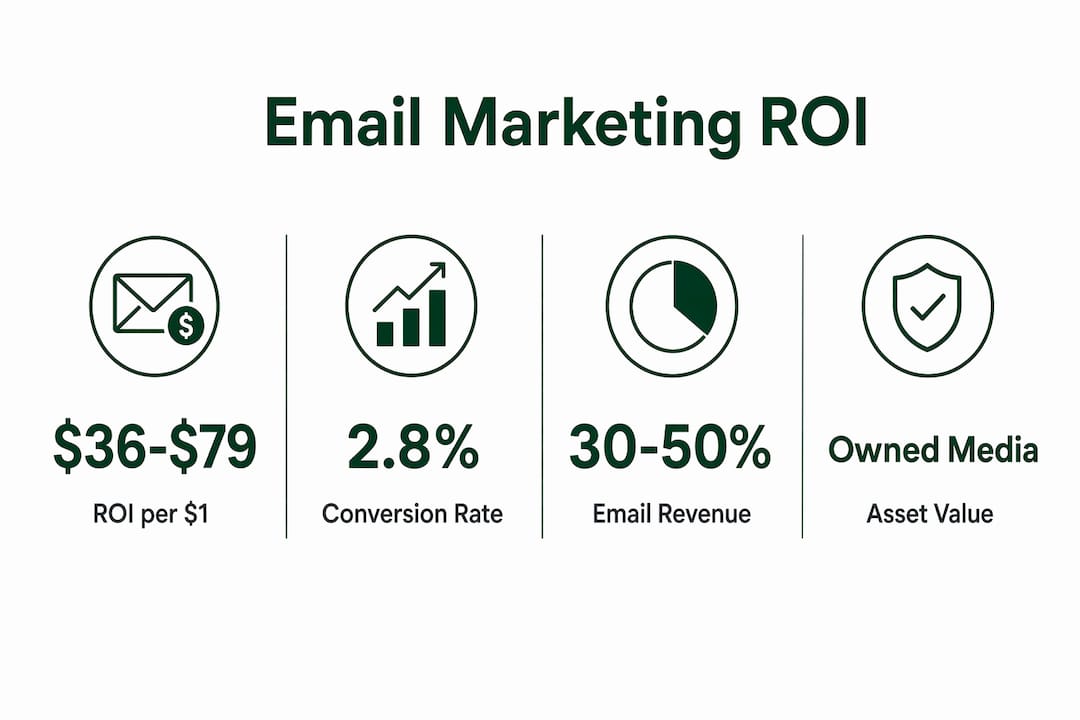
- Ecommerce email marketing offers a high return on investment, generating $36 to $79 per $1 spent in 2026.
- Segmentation, personalization, and automation are essential for maximizing revenue and customer engagement.
- Authenticating domains and measuring revenue per recipient are crucial for maintaining deliverability and true campaign performance.
Ecommerce email marketing is defined as personalized, automated campaigns sent directly to a brand’s subscriber list to drive purchases, retention, and lifetime value. The importance of email in ecommerce is backed by hard numbers: email delivers $36 to $79 ROI for every $1 spent in 2026, a return that paid social and paid search cannot match. Platforms like Klaviyo and ActiveCampaign have made it possible for brands of any size to build segmented, behavior-triggered programs that treat every subscriber as an individual. The industry term for this discipline is retention marketing, and it sits at the center of every high-performing direct-to-consumer brand’s growth strategy. If you are running an ecommerce business and email is not your highest-ROI channel, the problem is almost certainly execution, not the channel itself.
Why email in ecommerce outperforms every other channel
Email is the only marketing channel where you own the relationship completely. No algorithm decides who sees your message. No platform doubles its ad prices the week before Black Friday. Your subscriber list is a compounding asset that grows in value every time you add a qualified contact or improve your segmentation.

The performance gap between email and other channels is not marginal. Email conversion rates average 2.8% for B2C ecommerce in Q1 2026, while organic social typically lands below 1% and paid social rarely clears 1.5% without heavy retargeting spend. That gap translates directly to revenue per campaign.
Here is how email stacks up against the primary alternatives:
| Channel | Average conversion rate | Cost structure |
|---|---|---|
| Email marketing | 2.8% | Fixed platform fee, owned list |
| Paid social (Meta, TikTok) | 0.9–1.5% | Variable CPM, algorithm-dependent |
| Paid search (Google) | 1.5–2.2% | Variable CPC, competitive bidding |
| Organic social | 0.5–1.0% | Time cost, reach limited by algorithm |
The email marketing benefits go beyond conversion rate. Because email lists are owned media assets, they are immune to the platform volatility that erodes paid channel returns. A brand that builds a 200,000-subscriber list with 35% engagement has a revenue engine that runs regardless of what Meta or Google does next quarter. That is a strategic advantage no paid channel can replicate.
How segmentation and personalization drive email campaign impact
Segmentation is the single biggest lever in ecommerce email performance. Over 90% of marketing professionals report that segmentation improves campaign results, and the data on personalization is equally clear: including a company or brand name in a subject line lifts open rates by 41%.
The most effective segmentation frameworks for ecommerce divide subscribers into four core groups:
- VIP buyers: Customers in the top 20% of purchase frequency or order value. They respond to early access, exclusive products, and loyalty rewards.
- At-risk customers: Subscribers who purchased once but have not engaged in 60 to 90 days. They need a targeted win-back sequence before they go cold permanently.
- Category affinity segments: Customers who consistently buy from one product category. Sending them category-specific recommendations outperforms generic promotions every time.
- New subscribers: People who joined your list but have not purchased. A welcome series with social proof, product education, and a time-limited offer converts this group at a significantly higher rate than a standard newsletter.
Behavior-triggered messaging consistently outperforms batch-and-blast sends because it reaches the subscriber at the moment of highest intent. A browse abandonment email sent two hours after a session is worth more than a weekly promotional blast sent to your entire list.
Pro Tip: Build your segmentation around purchase recency, frequency, and monetary value (RFM scoring) before you invest in creative. The right message to the wrong segment wastes both money and subscriber goodwill. Klaviyo’s RFM dashboard makes this analysis straightforward for most ecommerce stores.
You can go deeper on advanced segmentation tactics to understand how multi-dimensional segmentation compounds revenue over time.
What technical changes reshaped email marketing in 2026
Deliverability is no longer a back-office concern. Since 2024, Google and Yahoo require SPF, DKIM, and DMARC authentication for all bulk senders. Brands that fail to implement these protocols see inbox placement collapse, meaning their emails land in spam regardless of content quality or list health.
The practical steps every ecommerce sender must take in 2026:
- Authenticate your sending domain with SPF, DKIM, and DMARC records. Your ESP (Klaviyo, ActiveCampaign, or similar) provides setup documentation. This is non-negotiable.
- Enable one-click unsubscribes in every campaign. Google’s inbox algorithms penalize senders who make it difficult to opt out, and spam complaint rates above 0.08% trigger deliverability suppression.
- Monitor sender reputation through Google Postmaster Tools and Microsoft SNDS. These free dashboards show your domain reputation score and spam rate in real time.
- Shift your primary performance metric away from open rates. Apple’s Mail Privacy Protection (MPP), introduced in iOS 15 and now standard across Apple devices, inflates open rates artificially. Click rate and revenue per recipient are the metrics that actually reflect campaign health.
The integration of email with SMS and push notifications has also matured significantly. Email handles considered communications like product launches, newsletters, and multi-product promotions, while SMS and push handle time-sensitive triggers like shipping updates and flash sales. Brands that treat these as separate programs miss the compounding effect of a coordinated customer journey.
Pro Tip: Run a deliverability audit before your next major campaign. Check your domain reputation in Google Postmaster Tools, verify your DMARC policy is set to at least “quarantine,” and suppress any address that has not opened or clicked in 180 days. A smaller, engaged list always outperforms a large, disengaged one.
Which automated flows generate the most consistent revenue
Automated email flows generate 30 to 50% of total email revenue for high-performing ecommerce brands, despite running on a fraction of the send volume of broadcast campaigns. These flows are infrastructure, not campaigns. They run continuously, triggered by subscriber behavior, and compound in value as your list grows.
The five flows every ecommerce brand must have running:
| Flow type | Trigger | Primary goal |
|---|---|---|
| Welcome series | New subscriber signup | First purchase conversion |
| Abandoned cart | Cart created, no purchase | Revenue recovery |
| Post-purchase | Order confirmed | Loyalty and repeat purchase |
| Win-back | 60 to 90 days no engagement | Reactivation or list removal |
| Replenishment | Product lifecycle timing | Repeat purchase at the right moment |
Abandoned cart flows deserve special attention. A three-email sequence sent at one hour, 24 hours, and 72 hours after abandonment consistently recovers 5 to 15% of lost carts. The first email is a simple reminder. The second adds social proof. The third introduces a time-limited incentive. This sequence alone can generate six figures annually for a mid-size ecommerce brand.
Post-purchase flows are equally underused. Most brands send a confirmation email and stop. The brands that win long-term send product education content, cross-sell recommendations, and replenishment reminders timed to the product’s average consumption cycle. This approach increases second-purchase rate, which is the single most important predictor of long-term customer lifetime value.
For a broader view of how these flows fit into a complete program, the ultimate email marketing strategy guide covers the full architecture in detail.
How to measure the true impact of your email program
Open rates are a broken metric in 2026. Apple MPP pre-loads email pixels on Apple devices, which means your open rate includes millions of “opens” that never actually happened. Brands that optimize for open rate are optimizing for a number that does not reflect real engagement.
Revenue per recipient (RPR) is the metric that actually tells you what your email program is worth. An abandoned cart flow generating $3.65 RPR versus a broadcast campaign generating $0.11 RPR tells you exactly where to invest your time and budget. Track RPR by flow type, by segment, and by campaign to build a clear picture of what drives revenue.
The measurement framework that works:
- RPR by flow: Identifies which automated sequences generate the most revenue per email sent.
- Click-to-purchase rate: Measures the quality of your offer and landing page experience, not just email engagement.
- Multi-touch attribution: Assigns credit across the full customer journey rather than last-click only. Many ecommerce brands discover that email assists 40 to 60% of purchases attributed to other channels.
- List health score: Track your list hygiene practices by monitoring bounce rate, unsubscribe rate, and spam complaints monthly. Remove unengaged addresses every 90 days.
Pro Tip: Set up a holdout test by suppressing 10% of your list from a specific flow for 30 days. Compare the purchase rate of the holdout group against the emailed group. This gives you the cleanest possible read on the incremental revenue your email program generates.
Key takeaways
Email marketing in ecommerce is the highest-ROI owned channel available, and its advantage compounds when you combine authentication, segmentation, automation, and revenue-focused measurement.
| Point | Details |
|---|---|
| ROI superiority | Email delivers $36 to $79 per $1 spent, far exceeding paid social and search returns. |
| Owned channel advantage | Subscriber lists are assets unaffected by algorithm changes or rising ad costs. |
| Segmentation multiplier | Behavior-triggered and RFM-segmented sends consistently outperform broadcast campaigns. |
| Deliverability is non-negotiable | SPF, DKIM, and DMARC authentication are required by Google and Yahoo for inbox placement. |
| Measure RPR, not open rate | Revenue per recipient reveals true program value; open rates are inflated by Apple MPP. |
Why I think most ecommerce brands are leaving serious money on the table
I have worked with dozens of ecommerce brands across DTC, subscription, and luxury retail. The pattern I see most often is not a lack of email activity. It is a lack of email architecture. Brands send newsletters. They run promotions. But they have no welcome series, no post-purchase flow, and no win-back sequence. They are driving traffic into a bucket with holes in the bottom.
The second mistake I see constantly is treating deliverability as someone else’s problem. Your ESP does not manage your sender reputation for you. If your domain is not authenticated and your list has not been cleaned in six months, your campaigns are landing in spam for a significant portion of your list. You will never see it in your dashboard because those subscribers are invisible to your reporting.
The brands that win with email in 2026 treat it as infrastructure, not a campaign calendar. They build the flows first, get the authentication right, and then layer campaigns on top of a foundation that works. The role of email in sales is not just about sending more. It is about sending smarter, to the right people, at the right moment in their lifecycle. That is where the real returns live.
— Melanie
How The Email Marketers can build your email revenue engine
The Email Marketers specializes in retention marketing for ecommerce brands that are ready to treat email as a revenue channel, not a newsletter service. The team builds the full architecture: authenticated sending infrastructure, RFM-based segmentation, automated flows for every lifecycle stage, and campaign programs calibrated to your customer data. If you want to see what a fully optimized email program looks like in practice, the ecommerce case studies show the revenue impact across real brands. For brands ready to build or rebuild their retention program from the ground up, The Email Marketers offers a strategic partnership built around measurable outcomes, not vanity metrics.
FAQ
What is the average ROI of email marketing for ecommerce?
Email marketing delivers between $36 and $79 for every $1 spent in 2026, making it the highest-ROI channel in ecommerce. This return far exceeds typical paid social and paid search returns of $2 to $5 per dollar.
Why is segmentation so important in ecommerce email campaigns?
Segmentation ensures each subscriber receives messaging relevant to their purchase behavior and lifecycle stage, which directly increases conversion rates. Over 90% of marketing professionals confirm that segmentation improves email campaign performance.
What email authentication is required in 2026?
Google and Yahoo require all bulk senders to implement SPF, DKIM, and DMARC authentication on their sending domains. Without these records in place, emails from your domain risk being filtered to spam regardless of content quality.
Which automated email flows drive the most ecommerce revenue?
Welcome series, abandoned cart, post-purchase, win-back, and replenishment flows collectively generate 30 to 50% of total email revenue for high-performing ecommerce brands. Abandoned cart sequences alone recover 5 to 15% of lost carts when structured as a three-email sequence.
What metric should replace open rate for measuring email performance?
Revenue per recipient (RPR) is the most accurate measure of email program health in 2026. Apple Mail Privacy Protection inflates open rates artificially, making RPR and click-to-purchase rate the reliable indicators of true campaign impact.


