.png)


SMS Promotions That Actually Drive Sales in 2026
TL;DR:
- SMS marketing now offers open rates up to 98%, making it a highly effective channel for ecommerce brands.
- Effective strategies include personalized triggers, limited-time offers, and rich experiences like RCS and mobile wallet campaigns.
SMS marketing is no longer a nice-to-have. With open rates up to 98% and 78% of consumers making purchases directly from SMS promotions, the channel punches harder than almost anything else in your retention stack. But the gap between brands that run SMS well and those that irritate their lists into unsubscribing is wider than most marketers expect. This guide covers the 10 most effective SMS promotion types in 2026, how to evaluate them, and exactly when to use each one.
Table of Contents
- Key takeaways
- How to evaluate SMS promotions before you send
- Top 10 SMS promotion types for e-commerce brands
- Comparing SMS promotions: effectiveness, ROI, and best fit
- Situational recommendations for choosing the right approach
- My take on where SMS promotions are really heading
- How Theemailmarketers can help you run better SMS campaigns
- FAQ
Key takeaways
| Point | Details |
|---|---|
| SMS outperforms most channels | Open rates near 98% make SMS one of the highest-engagement channels available to e-commerce marketers. |
| ROI justifies the investment | Campaigns can return $45 to $71 per $1 spent, making budget allocation straightforward. |
| Personalization reduces churn | Behavioral trigger messages keep unsubscribe rates low and engagement high. |
| Format discipline matters | Effective SMS promotions stay under 160 characters with a single, clear call to action. |
| Hybrid strategies extend reach | Combining SMS with RCS creates richer experiences while keeping delivery reliability intact. |
How to evaluate SMS promotions before you send
Before you pick a promotion type, you need a filter. Not every SMS tactic works for every brand, and sending the wrong message at the wrong time is how you burn through a subscriber list you spent months building.
Engagement metrics are your baseline. Click-through rates on SMS typically run between 19% and 35%, far above email. If your campaigns are falling below that range consistently, the issue usually lives in copy quality, audience segmentation, or timing, not the channel itself.
Compliance is non-negotiable. A2P 10DLC registration with verified sender profiles is now standard for U.S. brands. Skipping this does not just risk fines. It degrades deliverability at the carrier level, meaning your messages get filtered before they ever reach the subscriber.
Here is what a solid evaluation framework covers:
- Opt-in quality: Are subscribers genuinely interested, or were they swept in through a low-friction checkbox? 46% of U.S. smartphone users increased their SMS opt-ins last year, but volume means nothing without intent.
- Frequency and timing: Most brands find a sweet spot between two and four messages per month. Above that, unsubscribe rates spike regardless of offer quality.
- Personalization signals: Generic blasts underperform. Behavioral triggers tied to browse history, purchase timing, or loyalty tier drive better results.
- ROI tracking: Use unique short links or promo codes tied to each campaign so attribution is clean.
- Technology stack: Your bulk SMS services provider should support segmentation, automation, and integration with your e-commerce platform.
Pro Tip: Before launching any new SMS promotion type, run a 30-day audit of your current unsubscribe rate. Top performers maintain 0.2% to 0.5%. If you are already above 1%, fix your segmentation before adding more promotions to the mix.
Top 10 SMS promotion types for e-commerce brands
1. Limited-time offers and flash sales
Flash sales are the native format of SMS. The channel is built for urgency. Messages read within five minutes by 82% of recipients mean a well-timed flash sale can generate a revenue spike within the hour it sends.
The copy formula here is simple: one offer, one deadline, one link. “20% off sitewide. Today only. Ends at midnight: [link]” outperforms every variation that tries to explain more. Anything over 160 characters loses attention fast.
2. Exclusive promotions for loyal customers
Loyalty-tier SMS is one of the highest-ROI mobile promotional messages you can send, because the audience already trusts you. These are customers who have bought multiple times. Treating them like a general subscriber is a missed opportunity.
Segment your VIP tier separately and send them early access, deeper discounts, or members-only bundles. The exclusivity framing (“This offer is only for our top customers”) measurably lifts conversion over the same offer sent broadly.
3. Seasonal and holiday campaigns
Holiday SMS promotions work, but the window is competitive. The brands that win are the ones who start their sequence early and use SMS to support, not duplicate, their email campaigns.
A practical structure: send a preview text three days before a sale, a launch message on day one, and a last-chance reminder on the final day. Three messages across a week-long sale is responsible. Ten is not.
4. Abandoned cart alerts
Abandoned cart SMS is one of the highest-converting automations available to e-commerce brands. A text sent within 30 to 60 minutes of cart abandonment, while the product is still on the customer’s mind, consistently outperforms 24-hour email reminders.
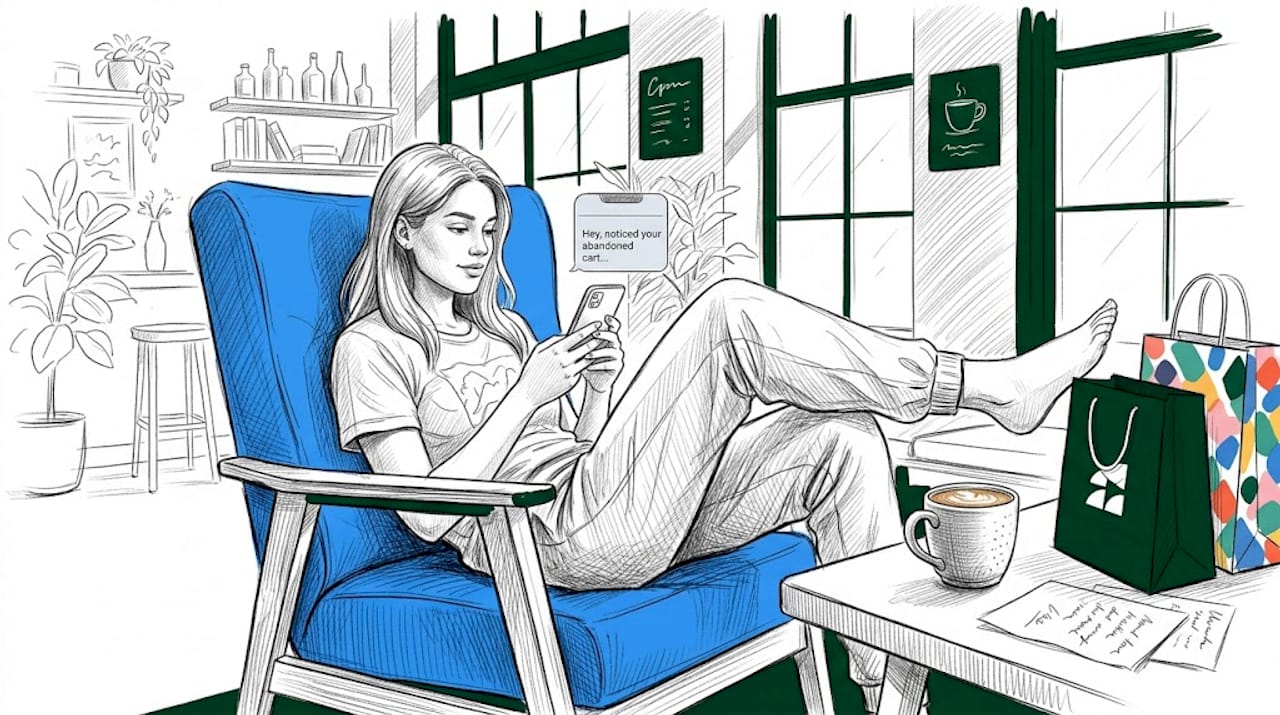
Keep the message direct. Name the product, include the cart link, and optionally add a small incentive like free shipping if the cart value justifies it. Pair this with frictionless checkout links tied to digital wallets and you remove most of the barrier between intent and purchase.
5. Price drop alerts
Price drop SMS works especially well for considered purchases where customers have been waiting for a better deal. Electronics, furniture, and premium apparel all see strong conversion when a subscriber who viewed a product gets a text the moment that product goes on sale.
This is a behavioral trigger play. The subscriber opted in at a moment of genuine interest. You are closing the loop at exactly the right time.
6. New product announcements
A new product launch text to your subscriber list is one of the cleanest uses of SMS. These people already like your brand. A concise message with a product name, one benefit, and a direct link gets results without requiring elaborate copy.
The mistake most brands make is launching via email only and treating SMS as an afterthought. Send the SMS at the same time or slightly before the email. The open speed of texts means early-access messaging lands harder when it arrives first.
7. Customer appreciation offers
Birthday texts, anniversary discounts, and milestone rewards are personal by design. They do not feel like promotions. They feel like a relationship. That distinction matters because segmented, personalized messages consistently achieve better engagement and lower opt-out rates than broadcast campaigns.
A simple “Happy birthday, here is 15% off this week” message sent on the actual birthday regularly outperforms campaign-wide sale texts by a significant margin.
8. SMS contests and giveaways
Contests drive opt-ins and engagement simultaneously. A “Text WIN to 12345 to enter” mechanic is easy to implement and gives people a clear reason to join your list beyond the expectation of future promotions.
Use contests strategically, not as a shortcut to grow a list that will immediately disengage. The best practice is to follow every contest message with value-first content over the next 30 days to retain the subscribers who entered.
Pro Tip: After any contest, segment your new subscribers by how they joined. Run a separate nurture flow for contest entrants. Their purchase intent is different from someone who opted in during checkout, and the messaging should reflect that.
9. Event updates and reminders
If your brand runs sales events, pop-ups, webinars, or product launches, SMS is the right channel to drive attendance. Email invitations get buried. A text sent two hours before an event consistently lifts show rates.
This also applies to in-store retail. A “doors open at 10 AM today, here is what to expect” message the morning of an event gives customers a reason to prioritize showing up.
10. Mobile wallet and one-click checkout campaigns
Mobile wallet-integrated SMS is where the channel is heading in 2026. Rather than linking to a product page and requiring multiple steps to buy, these campaigns push directly to Apple Wallet or Google Pay, allowing customers to complete a purchase in two taps.
Combining this with RCS hybrid messaging creates even richer experiences, using RCS for interactive product previews with an SMS fallback for guaranteed delivery. The result is higher conversion with no sacrifice in reach.
Comparing SMS promotions: effectiveness, ROI, and best fit
Different promotion types suit different business goals. This table gives you a quick reference for matching the right tactic to the right situation.
| Promotion type | Conversion potential | Effort required | Best for |
|---|---|---|---|
| Flash sales | High | Low | Quick revenue spikes, clearing inventory |
| Abandoned cart alerts | Very high | Medium (automation setup) | Recovering lost revenue |
| Loyalty exclusives | High | Medium | Retaining high-value customers |
| Price drop alerts | High | Medium (trigger setup) | Considered purchases, premium categories |
| Birthday/milestone offers | Medium-high | Low (once built) | Long-term relationship building |
| New product launches | Medium | Low | Awareness and early sales momentum |
| Contests and giveaways | Medium | High | List growth and brand awareness |
| Mobile wallet campaigns | Very high | High (integration needed) | High-volume e-commerce, subscription brands |
The cost difference between running bulk SMS services for a flash sale versus a personalized birthday trigger is minimal. The difference in unsubscribe rate is not. Behavioral campaigns consistently outperform broadcast in retention metrics, even when the broadcast generates more short-term revenue.
For brands integrating SMS into omnichannel marketing strategies, the best-performing setups use SMS for urgent, high-priority messages and reserve email for longer-form storytelling and product education.
Situational recommendations for choosing the right approach
The right SMS promotion strategy depends on where your business is, not just where you want to go. Here is how to think about it practically:
- Small or growing e-commerce brands: Start with automated triggers only. Abandoned cart, welcome series, and birthday messages require minimal ongoing effort and deliver measurable results from day one. Broadcast campaigns can wait until your list exceeds a few thousand engaged subscribers.
- Large or scaling DTC brands: You have the segmentation data to run all 10 promotion types. The discipline is in prioritizing personalization over volume. More messages rarely means more revenue at scale.
- High-frequency messaging brands: If your category supports it (flash-sale retailers, subscription boxes), you can send more often. But every message needs a distinct offer or reason to exist. Sending for the sake of a weekly cadence is how lists erode.
- Budget-conscious operators: Prioritize automations over manual campaigns. The upfront setup cost of trigger-based SMS flows pays back continuously without requiring additional spend per send.
- Multichannel marketers: Use the SMS marketing trends data to coordinate your SMS timing with email sends. The two channels reinforce each other when sequenced correctly. Sending both at the same moment splits attention and reduces impact.
Subscriber growth is its own consideration. Opt-in rates improve when the value exchange is clear at the point of signup. Tell subscribers exactly what they will receive and how often before they text in or check the box. This filters out low-intent subscribers who will unsubscribe after the first message anyway.
My take on where SMS promotions are really heading
I have watched a lot of brands approach SMS the same way they approached email in 2012: blast everyone, measure opens, repeat. That worked for a while. It does not anymore.
What I have seen work consistently is treating SMS like a high-trust, low-tolerance channel. Subscribers give you access to their phone. That is not the same as giving you permission to fill their notification tray with every promotion you run. The brands I have seen maintain unsubscribe rates below 0.5% are the ones that send fewer messages with sharper relevance, not more messages with bigger discounts.
The thing that surprises most marketers is how much copy quality matters. A flash sale with a deadline written into the sentence converts better than the same offer with vague urgency. One clear call to action beats two. 160 characters beats 320. These are not preferences. They are patterns I have seen hold across dozens of brands.
For 2026 and beyond, the brands that will win on SMS are building trigger-based flows tied to actual behavior, combining SMS with RCS for richer moments, and integrating one-click purchase paths that eliminate friction between the message and the transaction. The technology is there. Most brands just have not built the infrastructure yet.
— Melanie
How Theemailmarketers can help you run better SMS campaigns
Running effective SMS promotions at scale requires more than a platform and a schedule. It requires segmentation strategy, compliance infrastructure, copy that converts, and automation flows that fire at the right moment. That is exactly what Theemailmarketers builds for e-commerce brands every day.
Whether you are starting from scratch or trying to fix a strategy that has plateaued, the team brings deep experience in retention-focused SMS marketing for DTC brands, VC-backed companies, and subscription businesses. You can explore real client results to see how brands at different growth stages have used SMS and email together to increase repeat purchases and lift customer lifetime value. If you are ready to build a program that compounds over time, the Retention Lab is where that work starts.
FAQ
What is the average ROI for SMS promotions?
SMS marketing campaigns can generate between $45 and $71 for every $1 spent, making it one of the highest-ROI channels available for e-commerce brands running direct-to-consumer promotions.
How often should you send SMS promotions?
Most brands perform best sending two to four messages per month. Exceeding this without strong personalization or distinct offers is one of the leading causes of elevated unsubscribe rates.
What is the best SMS promotion type for recovering lost revenue?
Abandoned cart SMS sent within 30 to 60 minutes of abandonment consistently delivers the highest conversion rate of any SMS promotion type, particularly when paired with a direct checkout link.
Do SMS promotions require special compliance setup?
Yes. U.S. brands sending business SMS at scale need A2P 10DLC registration and verified sender profiles to maintain deliverability and avoid carrier filtering.
How do you reduce SMS unsubscribe rates?
Top-performing brands maintain unsubscribe rates between 0.2% and 0.5% by prioritizing behavioral triggers over broadcast campaigns, keeping messages under 160 characters, and sending only when there is a genuine reason to reach the subscriber.


