.png)


Shopify Personalized Products: Boost Retention with Smart Email
TL;DR:
- Poorly executed personalization creates friction and drives customers away.
- Simplifying customization flow and optimizing for mobile boosts conversion and reduces returns.
- Connecting personalization data to targeted email campaigns enhances engagement and long-term loyalty.
Personalization sounds like a guaranteed win. Add a monogram here, a build-your-own option there, and customers will keep coming back. But here’s what most brand managers discover too late: poorly executed personalization actively drives customers away. Clunky interfaces, confusing pricing, and broken mobile experiences create friction that erodes trust faster than a generic product ever would. For luxury and subscription brands especially, the stakes are higher because your customers expect excellence at every touchpoint. This article breaks down how to implement Shopify personalized products the right way, and how to connect those experiences to targeted email campaigns that actually move the retention needle.
Table of Contents
- The business case for Shopify personalized products
- Avoiding personalization pitfalls: Operational and UX essentials
- Integrating personalized products with targeted email campaigns
- Making personalization profitable: Metrics and ongoing optimization
- Our perspective: Why most Shopify personalization fails and how to do what works
- Unlock higher retention with Shopify and advanced email strategies
- Frequently asked questions
Key Takeaways
| Point | Details |
|---|---|
| Simplicity wins | The best personalized product experiences are intuitive and mobile-optimized. |
| Email integration boosts retention | Personalized email campaigns tied to product choices drive more repeat customers. |
| Measure what matters | Track conversions, abandonment, and returns to fine-tune your personalization and retention strategy. |
| Luxury brands need clarity | Transparent pricing and smooth customization are critical for high-value customer relationships. |
The business case for Shopify personalized products
Customers want to feel seen. A monogrammed tote, a curated subscription box built around their preferences, or a fragrance blended to their taste signals something powerful: this brand knows me. That emotional connection is the foundation of long-term loyalty, and it’s why personalized products have become a core retention strategy for luxury and subscription e-commerce brands.
The numbers back this up. Brands that offer meaningful personalization see repeat purchase rates climb significantly, and average order values rise because customers perceive custom items as inherently more valuable. Personalized offerings reduce return rates by up to 30% when the customization process is intuitive and the product matches expectations. That’s a meaningful operational win on top of the loyalty benefit.
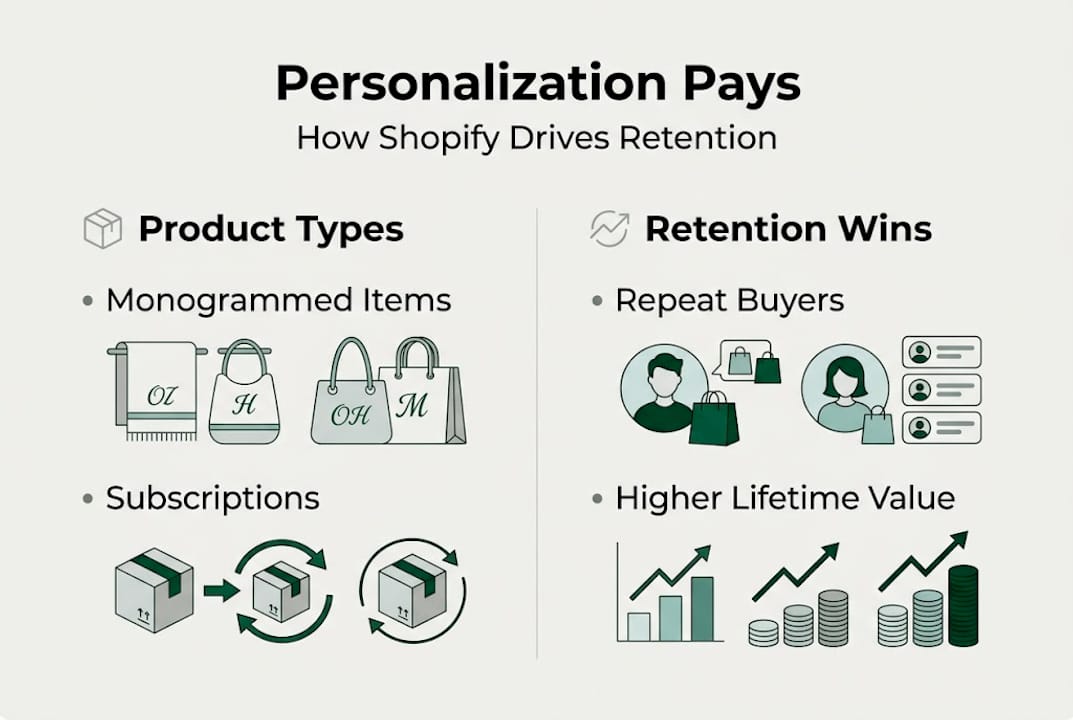
For subscription brands, personalization takes a different shape. Instead of one-time custom items, you’re building ongoing relevance. A skincare subscription that adjusts to a customer’s changing skin concerns, or a coffee service that learns a member’s roast preferences over time, creates a relationship that’s genuinely hard to cancel. The product becomes personal, and canceling feels like losing something tailored specifically to you.
Luxury brands face a different challenge. Their customers expect exclusivity and craftsmanship, not just a name stamped on a box. Personalization at this level means offering bespoke configurations, limited editions tied to customer milestones, or concierge-style customization experiences. The perceived value must justify the price, and the experience must feel as premium as the product itself.
But here’s where many brands stumble. They invest in personalization features without investing in the experience around them. Complexity, lack of preview, and high costs are the top complaints customers have about product customization. Adding options without simplifying the journey creates decision fatigue, not delight.
Key benefits of personalized products when done right:
- Higher perceived value leading to stronger price tolerance
- Lower return rates because customers get exactly what they chose
- Stronger emotional connection that resists competitor switching
- Increased word-of-mouth as customers share their unique items
- Better data collection on preferences that fuels smarter email targeting
Personalization only drives retention when the process is seamless. Pair your product strategy with a strong Shopify email marketing foundation, and you create a flywheel where product choices inform messaging, and messaging deepens product engagement.
With the value of personalization established, let’s examine the operational and technical pitfalls that can stand in the way.
Avoiding personalization pitfalls: Operational and UX essentials
Most personalization failures aren’t product failures. They’re experience failures. A customer who can’t figure out how to preview their custom engraving, or who hits an unexpected price jump at checkout, doesn’t blame the interface. They blame your brand.
“Mobile UX and pricing transparency are key conversion risks in product personalization.”
Mobile accounts for over 70% of e-commerce traffic, and most personalization flows were designed on desktop. Small text fields, fiddly color selectors, and previews that don’t render correctly on a phone screen are conversion killers. If your customizer isn’t flawless on mobile, you’re losing the majority of your potential buyers before they even get to checkout.
Top reasons customers abandon personalization flows:
- Too many steps or options with no clear path forward
- No real-time preview of the final product
- Unexpected price increases mid-flow
- Compatibility errors between selected options
- Slow loading times during customization
- Confusing interface with no guidance or tooltips
Here’s a comparison of common pitfalls and their practical fixes:
| Pitfall | Impact | Fix |
|---|---|---|
| Over-engineered customizer | 23% abandonment from complexity | Reduce steps, use guided flows |
| No live preview | 16% drop-off at design stage | Add real-time rendering |
| Mobile UX issues | 70%+ traffic affected | Mobile-first design and testing |
| Price confusion | Trust erosion at checkout | Show pricing updates in real time |
| Compatibility errors | Frustration and cart abandonment | Build logic rules into the configurator |
Returns drop 15 to 30% when customizers are kept simple and effective. That’s not just a customer satisfaction metric. It’s a direct cost reduction that compounds over time.
For agency insights on Shopify brands, the pattern is consistent: brands that simplify their customization flows see immediate lifts in conversion and a measurable drop in post-purchase complaints. Complexity is the enemy of retention.
Pro Tip: Before launching any personalization feature, run your entire customization flow on three different mobile devices. If anything feels slow, confusing, or visually broken, fix it before it reaches your customers. Your personalized email strategy will only work if the product experience it references is worth celebrating.
Once your process is streamlined, you’ll need to connect these personalized experiences with your email marketing. Here’s why that matters.
Integrating personalized products with targeted email campaigns
A customer who builds a custom product on your Shopify store has just handed you the most valuable data point in retention marketing: their explicit preferences. Most brands collect this data and do nothing with it. The ones that win use it to power every subsequent communication.
Seamless connections between product customization and email outreach drive significantly higher customer engagement. When a subscriber receives an email that references the exact product configuration they built, or suggests a complementary item based on their choices, it doesn’t feel like marketing. It feels like service.

For subscription brands, this integration is especially powerful. Imagine a candle subscription that sends a “your next scent is almost ready” email featuring a preview of the fragrance blend the customer selected last month. Or a meal kit service that sends a mid-cycle email with a recipe tip tailored to the proteins in their current box. These touches don’t just retain customers. They create advocates.
Luxury brands can use this data to offer exclusive personalization upgrades via email. A customer who purchased an engraved item becomes a prime candidate for a “reserve your holiday engraving slot” campaign. The email feels earned, not intrusive, because it’s rooted in what the customer already told you they value.
Steps to integrate product and email personalization seamlessly:
- Sync your Shopify customization data to your email platform in real time
- Tag customers based on the product options they selected
- Build triggered flows that activate based on those tags
- Create email content that references specific choices, not just product categories
- Test messaging cadence to avoid over-communication
Common triggers and email ideas for Shopify stores:
| Trigger | Email Idea |
|---|---|
| Custom product completed | “Your [item] is being crafted” confirmation |
| 30 days post-purchase | Care guide or styling tip for their specific item |
| Subscription renewal approaching | Preview of next personalized selection |
| Abandoned customizer | “Finish your design” reminder with preview image |
| Anniversary of first custom order | Exclusive upgrade or loyalty reward offer |
Pro Tip: Sync your product customization data to your email platform daily at minimum. Stale data means irrelevant emails, and irrelevant emails train customers to ignore you. Use personalized email tactics and email automation flows to build sequences that feel timely and personal.
Now that we’ve tied together your store’s product and email strategies, see how brands move from strategy to execution.
Making personalization profitable: Metrics and ongoing optimization
Personalization without measurement is just guessing with extra steps. To know whether your strategy is working, you need to track the right numbers and create a feedback loop that drives continuous improvement.
The core KPIs for personalized product and email performance:
- Conversion rate on the customization flow (where do customers drop off?)
- Average order value for personalized vs. standard products
- Repeat purchase rate among customers who bought custom items
- Customizer abandonment rate by step or option
- Return rate for personalized orders vs. standard
- Email engagement on triggered personalization campaigns
Return rates decrease when product customizers are kept simple and effective, which means your abandonment and return data will tell you exactly where complexity is creeping in. Review these numbers monthly, not quarterly.
Five-step cycle for ongoing optimization:
- Audit your current customizer flow using session recordings and heatmaps
- Identify the highest-drop-off points and the most-selected options
- Test one change at a time, whether it’s simplifying a step or adding a preview
- Measure the impact on conversion, AOV, and return rate over 30 days
- Iterate based on results and feed findings back into your email strategy
Quick wins for brand managers:
| Action | Expected Impact |
|---|---|
| Add real-time price updates to customizer | Reduces checkout abandonment |
| Simplify to three options per customization step | Cuts decision fatigue |
| Launch abandoned customizer email flow | Recovers 10 to 15% of lost sessions |
| A/B test subject lines on triggered emails | Improves open rates by 15 to 25% |
| Add post-purchase survey for custom orders | Surfaces UX issues before they scale |
For deeper guidance, explore email marketing optimization frameworks and newsletter best practices that apply directly to retention-focused campaigns. Small, consistent improvements compound into significant retention gains over a 12-month period.
With these results-focused tactics in hand, let’s step back for a fresh perspective on what most brands get wrong with personalization.
Our perspective: Why most Shopify personalization fails and how to do what works
After working with luxury and subscription brands across multiple verticals, we’ve seen the same pattern repeat. Brands invest heavily in personalization features, add every possible option to their customizer, and then wonder why conversion rates don’t move. The problem isn’t the technology. It’s the philosophy.
Conventional personalization prioritizes features over experience. More options feel like more value, but over-engineering and lack of mobile-first design drive abandonment and lost sales. The brands that consistently outperform their peers build around the shopper, not the product catalog.
Simplicity wins. Every time. The best personalization experiences feel effortless because someone made hard decisions about what not to include. That discipline is rare, and it’s where most brands fail.
The other gap we see constantly is the disconnect between product data and CRM. Brands collect rich customization data at the point of sale and then let it sit unused. Connecting that data to your email platform, and using it to power genuinely relevant communications, is where the real retention lift comes from. Our Shopify email marketing expertise is built around exactly this kind of integration. Test, listen to your customers, and iterate. That’s the only path to personalization that actually retains people.
Unlock higher retention with Shopify and advanced email strategies
If you’re ready to turn personalized products into a genuine retention engine, the next step is working with a team that understands both the product and the communication side of the equation. At The Email Marketers, we build retention systems that connect your Shopify customization data to high-converting email and SMS campaigns. Explore our Retention Lab to see the frameworks we use with 8-figure brands, or review a customer retention case study to see real results. Ready to build a strategy tailored to your brand? Visit The Email Marketers and let’s talk about what’s possible.
Frequently asked questions
What are the top reasons customers abandon Shopify personalized products?
The most common reasons are too many steps in the customization process, lack of real-time previews, high costs, and confusing interfaces. Complexity, lack of preview, and high costs consistently rank as the top complaints in product customization research.
How can brands reduce abandoned carts for custom products on Shopify?
Simplify the customization flow, optimize for mobile devices, and ensure price transparency to lower abandonment rates. Mobile UX and pricing transparency are the two conversion risks that most directly affect cart completion for personalized products.
What personalized email campaigns work best for subscription brands?
Automated reminders, tailored upsell offers, and surprise-and-delight messages based on past choices are most effective. Seamless connections between customization and email outreach consistently drive higher engagement for subscription audiences.
What metrics should I track to measure personalization ROI?
Monitor conversion rate, average order value, repeat rate, customizer abandonment, and return rate for best results. Return rates drop 15 to 30% when effective, simple customization is in place, making it one of the clearest indicators of personalization quality.


