.png)


Personalized CBD messaging guide for e-commerce brands

TL;DR:
- Most CBD brands waste marketing budgets by sending generic messages that fail to engage the right audience.
- Effective personalization requires audience segmentation based on customer lifecycle stages, purchase frequency, and product preferences.
Most CBD e-commerce brands are burning marketing budget on messages that nobody asked for. The same welcome email goes to first-time visitors and loyal repeat buyers. The same SMS blast hits customers who bought last week and customers who haven’t opened anything in four months. This personalized CBD messaging guide exists to fix that. You’ll find proven segmentation frameworks, compliance requirements specific to CBD and hemp brands, and cross-channel automation flows designed to improve customer retention and drive repeat purchases — without landing your brand in legal trouble.
Table of Contents
- Segment your audience for effective CBD personalization
- Comply with CBD marketing regulations in email and SMS
- Build personalized email and SMS flows for retention and re-engagement
- Overcome SMS content restrictions with personalized URLs for CBD brands
- Troubleshooting, common mistakes, and measuring success
- Why simple segmentation and compliance-first personalization win in CBD marketing
- How we help CBD brands master personalized messaging
- Frequently asked questions
Key Takeaways
| Point | Details |
|---|---|
| Segment your audience | Divide customers into first-time, regular, and VIP groups to deliver tailored messaging that boosts engagement. |
| Ensure compliance | Follow federal and state rules for email and SMS marketing including consent, opt-out handling, and avoiding health claims. |
| Use personalized flows | Create behavior-triggered, cross-channel automated flows combining SMS visibility with email storytelling for higher retention. |
| Overcome SMS limits | CBD SMS personalization works via notification messages linking to personalized URLs due to restrictions on SMS content. |
| Measure and optimize | Track re-engagement rates, attributed revenue, and unsubscribe rates to refine your personalized messaging strategy effectively. |
Segment your audience for effective CBD personalization
Before you write a single subject line, you need to know who you’re writing to. Generic blasts don’t just underperform — they actively train your best customers to ignore you, which is a far more expensive problem than low open rates.
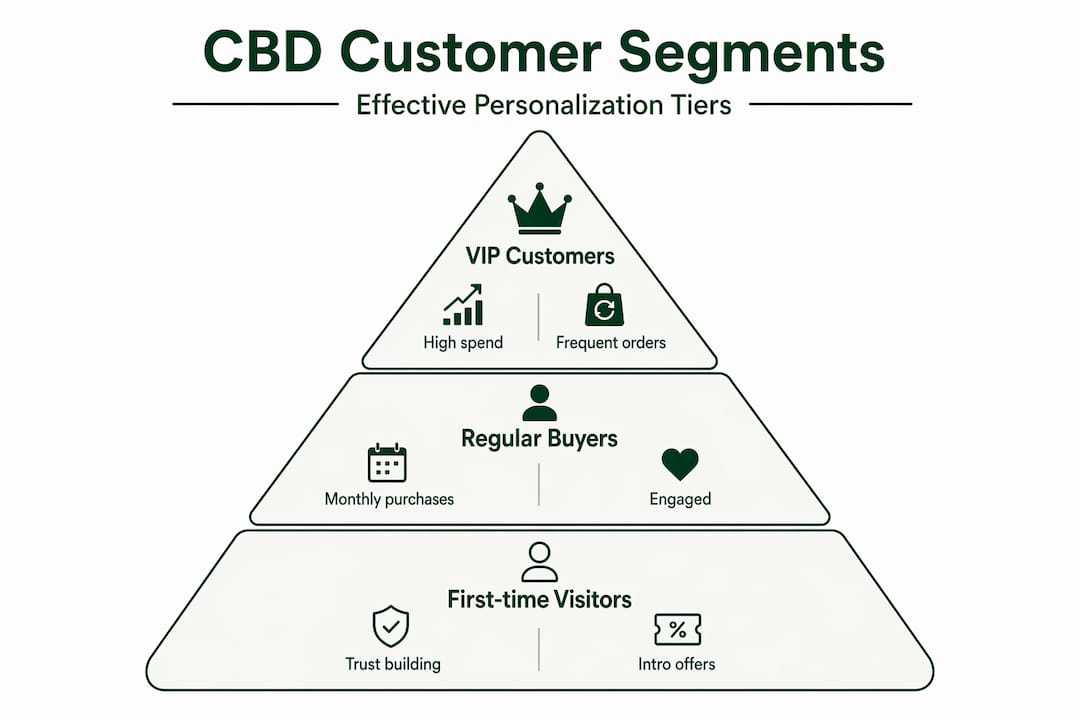
The most practical starting point for any personalized CBD messaging guide is a three-tier customer model. Based on target audience identification research and what we see consistently across CBD and wellness brands, these are the three segments worth building around:
- First-time visitors: People who signed up but haven’t purchased, or completed a single order. They need education, trust-building, and a reason to come back. Think product education emails, ingredient explainers, and a first-purchase incentive.
- Regular buyers (1 to 4 purchases per month): These customers already believe in your product. They respond to loyalty offers, restocking reminders, and product expansion suggestions that feel curated to what they already buy.
- VIP customers: Roughly 20% of your list who drive around 80% of revenue. They deserve exclusive recognition, early access, and messaging that treats them like insiders, not just another email address.
The table below shows how messaging strategy shifts across each group:
| Segment | Primary goal | Message type | Frequency |
|---|---|---|---|
| First-time visitors | Build trust and first purchase | Education, welcome, incentive | 3 to 5 per week (early) |
| Regular buyers | Retain and expand basket | Loyalty, restocking, cross-sell | 2 to 3 per week |
| VIP customers | Deepen loyalty and protect revenue | Exclusive access, recognition | 1 to 2 per week (high value) |
Setting up lifecycle-based segments from day one prevents the most common mistake: treating your highest-value customers like strangers. When a VIP receives the same “here’s 10% off your first order” email as someone who just found your site, it signals that you don’t actually know them. That erodes loyalty fast.
Pro Tip: Use purchase frequency combined with total spend to define your VIP tier, not just spend alone. A customer who buys mid-range products every two weeks is often more valuable long-term than someone who made one large purchase and disappeared.
For CBD specifically, cbd email segmentation should also account for product category. A customer who buys CBD tinctures for sleep has different content needs than someone buying topicals for recovery. Layering product affinity onto your lifecycle segments gives you messaging that feels genuinely tailored rather than just addressed by first name.
Comply with CBD marketing regulations in email and SMS
Personalization in CBD marketing is not just a creative challenge — it carries serious regulatory weight. The rules governing email and SMS for hemp and CBD brands are stricter than most other consumer categories, and the consequences of getting it wrong include fines, deliverability damage, and permanent carrier blocks.
For email, every message must include a valid physical address, a clear sender identity, and a working unsubscribe mechanism that processes within 10 business days. Beyond CAN-SPAM basics, CBD-specific rules require that you avoid unverified health claims, which means no language suggesting your products treat, cure, or prevent any medical condition. “Supports restful sleep” is compliant. “Treats insomnia” is not.
For SMS, the bar is even higher. U.S. SMS marketing requires prior express written consent, which means a customer must actively opt in specifically to SMS communications. Pre-checked boxes and implied consent do not count. You also need to:
- Log the exact timestamp, IP address, and opt-in source for every SMS subscriber
- Honor STOP keywords immediately, removing the subscriber from all future SMS sends
- Include HELP instructions in your welcome message and make them accessible on request
- Send only between 8 AM and 9 PM in the recipient’s local time zone
- Keep consent records for at least four years in case of a TCPA complaint
Review our sms marketing compliance guidance for a deeper breakdown of TCPA requirements, and check our resource on cbd advertising laws for channel-specific restrictions that apply to your brand.
Pro Tip: Build a compliance audit log inside your email and SMS platform. Screenshot or export your opt-in confirmation flows quarterly. If a subscriber ever disputes consent, your documentation is your first and best defense.
Build personalized email and SMS flows for retention and re-engagement
Custom CBD communication only becomes effective at scale when it runs on automation. Manual sends can handle new subscribers, but re-engagement and winback flows require behavior-triggered logic that responds to what customers actually do, not what you predict they’ll do.
A cross-channel winback flow should cover six to eight touchpoints over approximately 30 days, mixing email and SMS to maximize visibility without overwhelming your audience. A typical structure looks like this:
- Day 1: Email with a soft re-engagement message referencing their last purchase category
- Day 3: SMS notification with a personalized URL and brief CTA (more on this in the next section)
- Day 7: Email with educational content relevant to their product history
- Day 10: SMS with a time-limited offer
- Day 14: Email with social proof, customer stories, or new product updates
- Day 20: Final SMS notification
- Day 25: Last-chance email with a direct offer
- Day 30: Suppression from active campaigns if no engagement
The key to making this flow work is behavior-triggered automation based on real-time purchase, signup, and cart data. If a customer clicks your Day 3 SMS link but doesn’t open the Day 7 email, your flow should recognize that and adjust accordingly, skipping the educational email and moving directly to an offer.
Here is how email and SMS compare as channels within these flows:
| Channel | Strength | Best use case | Typical open rate |
|---|---|---|---|
| Rich content, narrative, education | Product storytelling, detailed offers | 20 to 45% | |
| SMS | Immediate visibility, urgency | Flash offers, reminders, quick CTAs | 85 to 98% |

Both channels work better together than apart. Omnichannel marketing approaches consistently outperform single-channel campaigns because customers interact with brands across multiple surfaces. For CBD brands, email handles the “why this product is right for you” content. SMS handles the “this offer expires tonight” push.
Pro Tip: Do not send SMS and email within the same hour. Space them by at least 12 hours. Customers who receive both channels simultaneously report feeling spammed, which increases unsubscribes on both channels.
Review our detailed email personalization strategies guide for flow architecture examples, and see our sms marketing strategy resource for SMS-specific timing and content frameworks.
Overcome SMS content restrictions with personalized URLs for CBD brands
Here is something most CBD brands discover too late: carriers actively filter SMS messages from restricted categories, including hemp and CBD products. This means you cannot send richly personalized product recommendations directly inside an SMS body without risking delivery failure or account suspension.
The solution that actually works is the personalized URL approach. Restricted CBD brands can send notification-style SMS messages that include your logo, a short neutral message, and a unique URL generated specifically for each recipient. The customer clicks the link and lands on a fully personalized page showing their name, their purchase history, relevant product suggestions, and any offers tailored to their segment.
This approach does several important things:
- It keeps the SMS body clean and carrier-compliant, reducing the risk of filtering or blocking
- It moves all the rich personalization into a landing page environment where you have full creative control
- It allows you to track engagement precisely, because every URL click is tied to a specific subscriber record
- It lets you A/B test landing page content independently from the SMS message itself
Use a branded short domain that your customers will recognize. An unfamiliar URL shortener kills click-through rates because customers assume it is spam or phishing. Your domain, shortened or not, builds the trust that gets the click.
Pro Tip: Segment your personalized landing pages by customer tier. VIP customers should land on a page with exclusive offers and priority service language. First-time visitors should land on a trust-building page with social proof and educational content front and center.
Troubleshooting, common mistakes, and measuring success
The two failure modes in tailored CBD messaging are opposite extremes. The first is minimal personalization, often called batch-and-blast, where brands add a first name to every email and call it done. The second is over-segmentation, where brands create hundreds of micro-segments with stale data and no way to maintain them.
Both extremes hurt performance. The practical sweet spot is five to 15 meaningful segments with active data maintenance. Here are the most common mistakes CBD brands make, and how to avoid them:
- Name-only personalization: Adds no behavioral relevance. Customers notice when the content doesn’t match their actual history with your brand.
- Stale segment data: If you built segments six months ago and haven’t refreshed them, customers will have moved between tiers. Run a data audit at least quarterly.
- SMS frequency abuse: Sending more than two to four SMS messages per month to the same subscriber increases opt-outs significantly. Respect quiet hours and frequency caps.
- Ignoring deliverability signals: High unsubscribe rates and spam complaints affect inbox placement for your entire list, not just the segments causing problems.
- No suppression logic: Customers who recently purchased should not receive winback campaigns. Overlapping flows create confusion and damage trust.
To know whether your personalized hemp messaging is actually working, track these four metrics for every major flow:
| Metric | What it tells you | Target benchmark |
|---|---|---|
| Re-engagement rate | Percentage of lapsed customers who returned | 10 to 25% |
| Attributed revenue | Revenue directly tied to flow touchpoints | Varies by brand size |
| Unsubscribe rate | Messaging fatigue or relevance problems | Below 0.5% per send |
| Deliverability health | Inbox placement and sender reputation | Above 90% inbox rate |
Pro Tip: Set up weekly automated reports on unsubscribe rate and deliverability in your ESP. These are the earliest signals that something is wrong, often weeks before revenue metrics show the damage.
Explore our resources on personalization pitfalls and sms personalization pitfalls for troubleshooting guidance specific to CBD and wellness brands.
Why simple segmentation and compliance-first personalization win in CBD marketing
Most CBD brands that struggle with retention have not failed at personalization technology. They have failed at restraint.
There is a real temptation to build complex personalization systems because the tooling makes it feel possible. Klaviyo, Attentive, and similar platforms will let you create 200 segments if you want. But for CBD and wellness brands specifically, complexity creates two compounding risks. First, you lose the ability to maintain data quality across too many segments. Second, and more importantly for this category, complexity increases the surface area for compliance mistakes.
The biggest waste in cannabis marketing is not running the wrong campaign. It is running the same campaign to everyone. The fix is simpler than most brands realize. A three-group lifecycle approach produces measurable lifts in engagement and purchase frequency without requiring a team of data scientists or a six-figure martech stack.
What compliance constraints actually teach you about personalization is valuable. When you cannot make medical claims, you are forced to personalize on use cases, product education, and customer value instead. That is better personalization. A customer who feels recognized for their loyalty and educated about the products they actually use is more likely to stay than a customer who received a technically sophisticated but legally risky “this product cures your anxiety” message.
The brands we see building lasting retention in CBD are the ones who treat opt-in quality as a competitive advantage. When someone genuinely wants to hear from you and you genuinely send them content worth reading, the economics of email and SMS marketing work exactly as they should. The email personalization strategies that perform long-term in this category are not the most technically advanced. They are the most disciplined.
How we help CBD brands master personalized messaging
Building a personalized messaging program for a CBD or wellness brand takes more than good intentions. It takes segmentation logic that reflects how your customers actually behave, compliance infrastructure that holds up under scrutiny, and automated flows that improve over time rather than degrading. That is exactly what we build at The Email Marketers. Our work with CBD and wellness brands covers lifecycle segmentation setup, compliant SMS and email flow design, and ongoing performance tracking tied to your actual revenue goals. You can see how this plays out in our success stories. If you are ready to move past generic blasts and build a program that retains customers and grows lifetime value, our retention strategies are where to start.
Frequently asked questions
What are the main customer segments for personalized CBD messaging?
The main segments are First-time Visitors, Regular Buyers who purchase one to four times per month, and VIP Customers who generate the majority of brand revenue. Each group requires distinct messaging strategies based on their relationship with your brand.
How can CBD brands personalize SMS messages within carrier restrictions?
Restricted CBD brands can use notification-style SMS messages with a unique personalized URL for each recipient, directing customers to a tailored landing page that contains all the rich personalization content that would otherwise be blocked in the SMS body.
What are the key compliance requirements for CBD SMS marketing?
U.S. SMS marketing rules require prior express written consent, immediate honoring of STOP opt-outs, HELP instructions for subscribers, and restricting all sends to between 8 AM and 9 PM in the recipient’s local time zone.
Why is segmenting customers important for CBD email marketing?
Most dispensaries and CBD brands see 15 to 50% lifts in engagement and purchase frequency when they segment customers and tailor emails to lifecycle stage, rather than sending identical messages to their entire list.
How do email and SMS channels work together in personalized campaigns?
SMS delivers immediate visibility with short urgent messages, while email provides richer educational content and product storytelling. Cross-channel flows with branching logic based on how customers engage with each channel reduce waste and increase the relevance of every touchpoint.


