.png)


Lifecycle Marketing Guide 2025: Stage-by-Stage Strategy

TL;DR:
- Most lifecycle marketing efforts are disorganized campaigns that fail to improve retention or lower costs. A structured, stage-specific framework utilizing dynamic segmentation, automation, and measurable outcomes can significantly enhance results. Focusing on retention and expansion stages, ensuring cross-channel consistency, and choosing the right automation tools are essential for sustainable growth.
Most marketing teams treat lifecycle marketing like a loose collection of campaigns. They send a welcome email, run a re-engagement flow, maybe schedule a birthday discount, and call it a program. Then they wonder why retention numbers flatline while acquisition costs climb. This lifecycle marketing guide 2025 exists to fix exactly that. What you’ll find here is a structured, stage-specific framework built around dynamic segmentation, marketing automation techniques, and measurable outcomes. Whether you’re rebuilding from scratch or tightening a system that almost works, this guide gives you the architecture to do it right.
Table of Contents
- Key takeaways
- Understanding lifecycle marketing stages
- Dynamic segmentation and automation setup
- Choosing the right automation tools
- Executing and measuring lifecycle campaigns
- My honest take on where most programs fail
- Take your lifecycle marketing further
- FAQ
Key takeaways
| Point | Details |
|---|---|
| Five stages, five strategies | Each lifecycle stage from Awareness to Expansion requires distinct goals, content types, and KPIs. |
| Dynamic segmentation wins | Behavior-based and time-based filters keep your audience segments accurate and prevent lifecycle drift. |
| Automation needs guardrails | Automated workflows perform best when paired with human oversight at high-stakes touchpoints. |
| KPIs must include outcomes | Tracking opens and clicks alone is misleading; churn rate, CLV, and NPS reveal actual retention health. |
| Tools should fit your stack | Platform choice must align with your team’s capacity, data infrastructure, and compliance requirements. |
Understanding lifecycle marketing stages
Lifecycle marketing is organized around five core stages: Awareness, Consideration, Purchase, Retention, and Expansion. Each stage has a different objective, and treating them the same way is the most common reason programs underperform.
| Stage | Primary goal | Content type | Key KPI |
|---|---|---|---|
| Awareness | Generate reach and recognition | Educational content, social proof | Impressions, new visitors |
| Consideration | Build intent and trust | Comparisons, case studies, demos | Engagement rate, email sign-ups |
| Purchase | Convert engaged prospects | Offers, urgency messaging, checkout flows | Conversion rate, cost per acquisition |
| Retention | Reduce churn, build habits | Onboarding, loyalty programs, health checks | Churn rate, NPS, repeat purchase rate |
| Expansion | Grow account value | Upsell, cross-sell, referral programs | Net Revenue Retention (NRR), CLV |
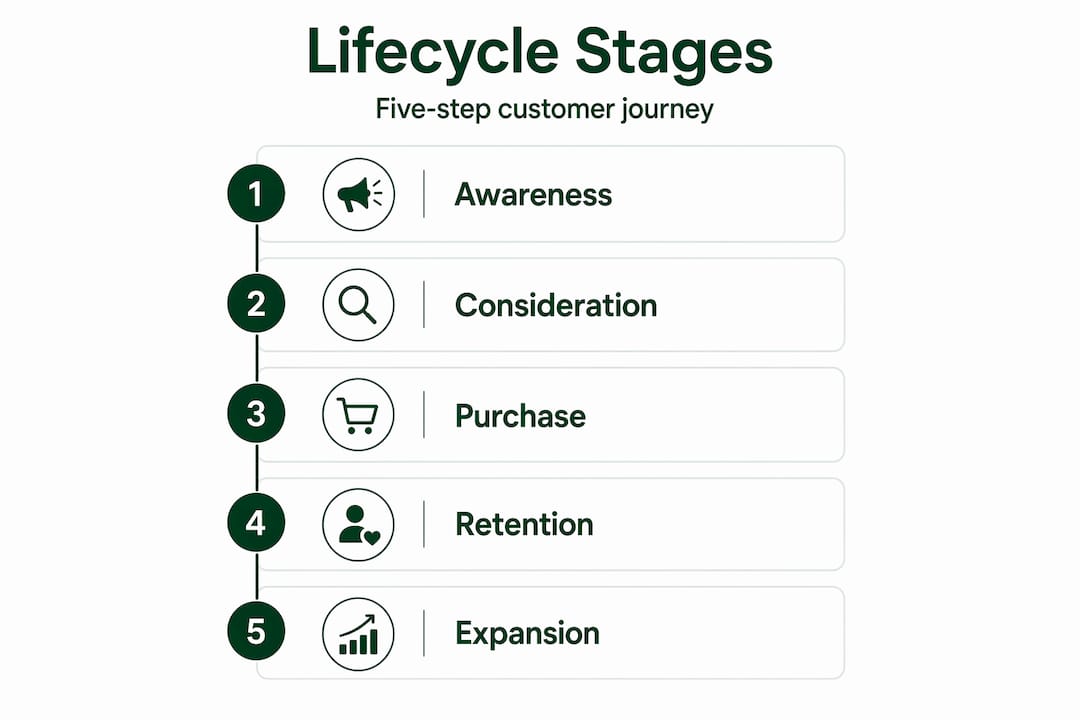
The Retention and Expansion stages get the least attention and generate the most revenue. Retention-focused activities like structured onboarding, renewal campaigns, and health-scoring alerts drive product adoption and sustainable growth. Yet most teams invest the bulk of their resources in Awareness and Purchase, then act surprised when customers churn silently.
Effective customer journey marketing depends on cross-channel consistency. A prospect who reads a product comparison email and then lands on an unrelated homepage ad loses trust immediately. Before executing any campaign, audit whether your messaging, timing, and channel selection actually reflect where the customer is in their journey. Data readiness matters just as much. You need clean, centralized behavioral data feeding each stage, or your automation logic collapses from the start.
Dynamic segmentation and automation setup
Static lists are the enemy of relevance. A segment built on “purchased in the last 90 days” stays accurate for exactly one moment. The moment a customer’s behavior changes, that list becomes misleading. Automated segmentation that blends field-based properties, event-based triggers, and time-based filters keeps your audiences fresh and your messaging precise.
Here’s how to build a segmentation and automation system that holds up over time:
- Map your key customer events. Identify the behavioral signals that indicate a stage transition: first purchase, second purchase within 30 days, 60-day inactivity, product page visits with no cart addition. Each event should correspond to a lifecycle stage.
- Build dynamic membership rules. Set segments to update automatically based on recency and behavior. Mapping customer events to automation logic is the difference between a segment that reflects reality and one that reflects a spreadsheet from three months ago.
- Connect segments to enrollment triggers. Each segment should feed directly into a workflow. A customer who enters the “at-risk” segment based on 45-day inactivity should automatically enter a re-engagement sequence within 24 hours.
- Add guardrails to prevent overlap. Customers should not receive an upsell email and a win-back email in the same week. Set suppression rules and frequency caps across all active flows.
- Define human intervention points. High-value accounts approaching renewal, customers with declining NPS scores, and high-spend buyers who go quiet should trigger a human review flag, not just another automated email.
AI-powered predictive segmentation takes this further. Reinforcement learning tools can continuously optimize which message, channel, and timing combination performs best for each individual customer rather than for a broad segment. This level of personalization was expensive to build two years ago. In 2025, it’s available through most mid-tier automation platforms.
Pro Tip: Before you build any automation workflow, document the expected segment size and the suppression logic alongside the enrollment trigger. Teams that skip this step end up with customers receiving contradictory messages from multiple flows simultaneously.
Personalized content driven by real-time behavioral data compounds over time. The more accurately your segments reflect actual customer behavior, the more relevant your messaging becomes, and the more your email personalization strategy rewards you with repeat engagement.
Choosing the right automation tools
Platform selection is where a lot of otherwise solid lifecycle strategies break down. Marketers choose tools based on price or familiarity rather than fit. A platform that works beautifully for a newsletter-first brand will frustrate a team trying to run behavior-triggered, multi-channel lifecycle campaigns at scale.
Here’s what to evaluate when choosing your marketing automation toolkit:
| Feature category | What to look for | Red flag |
|---|---|---|
| Journey builder | Visual, multi-step flows with conditional branching | Linear-only sequence builders |
| Behavioral triggers | Event-based enrollment from CRM and web activity | Only time-based or manual triggers |
| AI capabilities | Predictive send time, content recommendations | No native AI or add-on only |
| Deliverability | Dedicated IP options, reputation monitoring | No built-in deliverability tools |
| CRM integration | Native CRM sync or direct API | CSV imports as primary data method |
A well-chosen automation platform must support journey-based targeting, predictive analytics, AI-powered personalization, and deliverability safeguards. That last item is non-negotiable for retention marketing. A platform that lets you build sophisticated flows but can’t protect your sender reputation will undermine every campaign you launch.
CRM-native platforms carry a structural advantage: they reduce data-syncing errors, keep segmentation logic consistent, and eliminate the latency that causes customers to receive outdated messaging. If your CRM and email tool are separate systems with a third-party connector in between, your segments are always slightly stale.
Compliance matters more than most teams budget for. GDPR, CAN-SPAM, and TCPA requirements affect not just what you send but how you store consent data and handle unsubscribes. A platform with built-in compliance tools reduces legal risk and keeps your list clean.
Pro Tip: Before signing an annual contract, run a two-week pilot with your actual data, your actual segments, and your actual workflow logic. Demo environments never replicate the edge cases your live customer data will expose.
For a practical walkthrough of building your automation stack, the marketing automation checklist from BabyLoveGrowth covers tool selection and implementation in a format built for real-world teams.
Executing and measuring lifecycle campaigns
The best lifecycle marketing strategy produces nothing without disciplined execution and measurement. Here’s how to structure campaigns at each stage and track what actually matters.
Campaign structure by stage:
- Welcome series (Purchase stage): Three to five emails over the first two weeks. Focus on product education, first-use guidance, and a single clear next action per email. Don’t promote everything at once.
- Onboarding sequences (Retention stage): Milestone-based, not date-based. Trigger the next email when the customer completes an action, not on day seven regardless of behavior.
- Re-engagement campaigns (Retention stage): Triggered by inactivity thresholds. A 45-day silence is very different from a 90-day silence. Segment those audiences separately and test different reactivation angles.
- Upsell and cross-sell flows (Expansion stage): Tied to purchase history and product usage data. Generic upsell emails convert poorly. Personalized recommendations based on actual behavior convert.
Omnichannel journey analytics can expose the exact moments where loyalty is built or broken. Post-purchase silence is one of the most common loyalty-killing gaps. Customers who buy and hear nothing for two weeks rarely buy again. Identifying those gaps through connected analytics across email, SMS, and on-site behavior gives you the specific places to intervene.
When it comes to KPIs, the trap most teams fall into is optimizing for engagement when the real problem is retention. Tracking both behavioral and outcome metrics is what separates programs that improve open rates from programs that actually reduce churn. Your dashboard should include churn rate, Net Promoter Score, renewal rate, CLV, and upsell rate alongside the standard engagement metrics.
Continuous KPI-driven optimization means testing inside active journeys, not just reviewing post-campaign reports. Real-time in-flight adjustments to subject lines, send timing, and content sequencing based on live performance data will outperform any static campaign that runs on a fixed schedule.
The digital marketing trends of 2025 all point in the same direction: customers expect messaging that reflects their current reality, not the state they were in when they first signed up. Adaptive, behavior-triggered campaigns powered by continuous experimentation are the standard, not the exception. Brands still running calendar-based blasts to undifferentiated lists are effectively competing with one hand tied behind their back.
My honest take on where most programs fail
I’ve reviewed lifecycle marketing programs across dozens of e-commerce brands over the past several years, and the most common failure point is never the strategy document. It’s the gap between the strategy and the data quality underneath it.
In my experience, teams invest months building multi-stage workflows and beautiful email templates, then discover that their behavioral event tracking is inconsistent, their CRM has duplicate records, and their segments are pulling from data that’s weeks out of date. The automation runs, but it’s running on fiction.
What I’ve learned is that the best practices in lifecycle marketing always start with a data audit, not a campaign brief. Before you map a single customer journey, verify that your event tracking fires consistently, that your lifecycle stage fields update in real time, and that your suppression lists are actually connected to your sending platform.
The other thing I’d push back on is the obsession with automation completeness. I’ve seen teams spend six months trying to automate every possible lifecycle scenario and end up with a system so complex no one understands it well enough to optimize it. The programs that actually move the needle treat lifecycle as a coordinated system with clear ownership per stage, not a fully automated machine that runs without human attention.
AI is genuinely changing what’s possible here. But AI works best when the foundational data and logic are solid. It amplifies good systems and amplifies broken ones equally.
— Melanie
Take your lifecycle marketing further
If this framework resonates and you’re ready to move from planning to results, Theemailmarketers has built exactly this kind of system for 8-figure DTC brands and VC-backed e-commerce companies. The team specializes in retention marketing, lifecycle campaign execution, and the segmentation infrastructure that makes automation actually perform. You can explore how these strategies translate into measurable revenue lifts through the case studies on the site, or go deeper into the tools and frameworks inside the Retention Lab. For brands serious about turning their customer base into a growth engine, this is where the work starts.
FAQ
What are the five stages of lifecycle marketing?
Lifecycle marketing covers Awareness, Consideration, Purchase, Retention, and Expansion. Each stage requires different content types, channels, and KPIs to move customers forward effectively.
How does dynamic segmentation improve lifecycle campaigns?
Dynamic segmentation updates automatically based on customer behavior, recency, and events. This keeps audience lists accurate and prevents customers from receiving messaging misaligned with their current stage.
What KPIs should I track for customer retention?
Go beyond open rates. The most revealing retention KPIs are churn rate, Net Promoter Score, repeat purchase rate, and Customer Lifetime Value, measured alongside engagement data to avoid optimizing misleading signals.
When should I use automation versus human intervention?
Automate high-volume, repeatable touchpoints like welcome series and re-engagement flows. Reserve human intervention for high-value accounts approaching renewal, customers with declining NPS, and situations where a generic automated response would do more harm than good.
How do I choose the right marketing automation platform?
Prioritize platforms with native CRM integration, behavioral trigger support, AI-driven personalization, and built-in deliverability tools. Run a pilot with your real data before committing to an annual contract.


