.png)


How to Segment Customers for Better Targeting

TL;DR:
- Customer segmentation groups customers by shared traits to enhance marketing effectiveness and resource allocation. Employing behavioral and value-based models offers the fastest revenue impact, especially when supported by unified, high-quality data. Continuous AI-driven updates and strategic activation across channels are essential for maximizing segmentation benefits.
Customer segmentation is the process of grouping customers by shared traits to tailor marketing, personalize messaging, and allocate resources where they generate the highest return. The formal industry term is customer segmentation, and it sits at the foundation of every high-performing retention strategy. Brands using Shopify, Salesforce, and Klaviyo have proven that segmented campaigns consistently outperform one-size-fits-all broadcasts on every metric that matters: open rates, conversion, and lifetime value. This guide walks you through how to segment customers from first principles to AI-powered execution, covering the models, data requirements, and activation steps that separate brands with loyal repeat buyers from those stuck chasing cold traffic.
How to segment customers: choosing the right model
The most common mistake marketers make is picking a single segmentation model and treating it as complete. Segmentation dimensions should align with the desired outcome, which means different goals call for different lenses. A retention campaign needs lifecycle and behavioral data. A product launch needs psychographic and needs-based data. A geographic expansion needs, obviously, geographic data.
Here are the seven segmentation types worth knowing:
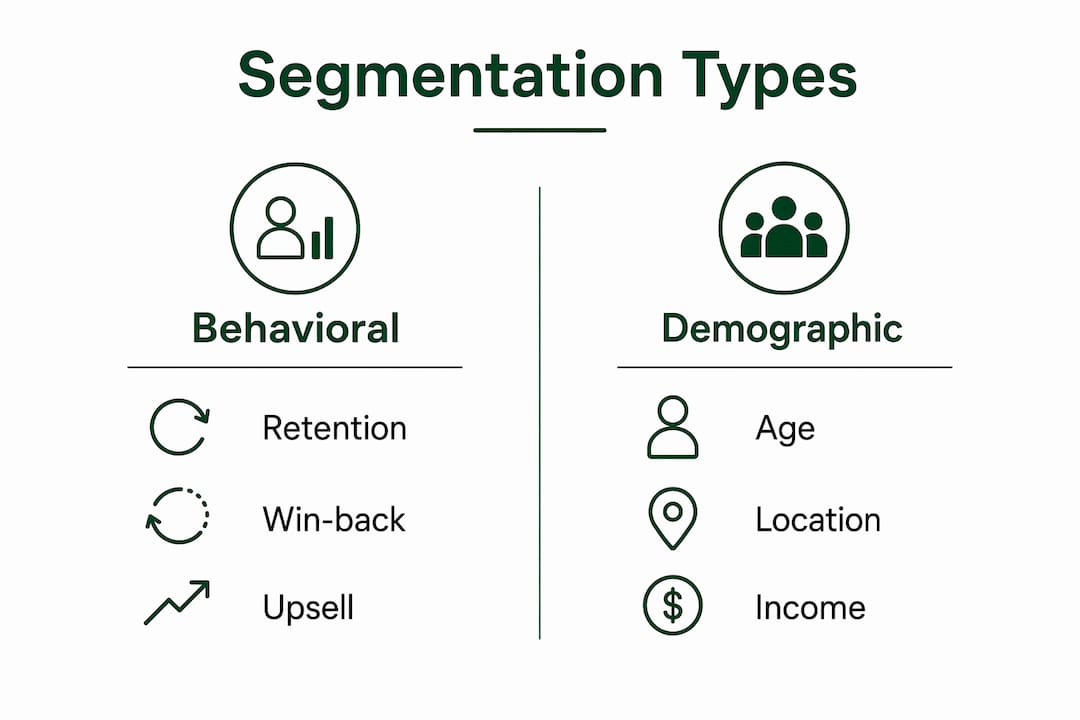
- Demographic segmentation: Age, gender, income, education, occupation. Useful for broad targeting and ad creative decisions.
- Geographic segmentation: Country, region, city, climate zone. Relevant for localized promotions and shipping offers.
- Behavioral segmentation: Purchase frequency, product categories bought, email engagement, site activity. The most directly actionable type because it reflects what customers actually do.
- Psychographic segmentation: Values, lifestyle, interests, personality. Powers brand storytelling and content strategy.
- Value-based segmentation: Customer lifetime value tiers, average order value, margin contribution. Tells you where to invest retention spend.
- Needs-based segmentation: What problem the customer is solving. Drives product development and messaging hierarchy.
- Technographic segmentation: Device type, software used, platform preference. Relevant for SaaS, apps, and omnichannel retailers.
Behavioral segments are more actionable than demographic ones because they reflect intent and habit rather than assumed characteristics. A 35-year-old woman in Chicago and a 60-year-old man in Atlanta can share identical purchase behavior and respond identically to the same offer. Demographics alone would never surface that overlap.
Pro Tip: Start with behavioral and value-based segmentation first. These two lenses give you the fastest path to revenue because they identify who buys often, who buys big, and who is drifting toward churn. Add demographic and psychographic layers once you have the behavioral foundation in place.

| Segmentation type | Best used for |
|---|---|
| Behavioral | Retention campaigns, win-back flows, upsell sequences |
| Value-based | VIP programs, loyalty tiers, high-margin targeting |
| Demographic | Ad creative testing, broad audience targeting |
| Psychographic | Brand content, email storytelling, influencer selection |
| Needs-based | Product launches, onboarding flows, support prioritization |
What data do you need before building segments?
Segmentation is only as accurate as the data feeding it. Unified customer profiles that link all customer activity into a single identity are the prerequisite for any segmentation work that produces reliable results. Without this foundation, you end up with fragmented records: one customer appearing as three different contacts because they used two email addresses and a guest checkout.
Follow these steps to build a data foundation that supports accurate segmentation:
-
Audit every data source. List all touchpoints generating customer data: your ecommerce platform (Shopify, WooCommerce, BigCommerce), CRM (Salesforce, HubSpot), email platform (Klaviyo, Attentive), paid ad accounts, customer support tools (Gorgias, Zendesk), and social channels.
-
Establish a primary identifier. Email address, phone number, or account ID should serve as the master key that links records across systems. Choose one and enforce it consistently across every integration.
-
Consolidate into a single source of truth. A unified database includes transaction history, behavioral data, service interactions, and preferences. Tools like Segment (the customer data platform), Snowflake, or Shopify’s built-in customer profiles can serve this function depending on your stack.
-
Apply identity resolution before segmentation. Segment filters should only be applied after identity resolution to avoid fragmented profiles and corrupted segment membership. Running segmentation on unresolved data produces groups that overlap incorrectly and campaigns that reach the wrong people.
-
Set data governance rules. Define who can modify customer records, how consent is tracked (especially for SMS and email), and how often profiles are refreshed. Stale data is the silent killer of segmentation accuracy.
Pro Tip: If you are on Shopify, use Shopify’s native customer segments as a starting point. They pull from order history, location, and email engagement automatically. Then layer in Klaviyo’s profile properties for behavioral depth. This two-platform approach covers 80% of what most DTC brands need without a custom data warehouse.
How does AI-powered segmentation work?
Traditional segmentation is static. You define rules, customers fall into buckets, and those buckets stay fixed until someone manually updates them. AI segmentation gathers data from all touchpoints and uses machine learning to find patterns that manual rule-setting would never surface. The practical difference is enormous: a machine learning model can identify that customers who buy a specific product combination within their first 30 days have a 3x higher lifetime value, and automatically flag every new customer who hits that pattern.
Here is the workflow for implementing AI-powered segmentation:
-
Integrate all data sources into a unified pipeline. AI models need clean, connected data. Feed your ecommerce, CRM, email, and support data into a single environment before running any models.
-
Choose your clustering approach. Unsupervised clustering algorithms (K-means, DBSCAN) discover natural groupings in your customer base without predefined rules. Supervised models predict specific outcomes like churn probability or upgrade likelihood.
-
Define predictive segment goals. Common AI-driven segments include: customers likely to churn in the next 30 days, customers with high upgrade probability, customers approaching a loyalty tier threshold, and lapsed buyers with reactivation potential.
-
Set segments to update dynamically. Segments update continuously as behaviors change, which means a customer who was in your “at-risk” segment last week can move to “active” this week without any manual intervention. This is the core advantage of AI over static lists.
-
Build activation layers. Activation layers that flow unified customer data to downstream systems like Klaviyo, Meta Ads, and Google Ads are what turn segments into revenue. A segment that exists only in your data warehouse generates zero return.
The role of AI in marketing strategies has shifted from experimental to operational for most growth-stage brands. Platforms like Shopify Audiences, Salesforce Einstein, and AI-driven content marketing tools now make predictive segmentation accessible without a data science team. The barrier is no longer technical capability. It is data quality and strategic clarity about what you want segments to do.
How do you activate segments in marketing campaigns?
Building segments is the analytical work. Activating them is where revenue is made. Segmentation requires persona understanding and baseline analytics before effective customization, which means you need to translate each segment into a clear persona before writing a single email or setting up a single ad audience.
Key activation practices that separate high-performing brands from average ones:
-
Map each segment to a message. A VIP segment (top 10% by lifetime value) gets early access and exclusive offers. A lapsed segment (no purchase in 90 days) gets a win-back sequence with a time-limited incentive. A new subscriber segment gets an onboarding flow that educates before it sells.
-
Sync segments to every channel. Push segment membership to Klaviyo for email and SMS, to Meta Ads for custom audiences, and to Google Ads for customer match. A customer who is in your “high churn risk” segment should receive consistent messaging across every touchpoint, not just email.
-
Handle segment overlap with precedence rules. Customers can belong to multiple segments, and your marketing systems need rules for which segment takes priority. A customer who qualifies as both “VIP” and “lapsed” should receive the VIP win-back message, not the generic re-engagement offer. Define these rules by campaign type: transactional, promotional, and research invitations each warrant different precedence logic.
-
Test segments against your general audience. Measure ROI in segments versus general audience rather than relying on open rates alone. If your “high-value behavioral” segment generates 4x the revenue per email compared to your full list, that is the proof point that justifies deeper segmentation investment.
-
Audit segment accuracy quarterly. Without constant updates, customer segments quickly become stale and campaigns drift toward irrelevance. Schedule a quarterly review of segment membership, criteria, and performance metrics.
For a deeper look at how segmentation maps to email campaign architecture, the advanced email segmentation guide from Theemailmarketers covers ecommerce-specific frameworks in detail.
Pro Tip: Never launch a new segment into a full campaign immediately. Run an A/B test with 20% of the segment first. Validate that the segment definition actually predicts the behavior you expect before scaling spend or automating the full flow.
Key takeaways
Effective customer segmentation combines the right data foundation, the right segmentation models, and dynamic activation to produce measurable revenue gains over static, one-size-fits-all campaigns.
| Point | Details |
|---|---|
| Start with behavioral data | Behavioral and value-based segments deliver the fastest revenue impact for retention campaigns. |
| Unify data before segmenting | Identity resolution and a single source of truth are prerequisites for accurate segment membership. |
| Use AI for dynamic updates | Machine learning keeps segments current as customer behavior changes, removing manual maintenance. |
| Handle overlap with rules | Define precedence logic by campaign type to prevent conflicting messages reaching the same customer. |
| Measure segments vs. full list | Compare segment ROI against your general audience to prove and scale segmentation investment. |
Why most segmentation strategies underperform
I have reviewed segmentation setups for dozens of ecommerce brands, and the most common failure is not a lack of data. It is a lack of discipline about what the data is supposed to do. Brands collect everything, segment on everything, and end up with 47 micro-segments that nobody has the bandwidth to activate properly. The result is a sophisticated-looking spreadsheet and a mediocre email program.
The second failure I see consistently is treating segmentation as a one-time project. Segmentation using only survey data or customer statements fails when it is not connected to behavioral fingerprints. Customers tell you what they think they want. Their purchase history tells you what they actually buy. Build on the behavioral record, not the stated preference.
The brands I have seen get this right share one habit: they start with three to five segments maximum, activate them fully across email, SMS, and paid channels, measure the revenue difference, and then expand. They treat segmentation as an ongoing practice tied to business goals, not a setup task tied to a platform migration. If your segments are not being reviewed and updated at least quarterly, they are already working against you.
The email marketing segmentation guide is a good reference point if you want to see how this thinking translates into specific campaign architecture for ecommerce.
— Melanie
How Theemailmarketers builds segmentation that drives retention
Theemailmarketers specializes in building segmentation strategies that go beyond demographic buckets. The agency works with 8-figure DTC brands and VC-backed ecommerce companies to design behavioral and value-based segments that feed directly into automated email and SMS flows. Every engagement starts with a data audit, identity resolution, and segment architecture before a single campaign goes live. You can see the results in the client case studies or explore the Retention Lab service, which is built specifically around segmentation-driven lifecycle marketing. If you want segments that actually move revenue, this is where to start.
FAQ
What is customer segmentation?
Customer segmentation is the practice of dividing a customer base into groups that share common traits, behaviors, or values so that marketing messages can be tailored to each group. The goal is to replace broad, generic campaigns with targeted outreach that reflects what each group actually needs.
What are the most effective segmentation types for ecommerce?
Behavioral and value-based segmentation are the most effective for ecommerce because they reflect purchase history, engagement patterns, and revenue contribution rather than assumed demographic characteristics. These two models give the clearest signal for retention, upsell, and win-back campaigns.
How many customer segments should you start with?
Start with three to five segments and activate them fully before expanding. Over-segmentation creates operational complexity without proportional revenue gain, and most brands lack the content resources to personalize effectively beyond five to seven active segments at once.
How does AI improve customer segmentation?
AI uses machine learning and clustering algorithms to identify patterns in customer data that manual rule-setting misses, and it updates segment membership continuously as behavior changes. This means predictive segments for churn risk, upgrade likelihood, and reactivation potential stay accurate without manual maintenance.
How do you measure whether your segments are working?
Compare revenue per email, conversion rate, and repeat purchase rate for each segment against your general audience baseline. If a segment is not outperforming the full list on at least one key metric, the segment definition or the activation message needs to be revised.


