.png)


How to Improve Retention for E-Commerce Brands

TL;DR:
- Improving activation rates by fixing onboarding leaks is essential before scaling loyalty programs to sustain customer retention.
- Tracking key metrics weekly and conducting open-text surveys help identify churn drivers and optimize the post-purchase experience effectively.
- Most retention stalls are due to onboarding failures, emphasizing that cross-functional efforts and continuous measurement are crucial for growth.
Customer retention is the practice of maximizing the percentage of buyers who return to purchase again, and a 5% retention increase can raise profits by 25% to 95%. That single number reframes the entire marketing budget conversation. Most e-commerce brands pour resources into acquisition while their repeat purchase rate quietly signals a leaking bucket. The industry term for this discipline is retention marketing, and it covers everything from activation milestones and onboarding sequences to loyalty programs and lifecycle campaigns. This guide covers how to improve retention at every stage of the customer journey, with specific tactics that move the metrics that matter.
How to improve retention: fix the activation leak first

Activation is the moment a new customer completes a behavior that predicts long-term loyalty. For most e-commerce brands, that means making a second purchase, leaving a review, or engaging with a post-purchase email within the first week. If fewer than 30% of new signups reach that activation milestone within 7 days, every downstream retention effort underperforms. Loyalty programs, win-back campaigns, and personalized upsells all depend on a customer base that actually engaged in the first place.
The activation leak is the gap between customers who signed up and those who hit that threshold. RetentionCheck’s analysis identifies it as the single most common reason retention programs fail to scale. Before investing in a points program or a complex segmentation strategy, audit your activation rate.
Here is how to identify and close the activation leak:
- Map your activation milestone. Define the one behavior that most strongly predicts a second purchase. For apparel brands, it is often a second order within 30 days. For subscription boxes, it is completing the onboarding quiz.
- Measure the 7-day activation rate. Pull the percentage of new customers who hit that milestone within one week. If it is below 30%, stop scaling other retention tactics until this number improves.
- Audit your welcome sequence. Most brands send a single welcome email. High-retention brands send a three-to-five message sequence that educates, reassures, and prompts the next action.
- Remove friction from the first experience. Slow load times, confusing navigation, and unclear product instructions all suppress activation. Use tools like Hotjar or Microsoft Clarity to identify drop-off points.
- Segment by acquisition source. Customers from paid social often need different onboarding than organic search visitors. Tailor your welcome flow accordingly.
Pro Tip: Fix your activation leak before launching a loyalty program. A loyalty program built on a weak activation foundation rewards the wrong customers and inflates your cost per retained buyer.
What does the post-purchase experience do for churn?
A repeat-purchase rate below 20% signals an acquisition-to-product fit problem, not a loyalty program gap. That distinction matters because it tells you where to invest first. The post-purchase experience covers everything from the order confirmation email to the unboxing moment to how your support team handles a return. Each touchpoint either builds trust or erodes it.
Here is a sequenced approach to optimizing the post-purchase journey:
- Send a confirmation email within minutes. Customers who receive an immediate, detailed order confirmation report significantly higher satisfaction. Include the order summary, estimated delivery window, and a direct link to customer support.
- Build a proactive shipping notification sequence. Do not wait for customers to ask “where is my order?” Send updates at dispatch, in transit, and out for delivery. Brands using SMS for shipping updates see higher open rates than email alone.
- Design an onboarding sequence that drives the second purchase. The first email after delivery should not be a discount. It should be product education, usage tips, or a curated recommendation based on what they bought.
- Make returns frictionless. A complicated return process is one of the top drivers of churn. Offer prepaid return labels, clear instructions, and fast refund processing. Customers who have a smooth return experience are more likely to buy again than customers who never returned anything.
- Act visibly on customer feedback. Regular feedback loops build trust when customers see their input reflected in product or service changes. A simple post-delivery survey with one or two questions, followed by a public response or update, signals that the brand listens.
Pro Tip: Proactive customer support that reaches out before issues arise turns a cost center into a retention engine. Set up automated triggers for delayed shipments and send a heads-up before the customer notices.
Do loyalty programs actually increase customer loyalty?
84% of loyalty program members are more likely to make repeat purchases. That statistic from Salesforce’s research is compelling, but it masks a critical nuance. Generic points programs with no personalization deliver a fraction of that result. The programs that consistently increase customer loyalty are built around behavioral triggers, not calendar dates.
The comparison below shows where most brands go wrong and what high-performing programs do differently:
| Generic loyalty program | Behaviorally triggered program |
|---|---|
| Points awarded on every purchase equally | Points weighted by high-value behaviors like reviews or referrals |
| Monthly email blast to all members | Triggered message sent when customer nears a reward threshold |
| Same rewards for all segments | Tiered perks based on purchase history and category preference |
| Calendar-based upsell campaigns | Usage-triggered upsells that convert 3 to 7 times higher |
| Loyalty program siloed from email and SMS | Omnichannel sync across email, SMS, and on-site experience |
The structural difference is timing and relevance. Omnichannel loyalty programs that sync real-time customer data deliver consistent personalized experiences across every channel. When a customer’s loyalty status updates in your CRM, it should immediately reflect in their next email, their SMS, and their on-site experience.
The most effective loyalty programs also follow a lifecycle structure:
- Onboarding rewards: Incentivize the second purchase within 30 days of the first.
- Progress nudges: Notify members when they are close to a tier upgrade or reward redemption.
- Reactivation flows: Trigger a win-back sequence when a member goes 60 to 90 days without a purchase.
- Exclusive perks: Give top-tier members early access to new products or private sales. This creates status, not just savings.
Customer loyalty built through consistent experience quality and aligned communication outperforms big-budget campaigns. The brands that win on retention are not the ones with the most generous points. They are the ones whose every touchpoint feels intentional.
Which metrics should you track to sustain retention gains?
Retention improvement without measurement is guesswork. The three metrics that matter most for e-commerce brands are repeat purchase rate, customer lifetime value (CLV), and time between orders. Each one tells a different part of the story.
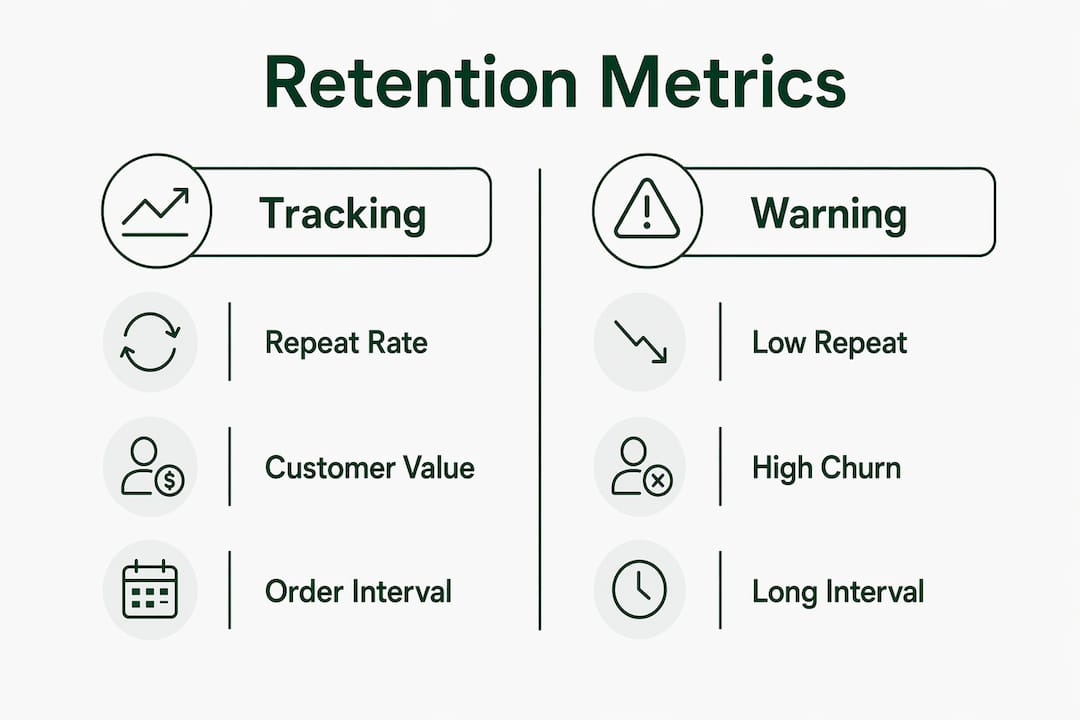
| Metric | What it measures | Warning threshold |
|---|---|---|
| Repeat purchase rate | Percentage of customers who buy more than once | Below 20% signals onboarding or fit issues |
| Customer lifetime value | Total revenue per customer over their relationship | Declining CLV signals loyalty program failure |
| Time between orders | Average days between first and second purchase | Increasing gap signals post-purchase friction |
Assigning internal ownership to monitor these metrics weekly is what separates brands that sustain retention gains from those that plateau. Without a named owner, retention reviews get deprioritized when acquisition campaigns demand attention. The fix is simple: assign one person or team to own the retention dashboard and report on it every Monday.
Beyond weekly reviews, quarterly strategy adjustments let you respond to seasonal patterns and campaign performance. Here is what that rhythm looks like in practice:
- Weekly: Review repeat purchase rate, CLV trend, and email/SMS engagement by segment.
- Monthly: Analyze cohort performance. Which acquisition month produced the highest 90-day retention rate?
- Quarterly: Audit your loyalty program structure, onboarding sequence, and win-back campaign performance. Adjust thresholds and messaging based on what the data shows.
For diagnosing churn, a single open-text cancellation survey question reveals churn drivers two to three times more accurately than multiple-choice surveys. Ask one question: “What was the main reason you stopped purchasing?” The answers will surface patterns that no analytics dashboard can show. Use those patterns to build proactive campaigns, including win-back sequences for lapsed customers and silent-account sweeps for buyers who have not opened an email in 90 days. You can explore proven retention email tactics to build these sequences effectively.
Key takeaways
Sustainable retention improvement requires fixing activation first, then optimizing the post-purchase experience, then scaling personalized loyalty programs, all measured weekly by a named internal owner.
| Point | Details |
|---|---|
| Fix activation before loyalty | If fewer than 30% of new customers activate within 7 days, loyalty programs will underperform. |
| Post-purchase experience drives repeat rate | Proactive shipping updates, frictionless returns, and feedback loops reduce churn measurably. |
| Behavioral triggers outperform calendars | Usage-triggered upsells convert 3 to 7 times higher than generic, date-based campaigns. |
| Assign metric ownership | Weekly retention reviews by a named owner move retention from intention to business outcome. |
| One survey question beats many | A single open-text cancellation question identifies churn drivers more accurately than complex surveys. |
Why most retention programs stall before they scale
I have worked with dozens of e-commerce brands that launched loyalty programs before they fixed their onboarding. Every single one of them hit the same wall: strong launch numbers followed by a plateau at month three. The loyalty program was rewarding customers who would have returned anyway, while the real problem, a leaking activation funnel, kept draining new buyers before they ever became loyal ones.
The uncomfortable truth is that most retention stalls are not loyalty program failures. They are onboarding failures wearing a loyalty program’s clothes. When I audit a brand’s retention metrics, the first thing I look at is the 7-day activation rate and the repeat purchase rate in the first 30 days. Those two numbers tell me more than any loyalty dashboard.
The other mistake I see constantly is treating retention as a marketing function rather than a cross-functional business outcome. Retention touches product, support, logistics, and marketing. When only the email team owns it, the insights from cancellation surveys never reach the product team, and the shipping friction that support hears about daily never gets fixed. Retention marketing trends for 2026 point clearly toward integrated, data-sharing teams as the differentiator between brands that grow and brands that churn.
My advice: start with the activation audit, assign a retention owner this week, and run one open-text cancellation survey before you touch your loyalty program structure. The data will tell you exactly where to focus.
— Melanie
How Theemailmarketers helps e-commerce brands retain more customers
Theemailmarketers is a retention marketing agency built specifically for e-commerce brands that need more than a pretty email template. The team builds automated lifecycle flows, activation sequences, and loyalty-integrated campaigns that move repeat purchase rate and CLV in measurable ways. For brands ready to stop guessing and start measuring, the retention marketing results from Theemailmarketers’ client work show what a structured retention program actually delivers. Whether you need to fix an activation leak, rebuild your post-purchase sequence, or launch a behaviorally triggered loyalty program, the Retention Lab gives your brand the framework and execution support to make it happen.
FAQ
What is the fastest way to improve customer retention?
Fix your activation leak first. If fewer than 30% of new customers complete a meaningful engagement milestone within 7 days, no downstream retention tactic will perform at its potential.
How does a loyalty program increase customer loyalty?
Loyalty programs work when they use behavioral triggers rather than generic rewards. 84% of loyalty members are more likely to repeat purchase, but only programs tied to real-time customer behavior and omnichannel data consistently deliver that result.
What metrics should e-commerce brands track for retention?
Track repeat purchase rate, customer lifetime value, and time between orders on a weekly basis. A repeat purchase rate below 20% signals an onboarding or product fit problem that loyalty programs cannot fix on their own.
How do you identify why customers are churning?
Use a single open-text cancellation survey question. One open-text question surfaces churn drivers two to three times more accurately than multiple-choice formats, giving you the specific language customers use to describe their dissatisfaction.
How often should retention metrics be reviewed?
Review core retention metrics weekly, analyze cohort performance monthly, and adjust your loyalty program and onboarding strategy quarterly. Assigning one internal owner to the retention dashboard is what keeps this cadence consistent.


