.png)


How Data Enhances Email Marketing for E-Commerce Brands

TL;DR:
- Data-driven email marketing leverages behavioral, transactional, and zero-party data to create personalized, timely campaigns that significantly boost revenue and customer lifetime value.
- Prioritizing high-impact data types, maintaining data hygiene, and using CRM-based personalization strategies leads to more effective segmentation, automation, and content relevance.
Data-driven email marketing is the practice of using behavioral, transactional, and demographic data to send the right message to the right person at the right time. How data enhances email marketing is no longer a theoretical question. Platforms like Klaviyo, HubSpot, and Salesforce Marketing Cloud have made it possible for e-commerce managers to build campaigns that respond to what customers actually do, not just who they are on paper. Segmented campaigns generate 760% more revenue than broadcast emails. That number alone reframes the entire conversation about what email marketing is supposed to accomplish.
What types of data are essential for email marketing personalization and targeting
Effective personalization in email marketing starts with knowing which data categories actually move the needle. Not all data is created equal, and collecting the wrong signals wastes both budget and engineering time.
Behavioral data is the most predictive category. Email opens, link clicks, website browsing patterns, and cart abandonment signals tell you what a subscriber wants right now, not six months ago. Implicit behavioral data predicts purchase intent more accurately than the demographic fields someone fills in at signup. Progressive profiling, where you collect additional data points across multiple touchpoints over time, is the most practical way to build rich behavioral profiles without overwhelming new subscribers.
Transactional data covers purchase history, average order value, product categories bought, and repurchase frequency. This is the backbone of lifecycle campaigns. A customer who bought a $300 skincare set three months ago and hasn’t returned is a completely different segment than someone who orders every six weeks.
Demographic, geographic, and psychographic data round out the picture. Geographic data alone can drive meaningful personalization: sending winter coat promotions to customers in Miami is a waste of send credits and trust.
Zero-party data is the category most brands underuse. This is information customers voluntarily share through preference centers, quizzes, and surveys. Zero-party data yields higher quality insights than behavioral tracking alone because it reflects stated intent rather than inferred behavior. A customer who tells you they prefer fragrance-free products will never be annoyed by a scented candle campaign.
The data categories worth prioritizing:
- Behavioral signals (clicks, browsing, cart activity, email engagement history)
- Transactional records (purchase frequency, AOV, product affinity, return history)
- Zero-party preferences (quiz responses, preference center selections, survey answers)
- Geographic and device data (location, time zone, mobile vs. desktop behavior)
- Suppression and compliance data (unsubscribes, bounce history, consent records)
Pro Tip: Run a data audit before building any new segment. If your CRM or ESP like Klaviyo or HubSpot is holding fields that haven’t been updated in 12 months, those fields are actively degrading your segmentation accuracy.
How to use CRM and first-party data to build behavior-driven email campaigns
CRM data transforms email from a broadcast channel into a one-to-one conversation at scale. The key is mapping your data to specific personalization layers, then building campaign types that match each layer.
Here is a practical framework for layering personalization using CRM and first-party data:
- Basic personalization: First name, location, and account status. This is table stakes, not a strategy.
- Behavioral personalization: Trigger emails based on actions taken, such as browsing a product category without purchasing, or opening three emails in a row without clicking.
- Transactional personalization: Product recommendations based on purchase history, replenishment reminders timed to average reorder cycles, and VIP tier upgrades triggered by cumulative spend.
- Predictive personalization: Using machine learning models inside platforms like Klaviyo or Salesforce to predict next purchase date, churn probability, or product affinity before the customer signals it explicitly.
Behavioral triggers drive 29% of personalization ROI, while attribute-based segmentation drives 31%. Together, they account for the majority of revenue generated by data-driven campaigns. That means the campaigns you build around what people do and who they are will consistently outperform generic promotional blasts.
The campaign types that deliver the highest returns from CRM data include win-back sequences for lapsed buyers, replenishment flows for consumable products, post-purchase upsell series, and VIP loyalty programs triggered by spend thresholds. Dynamic content blocks inside these campaigns, where the product image, copy, and offer change based on the recipient’s segment, are what separate a good campaign from a great one.
| Campaign type | Data trigger | Primary goal |
|---|---|---|
| Win-back | No purchase in 60-90 days | Reactivate lapsed customers |
| Replenishment | Average reorder cycle | Capture repeat purchases |
| VIP upgrade | Cumulative spend threshold | Increase loyalty and AOV |
| Post-purchase upsell | Specific product purchased | Expand basket size |
| Browse abandonment | Product page visit, no add-to-cart | Convert high-intent visitors |
E-commerce merchants using first-party email data strategies achieve 67% higher customer lifetime value than those relying on third-party data or generic campaigns. That gap will only widen as third-party cookies continue to disappear.
Pro Tip: Use a Customer Data Platform like Segment or Bloomreach to unify your Shopify order data, website behavior, and ESP subscriber records into a single subscriber profile. Fragmented data sources produce fragmented personalization.
Key email marketing data strategies to optimize timing, frequency, and content relevance
Knowing what to send is only half the equation. When you send it, and how often, determines whether your campaigns build revenue or burn your list.
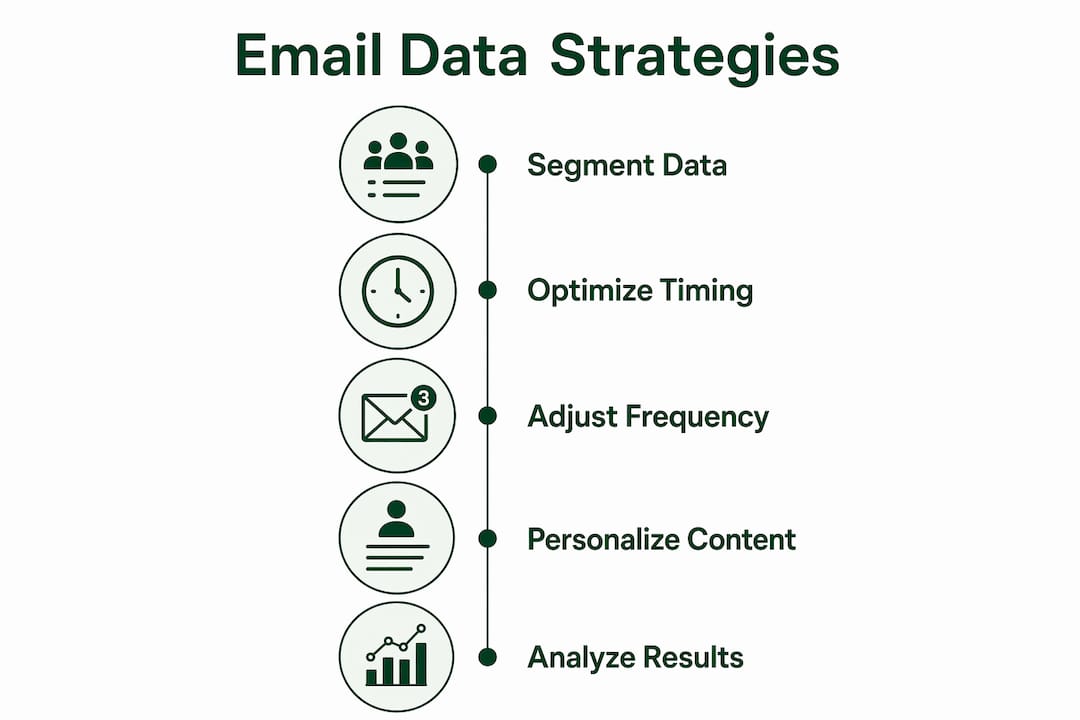
Send-time optimization uses each subscriber’s historical engagement data to deliver emails when that individual is most likely to open. This is not a global “best time to send” setting. Platforms like Klaviyo and Customer.io calculate optimal send windows at the subscriber level. AI-powered send-time optimization improves engagement measurably, but it requires quality behavioral data inputs to function accurately. A list with six months of clean engagement history will produce far better send-time predictions than a freshly imported list.
Frequency is where most e-commerce brands make their biggest data mistakes:
- Send frequency should be calibrated by segment engagement level, not by a universal calendar
- High-engagement subscribers can receive more frequent sends without list fatigue
- Disengaged subscribers need a suppression or re-engagement strategy before they become unsubscribes
- High-frequency triggers risk list fatigue when send-time optimization is neglected
- Monitoring unsubscribe rates by segment, not just overall, reveals which audiences are being over-mailed
Content relevance goes beyond inserting a first name. True hyper-personalization adapts content at the moment of email open, pulling in real-time inventory, pricing, or weather data to make each message contextually accurate. A flash sale email that shows sold-out products because the content was static at send time destroys trust faster than any unsubscribe ever would.
Multivariate testing combined with big data analytics lets marketers refine subject lines, hero images, CTA copy, and send times simultaneously across diverse audience segments. This is a significant upgrade from standard A/B testing, which only isolates one variable at a time.

Pro Tip: Test your email personalization strategies at the segment level, not the list level. A subject line that wins for your VIP buyers may perform poorly with first-time purchasers.
Common challenges and pitfalls in data-driven email marketing
Data-driven campaigns fail for predictable reasons. Recognizing these pitfalls before they cost you deliverability or revenue is the difference between a mature program and one that looks sophisticated on paper but underperforms in practice.
- Stale data: Most marketers treat data collection as a one-time setup rather than an ongoing process. Email addresses decay at roughly 20-25% per year. Without regular list cleaning and validation, your segmentation is built on a foundation that is actively rotting. Email validation APIs integrated at the signup point prevent invalid and disposable addresses from entering your CRM in the first place.
- Over-segmentation: Creating 40 micro-segments sounds sophisticated but produces segments too small to test, optimize, or scale. Prioritize 2-3 high-impact segments tied directly to revenue goals. You can always add complexity once the core segments are performing.
- Privacy compliance gaps: GDPR, CAN-SPAM, and CCPA require explicit consent records, clear unsubscribe mechanisms, and documented data retention policies. First-party data strategies are inherently more resilient to regulatory changes than approaches built on third-party data.
- Siloed data sources: Your Shopify store, your ESP, your loyalty platform, and your customer service tool all hold pieces of the subscriber profile. Without integration, you send replenishment emails to customers who just returned the product. Customer Data Platforms solve this by creating a unified subscriber record across all sources.
- Measuring the wrong metrics: Open rates, inflated by Apple Mail Privacy Protection since iOS 15, are no longer a reliable signal of engagement. Click-to-open rate and revenue per email are the metrics that reflect actual campaign performance.
How to measure and optimize the impact of data on email marketing success
Analyzing email marketing metrics correctly requires moving past vanity numbers and focusing on revenue-generating signals. Revenue per email, repeat purchase rate, and customer lifetime value are the KPIs that connect email performance directly to business outcomes.
| Metric | What it measures | Why it matters |
|---|---|---|
| Revenue per email | Average revenue generated per send | Directly ties campaign performance to business impact |
| Click-to-open rate | Clicks as a percentage of opens | Measures content relevance for engaged subscribers |
| Repeat purchase rate | Customers who buy more than once | Indicates lifecycle program effectiveness |
| Customer lifetime value | Total revenue per customer over time | Reflects long-term retention program success |
| Segment unsubscribe rate | Unsubscribes by audience segment | Identifies over-mailed or misaligned segments |
Segment performance analytics reveal which audience groups drive disproportionate revenue and which are dragging down overall deliverability. A segment generating 40% of your email revenue but representing 15% of your list is telling you something important about where to invest your personalization budget.
Nearly 93% of marketers report that personalized or segmented experiences generate more leads and purchases. The brands that consistently outperform use continuous testing cycles: run a test, read the data, update the workflow, and repeat. Automation workflows should be reviewed quarterly at minimum, because customer behavior shifts and a flow built on last year’s data will drift out of alignment with current purchase patterns.
Key takeaways
Data-driven email marketing works because clean, first-party behavioral and transactional data enables precise personalization that generic campaigns cannot replicate.
| Point | Details |
|---|---|
| Segmentation drives revenue | Segmented campaigns generate 760% more revenue than unsegmented broadcasts. |
| First-party data builds LTV | Merchants using first-party strategies achieve 67% higher customer lifetime value. |
| Data hygiene is non-negotiable | Stale data degrades segmentation accuracy; validate lists continuously, not once at setup. |
| Measure revenue, not opens | Revenue per email and click-to-open rate reflect true campaign performance post-iOS 15. |
| Focus segments on revenue goals | Prioritize 2-3 high-impact segments tied to business outcomes before adding complexity. |
Why data quality beats data quantity every time
I’ve worked with brands that had millions of subscriber records and campaigns that consistently underperformed. I’ve also worked with brands that had 50,000 subscribers and generated more revenue per email than most eight-figure lists. The difference was never the size of the database. It was always the quality of the data inside it.
The instinct to collect everything is understandable. More data feels like more power. But a CRM full of stale fields, unvalidated addresses, and behavioral signals from three years ago is not an asset. It’s noise. The brands I’ve seen build genuinely durable email programs start with a ruthless audit of what data they actually have, what’s accurate, and what’s actionable. Then they build from there.
The other thing I’d push back on is the assumption that AI solves the data problem. AI in platforms like Klaviyo or Customer.io is genuinely impressive at predicting send times, generating subject line variants, and scoring churn risk. But every one of those models is only as good as the data it trains on. Garbage in, garbage out is not a cliché. It’s the most expensive lesson in email marketing.
The brands that will win in 2026 and beyond are the ones treating their subscriber data as a living asset: cleaning it regularly, enriching it through zero-party data collection, and mapping it to the full customer lifecycle rather than just the next campaign send.
— Melanie
How The Email Marketers can build your data-driven email program
The Email Marketers specializes in building retention-focused email programs for e-commerce brands that take data seriously. From advanced segmentation strategies built on behavioral and transactional CRM data to fully automated lifecycle flows, the agency’s work is grounded in measurable outcomes, not aesthetics. If you want to see what a data-driven program actually produces, the client case studies show the revenue impact across real DTC brands. For brands ready to build a retention engine that compounds over time, The Email Marketers is the partner that treats your subscriber data as the strategic asset it is.
FAQ
What is data-driven email marketing?
Data-driven email marketing uses behavioral, transactional, and demographic data to personalize and time email campaigns for individual subscribers. It replaces generic broadcast sends with targeted messages that respond to what customers actually do.
How does data improve email open rates?
Personalized subject lines increase open rates by 26%, and send-time optimization using individual engagement history further improves open performance. Both tactics require clean, current subscriber data to work effectively.
What data types matter most for email segmentation?
Behavioral data (clicks, browsing, cart activity) and transactional data (purchase history, AOV) are the highest-impact inputs for segmentation. Zero-party data from preference centers adds stated intent that behavioral tracking alone cannot capture.
How often should email marketing data be cleaned?
Email lists should be validated continuously, not annually. Email validation APIs at the signup point prevent bad data from entering your CRM, while quarterly audits of existing records catch decay before it damages deliverability.
Which email metrics actually reflect campaign performance?
Revenue per email, click-to-open rate, and repeat purchase rate are the most reliable performance indicators. Open rates have been unreliable since Apple Mail Privacy Protection launched with iOS 15.


