.png)


Email in E-Commerce: Why It's Your Highest-ROI Channel

TL;DR:
- Email marketing offers e-commerce businesses a high return on investment, generating an average of $36 for every dollar spent. Segmentation and automation significantly enhance campaign performance, with automated emails converting at a much higher rate than standard broadcasts, especially when personalized. As an owned channel, email provides greater control, better tracking, and helps deepen customer relationships, making it essential for sustainable growth.
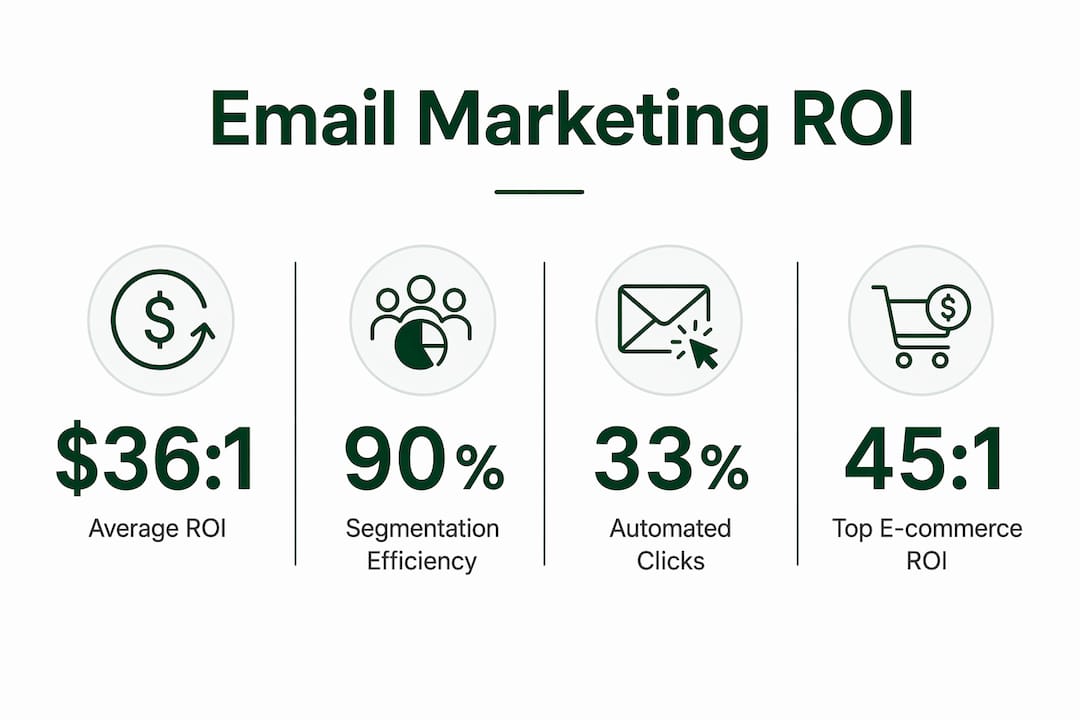
Email marketing is the highest-ROI digital channel available to e-commerce businesses, delivering an average return of $36 for every $1 spent. That number climbs even higher for online retail, where behavioral data and purchase history make personalization precise and profitable. The importance of email in e-commerce goes beyond sending promotions. It gives you a direct, owned line to your customers that no algorithm can cut off. Platforms like Shopify, Mailchimp, and Salesforce have all built their marketing guidance around email for exactly this reason. It converts, it retains, and it compounds over time.
What measurable benefits does email marketing bring to online stores?
Email marketing delivers returns that most digital channels cannot match. 35% of companies surveyed in 2025 reported an email ROI of 36:1 or more. That means more than a third of businesses using email are generating extraordinary returns, not just average ones.
The benefits of email in e-commerce are measurable at every stage of the funnel. Metrics like opens, clicks, bounces, and conversions give you a clear picture of what is working and what is not. That feedback loop is tighter than what you get from paid social or organic search, where attribution is murky and results shift with platform changes.
Here is what makes email stand out against other channels:
- Conversion tracking: Every click and purchase ties directly back to a specific email send
- Cost control: You set the budget without bidding against competitors for visibility
- Audience ownership: Your list belongs to you, not to a platform’s algorithm
- Repeatability: You can test subject lines, offers, and timing and apply learnings immediately
Paid social and search ads can drive acquisition, but their reach is unpredictable. A single algorithm update on Meta or Google can cut your visibility overnight. Email removes that variable entirely. Optimization without algorithm unpredictability is one of the most underrated advantages email holds over every other channel.
Pro Tip: Track your revenue per email sent, not just open rates. This single metric tells you more about the health of your email program than any other number.
How do segmentation and automation multiply email results?
Segmentation is the single biggest performance driver in e-commerce email marketing. More than 90% of email marketers say segmentation significantly improves campaign performance. That is not a marginal lift. It is the difference between a list that generates revenue and one that generates unsubscribes.

Segmentation works because it replaces generic messaging with relevance. A first-time buyer needs a different message than a customer who has purchased five times. A shopper who browsed a product page but did not buy is closer to converting than someone who has not visited in six months. When you treat these groups the same way, you leave money on the table.
Marketing automation connects purchase history and behavioral data to your email campaigns, enabling personalized messaging at scale. The most effective automated flows for e-commerce include:
- Welcome sequences: Set expectations, introduce your brand story, and drive the first purchase
- Abandoned cart emails: Recover revenue from shoppers who showed clear purchase intent
- Post-purchase follow-ups: Confirm the order, request a review, and introduce complementary products
- Win-back campaigns: Re-engage lapsed customers before they disappear permanently
- Browse abandonment: Reach shoppers who viewed products but did not add them to their cart
The data behind automation is striking. One in three clicks on automated emails completes a purchase, compared to one in eighteen for standard broadcast campaigns. That gap exists because automated emails reach customers at the exact moment their purchase intent is highest.
Each lifecycle email also builds behavioral data that feeds better segmentation over time. Salesforce describes this as a compounding effect on revenue. The more your customers interact with your emails, the more precisely you can target them next time. You can explore advanced segmentation strategies to see how this plays out in practice for e-commerce brands.
How does email compare with other digital marketing channels?
Email is an owned channel. Social media, paid search, and display advertising are rented channels. That distinction matters more than most marketers acknowledge.
When you build an audience on Instagram or Facebook, you are building on someone else’s platform. A policy change, an algorithm shift, or a rate increase can reduce your reach without warning. Email provides control over communication timing and audience access that social and search platforms simply cannot offer. Mailchimp frames this as email’s defining structural advantage over every algorithm-dependent channel.
| Channel | Audience Ownership | Cost Predictability | Conversion Tracking | Personalization Depth |
|---|---|---|---|---|
| Owned | High | Precise | High | |
| Paid Social | Rented | Low | Moderate | Moderate |
| Paid Search | Rented | Low | Moderate | Low |
| Organic Social | Rented | High | Limited | Low |
| SEO | Earned | High | Moderate | Low |
The cost comparison is equally clear. Email marketing costs scale with list size and platform fees, not with bid auctions. A paid social campaign that performs well today may cost 40% more next quarter if competition in your category increases. Email costs stay predictable.
Email also retains and monetizes existing customers far better than acquisition channels. Paid ads are built for reaching new audiences. Email is built for deepening relationships with people who already know your brand. For e-commerce businesses focused on customer lifetime value, that distinction determines profitability.
What email strategies actually drive engagement and sales?
The best email strategies for online stores share a common structure: they treat every email as a step in a longer relationship, not a standalone broadcast.
Here are the strategies that consistently produce results:
- Write subject lines that create curiosity or urgency. Avoid generic lines like “Check out our new arrivals.” Specific lines like “Your cart is about to expire” or “We picked something for you” outperform broad ones every time.
- Use product recommendations based on purchase history. Showing customers products related to what they already bought increases average order value without requiring new acquisition spend.
- Send post-purchase emails within 24 hours. Confirmation emails have some of the highest open rates in e-commerce. Use that attention to cross-sell, request a review, or introduce your loyalty program.
- Practice list hygiene consistently. Deliverability and audience quality directly protect your ROI. Sending to unengaged subscribers hurts your sender reputation and reduces inbox placement for everyone on your list.
- Test one variable at a time. Change the subject line, the send time, or the offer, but not all three at once. Clean tests produce learnings you can actually use.
- Set a sustainable send frequency. Sending too often burns out your list. Sending too rarely lets subscribers forget you. Most e-commerce brands find a weekly or biweekly cadence works well, with triggered emails layered on top.
Pro Tip: Your welcome email is the most opened email you will ever send. Treat it like a first impression, not a formality. Include your brand story, a strong offer, and a clear next step.
The basics of ecommerce email marketing also include design principles worth following. Mobile-first layouts, single clear calls to action, and fast-loading images all improve click-through rates. Most email opens happen on mobile, so a desktop-only design approach costs you conversions.
A personalized email strategy goes further by using dynamic content blocks that change based on subscriber data. A customer in New York sees different product recommendations than one in Los Angeles. A VIP buyer sees a different offer than a first-time subscriber. That level of relevance is what separates high-performing programs from average ones.
For brands building out their automation infrastructure, a marketing automation checklist can help you sequence the right flows before you scale.
Key takeaways
Email marketing drives e-commerce growth because it combines owned audience access, precise measurement, and behavioral personalization into a single channel that compounds in value over time.
| Point | Details |
|---|---|
| Highest ROI channel | Email generates $36 per $1 spent on average, with e-commerce returns often reaching 45:1. |
| Segmentation is non-negotiable | Over 90% of email marketers confirm segmentation significantly lifts campaign performance. |
| Automation converts at scale | Automated emails convert one in three clicks to a purchase versus one in eighteen for standard sends. |
| Owned audience beats rented reach | Email gives you full control over timing and access, unlike social or paid search platforms. |
| List hygiene protects revenue | Maintaining deliverability and engagement quality directly sustains repeat-purchase rates. |
Why email will always be the backbone of e-commerce marketing
I have worked with enough e-commerce brands to know where the real money gets left on the table. It is almost never in the acquisition budget. It is in the inbox.
Most brands I see are sitting on a list of past buyers they barely communicate with. They are spending aggressively on paid ads to find new customers while ignoring the people who already trust them enough to have purchased once. That is backwards. The cost to retain a customer is a fraction of the cost to acquire one, and email is the primary tool for doing it.
What I find most interesting about email is its compounding nature. Every send teaches you something. Every click tells you what your customers care about. Every unsubscribe tells you where you pushed too hard or missed the mark. Over time, a well-managed email program becomes a precision instrument. Brands that treat it as a broadcast tool never unlock that potential.
The common mistakes I see are predictable: ignoring segmentation until the list is too large to manage, skipping deliverability monitoring until open rates collapse, and writing emails that sound like ads instead of conversations. The fix for all three is the same. Treat your list like a community, not a database.
The future of email in e-commerce runs through AI-assisted personalization and tighter integration with SMS. But the fundamentals will not change. Relevance, timing, and trust are what drive results. Technology just makes those things easier to execute at scale.
— Melanie
Ready to turn your email list into a revenue engine?
Theemailmarketers specializes in retention marketing for e-commerce brands that want more than pretty emails. The team builds automated flows, segmentation strategies, and lifecycle campaigns that turn one-time buyers into repeat customers. If you want to see what a results-driven email program looks like in practice, the e-commerce case studies show exactly how brands like yours have grown revenue through strategic email. For brands ready to build a full retention system, the Retention Lab offers a structured path to higher customer lifetime value. The results speak for themselves.
FAQ
What is the average ROI of email marketing for e-commerce?
Email marketing generates an average ROI of $36 for every $1 spent, with e-commerce brands often reaching closer to 45:1. More than a third of companies report returns of 36:1 or higher.
How does segmentation improve email marketing performance?
Segmentation matches messages to specific customer groups based on behavior, purchase history, or lifecycle stage. Over 90% of email marketers report that segmentation significantly improves campaign performance.
Why is email better than social media for e-commerce marketing?
Email is an owned channel, meaning you control access to your audience regardless of algorithm changes. Social platforms can reduce your organic reach at any time without notice.
What automated emails should every e-commerce store have?
Every online store needs a welcome sequence, abandoned cart recovery, and post-purchase follow-up at minimum. Automated emails convert one in three clicks to a purchase, making them the highest-leverage flows in any email program.
How often should e-commerce brands send marketing emails?
Most e-commerce brands perform well with a weekly or biweekly send cadence for broadcast campaigns, with behavioral triggered emails layered on top. Frequency should match your content quality and list engagement levels, not an arbitrary schedule.


