.png)


Email Automation for Marketing: Drive More Revenue

TL;DR:
- Effective email automation strategies, built on precise sequencing and segmentation, significantly boost e-commerce revenue.
- Ongoing testing, compliance, and multichannel integration are crucial to transforming automation from a basic task into a revenue-generating system.
Most marketing teams set up their email automation once, watch open rates for a week, and call it done. That’s exactly why they leave money on the table. Email automation for marketing, when built with precision, consistently generates 10–40× return on monthly investment for e-commerce brands. The difference between a program that hums along and one that transforms customer lifetime value isn’t the software you pick. It’s the strategy behind the sequences, the discipline of segmentation, and the rigor of ongoing optimization. This guide covers all of it.
Table of Contents
- Key Takeaways
- Email automation for marketing: the foundations
- Designing high-impact marketing email sequences
- Compliance in email automation
- Optimizing and measuring email automation campaigns
- My take on what separates good from great automation
- Take your automation further with expert support
- FAQ
Key Takeaways
| Point | Details |
|---|---|
| Multi-email sequences outperform single sends | A 3-email abandoned cart sequence recovers 15–22% of carts versus a fraction of that with one email. |
| Timing and segmentation are the real differentiators | Top performers use cart value tiers and buyer type to personalize offers rather than blasting blanket discounts. |
| Compliance must be built in, not bolted on | Automated suppression management protects you legally and preserves subscriber trust at scale. |
| Revenue per recipient beats open rate every time | Track RPR to get a true picture of automation value after accounting for conversion costs and incentives. |
| Treat automation as a living system | Continuous A/B testing and attribution analysis separate static campaigns from compounding revenue engines. |
Email automation for marketing: the foundations
At its core, email automation for marketing means sending pre-built, behavior-triggered messages to contacts based on what they do (or stop doing) in relation to your brand. A subscriber joins your list and receives a welcome series. A shopper abandons their cart and gets a recovery sequence. A customer goes quiet for 90 days and enters a re-engagement flow. None of this requires manual send decisions. The system handles it.
The four flows every e-commerce brand needs are:
- Welcome series: Introduces your brand, sets expectations, and converts first-time subscribers into first-time buyers. Done right, this sequence does more conversion work than any promotional blast.
- Abandoned cart sequence: The single highest-ROI automation in e-commerce. A 3-email abandoned cart sequence recovers 15–22% of abandoned carts, far ahead of what a lone email can achieve.
- Post-purchase flow: Confirms the order, sets delivery expectations, cross-sells adjacent products, and plants the seed for repeat purchase. This is where loyalty is built or lost.
- Re-engagement campaign: Identifies subscribers who haven’t opened or clicked in a defined window and attempts to win them back before suppressing them. Keeping a clean, active list protects your sender reputation.
Most platforms (Klaviyo, Omnisend, Drip) handle all four natively. The platform is rarely the bottleneck. Strategy is.
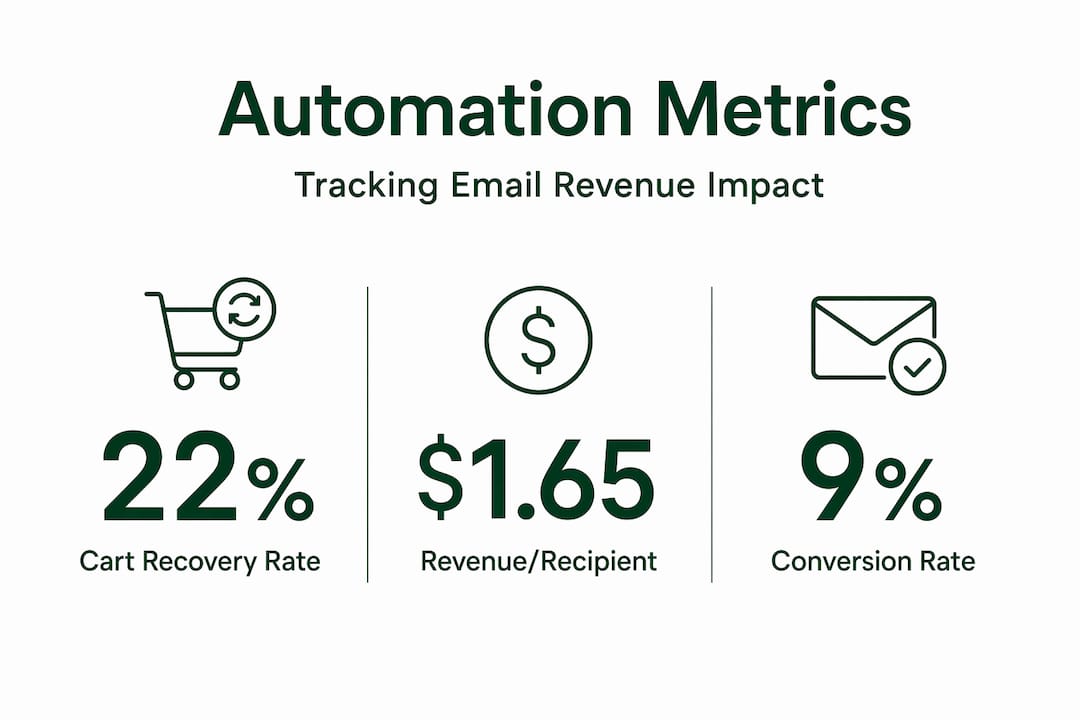
Beyond opens and clicks, the metrics that actually matter are recovery rate, revenue per recipient, and conversion rate by segment. Open rate tells you how your subject line performed. Revenue per recipient tells you whether your automation is making you money.
Pro Tip: Set up your automation reporting to show revenue attributed per flow, not just total email revenue. This makes it instantly clear which sequences are pulling their weight and which need work.
Designing high-impact marketing email sequences
The architecture of your marketing email sequences determines whether you recover 8% of carts or 22%. The gap between those numbers isn’t luck. It’s precision in timing, segmentation, and offer logic.

Getting the timing right
For abandoned cart flows specifically, industry data consistently points to three optimal send windows:
- 1 hour after abandonment: Catches shoppers while intent is highest. No discount needed here. A clean reminder with product imagery and a direct call to action is enough.
- 24 hours after abandonment: Reinforces the consideration. This is where you add social proof, reviews, or a “low stock” signal if it’s true.
- 72 hours after abandonment: This is the offer email. By now, the shopper needs a reason to act. Top 10% e-commerce operators achieve 14–22% cart recovery using precisely this timing combined with smart segmentation.
Segmenting for real results
Not every shopper deserves a 15% discount. First-time visitors with a $30 cart are a different audience than repeat customers who abandoned a $250 order. Your incentive logic should reflect that.
Segment your flows by at minimum two variables: cart value tier (low, mid, high) and buyer type (first-time vs. returning). Personalized incentives tied to cart value dramatically improve conversion without over-discounting. A returning customer with a $200+ cart might respond better to free expedited shipping than a percentage off. A first-time buyer at $50 might need 10% off to commit.
Pro Tip: For high-value cart abandoners, try a “save your cart” message first before introducing any discount. Many will convert without one, protecting your margin entirely.
Adding SMS to the mix
SMS in abandoned cart flows increases recovery rates by 8–15 percentage points among opted-in customers. SMS carries a 98% open rate and works as a complement, not a replacement. A typical multi-channel sequence might run email at 1 hour, SMS at 4 hours, email at 24 hours, and email with offer at 72 hours. The incremental cost is modest compared to the lift in recovered revenue.
For deeper guidance on personalizing sequence content by segment and purchase history, that’s where the real conversion gains live.
Compliance in email automation
Compliance is the part most marketing teams underinvest in until they get burned. GDPR, CAN-SPAM, and CASL each have distinct requirements, but they share the same core principle: respect the subscriber’s choice.
Here is what you need to get right:
- CAN-SPAM requirements: Every commercial email must include a physical mailing address, a clear unsubscribe mechanism, and an honest subject line. Unsubscribe requests must be honored within 10 business days.
- GDPR requirements: Consent must be freely given, specific, and documented. Subscribers can request data deletion at any time and you must process that request promptly.
- CASL: Canada’s anti-spam legislation is among the strictest globally, with non-compliance penalties reaching CAD $10 million for organizations.
- Suppression lists: Every opt-out must feed automatically into a suppression list that blocks future sends across all your flows. This cannot be a manual process.
“Compliance isn’t just about including unsubscribe links. It requires building automated suppression management into your entire tech stack to reliably honor opt-outs and data requests at scale.” — Email Compliance Guide
Manual opt-out processes create dangerous gaps. A subscriber who unsubscribes from your cart flow but still receives your welcome series represents both a legal risk and a brand trust problem. The solution is building suppression logic directly into your platform workflows so that an opt-out in one flow automatically excludes the contact from all active sequences.
For a plain-English breakdown of your obligations under US law, the CAN-SPAM Act is a good place to start. Compliance done right doesn’t just keep you legal. It signals to subscribers that you operate with integrity, which improves long-term engagement.
Optimizing and measuring email automation campaigns
Getting your flows live is the beginning, not the finish line. The brands generating three-email sequence revenue of $1.77 per recipient versus the industry average of $0.47 per recipient didn’t get there by setting and forgetting. They tested, measured, and iterated.
The metrics that drive decisions
| Metric | What it tells you | Why it matters |
|---|---|---|
| Recovery rate | % of abandoned carts converted | Direct measure of sequence effectiveness |
| Revenue per recipient | Revenue divided by emails sent | True ROI picture including incentive cost |
| Click-through rate | % of opens that click through | Indicates offer and design relevance |
| Conversion rate by segment | Purchases per segment cohort | Reveals where personalization is working |
Revenue per recipient is the single most telling number in your automation reporting. It accounts for conversion and the cost of any discounts offered, giving you a clean view of net performance.
Running A/B tests that actually teach you something
Test one variable at a time. Subject line tests, send time tests, and offer structure tests each require their own experiment with a clean control. Testing subject line and discount amount simultaneously means you cannot attribute the outcome to either change.
The highest-leverage tests for most brands are:
- Subject line framing (urgency vs. curiosity vs. straight product)
- First email timing (45 minutes vs. 1 hour vs. 2 hours)
- Offer type in email three (% off vs. free shipping vs. gift with purchase)
- CTA copy (“Complete your order” vs. “Get your [product name]”)
Integrating your email platform with your CRM or sales system closes the attribution loop. When you can see that a specific cart recovery sequence drove a first-time buyer into a high-lifetime-value cohort, you have the data to justify deeper investment in that flow.
Pro Tip: Treat your email automation architecture like a product, not a campaign. Schedule a quarterly audit of every active flow to check performance against benchmarks, update creative, and test new segment logic.
The brands that treat email automation as a connected system rather than isolated campaigns are the ones that compound their results over time.
My take on what separates good from great automation
I’ve worked alongside enough marketing teams to say this with confidence: the obsession with tools is the single biggest distraction in this space. Teams will spend weeks debating platforms and templates while their abandoned cart timing is off by two hours and they have no suppression logic in place.
The difference between average and elite performance comes down to precision in sequence structure, timing, and incentive logic. Not design. Not platform features. The brands that consistently outperform spend their energy on getting those three variables right and then testing relentlessly.
I’ve also seen firsthand how dangerous the “set it and forget it” mindset is. A flow that was built 18 months ago may have been solid then. But your customer mix has changed, your competitive environment has changed, and your offers may no longer reflect market rates. Automation that isn’t audited becomes automation that quietly bleeds revenue.
The compliance piece is where I see the most avoidable damage. Brands build beautiful flows and then lose sender reputation or face legal exposure because they treated GDPR as a checkbox instead of a system requirement. Suppression management built into your stack from day one protects everything you’ve built.
The learning curve is real. But the brands willing to invest in clean data, smart segmentation, and continuous testing are the ones who turn email from a revenue line item into a genuine competitive advantage.
— Melanie
Take your automation further with expert support
Building and optimizing email automation for marketing is one of the highest-return investments a growth-focused brand can make. But the gap between a technically functional flow and a genuinely high-performing one requires real strategic depth. Theemailmarketers works with 8-figure DTC brands and VC-backed companies to build retention systems that compound over time, not just one-off automations. From suppression management and compliance architecture to advanced segmentation and A/B testing infrastructure, the team handles it all. Browse real results from e-commerce brands to see what optimized automation looks like in practice. For those ready to build from a proven foundation, the Email Marketers Retention Toolkit and Retention Lab give you the frameworks and expert support to get there faster.
FAQ
What is email automation for marketing?
Email automation for marketing uses behavior-triggered, pre-built email sequences sent automatically based on what a subscriber or customer does. Common flows include welcome series, abandoned cart recovery, post-purchase, and re-engagement campaigns.
How many emails should an abandoned cart sequence include?
A 3-email sequence is the industry standard and consistently outperforms single-email approaches. Optimal timing is 1 hour, 24 hours, and 72 hours after abandonment, with the third email typically containing an incentive.
What is revenue per recipient and why does it matter?
Revenue per recipient measures total revenue generated divided by the number of emails sent, accounting for both conversions and the cost of any discounts offered. It gives a far more accurate picture of automation ROI than open rate or click rate alone.
How does GDPR affect email automation?
GDPR requires documented consent before sending marketing emails, and subscribers can request data deletion at any time. You must build automated suppression management into your tech stack to process opt-outs reliably and avoid accidental recontact.
Can adding SMS to email automation really improve results?
Yes. Adding SMS to abandoned cart flows increases recovery rates by 8–15 percentage points among opted-in customers, making it one of the highest-return additions to an existing email automation program.


