.png)


Benefits of Email Flows: A Guide for Marketers

TL;DR:
- Email flows are automated sequences triggered by customer actions that significantly boost revenue and engagement. They respond to behavior, providing timely, personalized messages that produce higher conversion rates and save time.
Email flows are automated email sequences triggered by customer behavior that generate revenue, deepen engagement, and reduce manual workload at scale. Unlike one-time broadcast campaigns, flows respond to what a subscriber actually does, whether that is browsing a product page, abandoning a cart, or completing a first purchase. Platforms like Klaviyo and Mailchimp make these sequences accessible to brands of any size. The benefits of email flows are measurable and significant: lifecycle flows account for roughly 5.3% of total email sends but generate about 41% of email revenue. That ratio alone explains why retention-focused brands treat automation as their highest-priority channel.
What are the main benefits of email flows?
Email flows produce outsized returns because they reach the right subscriber at the right moment without requiring a marketer to press send. That timing advantage compounds across every stage of the customer lifecycle.

Revenue efficiency is the clearest benefit. Lifecycle flows generate roughly 8x more revenue per email than standard broadcast campaigns. That gap exists because flows fire when intent is highest, not when a marketing calendar says it is time to send.
Personalization at scale is the second major advantage. Flows use behavioral data, purchase history, and browsing activity to tailor every message. A subscriber who viewed a specific product category receives content relevant to that category. A first-time buyer receives a different post-purchase sequence than a repeat customer. This level of relevance is impossible to replicate manually across a large list.
The core advantages of automated email sequences include:
- Higher conversion rates: Abandoned cart flows yield an average of $3.65 revenue per recipient with conversion rates between 5% and 8% when optimized.
- Stronger engagement: Welcome series emails achieve open rates of 60% to 80%, far above industry averages for broadcast sends.
- Time savings: Once built, flows run continuously without manual intervention, freeing your team for strategy and creative work.
- Customer lifetime value growth: Automated nurture and win-back flows keep customers engaged between purchases, increasing repeat purchase rates over time.
Pro Tip: Build your win-back flow before you think you need it. Most brands wait until churn is visible. The best time to re-engage a customer is 60 days after their last purchase, not 180.
How do email flows compare to manual campaigns?
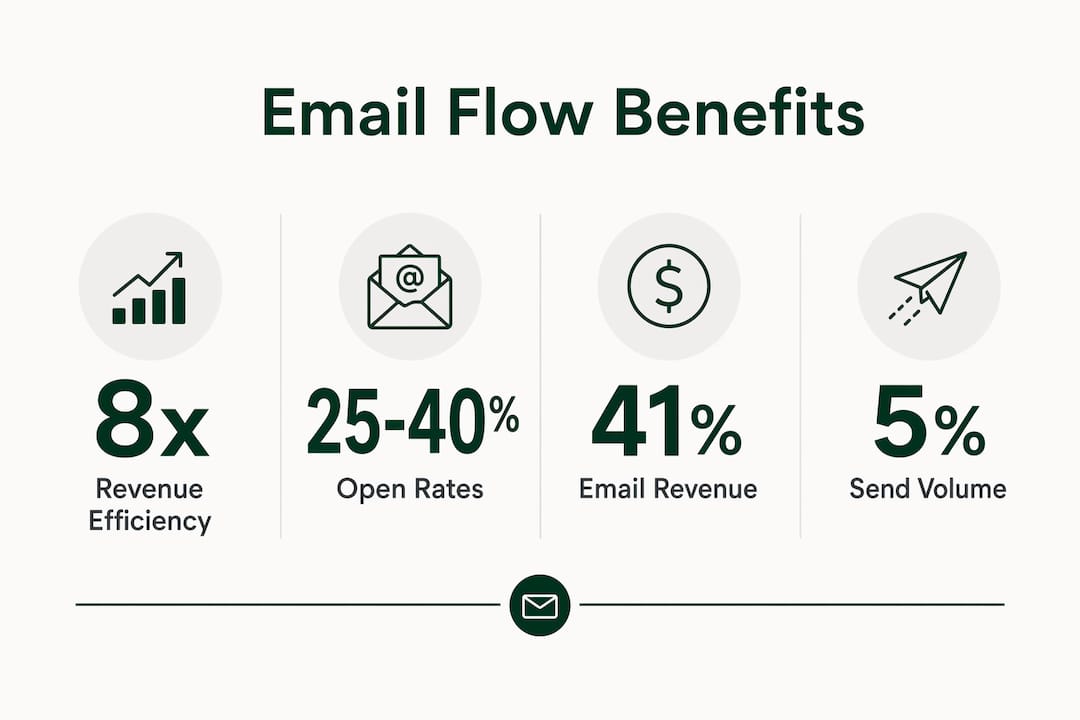
The difference between automated flows and manual batch campaigns is not just operational. It is structural. Flows respond to behavior. Campaigns respond to a schedule. That distinction drives every performance gap between the two.
| Factor | Automated flows | Manual campaigns |
|---|---|---|
| Trigger | Customer behavior or lifecycle event | Marketer-set send date |
| Timing | Immediate or behavior-relative | Fixed, regardless of readiness |
| Revenue per email | ~8x higher than campaigns | Baseline benchmark |
| Open rates | 25%–40% for triggered emails | Typically lower for batch sends |
| Subscriber fatigue risk | Lower with proper exit criteria | Higher with frequent blasts |
| Scalability | Scales automatically with list growth | Requires manual effort per send |
Automated triggered emails achieve open rates of 25%–40%, significantly outperforming scheduled batch campaigns. The reason is simple: a triggered email arrives when the subscriber’s action has already signaled interest.
Manual campaigns still have a role. Promotional events, product launches, and seasonal announcements benefit from a broadcast approach. The mistake most brands make is relying on campaigns for communication that should be handled by flows. A new subscriber does not need to wait for your next newsletter. They need a welcome series that starts within minutes of signing up.
Common flow types and their specific strengths:
- Welcome series: Builds brand trust and sets purchase expectations in the first 14 days.
- Abandoned cart: Recovers high-intent shoppers who left without buying.
- Post-purchase: Reduces buyer’s remorse, drives reviews, and seeds the next purchase.
- Win-back: Re-engages lapsed customers before they churn permanently.
Pro Tip: Treat your welcome series as your highest-leverage flow. A subscriber is most engaged in the first 72 hours. A 3-to-5 email sequence over the first 14 days sets the tone for the entire customer relationship.
What are best practices to maximize email flow results?
Effective email automation benefits come from disciplined setup, not just turning flows on. The brands that extract the most value from automation follow a consistent set of practices.
-
Set clear triggers and exit criteria. Every flow needs a defined start condition and a defined stop condition. Failing to set exit criteria results in emails sent to customers who already converted, which damages trust and increases unsubscribes. If a subscriber buys during an abandoned cart sequence, that sequence must stop immediately.
-
Use engagement filters after the first 2–3 emails. Sending to disengaged contacts hurts deliverability. Engagement checks after 2–3 emails within a sequence, combined with frequency caps, reduce spam complaints and protect your sender reputation.
-
Apply branching logic for relevance. Top brands get half their email revenue from just 6% of sends by using advanced branching logic and AI-optimized timing. Branching means a subscriber who clicks a specific link receives a different next email than one who did not. That conditional logic is what separates a flow from a drip sequence.
-
Stagger send times with random delays. Staggering sends with random delays of 0–6 hours avoids volume spikes that trigger spam filters. Inbox providers recognize natural sending patterns. A flow that fires 10,000 emails at exactly the same second looks like a blast, not a triggered sequence.
-
Sequence content to match the customer’s mindset. The first email in a post-purchase flow should confirm and celebrate the purchase. The second should set expectations for delivery. The third should introduce complementary products. Each email earns the next one by delivering specific value first.
For a full checklist on implementing these practices, the SMB automation checklist from Babylove Growth is a practical starting point.
Pro Tip: Map your flows against your customer lifecycle stages before you build anything. Flows built without a lifecycle map often overlap, causing subscribers to receive conflicting messages from different sequences simultaneously.
What pitfalls reduce the effectiveness of email flows?
The impact of automated emails depends entirely on how well they are configured. Poor setup does not just underperform. It actively damages your list and your sender reputation.
-
No suppression for converted contacts. Sending a discount to a customer who bought at full price 10 minutes ago is a trust-breaking experience. Suppression lists and real-time purchase triggers must be connected to every flow.
-
Overlapping flows. A subscriber enrolled in a welcome series, an abandoned cart flow, and a win-back flow simultaneously can receive five or more emails in a single day. That volume, without relevance, leads to brand damage and disengagement. A global frequency cap prevents this.
-
Ignoring deliverability signals. Rising unsubscribe rates and spam complaints are early warnings that a flow is misfiring. Most brands catch these signals too late because they are not monitoring at the flow level, only at the account level.
-
Calendar triggers instead of behavioral triggers. Sending a “we miss you” email 90 days after signup, regardless of whether the subscriber has been active, is a calendar trigger masquerading as personalization. Behavioral triggers respond to what a subscriber actually did or did not do.
-
Losing brand voice inside automation. Automation without human nuance produces emails that feel robotic. Every flow email should sound like it came from a person who knows the customer, not from a system running a sequence.
How do you measure and improve email flow performance?
Measuring the importance of email flows requires tracking metrics at the flow level, not just the account level. Aggregate open rates hide which flows are working and which are quietly damaging your list.
The core metrics to track by flow type:
- Revenue per recipient: The clearest indicator of flow efficiency. Compare this across flow types to identify where to invest more.
- Conversion rate by email position: Which email in the sequence drives the most conversions? That tells you where the persuasive work is actually happening.
- Open and click rates by email number: A sharp drop after email two signals a content or frequency problem, not a subject line problem.
- Unsubscribe and spam complaint rates: Track these at the flow level. A spike in a specific flow is a diagnostic signal, not just a number to average away.
- List health over time: Sending relevant emails to engaged contacts is the single most reliable driver of long-term deliverability.
A/B testing inside flows requires patience. Test one variable per flow at a time: subject line, send timing, incentive amount, or email copy. Running multiple tests simultaneously makes it impossible to attribute results. For flows with lower traffic volume, run tests for at least four weeks before drawing conclusions.
Segment your performance data by customer lifecycle stage. A welcome series for first-time subscribers should be evaluated differently than a win-back flow for customers who have not purchased in six months. The benchmarks are different. The goals are different. Mixing them produces misleading averages.
For a deeper look at how lifecycle email marketing connects flow performance to long-term revenue, the data on retention-driven sequences is compelling.
Key takeaways
Automated email flows generate disproportionate revenue because they deliver relevant messages at the exact moment a subscriber’s behavior signals intent.
| Point | Details |
|---|---|
| Revenue efficiency | Lifecycle flows generate about 41% of email revenue from only 5.3% of sends. |
| Exit criteria matter | Flows without exit rules email converted customers, damaging trust and increasing unsubscribes. |
| Engagement filters protect deliverability | Applying engagement checks after 2–3 emails reduces spam complaints and preserves sender reputation. |
| Behavioral triggers outperform calendar triggers | Triggered emails achieve 25%–40% open rates versus lower rates for scheduled batch sends. |
| Measure at the flow level | Tracking revenue per recipient and unsubscribe rates by flow reveals which sequences need fixing. |
What I have learned from building flows for 8-figure brands
The most common mistake I see is treating email flows as a set-and-forget system. Brands spend weeks building a welcome series, launch it, and never touch it again. Six months later, the sequence is still running with outdated offers, broken product links, and copy that no longer reflects the brand voice. Automation does not eliminate the need for maintenance. It changes what maintenance looks like.
The second thing I have learned is that more emails rarely means more revenue. The brands I have worked with that generate the highest revenue per subscriber are not the ones sending the most. They are the ones sending the most relevant. A five-email abandoned cart sequence that sends regardless of engagement will underperform a two-email sequence that stops after the first email if the subscriber re-engages.
The third lesson is harder to quantify but more important than any metric: flows must sound human. When a subscriber replies to an automated email and gets no response, or receives a “we miss you” message the day after they made a purchase, the automation becomes visible. Visible automation erodes trust. The goal is for every flow email to feel like it was written specifically for that person at that moment. That requires email marketing frequency discipline, strong copy, and a willingness to send fewer emails than your platform will technically allow.
Build flows that you would want to receive. That standard is harder to meet than any open rate benchmark, and it produces better results than any A/B test.
— Melanie
How Theemailmarketers builds flows that drive real retention
Theemailmarketers works with 8-figure DTC brands and VC-backed e-commerce companies to build automated email flows that increase customer lifetime value and repeat purchase rates. The work goes beyond template setup. The team designs segmentation logic, writes flow copy that maintains brand voice, and monitors deliverability signals at the flow level. Brands looking for proof can review the client results directly. For brands ready to build or rebuild their retention infrastructure, the Retention Lab offers a structured program designed around the specific economics of e-commerce retention.
FAQ
What are email flows in email marketing?
Email flows are automated sequences triggered by subscriber behavior or lifecycle events, such as a signup, cart abandonment, or purchase. They run without manual intervention and deliver relevant messages based on what a contact actually did.
How much revenue do email flows generate compared to campaigns?
Lifecycle email flows generate about 41% of total email revenue while accounting for only 5.3% of sends. That makes them roughly 8x more revenue-efficient per email than standard broadcast campaigns.
What is the most effective email flow for e-commerce?
Abandoned cart flows consistently produce the highest revenue per recipient in e-commerce, averaging $3.65 per recipient with conversion rates between 5% and 8% when properly optimized.
How do you prevent email flows from hurting deliverability?
Set exit criteria tied to purchases or milestones, apply engagement filters after the first 2–3 emails, and use frequency caps to prevent subscribers from receiving too many emails across overlapping flows.
How often should you update your email flows?
Review active flows at least every quarter. Check for outdated offers, broken links, and copy that no longer reflects your current brand voice. High-traffic flows like welcome series and abandoned cart sequences warrant monthly performance reviews.


