.png)


Elevate customer experience in e-commerce with AI email & SMS

TL;DR:
- AI-driven email flows generate up to 41% of revenue from only 5% of sends.
- Personalized, behavior-based messaging improves customer retention and trust significantly.
- Unifying email and SMS with AI enhances engagement and maximizes revenue growth.
Most 8-figure DTC brands are sitting on a revenue engine they’ve barely started. AI-driven flows generate 41% of revenue from just 5% of total sends, with revenue per recipient running 18x higher than standard campaigns. Yet most brands keep pouring budget into volume, chasing opens instead of outcomes. This guide cuts through the noise and shows you exactly how to use AI-powered email and SMS to build customer experiences that drive retention, repeat purchases, and real loyalty. If you’re ready to stop guessing and start compounding, this is where it starts.
Table of Contents
- Why customer experience makes or breaks retention
- How AI transforms email and SMS for e-commerce
- Building omnichannel journeys: Unifying email and SMS
- Winning back and retaining customers: Best-practice flows and exception handling
- The uncomfortable truth about AI-powered customer experience
- How The Email Marketers can help
- Frequently asked questions
Key Takeaways
| Point | Details |
|---|---|
| AI amplifies impact | A small number of well-timed, AI-powered messages can drive the majority of retention revenue. |
| Segmentation boosts relevance | Sophisticated AI-driven segmentation dramatically lifts conversions and customer satisfaction. |
| Omnichannel flows matter | Synchronizing email and SMS ensures a cohesive customer journey that outperforms single-channel approaches. |
| Handle exceptions well | Designing for edge cases like payment failures reduces churn and grows long-term trust. |
| Human oversight essential | The best results come from blending smart technology with strategic, brand-aware marketing leadership. |
Why customer experience makes or breaks retention
Customer experience is no longer a soft metric. For fast-growing e-commerce brands, it’s the single biggest driver of whether someone buys again or disappears forever. Price and product matter, but they’re table stakes. The brands pulling ahead in 2026 are winning on how they make customers feel at every touchpoint.
Email and SMS are your most direct lines to that feeling. When messages are timed right, personalized to the customer’s actual behavior, and triggered by real journey signals, they don’t feel like marketing. They feel like service. That shift is what separates brands with 40% repeat purchase rates from those stuck at 15%.
AI amplifies this effect dramatically. A personalized email strategy built on behavioral data doesn’t just perform better, it builds trust. Customers feel understood. And customers who feel understood come back.
Here’s the wake-up call from Klaviyo benchmarks:
“AI-driven flows generate up to 41% of total email revenue from just 5% of sends, with revenue per recipient running 18x higher than broadcast campaigns.”
That’s not a marginal improvement. That’s a structural advantage.
Before you can fix your CX, you need to know where it’s breaking. Watch for these warning signs:
- High churn rate after the first or second purchase
- Low repeat purchase rate despite healthy acquisition numbers
- Rising customer support volume around order status, returns, or billing
- Declining email engagement even with growing list size
- Discount dependency where customers only return when there’s a promo
Each of these signals a gap between what customers expect and what they’re getting. AI-powered messaging, when done right, closes those gaps before they become churn.
How AI transforms email and SMS for e-commerce
AI in email and SMS isn’t about robots writing your copy. It’s about using data to send the right message to the right person at the exact right moment. That’s it. But the execution is where most brands fall short.
Start with segmentation. Predictive segmentation uses models like RFM (recency, frequency, monetary value), customer lifetime value scoring, and churn probability to group customers by behavior, not just demographics. Instead of blasting your whole list, you’re sending a win-back sequence only to customers whose purchase cadence has slipped, or a VIP upsell only to your top 10% by CLV. The precision is what drives results.
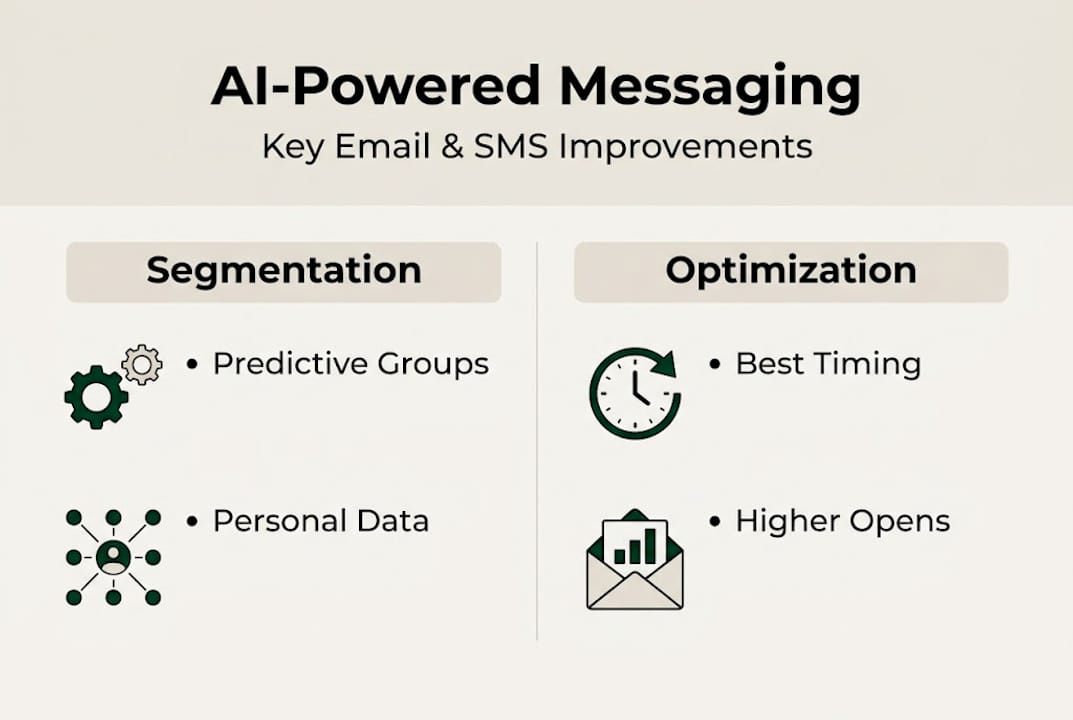
The numbers back this up. AI segmentation boosted conversions 8,489% and lifted open rates by 426% compared to traditional approaches. That’s not a typo. When your model knows who’s likely to buy and what they want, everything downstream performs better.
Here’s how AI-enabled flows compare to traditional campaigns:
| Metric | Traditional campaigns | AI-enabled flows |
|---|---|---|
| Open rate | ~20% avg | 40%+ with send-time optimization |
| Click-through rate | 1.69% avg | 5.58% avg |
| Revenue per recipient | Baseline | Up to 18x higher |
| Top 10% RPR | N/A | $7.79 per recipient |
Beyond segmentation, AI enables send-time optimization, which learns when each individual subscriber is most likely to open and engage. It also powers dynamic product recommendations that pull in items based on browse history, past purchases, and real-time inventory. These aren’t gimmicks. They’re the reason email optimization at the flow level consistently outperforms campaign-based thinking.
Pro Tip: Don’t let AI run on default settings. Feed your models with brand-specific context, product catalog data, and seasonal patterns. Generic AI outputs generic results. Calibrate it to your brand and your customers.
Also worth noting: quality beats quantity every time. Ninety-three percent of email revenue comes from just 1.6% of sends when flows are properly built. More sends isn’t the answer. Smarter email design best practices and sharper targeting are.
Building omnichannel journeys: Unifying email and SMS
Knowing what AI can do is one thing. Coordinating it across email and SMS is where the real leverage lives. Each channel has distinct strengths, and the brands seeing the biggest retention gains are the ones treating them as complementary, not interchangeable.
Email is your workhorse for rich content, storytelling, and product education. SMS is your urgency channel, built for time-sensitive triggers, quick confirmations, and conversational moments. When you blend them intelligently, you create a journey that feels cohesive rather than fragmented.

The results are hard to ignore. Attentive’s AI implementation for Sigma Sports delivered a +634% journey email revenue per send and a 770% increase in SMS campaign revenue year over year. That kind of lift doesn’t come from using one channel harder. It comes from using both channels smarter.
Here’s a quick comparison of leading AI platforms for journey building:
| Platform | Primary strength | Best for |
|---|---|---|
| Klaviyo | Email-first AI, deep flow logic | Complex lifecycle journeys |
| Attentive | SMS-first AI, conversational triggers | High-frequency SMS + email blend |
| Both combined | Full omnichannel orchestration | 8-figure DTC retention programs |
AI product recommendations lift email CTR to 3.75% on average, with top performers hitting 8.79%. That’s the kind of engagement that compounds into real retention numbers over time.
To unify your channels effectively, follow these steps:
- Consolidate your data into a single customer profile that captures email, SMS, purchase history, and browse behavior.
- Map your triggers so each channel fires based on specific customer actions, not just time delays.
- Personalize content at the message level using dynamic blocks, not just first-name tokens.
- Monitor engagement signals across both channels and suppress contacts showing fatigue.
- Test and iterate on channel sequencing, not just individual messages.
Pro Tip: Use SMS for post-purchase check-ins and win-back nudges, but keep frequency low. One well-timed SMS outperforms five generic ones. Pair it with a high-value automated email campaign for the full effect. And always make sure your personalized ecommerce emails are doing the heavy lifting on content depth.
Winning back and retaining customers: Best-practice flows and exception handling
Acquisition gets the headlines, but retention is where profit lives. The most effective retention programs aren’t just about sending more emails. They’re about anticipating where customers drop off and showing up with the right message before they’re gone.
Trigger-based flows are your foundation. Replenishment reminders fire when a consumable product is likely running out, based on average usage data. Post-purchase value emails build confidence in the purchase and reduce buyer’s remorse. Win-back sequences re-engage customers whose purchase frequency has declined below their historical pattern.
For win-backs specifically, RFM analysis and predictive churn scoring are essential. The optimal trigger point is 1.5x a customer’s average order frequency (AOF). If someone typically buys every 30 days and it’s been 45, that’s your window. Wait too long and you’re fighting inertia. Move too early and you create unnecessary urgency.
Avoid leading win-backs with discounts. You’re training customers to wait for a deal. Instead, lead with value: new arrivals, content, community, or a reminder of what they loved. Reserve discounts for the final step in a multi-touch sequence.
But here’s what most brands overlook entirely: exception handling. The moments that damage trust most aren’t bad products. They’re broken experiences around payment failures, fraud alerts, return processing delays, and order errors. Exception-first design means building flows that proactively address these edge cases before customers have to reach out.
“Brands that design for edge cases first build the kind of trust that turns one-time buyers into lifetime customers.”
The overlooked edge cases that quietly destroy retention include:
- Payment failures with no follow-up communication
- Fraud alerts that block legitimate purchases without explanation
- Return delays that leave customers in the dark
- Subscription billing errors that go unacknowledged
- Out-of-stock notifications sent after the purchase attempt
Building email automation around these moments isn’t glamorous, but it’s what separates brands with 4.8-star reviews from those stuck at 3.2. Following email marketing best practices means accounting for what goes wrong, not just optimizing for what goes right.
The uncomfortable truth about AI-powered customer experience
Here’s what most vendors won’t tell you: AI is a multiplier, not a replacement. If your strategy is weak, AI makes it fail faster and at greater scale. The brands we see struggling with AI-powered messaging aren’t struggling because the technology doesn’t work. They’re struggling because they handed the keys to an algorithm and walked away.
True differentiation comes from how you tune AI to your brand’s specific voice, customer nuances, and product context. A luxury skincare brand and a performance supplement brand might use the same platform, but their models need completely different inputs to produce messages that actually resonate.
Human oversight isn’t optional. AI drift is real. Models can start optimizing for clicks over conversions, or frequency over engagement, without anyone noticing until the damage shows up in churn data. You need experienced marketers reviewing outputs, questioning assumptions, and course-correcting when the algorithm starts sounding like everyone else.
The brands seeing the highest ROI from AI are the ones treating it as a tool that amplifies real-world strategies, not a strategy in itself. Smart technology plus experienced human judgment is the actual formula.
How The Email Marketers can help
Brands looking to execute these strategies at an elite level don’t have to figure it out alone. The Email Marketers specializes in building AI-driven retention programs for 8-figure DTC brands, combining deep segmentation strategy, lifecycle flow architecture, and channel-level personalization into systems that compound over time. Explore the Retention Lab for frameworks and tools built specifically for retention-focused teams, or review brand case studies to see how these strategies perform in practice. Ready to build a retention engine that actually works? Work with The Email Marketers and turn your email and SMS channels into your highest-ROI asset.
Frequently asked questions
How does AI segmentation improve customer experience in ecommerce?
AI segmentation analyzes behavioral data to deliver messages that match each customer’s actual needs and timing, which is why conversions can jump 8,489% compared to traditional batch-and-blast approaches. More relevant messages mean less friction and a stronger sense that the brand actually understands the customer.
What are the best ways to unify email and SMS in retention marketing?
Start by consolidating customer data into a single profile, then use AI to trigger coordinated flows where each channel plays to its strength. Attentive’s work with Sigma Sports shows what’s possible, with +634% email revenue per send and 770% SMS revenue growth when both channels are orchestrated together.
Why is exception-first design important for customer trust?
Most retention strategies optimize for the happy path, but customers remember how brands handle problems. Designing for edge cases like payment failures and return delays proactively reduces friction at the moments that matter most for long-term trust.
How quickly can AI-driven flows impact e-commerce revenue?
The impact can be significant and fast. Brands using properly configured AI flows see up to 41% of revenue generated from just 5% of total sends, often within the first few months of implementation.
Recommended
- Email marketing design best practices for ecommerce 2026
- Email Marketing Optimization Guide 2025 for Ecom Brands
- Optimize Email ROI 2025: Proven Tactics for E-Commerce Brands
- 7 Proven Email Automation Tips for Ecom Brands Success
- Fonctionnalités EasyGarage - Facturation Électronique 2026, Agents IA, Marketplace | Tout-en-un


