.png)


Accelerate growth with advanced Shopify marketing automations

TL;DR:
- Properly configured Shopify automations significantly boost retention and revenue through targeted messaging.
- Third-party tools like Klaviyo offer advanced segmentation and multichannel flows essential for high-growth brands.
- Continuous review and optimization of automations are crucial to prevent silent failures and maximize ROI.
Most DTC brands treat Shopify marketing automations like a smoke alarm: set it up once and forget it exists until something goes wrong. That mindset is costing you real revenue. Retention costs 5-7x less than acquiring a new customer, and repeat buyers spend 67% more per order. Yet the majority of high-growth brands still run misconfigured flows, overlapping triggers, and generic sequences that do little more than check a box. This guide cuts through the noise and gives you the frameworks, tooling decisions, and troubleshooting tactics that separate brands scaling past eight figures from those stuck in a plateau.
Table of Contents
- Why Shopify marketing automations matter for DTC brands
- Native Shopify automation tools vs. third-party apps: Making the right choice
- Five high-impact Shopify automation strategies to increase retention
- Common pitfalls and advanced troubleshooting for Shopify automations
- Beyond ‘set and forget’: The real difference makers in Shopify automation
- Take your Shopify marketing automations to the next level
- Frequently asked questions
Key Takeaways
| Point | Details |
|---|---|
| Retention trumps acquisition | Focusing on automation for retention delivers much higher ROI than chasing new customers. |
| Tool selection is key | Choose automation tools based on your DTC brand’s size, channel needs, and integration requirements. |
| Start with quick wins | Implement high-impact workflows like cart recovery first for fast revenue improvements. |
| Continuous optimization | Regularly review and troubleshoot automations to avoid failures and maximize performance. |
| Success requires iteration | Strategic, ongoing automation improvements set top-performing Shopify brands apart. |
Why Shopify marketing automations matter for DTC brands
Before diving into solutions, let’s clarify what’s at stake for DTC brands on Shopify. Retention is not a nice-to-have metric. It is the single biggest lever on your profitability curve. Repeat customers spend 67% more than first-time buyers, and the cost to keep them is a fraction of what you spend on paid acquisition. When you automate retention touchpoints correctly, you create an always-on revenue engine that works even when your team is offline.
Here is what well-built ecommerce email basics automation actually solves for the DTC marketer:
- Data-triggered communication that reaches customers at the exact moment they are most likely to act
- Personalized sequences based on purchase history, browse behavior, and lifecycle stage
- Consistent follow-up without relying on manual effort or human memory
- Revenue recovery from cart abandonment, lapsed buyers, and post-purchase upsells
The opportunity cost of doing this manually is enormous. A mid-sized DTC brand sending campaigns by hand is essentially leaving a full-time revenue channel unmanned. Automations replace that gap with precision.
“The brands winning on retention are not just sending more emails. They are sending the right message, to the right segment, triggered by the right behavior.”
Cart recovery alone can recapture 10 to 15 percent of abandoned revenue when configured with proper timing and copy. Win-back flows reactivate lapsed customers before they churn permanently. And post-purchase sequences turn one-time buyers into loyal repeat customers. These are not theoretical gains. They are measurable, trackable, and directly tied to Shopify email marketing performance data you already have access to.
The brands that treat automation as a strategic system rather than a technical feature are the ones compounding retention gains quarter over quarter. The ones that treat it as a plug-and-play checkbox are the ones wondering why their LTV is flat.
Native Shopify automation tools vs. third-party apps: Making the right choice
Understanding retention’s value, the next pivotal choice is tooling. And this decision has real financial consequences if you get it wrong.
Shopify’s native tools, including Shopify Flow, Shopify Email, and basic automation triggers, are genuinely capable for early-stage brands. They cover the fundamentals: order confirmations, basic segmentation, and simple conditional logic. If you are under $1M in annual revenue and just getting your automation stack off the ground, native tools are a reasonable starting point.
But as you scale, the cracks show fast. Native tools are efficient for basics, while third-party apps like Klaviyo add A/B testing, advanced segmentation, and multichannel reach that native Shopify simply cannot match. Here is a direct comparison:
| Feature | Shopify native | Klaviyo | Enterprise/custom |
|---|---|---|---|
| A/B testing | Limited | Full | Full |
| Segmentation depth | Basic | Advanced | Custom |
| SMS + email in one flow | No | Yes | Yes |
| Revenue attribution | Basic | Detailed | Custom |
| AI personalization | No | Yes | Yes |
| Setup complexity | Low | Medium | High |
For most high-growth DTC brands, top Shopify email tools like Klaviyo represent the sweet spot between capability and manageable complexity. Klaviyo’s advanced features include native Shopify sync, predictive analytics, and multichannel flows that let you run email and SMS from a single platform.
Enterprise or headless setups offer the most flexibility but come with significantly higher cost and technical overhead. They make sense for brands with complex product catalogs, international markets, or custom journey requirements.
Pro Tip: Resist the urge to stack multiple automation apps that overlap in function. App sprawl is one of the most common and costly pitfalls in DTC marketing. Two tools doing the same job create data conflicts, duplicate sends, and a reporting mess that is nearly impossible to untangle. Build your email marketing strategies around one primary platform and add only what fills a genuine gap.
Five high-impact Shopify automation strategies to increase retention
Once you have chosen the right tools, execution is everything. Here is where results multiply.
-
Cart recovery flows. This is your highest-priority automation. Automate cart recovery first before building anything else. A three-step sequence, sent at one hour, 24 hours, and 72 hours after abandonment, consistently outperforms single-email approaches. Personalize with the actual product left behind.
-
Browse abandonment sequences. Customers who viewed a product but did not add to cart are showing clear intent. A well-timed browse abandonment email, referencing the specific product, can recover a meaningful share of that traffic without discounting.
-
Behavioral win-back flows. Most brands trigger win-back emails based on a fixed number of days since last purchase. That is a mistake. Win-back flows should be behavioral, not just time-based. Trigger them when engagement signals drop: no opens, no clicks, no site visits. This targets the right customers at the right moment.
-
Post-purchase lifecycle sequences. Order and shipping confirmations have the highest open rates of any email type. Use them as engagement touchpoints, not just transactional receipts. Include product education, cross-sell recommendations, and loyalty program nudges to extend the customer relationship.
-
Weekly revenue per email (RPE) reviews. Track RPE for each automated flow every week. This single metric tells you which automations are earning their place and which need to be rebuilt. It also surfaces silent underperformers before they cost you a full quarter of revenue.
Pro Tip: Always QA your automation logic for edge-case failures. A trigger that works for 95% of customers but silently fails for the other 5% is a revenue leak you will never see in your dashboard. Test with real accounts, including edge cases like customers with multiple past orders or those who have previously unsubscribed and re-opted in. Follow automated campaign best practices and review automation tips for ecommerce to build a QA checklist that catches these gaps before they compound.
AI personalization can lift open rates by 52%, which means the gap between a personalized flow and a generic one is not marginal. It is the difference between a campaign that drives revenue and one that trains your list to ignore you.

Common pitfalls and advanced troubleshooting for Shopify automations
Even advanced automators run into costly issues. Here is what most guides miss.
The most dangerous automation problem is the one you cannot see. Silent failures happen when a trigger condition is never met because of a logic error, a data sync delay, or an app conflict. Customers fall through the gap and receive nothing. You see no error. You see no alert. You just see lower revenue that you attribute to seasonality or ad performance.
App data conflicts, edge condition failures, and automation overlap are the three most common sources of hidden drop-offs in Shopify automation stacks. Weekly reviews surface these issues before they become expensive.
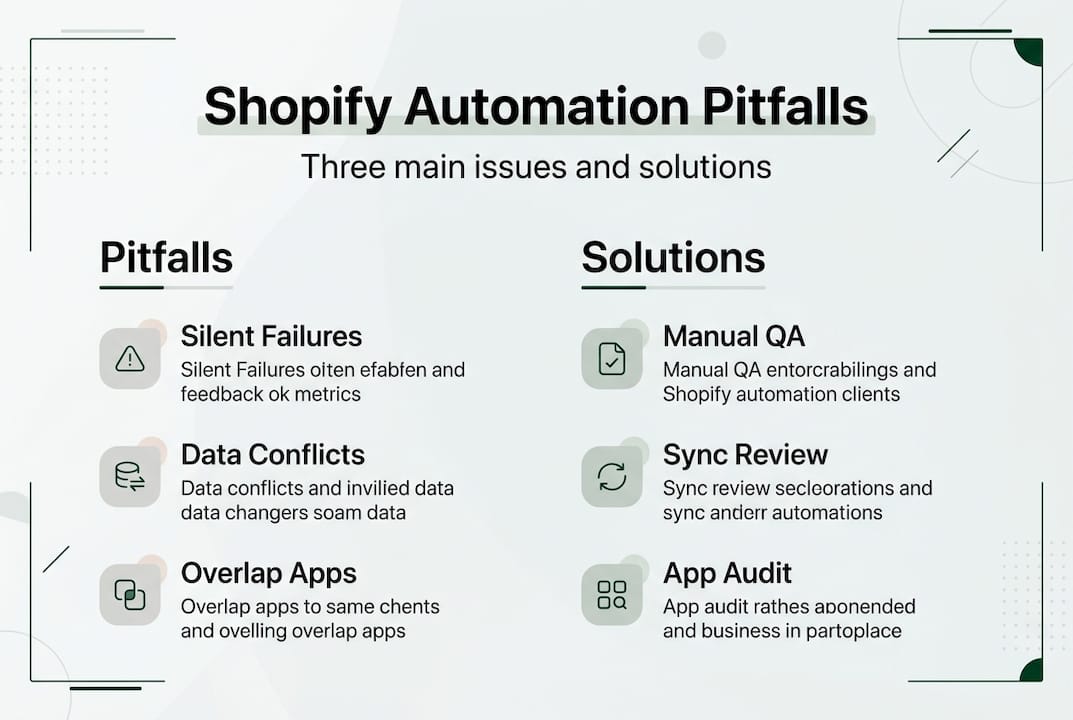
Here is a breakdown of the most common pitfalls and how to address them:
| Pitfall | Root cause | Fix |
|---|---|---|
| Silent trigger failures | Logic gaps or sync delays | Manual QA with test accounts |
| Duplicate sends | Overlapping automation rules | Audit flow entry conditions |
| Data conflicts | Multiple apps writing to same field | Designate one source of truth |
| Low engagement on flows | Generic segmentation | Rebuild with behavioral triggers |
| Missed win-back window | Time-based only triggers | Add engagement-based conditions |
Overlapping automations are another silent killer. If a customer qualifies for both a cart recovery flow and a win-back flow simultaneously, they may receive conflicting messages or be contacted too frequently. Both outcomes damage trust and increase unsubscribe rates.
For advanced troubleshooting, map every trigger in your stack visually. Identify where two flows could fire for the same customer and add suppression logic to prevent overlap. Review your email automation optimization process and apply design best practices to ensure your flows are both technically sound and visually compelling.
“The brands that catch silent failures early are the ones with a weekly review habit, not just a launch habit.”
Tag every automation with a performance label and set a recurring calendar reminder to review key metrics. Drop-offs in click rates, sudden dips in RPE, and spikes in unsubscribes are your early warning system.
Beyond ‘set and forget’: The real difference makers in Shopify automation
Here is the uncomfortable truth most playbooks skip: the majority of DTC brands plateau not because they chose the wrong tool, but because they treat automation as a project with a finish line.
The brands in the top 1% do not launch a flow and move on. They review it weekly. They test subject lines, timing, and offer structures. They rebuild segments when behavior shifts. They treat every automation as a living asset, not a completed task. That iterative mindset is what compounds over time.
AI and advanced segmentation are now table stakes. Every serious platform offers them. The real competitive advantage in 2026 is orchestration: how well your flows work together, how cleanly your data moves between tools, and how quickly your team identifies and fixes gaps. Brands that obsess over advanced email strategy and continuous improvement consistently outperform those chasing the next shiny feature.
Small, consistent improvements to existing flows beat a complete tech stack overhaul almost every time. The brands winning on retention are not the ones with the most sophisticated tools. They are the ones who use what they have with the most discipline.
Take your Shopify marketing automations to the next level
Ready to move from theory to tailored implementation? The Email Marketers works with 8-figure DTC brands to build, audit, and optimize Shopify automation stacks that drive measurable retention gains. From diagnosing silent failures to rebuilding underperforming flows, our team brings the strategic depth that generic agencies cannot match. Explore our Shopify automation case study to see how we have helped brands like yours increase repeat purchase rates and LTV. Access proven frameworks and tools in the Retention Lab, or connect directly with The Email Marketers team to discuss a custom retention strategy built around your specific growth stage.
Frequently asked questions
How do I choose between Shopify’s native automations and a tool like Klaviyo?
Start with Shopify’s built-in tools for basics, but shift to Klaviyo or similar if you need advanced triggers, reporting, and integrated channels as you scale. Native tools handle basics well, but third-party apps unlock the segmentation and multichannel capability that high-growth brands require.
What is the highest ROI automation for a new DTC Shopify brand?
Cart recovery flows deliver the highest ROI early on, since they directly recover lost sales with minimal setup. Start with cart recovery before building out more complex lifecycle sequences.
How often should we review Shopify automations for hidden failures?
Review automations weekly to catch silent failures and ensure triggers and integrations are working as expected. Weekly reviews surface hidden drop-offs that would otherwise go undetected for months.
What’s the risk of running multiple marketing apps in Shopify?
Running overlapping apps can cause data conflicts or duplicate messages, so mapping integrations carefully is vital. Map app integrations before launching any new tool to prevent conflicts from the start.
How does AI personalization affect Shopify marketing automations?
AI-driven personalization can increase open rates by 52%, improving engagement and conversion rates for automated campaigns significantly compared to generic messaging.


