.png)


Advanced email flows guide for e-commerce retention
TL;DR:
- Automated flows generate the majority of email revenue, outperforming campaigns significantly.
- High-engagement, behavior-triggered flows are essential for retention and maximizing customer lifetime value.
- Unified email and SMS orchestration, combined with advanced segmentation and predictability, drives superior results.
Most 8-figure DTC brands pour their energy into campaign calendars, obsessing over send frequency and subject line tests while leaving the biggest retention lever almost untouched. Automated flows generate 41% of email revenue from only 5.3% of sends, producing 18x higher revenue per recipient than broadcast campaigns. That single stat should reframe how you allocate your team’s time. This guide breaks down the advanced email and SMS strategies that move the needle on customer lifetime value, from flow architecture and segmentation to win-back mastery and unified channel orchestration.
Table of Contents
- Why flows outdrive campaigns in retention
- Essential flows architecture for retention
- Benchmarks and case studies: What great looks like
- Segmentation and orchestration: Beyond batch-and-blast
- Win-back mastery: Turning churn risk into opportunity
- The overlooked retention lever: High-LTV treatment and orchestration
- Take your retention results further with The Email Marketers
- Frequently asked questions
Key Takeaways
| Point | Details |
|---|---|
| Flows outperform campaigns | Automated flows drive the bulk of retention revenue with far fewer sends than campaigns. |
| Lifecycle flows are essential | Welcome, post-purchase, replenishment, and win-back flows are the building blocks for maximizing LTV. |
| Benchmark real performance | Use high-performing DTC case studies and published benchmarks to set aggressive, achievable retention goals. |
| Orchestrate by customer value | Segment, prioritize, and unify messages by predicted customer value, using AI and unified email/SMS platforms. |
| Test, refine, and escalate | Continually review flows, escalate offers, and feed win-backs into post-purchase automations for compounding results. |
Why flows outdrive campaigns in retention
The campaign-first mindset makes intuitive sense. You have a product launch, a sale, a seasonal moment. You send to the list. Repeat. But this approach treats every customer the same, regardless of where they are in their relationship with your brand. Flows solve that problem by responding to what customers actually do.
The performance gap is not subtle. Automated flows generate 41% of email revenue from just 5.3% of sends, meaning your flows are doing exponentially more work per email than any campaign you schedule. The reason is relevance. A triggered email arrives when the customer is already engaged, already thinking about your brand, already primed to act.
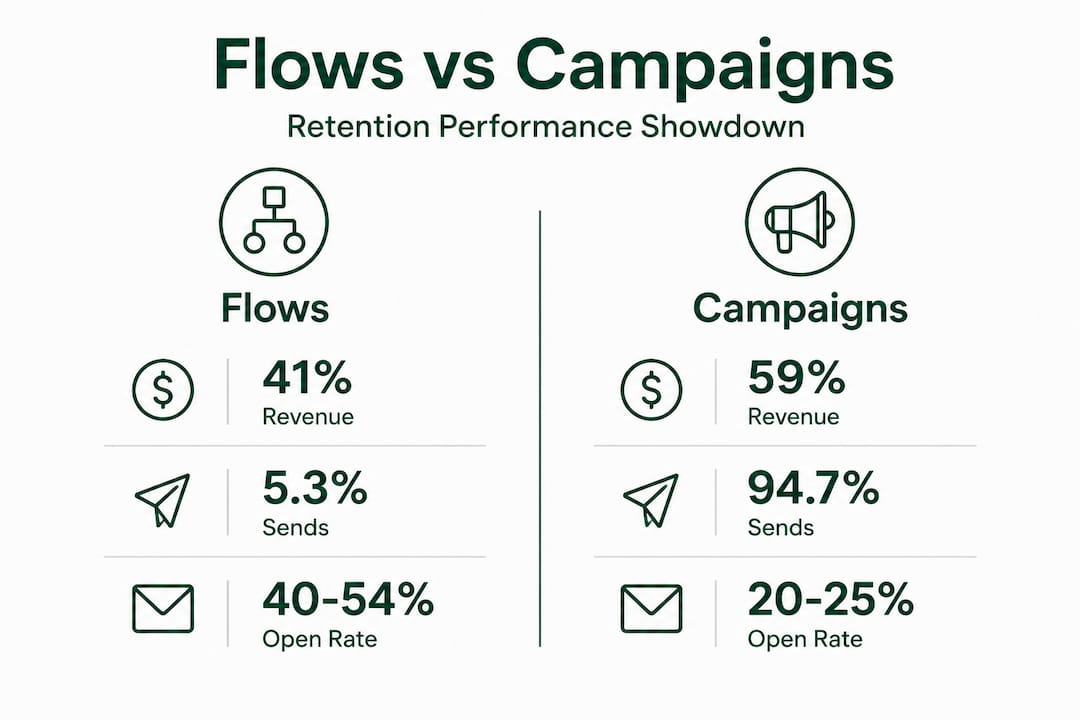
Look at the engagement data by flow type. Welcome flows average 54% open rates, cart abandonment flows hit around 51%, and even win-back flows pull 25% open rates with $0.84 revenue per recipient. Cart abandonment flows average $3.65 revenue per recipient. These numbers dwarf typical campaign benchmarks of 20-25% open rates and $0.10-0.20 RPR.
| Metric | Flows | Campaigns |
|---|---|---|
| Average open rate | 40-54% | 20-25% |
| Revenue per recipient | $0.84-$3.65 | $0.10-$0.20 |
| % of total email sends | 5.3% | 94.7% |
| % of total email revenue | 41%+ | ~59% |
| Click-through rate | 8-15% | 2-4% |
The table makes the math undeniable. You are getting disproportionate returns from a small fraction of your volume. That is the architecture advantage of best email flows built around behavior triggers rather than calendar dates.
Pro Tip: Build your retention architecture with flows as the foundation. Use campaigns tactically for launches, promotions, and content. Never let campaign volume crowd out flow optimization time.
The shift also protects deliverability. High-engagement flows improve your sender reputation, which in turn lifts campaign performance. It is a compounding system, not a tradeoff. Understanding how automated email campaigns interact with your broader calendar is the first step toward leveraging automation for real LTV gains.
Essential flows architecture for retention
Four flows form the backbone of any serious retention program. Get these right and you have a machine that works around the clock without additional send volume.
1. Welcome flow. This is your highest-leverage sequence. New subscribers are at peak curiosity. A strong welcome flow introduces your brand story, sets expectations, and guides the first purchase. Timing matters: send the first email within minutes of signup, follow up at 24 hours, then day three and day seven. Segment by acquisition source to personalize the angle.
2. Post-purchase flow. Post-purchase flows achieve 40-45% open rates and 10-15% repeat purchase rates, with 217% higher open rates and 500% higher click rates compared to average emails. The window right after a purchase is when trust is highest and the customer is most receptive to cross-sells, education, and community building. Do not waste it on a generic order confirmation. Build a sequence that delivers product education, usage tips, social proof, and a timely cross-sell.
3. Replenishment flow. For consumable products, this is pure revenue on autopilot. Replenishment flows average 50.5% open rates, 6.25% click rates, and 3.33% conversion rates, with top performers hitting 7.69% conversion. Critically, behavior-triggered replenishment emails outperform calendar-triggered sends by 2.5x. Use purchase data to calculate each customer’s likely reorder window and trigger the flow accordingly.
4. Win-back flow. Customers go quiet. The win-back flow catches them before they are truly gone. Target customers who have passed their expected reorder window with a sequence that reminds, adds value, and then incentivizes. More on this in a dedicated section below.
Here is how the benchmark performance stacks up across all four flows:
| Flow | Open rate | Click rate | Conversion/RPR | Key trigger |
|---|---|---|---|---|
| Welcome | ~54% | 10-14% | $1.20-$2.50 RPR | Signup |
| Post-purchase | 40-45% | 10-15% click | 10-15% repeat purchase | Order confirmed |
| Replenishment | 50.5% | 6.25% | 3.33-7.69% | Purchase interval |
| Win-back | ~25% | 5-8% | $0.84 RPR | Lapse trigger |
Pro Tip: Map each flow to a specific customer lifecycle stage and assign a clear success metric before you build. Flows without a north star metric drift into complexity without results.
Behavioral triggers consistently outperform calendar sends across every flow type. The reason is simple: calendar sends assume uniform customer behavior. Behavioral triggers respond to actual signals. Explore post-purchase email strategies and retention email tactics to see how leading brands structure these sequences.
Benchmarks and case studies: What great looks like
Benchmarks only matter if they are grounded in real outcomes. Here is what top DTC brands have actually achieved with unified email and SMS retention programs.
Tushbaby, a baby carrier brand, built a unified SMS and email retention system and achieved 287x ROI overall, with 48%+ open rates across flows and a staggering 900x ROI on their welcome flow alone. That welcome flow ROI is not a typo. It reflects what happens when you treat the first touchpoint as a revenue moment, not just a courtesy message.
UNTUCKit, the men’s apparel brand, saw a 25% year-over-year increase in triggered journey revenue, with open rates approaching 60% and SMS revenue matching email revenue despite having a much smaller SMS subscriber list. That last point is worth pausing on. SMS lists are typically 10-20% the size of email lists, yet they generate comparable revenue when used correctly.
The pattern across both case studies is the same: unified orchestration beats siloed channel management every time. When SMS and email work together as a system, each channel amplifies the other.
Key performance targets to set as your north star by lifecycle stage:
- Acquisition to first purchase: Welcome flow open rate above 45%, first-purchase conversion above 8%
- Post-purchase to repeat: Second purchase rate above 30% within 90 days of first order
- Active customer retention: Monthly email engagement rate above 20%, SMS click rate above 8%
- Win-back: Recovery rate of 15-20% for customers within 180 days of lapse
Track these against your email marketing benchmarks and use your email metrics dashboard to identify which flows are underperforming relative to these targets.
Segmentation and orchestration: Beyond batch-and-blast
Advanced segmentation is where 8-figure brands separate themselves from the pack. Most brands segment by purchase history. Elite brands segment by predicted behavior, engagement velocity, and channel preference simultaneously.
Start with RFM scoring: Recency, Frequency, and Monetary value. Customers with high scores across all three are your VIPs. Customers with high monetary value but low recency are your win-back priority. Customers with high frequency but low monetary value are candidates for upsell sequences. Each group needs a different message, offer, and channel mix.
Build your segmentation layers in this order:
- RFM score to establish baseline customer value tiers
- Product category purchased to personalize cross-sell and upsell messaging
- Purchase frequency to calibrate send cadence and avoid fatigue
- Recent engagement (last 30, 60, 90 days) to separate active from at-risk
- Churn risk score generated by AI propensity modeling to prioritize intervention
- Channel preference (email vs. SMS) to route the right message to the right medium
Segmentation by product, frequency, and engagement, combined with AI-driven propensity targeting and identity resolution, is what powered Tushbaby’s outsized results. Preference collection at signup or in post-purchase surveys also directly reduces unsubscribes by letting customers self-select their frequency and content preferences.
For orchestration, use email as your primary channel and SMS as the high-intent follow-up. The sequence looks like this: trigger the email, wait 24-48 hours, check for opens or clicks, then send an SMS to non-openers with a shorter, more urgent version of the message. This approach respects channel economics while maximizing reach.
High-LTV customers should never receive blanket discounts. Give them VIP treatment: early access, exclusive content, personalized recommendations. Discounts train your best customers to wait for sales. Exclusivity deepens loyalty. After a successful win-back, re-loop customers directly into your post-purchase flow to restart the retention cycle.
Pro Tip: Use AI to predict the next best action for each customer segment rather than defaulting to the next scheduled send. Predictive send-time optimization alone can lift open rates by 10-15%.
Understanding the difference between win-back vs. re-engagement flows is also critical here. They serve different purposes and should be built and measured separately.
Win-back mastery: Turning churn risk into opportunity
Win-back flows are the most misunderstood part of retention strategy. Most brands trigger them based on email inactivity. That is the wrong signal. Trigger win-back based on purchase intervals, specifically at 1.5x the customer’s average reorder time. A customer who normally buys every 60 days and has not purchased in 90 days is a win-back candidate, regardless of whether they opened your last email.
Win-back flows recover 12-18% of lapsed customers overall, with high-engagement segments recovering at 25-30% and low-engagement segments at 8-12%. The ROI on win-back is 1.8-2.2x, compared to 4-5x for active customer flows. That gap tells you win-back is worth doing but not at the expense of active customer investment.
Structure your win-back escalation path like this:
- Email 1 (day 0): Soft reminder. “We miss you.” No discount. Just a relevant product recommendation based on past purchase.
- Email 2 (day 3-5): Value add. Customer review, new product highlight, or editorial content relevant to their purchase history.
- Email 3 (day 10-14): Social proof. Bestseller list, user-generated content, community angle.
- Email 4 (day 21): Incentive. This is the first time you introduce a discount or offer. Keep it modest: 10-15% is enough for most segments.
- SMS (day 22-23): Send to non-openers of email 4 with a short, direct message and a clear expiry on the offer.
- Email 5 (day 30): Last chance. Clear subject line, simple copy, strong call to action. After this, move non-responders to a suppression segment.
“Discounts should be the last resort in a win-back sequence, not the opening move. Lead with value, lead with relevance, and save the incentive for customers who need that final push.”
Segment your win-back list by engagement level before you start. High-engagement lapsed customers get the full five-email sequence with SMS. Low-engagement lapsed customers get a shorter three-email sequence with a faster escalation to the incentive. Do not invest the same resources in every lapsed customer. The win-back campaign strategies that work best are the ones that match effort to predicted recovery value.
Once a customer re-engages, immediately loop them back into your post-purchase flow. This restarts the retention cycle and prevents them from falling back into churn risk within 60-90 days.
The overlooked retention lever: High-LTV treatment and orchestration
Here is the uncomfortable truth that most retention playbooks skip over: treating all lapsed customers the same is not just inefficient, it actively destroys margin.
The standard advice says build a win-back flow, offer a discount, recover the customer. But when you apply that logic uniformly, you end up training your best customers to lapse intentionally, knowing a 15% discount is coming. You also spend significant resources on low-LTV customers whose recovery cost exceeds their predicted future value.
The real unlock is orchestrating entirely different journeys for different customer value tiers. Your top 20% of customers by LTV should never see the same win-back sequence as your bottom 40%. High-LTV customers get a VIP re-engagement path: personalized outreach, exclusive early access, a direct message that acknowledges their history with the brand. No discount. No urgency pressure. Just recognition and relevance.
This is where predictive segmentation earns its keep. When you can score customers by predicted 12-month LTV before they lapse, you can allocate your win-back resources with precision. Invest heavily in recovering high-value customers. Run a lean, automated sequence for low-value segments. Suppress the rest before they damage your sender reputation.
The future of retention is not more emails or more SMS. It is smarter orchestration that matches the right message, the right channel, the right offer, and the right timing to each customer’s predicted value. VIP programs, individualized journeys, and AI-driven sequencing are not nice-to-haves for 8-figure brands. They are the competitive moat. Explore customer retention strategies that go beyond the standard playbook to see how leading brands are building this infrastructure today.
Take your retention results further with The Email Marketers
If this guide has surfaced gaps in your current flows, segmentation, or SMS orchestration, you do not have to close them alone. The Email Marketers work with 8-figure DTC brands to build and optimize the exact systems described here: advanced flow architecture, RFM-based segmentation, unified email and SMS orchestration, and predictive win-back strategies. Browse our retention case studies to see real outcomes from brands in your category. When you are ready to move from strategy to execution, the Retention Lab gives your team a hands-on environment to build and test flows with expert guidance, and the Retention Toolkit gives you the templates, benchmarks, and frameworks to accelerate implementation immediately.
Frequently asked questions
What’s the difference between email flows and campaigns?
Flows are automated, behavior-triggered sequences that fire based on what a customer does, while campaigns are one-off broadcasts sent to a list on a scheduled date. Automated flows generate 41% of email revenue from only 5.3% of sends, making them far more efficient per send than campaigns.
How often should I review and update my flows?
Review your flows quarterly for performance trends and update them whenever you see significant changes in customer behavior, product catalog, or seasonal patterns. Flows are not set-and-forget systems; they need regular tuning to stay relevant and high-performing.
Does integrating SMS with email actually boost ROI?
Yes, significantly. Brands using unified SMS and email see dramatically higher ROI and engagement than those running each channel in isolation. Tushbaby achieved 287x ROI and a 900x welcome flow ROI by combining SMS and email into a single orchestrated system.
What’s the optimal win-back sequence for lapsed customers?
Send 3-5 emails triggered at 1.5x the customer’s average reorder interval, escalating from a soft reminder to a value-add to a modest incentive, then follow up with SMS for non-responders after the incentive email.
What open and conversion rates should I expect for post-purchase flows?
Top DTC brands consistently achieve 40-45% open rates and 10-15% repeat purchase rates for post-purchase flows, which is 217% higher open rates and 500% higher click rates compared to average email performance.


